Sleep Study in Beijing: How to Book It as an International Patient
Sleep Study in Beijing: How to Book It as an International Patient
You have probably been told that arranging medical care in China as a foreigner is a bureaucratic maze. Fair assumption. But when it comes to something as routine as a sleep study, the reality is far more manageable than most people expect — and the sleep study cost in Beijing is often a fraction of what you would pay in the United States or Western Europe. The catch is not quality. It is navigation. Knowing which hospital to contact, what to send ahead, and how the appointment system actually works makes the difference between a smooth two-week process and a frustrating dead end.
This guide walks you through exactly how to book a sleep study in Beijing, what it costs, how to choose a sleep clinic for international patients, and where the process can stall if you are unprepared.
How This Actually Works, Step by Step
Here is the real sequence, from your first email to your final report. No abstractions.
Step 1: Gather your existing records. Before any hospital will schedule you, they want context. That means a referral note from your current physician if you have one, any prior sleep study results, a list of current medications, and a brief summary of your symptoms — snoring, witnessed apneas, daytime fatigue, morning headaches. If your records are in English, they will need translation into Chinese for the hospital’s internal review. This takes two to five business days depending on the volume.
Step 2: Choose the right facility. Beijing has two broad categories of sleep clinics: the sleep medicine departments inside large public tertiary hospitals, and the international or private hospitals that cater to foreigners. Public hospital sleep centers tend to have longer wait times for a bed but lower prices. Private international clinics offer English-speaking staff, shorter waits, and direct insurance billing — at roughly 1.5 to 2 times the public rate.
Step 3: Submit a remote pre-assessment. Most reputable sleep centers will review your records before offering an appointment slot. This is not a formality. It determines whether you need a full overnight polysomnography or a simpler home sleep apnea test. A written second opinion from a Chinese sleep specialist typically runs $300–500 and clarifies which test is appropriate for your case.
Step 4: Confirm the appointment and visa. Once accepted, the hospital issues an appointment confirmation letter. You use that letter — plus your passport and supporting documents — to apply for an S2 visa, which is the correct category for short-stay medical treatment and private affairs. Processing usually takes four to seven business days at a Chinese consulate, though this varies by country.
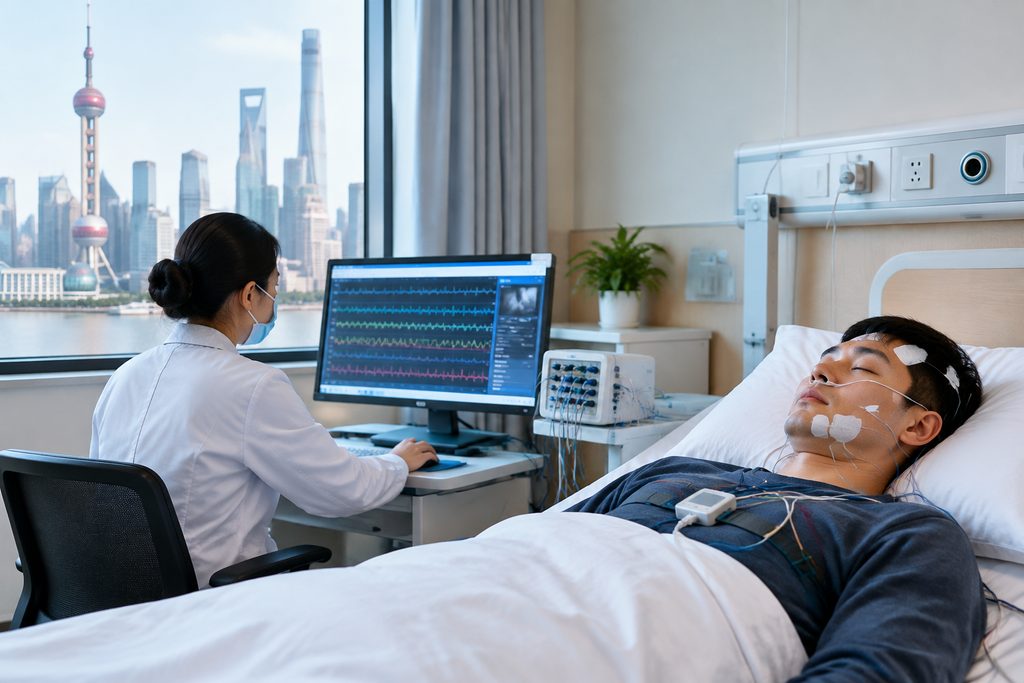
Step 5: Arrive, check in, and complete the study. An overnight sleep study means exactly that — you spend the night in a monitored room. Technicians attach sensors to your scalp, chest, and legs. You sleep. They record. In the morning, you leave, and results are typically ready within three to seven days.
What a Sleep Study in Beijing Actually Costs
Price transparency is where most international patients get stuck. Hospitals rarely publish sleep study prices online, and quotes vary based on whether you need a full overnight polysomnography (PSG) or a home sleep apnea test (HSAT). Here is a realistic range based on current market data across Beijing’s public and private facilities.
| Test Type | Beijing Public Hospital | Beijing Private/International | Typical U.S. Price |
|---|---|---|---|
| Home sleep apnea test (HSAT) | $150–300 | $400–700 | $1,000–2,500 |
| Overnight polysomnography (PSG) | $300–600 | $800–1,500 | $3,000–8,000 |
| Multiple sleep latency test (MSLT) | $400–700 | $900–1,600 | $2,500–6,000 |
| Follow-up consultation | $30–80 | $150–350 | $250–500 |
These figures are estimates and vary by hospital and case complexity. They also do not include the cost of a bilingual medical companion if you need one, which typically runs from $300 per day.
The gap between Beijing and U.S. pricing is not a reflection of lower quality. It reflects lower administrative overhead, government subsidy of public hospitals, and a different insurance reimbursement structure. The equipment is the same. The diagnostic criteria — the American Academy of Sleep Medicine scoring rules — are the same.
Is a Sleep Study in China Safe for Foreigners?
This is the question that stops people from booking. The honest answer: yes, with caveats.
Beijing’s top-tier hospitals — the ones ranked in the Fudan Hospital Rankings — operate sleep centers that meet international standards. The technicians are trained in AASM protocols. The equipment is calibrated and maintained. Reports are generated in a format that your physician back home can read and act on.
The caveats are logistical, not clinical. Public hospitals in Beijing are enormous. A single hospital can see 10,000 outpatients per day. Signage is in Chinese. The registration system assumes you can navigate a queue and speak Mandarin. Without a bilingual companion or an international department contact, the experience can be disorienting even for a straightforward overnight test.
That is why the private international hospitals exist. Facilities like United Family, Jiahui, and Parkway have English-speaking sleep specialists and streamlined check-in. You pay more. You get a smoother experience. Both paths are legitimate.
If you want to understand how we help patients navigate this divide, you can read more about our companion and coordination services.
A Realistic Timeline
Here is what the process looks like from decision to diagnosis, with realistic ranges. The steps people forget — document translation, appointment lead time, visa processing — are included.
| Stage | What Happens | Realistic Duration |
|---|---|---|
| Record gathering and translation | Collect prior reports, translate to Chinese | 3–7 business days |
| Remote pre-assessment | Sleep specialist reviews records, recommends test type | 2–5 business days |
| Hospital selection and appointment request | Submit to chosen hospital, await confirmation | 3–10 business days |
| Visa application (S2) | Apply with hospital letter, passport, documents | 4–7 business days |
| Travel and arrival | Fly to Beijing, settle in | 1–2 days |
| Pre-study consultation | In-person exam, confirm test plan | 1 day |
| Overnight sleep study | Attend sleep lab, complete PSG or HSAT | 1 night |
| Results and report | Sleep specialist interprets data, issues report | 3–7 days |
| Follow-up and treatment plan | Discuss CPAP, surgery, or other options | 1 consultation |
Total time from first contact to diagnosis: roughly four to eight weeks. The biggest variable is hospital appointment availability. Public hospital sleep labs are often booked two to four weeks out. Private clinics can sometimes accommodate within one week.
What Can Go Wrong — and What Happens Then
Things go wrong. Here is what actually happens and what your recourse is.
The hospital rejects your records. This happens when documentation is incomplete or the sleep specialist determines your case needs a different workup. The fix is straightforward: request a written second opinion from a different hospital, or ask your home physician to provide additional context. A second opinion typically costs $300–500 and often resolves the impasse.
No appointment slots are available. Public hospital sleep labs fill up. If your preferred hospital cannot accommodate you within your travel window, the alternative is a private international clinic, which has more flexibility but higher prices. We can also check availability across multiple hospitals in our network.
Your visa is delayed. S2 visa processing times vary by consulate and season. If your appointment is confirmed but your visa is not, you can usually reschedule the appointment once without penalty. Some hospitals charge a small rebooking fee. The key is to communicate early, not to no-show.
The study results are inconclusive. This happens in roughly 10–15% of cases, often because the patient did not sleep enough during the study. The remedy is a repeat study, sometimes with a different protocol. Most hospitals will offer a discounted rate for a repeat within 30 days.
You need treatment, not just diagnosis. A sleep study is diagnostic. If you are diagnosed with obstructive sleep apnea, treatment options include CPAP therapy, oral appliances, or in some cases surgery. CPAP is the most common. You can start CPAP in China and continue at home, or your physician can adjust the prescription after you return.
How to Choose a Beijing Sleep Clinic for International Patients
Not all sleep centers are equal. Here is what to look for.
Accreditation and protocol. Ask whether the sleep lab follows AASM scoring criteria. Most top-tier hospitals do. If they hesitate, look elsewhere.
Language support. Does the hospital have an international department? Can they provide an English-speaking technician or a bilingual companion? If not, you will need to arrange your own interpreter.
Report format. Will the final report be in English or Chinese? If Chinese, will they provide a translated version? Your physician at home needs to read it.
Insurance and payment. Public hospitals require upfront payment and provide receipts for later reimbursement. Private international hospitals often bill insurance directly. Know which model applies before you commit.
Follow-up pathway. If you are diagnosed with sleep apnea, what happens next? Can they titrate CPAP? Do they offer telemedicine follow-ups? A sleep study without a treatment plan is incomplete.
If you want to compare hospitals by specialty and city, our ranked hospital directory lists the top facilities across Beijing and other major cities.
Practical Considerations: Records, Visa, Payment, and Follow-Up
Records. Bring everything. Prior sleep studies, medication lists, relevant imaging, and a letter from your referring physician. Digital copies are fine, but printed copies are safer.
Visa. The S2 visa is the correct category for medical treatment. Do not apply for an M visa — that is for commercial and trade activities only and will not cover medical treatment. The hospital’s appointment letter is a required supporting document. Processing takes four to seven business days in most consulates, but allow two weeks to be safe.
Payment. Public hospitals accept cash, WeChat Pay, Alipay, and sometimes international credit cards. Private hospitals accept major credit cards and often bill insurance directly. Bring a backup payment method.
Language. If you do not speak Mandarin, arrange interpretation in advance. A bilingual medical companion can handle registration, payment, wayfinding, and translation during the study. This is not a luxury — it is often the difference between a completed study and a wasted trip.
Follow-up at home. Ask the sleep specialist to prepare a report that your home physician can act on. Include the raw data if possible. Most hospitals will provide this on request.
Frequently Asked Questions
Start by contacting a hospital’s international department or a medical coordination service. You will need to submit your existing records, complete a remote pre-assessment, and receive an appointment confirmation letter. That letter supports your S2 visa application. Most patients complete the process in four to eight weeks.
Yes. Top-tier Beijing hospitals follow international scoring protocols and use calibrated equipment. The main challenge is navigation, not clinical safety. Private international hospitals offer English-speaking staff and smoother logistics at higher prices.
A home sleep apnea test typically costs $150–300 at a public hospital or $400–700 at a private clinic. An overnight polysomnography runs $300–600 publicly or $800–1,500 privately. These figures vary by hospital and case complexity.
Yes. Most hospitals allow remote pre-assessment based on your records. You confirm the appointment before you travel. Some hospitals require an in-person consultation before the overnight study, so plan for at least one extra day in Beijing.
Yes. The S2 visa is the correct category for short-stay medical treatment. You will need the hospital’s appointment letter, your passport, and supporting documents. The M visa is for business and does not cover medical treatment.
Your Next Step
Booking a sleep study in Beijing is a logistical challenge, not a clinical one. The hospitals are capable. The equipment is modern. The prices are often a fraction of what you would pay at home. What most international patients lack is a guide who knows the system.
China Medical Services connects international patients with 340+ top-ranked hospitals across 37 cities. We do not provide medical care, and we do not guarantee appointments or outcomes. What we do is handle the coordination — record translation, hospital matching, appointment scheduling, visa guidance, and bilingual support on the ground.
If you are considering a sleep study in Beijing, start with a conversation. No pressure, no obligation. Just clarity on what is possible.
This article is for informational purposes only and does not constitute medical advice. Always consult a qualified physician regarding diagnosis and treatment.
For more medical information and treatment options in China, visit chinamedservices.com (China Medical Services).
