Endoscopy in China: One Sedation, Two Scopes Explained
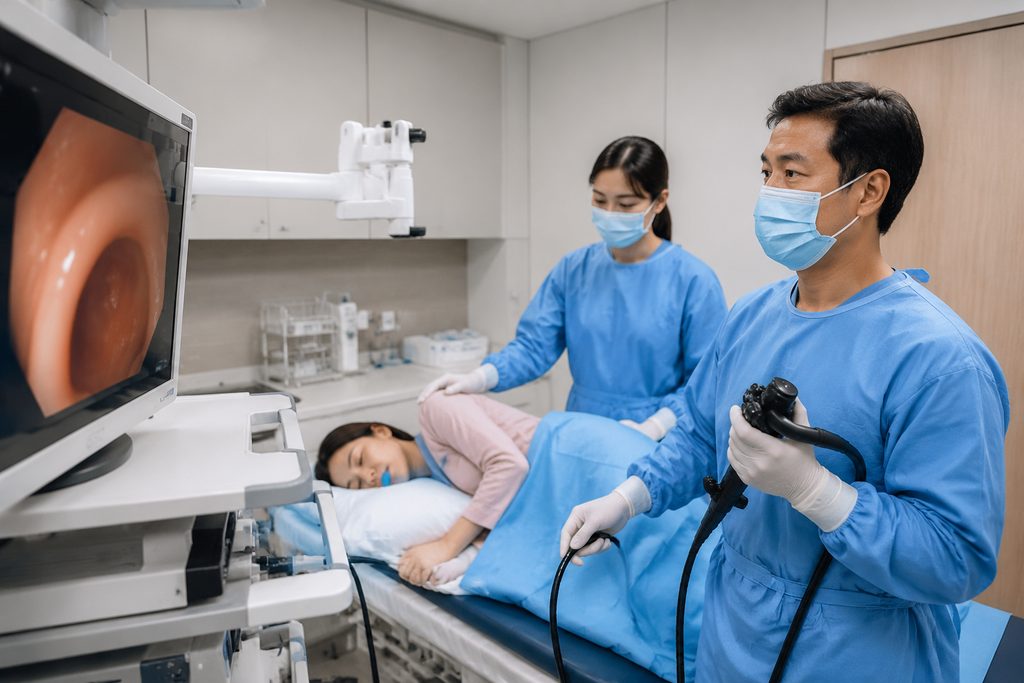
Endoscopy in China: One Sedation, Two Scopes
Have you ever been told you need both an upper endoscopy and a colonoscopy, then realized that in your home country that means two separate appointments, two separate sedations, and two separate bills? In China, these are frequently combined into a single session under one round of sedation. The gastroscopy and colonoscopy cost China hospitals charge for that combined procedure is often a fraction of Western pricing, and the scheduling can be remarkably fast. But the details matter enormously, and this guide walks through exactly how it works.
How This Actually Works, Step by Step
Here is the real sequence, from first contact to walking out of the recovery room.
Step 1 — You send your existing records. Recent lab work, prior endoscopy reports, imaging, medication lists, and a short note about your symptoms. Our team translates the relevant documents into Chinese and prepares a clinical summary for the gastroenterology department.
Step 2 — A Chinese specialist reviews the file. This is a written second opinion. The gastroenterologist confirms whether a combined gastroscopy and colonoscopy is clinically appropriate for you, flags anything that needs to happen first (bowel prep instructions, blood thinners, cardiac clearance), and returns written recommendations.
Step 3 — You choose the setting. Public tertiary hospitals handle enormous volumes and offer the lowest prices. Private international hospitals offer English-speaking staff, direct insurance billing, and shorter waits. The trade-off is real, and we lay it out plainly rather than steering you.
Step 4 — Appointment coordination. We handle registration, medical card creation, and scheduling through the hospital’s official international or VIP channel. You receive a confirmed date, a fasting protocol, and the bowel preparation schedule in English.
Step 5 — The procedure day. You arrive fasting. An anesthesiologist administers sedation. The gastroenterologist performs the gastroscopy first, then the colonoscopy, using the same sedation session. Total scope time is typically 20 to 40 minutes. You recover for 30 to 60 minutes and leave with a written report and, in most cases, preliminary findings the same day.
Step 6 — Biopsy results and follow-up. If tissue samples were taken, histopathology generally returns in 3 to 7 working days. We arrange a translated report and a follow-up consultation, in person or by video.
Why One Sedation for Two Scopes Matters More Than You Think
Two procedures under one sedation is not a marketing gimmick. It is a genuine clinical and practical advantage, and it is standard practice at many large Chinese gastroenterology centers.
Consider what you avoid. A second pre-procedure fast. A second anesthetic exposure. A second day lost to recovery. A second round of bowel preparation, which many patients describe as the worst part of the entire experience. And a second set of facility fees.
Anesthesia carries small but non-zero risks every time it is administered. Reducing two exposures to one is a legitimate consideration, particularly for older patients or those with cardiovascular or respiratory conditions. Any decision about sedation should be made with the anesthesiology team reviewing your specific health profile.
There is also a diagnostic argument. When the same endoscopist examines both the upper and lower gastrointestinal tract in one session, they can correlate findings across the entire digestive tract. If you are being investigated for unexplained anemia, weight loss, or chronic bleeding, that continuity has real value.
What Drives the Gastroscopy and Colonoscopy Cost in China
Price is the question nearly every patient asks first, so let’s answer it honestly.
Rough ranges for a combined gastroscopy and colonoscopy at a top-tier Chinese hospital, including sedation and standard facility fees, tend to fall between $600 and $1,800 depending on hospital tier, city, and whether polyps are removed during the procedure. Biopsy and histopathology charges are usually billed separately and are modest by Western standards. Private international hospitals sit at the upper end or above it.
For comparison, the same combined procedure in the United States frequently runs $2,500 to $6,000 or more before insurance, and in parts of Western Europe it can reach €1,500 to €3,000. These figures vary widely by hospital and case complexity — treat them as orientation, not quotation.
| Cost Component | Public Tertiary Hospital (China) | Private International Hospital (China) | Typical US Range |
|---|---|---|---|
| Combined gastroscopy + colonoscopy | $600 – $1,200 | $1,200 – $1,800+ | $2,500 – $6,000+ |
| Sedation / anesthesia | Often included | Usually included | Billed separately |
| Biopsy + histopathology | $50 – $150 per site | $150 – $400 | $200 – $800+ |
| Polypectomy (if performed) | $100 – $400 | $400 – $900 | $300 – $1,500+ |
| English-speaking staff | Via international department | Standard | Standard |
One structural point worth understanding: public hospitals in China generally require prepayment, and you file for insurance reimbursement afterward. Many private international hospitals bill insurers directly. If you carry international health coverage, confirm the reimbursement pathway before you travel, not after.
A Realistic Timeline
Patients consistently underestimate the administrative lead time. Here is what a realistic schedule looks like.
| Stage | Typical Duration | What Happens |
|---|---|---|
| Records collection and translation | 3 – 7 days | You send reports; our team translates and summarizes |
| Written second opinion | 3 – 7 days | Chinese gastroenterologist reviews and responds |
| Hospital selection and appointment request | 5 – 14 days | Registration, medical card, slot confirmation |
| Visa application (S2) | 1 – 3 weeks | Depends on consulate workload and documentation |
| Travel and arrival | 1 – 2 days | Flights, airport transfer, hotel check-in |
| Pre-procedure consultation | Same day or next day | In-person assessment, bowel prep instructions |
| Procedure day | Half day | Sedation, both scopes, recovery, preliminary report |
| Histopathology results | 3 – 7 working days | Translated report and follow-up consultation |
Realistically, from first contact to procedure, plan on four to eight weeks. Patients already in China can compress this dramatically. If your situation is urgent, say so early — urgency changes which hospitals and channels make sense.
What Can Go Wrong — and What Happens Then
Honesty here is more useful than reassurance.
Bowel preparation is inadequate. This is the single most common reason a colonoscopy gets repeated or partially abandoned. It happens when patients misunderstand the fasting timeline or the laxative schedule. Our companion service walks through the prep instructions in English the day before, and hospitals will reschedule rather than proceed with a poor view.
Sedation is deemed unsuitable. If the anesthesiologist finds an unmanaged cardiac or respiratory issue, the procedure may be postponed pending clearance. This is a safety decision, not a bureaucratic one.
A polyp is found and removed. This extends procedure time and adds cost. It also usually means a follow-up surveillance interval, which the gastroenterologist will specify.
The appointment cannot be secured. Public hospital slots are genuinely competitive. If we cannot confirm the appointment we quoted, coordination fees are refunded in full. We do not promise a specific doctor or a specific date.
Something unexpected appears. Endoscopy occasionally reveals findings that require a different pathway — further imaging, a surgical referral, or a multidisciplinary review. You will hear this directly, with a translated explanation, not filtered through optimism.
Choosing a Center: How to Evaluate What You Are Being Offered
The phrase “best hospital for endoscopy in Shanghai” gets searched constantly, and the honest answer is that “best” depends on your priorities. A few criteria that actually matter:
- Volume and endoscopist experience. High-volume gastroenterology departments see more pathology and handle more complex cases. Ask how many procedures the unit performs annually.
- Anesthesia staffing. Combined sedation requires a dedicated anesthesiology team. Confirm this is standard, not an add-on.
- Pathology turnaround. A hospital with in-house histopathology returns results faster than one sending samples out.
- Language support. Either the hospital has an international department, or you engage a bilingual medical companion. There is no third option that works.
- Ranking context. China’s Fudan rankings list 45 specialties with top-10 positions. Gastroenterology and digestive disease units at major tertiary hospitals appear consistently. Our specialty rankings by department let you filter by exactly this.
What you should be skeptical of: anyone promising a guaranteed appointment with a named professor, a fixed all-in price before your records are reviewed, or a “package” that bundles sightseeing with a medical procedure. Legitimate coordination is transparent about what it can and cannot control.
Practical Considerations: Records, Visa, Payment, and Follow-Up
Records. Bring everything, translated if possible. Prior endoscopy images and reports are especially valuable because they let the Chinese gastroenterologist compare directly rather than start from zero.
Visa. Medical travel to China uses the S2 visa, annotated for medical treatment purposes. Accompanying family members apply under the same category. Stays exceeding 180 days require the S1. Note clearly: the M visa is for commercial and trade activities and has nothing to do with medical treatment. Requirements shift, so verify current documentation with the nearest Chinese embassy or consulate before applying.
Payment. Public hospitals require prepayment; private international hospitals often bill insurers directly. Budget for the possibility that reimbursement takes weeks after you return home.
Language. A bilingual medical companion handles registration, queueing, payment, wayfinding, and interpretation throughout the day. For a procedure that involves fasting, sedation, and a written report you need to understand, this is not a luxury.
Follow-up at home. Request your endoscopy images and histopathology report in English before you leave. Your physician at home will want them, and obtaining them later from overseas is slow.
Frequently Asked Questions
At accredited tertiary and JCI-certified international hospitals, endoscopy follows international safety standards, with dedicated anesthesiology teams and sterile reprocessing protocols. Complication rates for diagnostic gastroscopy and colonoscopy are low worldwide when performed by experienced endoscopists. Your individual risk depends on your health profile, which is why the pre-procedure assessment matters.
The scopes themselves typically take 20 to 40 minutes when combined. Add 15 to 30 minutes for sedation induction and setup, and 30 to 60 minutes in recovery. Plan on roughly half a day at the hospital from arrival to discharge.
Yes, through the hospital’s international or VIP department, which accepts advance scheduling. Standard public outpatient registration cannot be booked from abroad in advance — that is a walk-in system. This distinction is exactly why coordination through the international channel exists.
Be careful with the word “package.” Reputable coordination covers appointment scheduling, translation, companion services, and logistics. Hospital charges — procedure, sedation, pathology, and any polypectomy — are billed by the hospital and depend on what is actually found. Any quote that fixes a total price before reviewing your records should be questioned.
It happens, most often due to inadequate bowel preparation or an incomplete view. The gastroenterologist will explain why and specify the interval. A repeat is a clinical decision, and you are entitled to a clear explanation before agreeing.
Your Next Step
A combined gastroscopy and colonoscopy under a single sedation is one of the more efficient things Chinese gastroenterology does well — and the cost difference against Western pricing is substantial. The catch is navigation: records, translation, appointment channels, visa category, and language support all have to line up.
China Medical Services is a coordination service, not a medical provider. We do not diagnose, treat, or guarantee outcomes, and we do not sell access to doctors. What we do is connect you with the right department at one of 340+ top-ranked hospitals across 37 cities, translate your records, arrange the appointment through official channels, and put a bilingual companion beside you on procedure day. If you would like to understand your options before committing to anything, a free consultation is the place to start.
For more medical information and treatment options in China, visit chinamedservices.com (China Medical Services).
