Lab Tests in China: Public or Private Labs for Foreigners?
Lab Tests in China: Public or Private Labs for Foreigners?
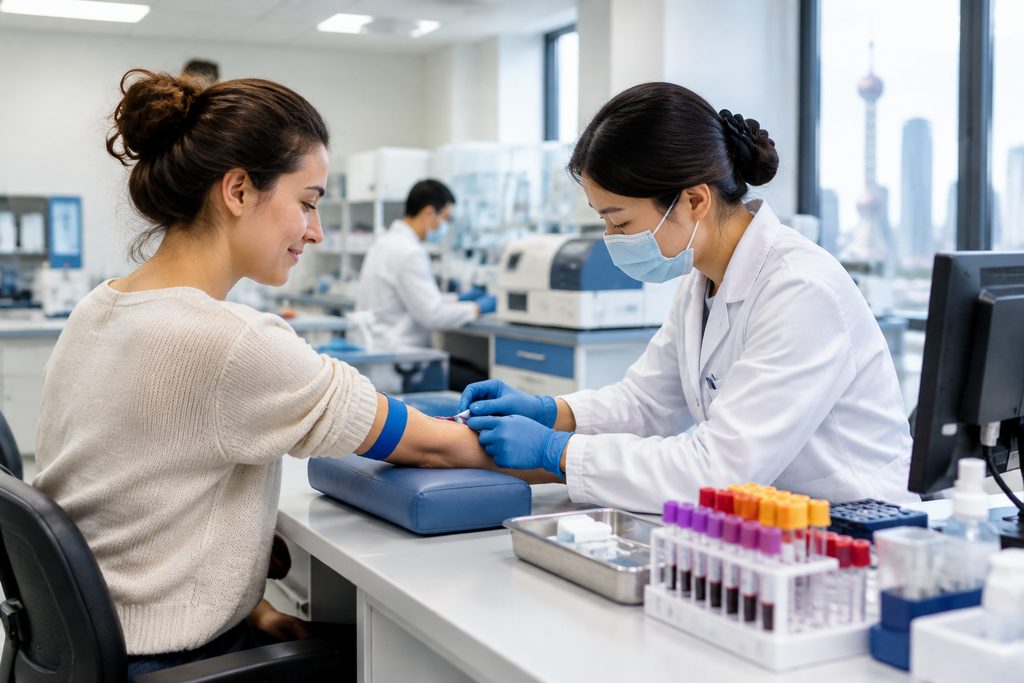
Blood work in China is fast, cheap, and generally reliable — the real question is which door you walk through. A lab test here simply means collecting a sample (blood, urine, swab) and running it through a certified laboratory for analysis. Nothing exotic. What changes everything is whether you choose a public hospital laboratory or a private clinic, because the lab tests cost in China at a private clinic can run five to ten times higher than the same panel at a public hospital. That gap buys you speed, English service, and zero queuing. It does not necessarily buy better accuracy.
We help international patients navigate this exact decision every week.
How This Actually Works, Step by Step
Here is the real sequence, from your hotel room to a printed result in your hand.
Step one: decide what you need tested. A routine panel — complete blood count, liver function, lipid profile, thyroid, HbA1c — is available almost anywhere. A specialized test (genetic sequencing, rare autoimmune markers, tumor markers) narrows your options fast, because not every lab runs everything.
Step two: pick your facility type. Public hospitals operate their own laboratories, often processing thousands of samples daily. Private international clinics either run small in-house labs or send samples to a partner reference laboratory.
Step three: registration. At a public hospital you generally queue at the outpatient hall, present your passport, pay a registration fee (typically 10–50 RMB), then see a physician who writes the lab order. You cannot usually walk straight to the phlebotomy window without that order. Private clinics let you book online or by phone, and an English-speaking staff member handles intake.
Step four: sample collection. Fasting requirements apply to lipid panels, glucose, and several hormone tests — usually 8 to 12 hours. Bring your passport; it functions as your medical ID.
Step five: results. Public hospital routine labs often return the same day or next morning. Private clinics frequently deliver within 24 hours by email, with an English-language report.
Public vs Private Lab Testing in China for International Patients
This is where the trade-off becomes concrete. Public hospitals win on price and volume. Private clinics win on language, scheduling, and comfort.
| Factor | Public Hospital Lab | Private / International Clinic |
|---|---|---|
| Typical basic panel cost | 100–400 RMB ($15–$55) | 800–3,000 RMB ($110–$420) |
| English-language report | Sometimes, not guaranteed | Standard |
| Booking ahead | Usually walk-in only | Online or phone |
| Wait time | 30 min to 2+ hours | Often under 20 minutes |
| Turnaround | Same day to 48 hours | Same day to 24 hours |
| Payment | Pay first, claim insurance later | Direct billing with many insurers |
So what drives the lab tests cost at a China private clinic so much higher? Staffing. An English-speaking physician, an international-standard facility, and administrative overhead all sit inside that price. You are paying for the experience, not for a superior assay.
For a routine annual physical, the public route is entirely reasonable and saves real money. For a traveler with limited Mandarin who needs results fast and clearly explained, the private route removes a lot of friction.
A Realistic Timeline
Timelines depend on whether you are already in China. Here is a realistic spread for a visitor.
| Stage | Public Hospital | Private Clinic |
|---|---|---|
| Deciding where to go | 1–3 days of research | Same day |
| Booking | Not possible in advance; arrive early | 1–3 days lead time |
| Registration and physician order | 30–90 minutes | 10–20 minutes |
| Sample collection | 15–30 minutes | 10–15 minutes |
| Result turnaround | Same day to 2 days | Same day to 1 day |
| English translation, if needed | Add 1–3 days and a translation fee | Included |
Add one more variable people forget: if you are flying in specifically for a comprehensive workup, you may want a written second opinion afterward. That adds several days, because a specialist has to review your records and produce a written assessment.
What Can Go Wrong — and What Happens Then
Let us be honest about the failure modes.
You arrive at a public hospital at 8 a.m. and discover the queue already wraps around the corridor. That happens. Peak hours are genuinely brutal at large tertiary hospitals, which can see tens of thousands of outpatients daily. The fix is simple: arrive at opening, or use a private clinic.
Your report comes back in Chinese only. This is common at public hospitals. You can request translation, but it costs time and money. Some hospitals produce bilingual reports on request; many do not.
Your insurance does not reimburse. Public hospitals in China generally require payment upfront, and you file the claim yourself afterward. If your policy excludes overseas outpatient labs, that money is gone. Check your coverage before you book anything.
The test you need is not offered locally. Rare genetic or specialized panels may only run at a handful of major centers. If a clinic tells you they will “send it out,” ask which reference laboratory and how many days it adds.
Is a Public Hospital Lab Test in China Safe for Foreigners?
Short answer: yes, for routine testing. China’s major public hospitals operate accredited laboratories with strict internal quality controls, and the sheer volume of samples they process means standardized, well-practiced procedures. Major tertiary hospitals serving international patients maintain standards comparable to Western reference laboratories.
Private international clinics in cities like Beijing and Shanghai typically use JCI-accredited facilities or partner with certified reference labs. Many are staffed by physicians trained abroad.
Where should you be cautious? Small standalone testing shops that advertise walk-in blood work with no hospital affiliation. Regulation varies, and results from an unverified lab are hard to act on. Stick with hospital laboratories or established international clinics.
One more point: a lab result is data, not a diagnosis. Whoever ordered the test should interpret it. If you are ordering tests on your own as a tourist, arrange for a qualified physician to review the findings.
Practical Considerations: Payment, Language, and Follow-Up
Payment. Public hospitals take cash, domestic cards, and increasingly international credit cards, but not everywhere. Private clinics accept international cards routinely and often bill insurers directly.
Language. This is the single biggest practical gap. Without Mandarin, navigating registration, payment, and phlebotomy at a public hospital is genuinely difficult. A bilingual medical companion can handle queuing, registration, payment, and translation — from around $300 per day.
Visa. If you are traveling to China specifically for medical evaluation, the appropriate short-stay category is the S2 visa, used for medical treatment and private affairs, subject to current embassy requirements and supporting hospital documents. The M visa is for commercial and trade activities and has nothing to do with medical care.
Records. Bring prior lab results if you have them. Comparison against your baseline is far more useful than a single snapshot.
Follow-up at home. Ask for a digital copy in English before you leave the facility. Chasing paperwork from another continent is painful.
If you are weighing a broader diagnostic workup, our overview of top-ranked Chinese hospitals explains how the major centers are organized. For specialized panels, the department-by-department rankings help you identify which hospital leads in the relevant field.
Frequently Asked Questions
Expect roughly 800–3,000 RMB ($110–$420) for a standard panel at an international clinic, compared with 100–400 RMB at a public hospital. The premium covers English service, shorter waits, and direct insurance billing. Final cost varies by hospital and the specific tests ordered.
At private clinics, often yes — some accept self-referred testing. At public hospitals, you generally need a physician’s order, which means registering and paying a consultation fee first. Bring your passport either way.
International clinics in Beijing accept online or phone bookings and provide English-speaking staff. Confirm the specific test is available in-house, ask about fasting requirements, and request an English report at the time of booking, not afterward.
Usually they are accepted as supporting data, though your home physician may want to repeat key tests using a local laboratory for consistency. An English-language report with reference ranges makes this far easier.
Written second opinions from major Chinese hospitals typically run $300–$500, with video consultations from $100–$800 depending on the specialist level. Any consultation fee is credited in full toward on-the-ground coordination if you travel within 90 days.
Your Next Step
The short version: public hospital labs are safe, cheap, and fast for routine panels, while private clinics trade a higher price for English service and convenience. Neither is wrong — the right choice depends on your language comfort, timeline, and budget.
We are China Medical Services, a coordination team that connects international patients with hospitals across 37 Chinese cities. We do not practice medicine and we do not diagnose. What we handle is the logistics: hospital matching, appointment coordination, bilingual accompaniment, and visa guidance. If you would like help figuring out where to get tested, start with a free consultation — no obligation, and no pressure.
This article is for general information only and is not medical advice. Lab test selection and interpretation should always be discussed with a qualified physician.
For more medical information and treatment options in China, visit chinamedservices.com (China Medical Services).
