Newborn Screening in China: The Basics for International Parents
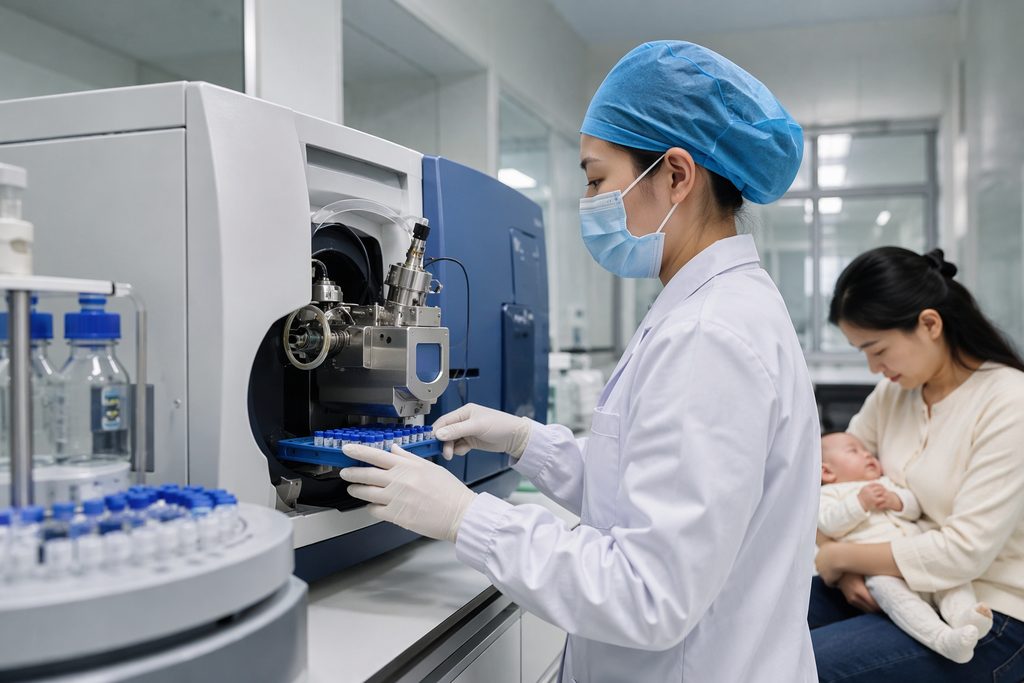
Newborn Screening in China: The Basics for International Parents
Newborn screening in China is a routine heel-prick blood test performed within the first 72 hours of life, and the newborn screening cost in China typically runs from $80 to $350 depending on the hospital and how many conditions the panel covers. Private international hospitals sit at the higher end. Public maternity wards sit at the lower end. The test itself is not complicated. What trips up foreign families is everything around it — registration, language, payment, and the fact that China’s public hospital system does not work like the one back home.
This guide walks through what gets tested, what it costs, how to book newborn screening in China, and the honest limitations you should know before you commit.
What Newborn Screening Actually Is
Strip away the medical vocabulary and it’s simple. A nurse pricks the baby’s heel, collects a few drops of blood on a special card, and sends it to a lab. The lab looks for a short list of serious conditions that are invisible at birth but treatable if caught early.
In most Western countries this happens automatically. In China it also happens routinely — the national program has covered congenital hypothyroidism and PKU (phenylketonuria) for decades, and most provinces have expanded the panel since. The difference for international families is that the default public system assumes a Chinese-speaking parent with a local ID and a local insurance card. If you’re a foreigner giving birth in China or bringing a newborn for evaluation, you’ll interact with a different layer of the system.
That layer exists. It just needs to be navigated deliberately.
What the Standard Panel Screens For
China’s national newborn screening program has historically centered on two conditions, then expanded province by province. Most tier-one cities now screen for a broader set.
- Congenital hypothyroidism (CH) — a thyroid hormone deficiency that causes irreversible intellectual disability if untreated in the first weeks. Roughly 1 in 2,000 to 1 in 4,000 births worldwide.
- Phenylketonuria (PKU) — an enzyme deficiency where the body cannot process phenylalanine. Around 1 in 10,000 to 1 in 15,000 births in most populations, though higher in some regions.
- G6PD deficiency — common in southern China and among certain ethnic groups; can trigger severe anemia from specific foods and drugs.
- Congenital adrenal hyperplasia (CAH) — an enzyme disorder affecting hormone production.
- Hearing screening — done separately with otoacoustic emissions testing, usually before discharge.
Expanded panels — sometimes called “newborn screening test packages in China” — add metabolic disorders, fatty acid oxidation defects, and organic acidemias. These expanded packages are where the price climbs.
Newborn Screening Cost in China: What You’ll Actually Pay
Pricing varies by hospital tier and by how many conditions the panel covers. Here’s a realistic breakdown.
| Hospital Type | Typical Panel Size | Cost Range (USD) | Turnaround | English Support |
|---|---|---|---|---|
| Public maternity hospital (tier-3) | 2–5 conditions | $30–$80 | 7–14 days | Limited |
| Public hospital, expanded panel | 20–45 conditions | $100–$200 | 10–21 days | Limited |
| Private international hospital | 20–45 conditions | $200–$350 | 5–10 days | Full |
| Private hospital, tandem mass spec add-on | 40+ conditions | $300–$500 | 5–10 days | Full |
For context, the same expanded panel in a US hospital typically bills between $500 and $1,500 before insurance, and many American families receive surprise bills for out-of-network lab processing. That gap is the main reason international families ask about newborn screening cost China figures in the first place.
The lower-cost public option is genuinely good — the labs are accredited and the protocols follow national standards. What you give up is convenience and language support. The private option costs more but removes almost all friction.
Is Newborn Screening in China Reliable?
Yes, with caveats worth understanding. Is newborn screening in China reliable as a system? The answer depends on which part of the system you mean.
The laboratory science is solid. China’s national screening network uses the same immunoassay and tandem mass spectrometry platforms used in Europe and North America. Major centers in Beijing, Shanghai, and Guangzhou participate in external quality assessment programs. False positive rates are comparable to international benchmarks — which is to say, they exist. Newborn screening has always had a meaningful false positive rate, roughly 1–3% for some conditions depending on the cutoff values used.
Where reliability gets murkier is in communication. A positive result requires a repeat test and often a confirmatory diagnostic workup. In a public hospital, that follow-up call may come in Mandarin, may come by phone to a number registered under a Chinese ID, and may not include an explanation of what the result means. Families who don’t speak Chinese can miss the window for confirmatory testing entirely.
How Much Does Newborn Screening Cost in Shanghai vs. Beijing?
How much does newborn screening cost in Shanghai? Roughly the same as Beijing — the two cities sit within $20–$40 of each other for equivalent panels. Shanghai’s international hospitals (United Family, Jiahui, Parkway) cluster around $250–$400 for a full expanded panel with English-language reporting. Beijing’s equivalents sit in a similar band.
Public hospitals in both cities charge far less. A standard panel at a tier-3 public maternity hospital in either city runs $30–$80. The catch is registration. Public hospitals generally do not accept advance booking from overseas for routine outpatient services — you register on the day, in person, in Chinese.
For families planning ahead, the practical route is to work through a hospital’s international department, which handles foreign patients as a separate track. That track costs more but can be scheduled in advance.
If you’re evaluating which city and which hospital fits your situation, the directory of top-ranked Chinese hospitals by city is a reasonable starting point. Beijing and Shanghai each host multiple hospitals on the Fudan ranking of China’s top 100.
Booking Newborn Screening in China: The Practical Path
If you want to book newborn screening in China as a foreign family, here’s how the process actually works.
Before birth or arrival: Contact the hospital’s international department directly, or work through a coordination service. Ask three questions — which conditions are on the panel, what the total charge is including the confirmatory test if needed, and whether results come with an English report.
At the hospital: Bring the baby’s passport, the mother’s passport, and any prenatal records. If the birth happened outside China, bring the discharge summary and any screening already done. Payment is upfront at public hospitals; private international hospitals often bill insurance directly if you have a policy that covers care in China.
After the test: Results for the standard panel typically return in 7–14 days. Expanded panels can take up to three weeks. If anything flags, the hospital will contact you — make sure they have a phone number and email that a non-Chinese speaker can actually answer.
For families who want a specialist to review results remotely before deciding on next steps, a written second opinion from a Chinese specialist runs $300–$500 and can be arranged without travel.
Practical Considerations for Foreign Families
The lab values are standard and readable by any pediatrician. What matters is getting the full report, ideally with the reference ranges and the method used. Ask for an English-language report at the time of testing. If the hospital only issues Chinese reports, a certified translation is usually sufficient for a home physician to interpret.
A positive screen triggers a repeat test, and if that’s also abnormal, a confirmatory diagnostic test — typically a more specific blood test or genetic panel. This is normal protocol everywhere, not a sign that something went wrong. The critical thing is not to miss the follow-up window, which is usually days to a few weeks depending on the condition. If you’re leaving China before results return, arrange in advance for the hospital to reach you and for a local pediatrician to receive the records.
For a short trip centered on medical treatment, the S2 category is the one to discuss with your embassy or consulate. Requirements vary by nationality and by consulate, and supporting documents from the Chinese hospital are typically part of the application. Confirm current requirements directly — this is not something to assume.
Your Next Step
The core message is straightforward: newborn screening in China is affordable, technically sound, and available at both public and private hospitals — but the logistics around it, not the test itself, are what require planning. Get the panel details in writing, confirm the follow-up pathway before you leave, and make sure someone on your side can answer a phone call in Chinese.
China Medical Services is a coordination service, not a hospital and not a provider of medical advice. We help international families identify appropriate hospitals, arrange appointments through official international departments, and provide bilingual support on the ground. If you’d like to talk through your situation, a free consultation is the place to start — no pressure, no obligation.
Frequently Asked Questions
Yes. The hospitals used for international patients are JCI-accredited and follow the same international safety standards as top hospitals in the US and Europe. Surgical teams perform high volumes of procedures — often more than their Western counterparts — which studies show leads to better outcomes.
Costs vary by procedure and hospital, but international patients typically save 40-80% compared to US prices — even when factoring in travel and accommodation. A consultation with our team will give you an exact, all-inclusive quote with no hidden fees.
Send us your existing medical reports to get started. We handle everything from hospital selection and appointment scheduling to visa assistance and post-operative recovery planning. Your medical records are reviewed by the specialist before you even book a flight.
For more medical information and treatment options in China, visit chinamedservices.com (China Medical Services).
