Heart Tests in China: English Service, Costs & Top Hospitals
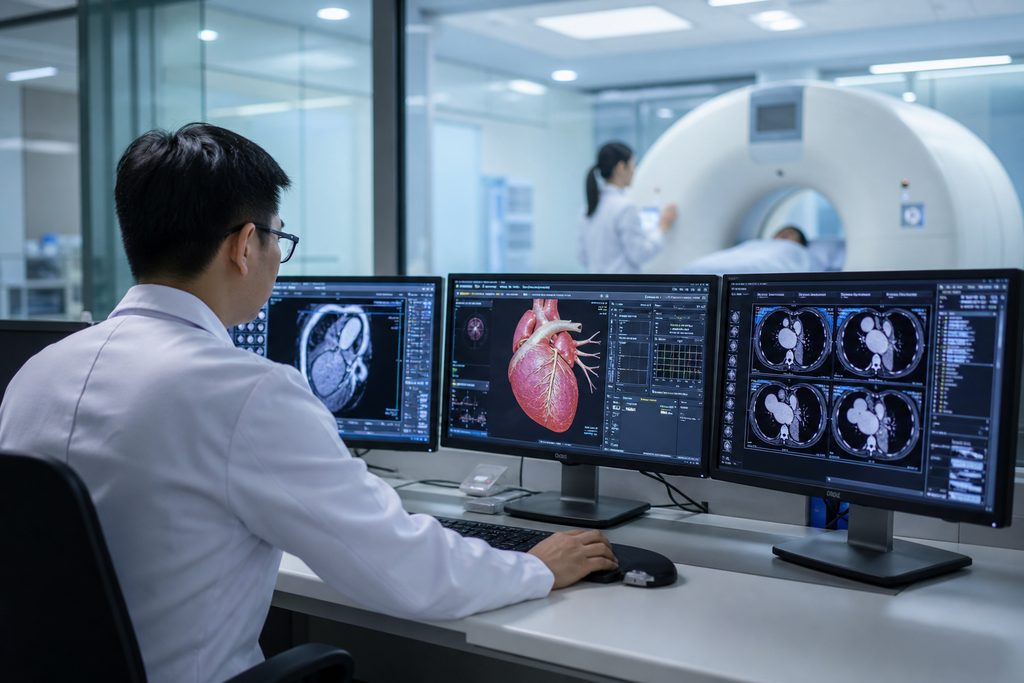
Heart Tests in China: English Service, Real Costs, and How to Book
What if you could get a complete cardiac workup — echocardiogram, stress test, Holter monitor, the full panel — in a top-tier Chinese hospital, with English-speaking staff, for a fraction of what you’d pay in the United States? That question is exactly why so many international patients now ask us about heart test cost China hospitals charge, and whether the quality holds up.
Short answer: yes, it usually does. The longer answer involves understanding how Chinese hospitals actually work, what a heart checkup costs in Shanghai versus Beijing, and why “English service” means something different here than it does in a Western clinic.
We’re China Medical Services. We connect international patients with 340+ top-ranked hospitals across 37 cities — the top 5% of China’s 35,000+ hospitals, ranked by Fudan and JCI. This guide covers what you need to know before you book a single test.
How This Actually Works, Step by Step
Here’s the real sequence. No marketing gloss.
Step one: you send us your existing records. Prior ECGs, blood work, imaging reports, medication lists, and a short note about your symptoms or goals. If you have a family history of coronary artery disease, say so. If you’re asymptomatic and just want a baseline, say that too.
Step two: a Chinese cardiology team reviews your file. Depending on what you need, this may be a written second opinion, a video consultation, or a proxy visit where we bring your materials to the hospital on your behalf. For a straightforward checkup, the video consultation route is usually enough — $100–300 at a standard international department, $500–800 with a top specialist.
Step three: you get a written plan. Which tests make sense. Which hospital. Rough cost range. How many days you’ll need on the ground.
Step four: we coordinate the appointment. This is where most foreign patients hit a wall on their own. Public hospital outpatient registration in China generally cannot be booked from overseas in advance — you queue on the day. To lock in a slot ahead of time, you go through the hospital’s international or VIP channel, which runs roughly 1.5–2x the standard price but gives you a senior specialist and English support.
Step five: you arrive, and someone walks you through it. Registration, payment, the echo lab, the treadmill room, pharmacy. A bilingual medical companion handles the logistics so you’re not navigating a hospital that sees 10,000+ outpatients a day in a language you don’t read.
What a Heart Checkup Actually Costs in China
Let’s put numbers on the table. Prices vary by hospital tier and case complexity, but these ranges reflect what international departments in Beijing, Shanghai, and Guangzhou currently quote.
| Test or Package | China (USD) | United States (USD) |
|---|---|---|
| Resting ECG | $15–40 | $50–200 |
| Echocardiogram (transthoracic) | $80–200 | $1,000–2,500 |
| 24-hour Holter monitor | $100–250 | $500–1,500 |
| Exercise stress test | $120–300 | $800–2,000 |
| Coronary CT angiography | $300–700 | $1,500–5,000 |
| Cardiac MRI | $500–1,200 | $3,000–6,000 |
| Full executive cardiac package | $800–2,500 | $5,000–15,000 |
So how much does a heart checkup cost in Shanghai? A typical package — ECG, echo, blood panel, stress test, specialist consultation — lands between $600 and $1,500 at a top public hospital’s international department. The same workup at a private international hospital like United Family or Jiahui runs higher, often $1,500–3,500, but includes direct insurance billing and a Western-style clinic experience.
For context: coronary artery bypass grafting in China’s top public hospitals runs $12,000–20,000. In the US, that same procedure frequently exceeds $120,000. That gap is why patients fly here.
Which Hospitals Handle International Cardiac Patients Well
If you’re searching for the best cardiology hospital Beijing English speaking patients can access, the name that comes up first is Fuwai Hospital. It performs more cardiac surgeries annually than any other hospital in the world — 14,000+ procedures a year — and its international department works with foreign patients routinely.
Other strong options:
- Zhongshan Hospital, Fudan University (Shanghai) — consistently ranked among China’s top centers for cardiovascular medicine
- Peking Union Medical College Hospital (Beijing) — the benchmark for complex diagnostics
- West China Hospital (Chengdu) — the dominant referral center for western China
- Ruijin Hospital (Shanghai) — strong cardiology plus a well-established international pathway
For private, JCI-accredited heart hospital China options, United Family Healthcare, Jiahui Health, ParkwayHealth, and Raffles Medical all offer English-speaking cardiologists, direct insurance billing, and shorter waits. You’ll pay more. You’ll also get a clinic that feels familiar.
You can browse cardiac surgery rankings by hospital on our specialty rankings page, or filter by city — Beijing and Shanghai have the deepest cardiac benches.
A Realistic Timeline
People underestimate this part. Here’s what a diagnostic trip actually looks like.
| Stage | Typical Duration | What’s Happening |
|---|---|---|
| Records collection & translation | 3–7 days | You gather reports; we translate into Chinese |
| Remote review / video consult | 2–5 days after records arrive | Cardiology team reviews and proposes a test plan |
| Appointment coordination | 1–3 weeks | International department slot confirmed; VIP channel if needed |
| Visa (S2) | 4–10 business days | Requires hospital invitation and supporting documents |
| On-the-ground testing | 2–5 days | ECG, echo, blood work, stress test, specialist consult |
| Results and follow-up plan | 1–3 days | Written report in English; recommendations for home |
Total: roughly 4–8 weeks from first contact to results in hand. If you’re already in China on another visa, you can compress this to 2–3 weeks.
What Can Go Wrong — and What Happens Then
Honest failure modes, because trust is built here, not in the sales pitch.
You can’t get the exact specialist you wanted. Public hospital outpatient slots for a named professor can be booked out weeks ahead, and no coordinator can guarantee one. What we can do is coordinate through the international or VIP channel and, if the specific appointment isn’t secured, refund the coordination fee in full.
Your test results need a follow-up you didn’t plan for. A stress test flags something. The cardiologist wants a CT angio before you fly home. This happens. Budget an extra 2–4 days and a few hundred dollars, or accept that the follow-up happens in your home country with the English report we provide.
Language breaks down at the worst moment. Even in international departments, lab technicians and nursing staff may not speak English. This is precisely why bilingual accompaniment exists. Without it, you’re relying on a translation app in a cardiology ward.
The visa takes longer than expected. S2 processing times shift with embassy workload. Apply early. Never book a non-refundable flight before the visa is in hand.
Is Heart Surgery Safe in China for Foreigners?
This is the question behind the question, and it deserves a straight answer.
China’s top cardiac centers — Fuwai, Zhongshan, West China — perform volumes that most Western hospitals never approach. High volume correlates with better outcomes in cardiac surgery; that’s a well-documented pattern in surgical literature. Fuwai alone does more than 14,000 cardiac operations a year.
But “safe” depends on your specific case. A straightforward valve replacement at a top-tier center is a different risk profile than complex redo surgery with multiple comorbidities. The honest answer: for many procedures, outcomes at China’s leading hospitals are comparable to Western centers. For highly complex or rare conditions, you should discuss the specific case with a qualified cardiologist before deciding anything.
What we can tell you is what the numbers show. What we can’t do is tell you what’s right for your heart. That’s a conversation between you and a physician.
Practical Considerations: Records, Visa, Payment, Follow-Up
Records. Bring everything. Prior ECGs, imaging on disc, medication names in generic form, allergy history. Chinese cardiologists are thorough, but they can’t review what they don’t have.
Visa. Medical travel to China uses the S2 visa with a medical-treatment annotation. Stays over 180 days require S1. Accompanying family members also apply for S2. Note carefully: the M visa is for commercial and trade activities only — it is not a medical visa, despite what you may read elsewhere. Requirements shift, so confirm current rules with your nearest Chinese embassy or consulate.
Payment. Public hospitals require prepayment; insurance reimbursement happens afterward, in your home country. Private international hospitals often bill insurers directly. Bring a card that works internationally and confirm the hospital’s accepted payment methods in advance.
Follow-up. Ask for your imaging on disc and a written English report before you leave. Your cardiologist at home will want both. Continuity matters more than the trip itself.
Frequently Asked Questions
In practice, it’s difficult. Standard public hospital registration generally can’t be reserved from overseas, and the international department pathway usually requires Chinese-language coordination or a local representative. That’s the gap our appointment coordination service fills — we handle registration, medical card creation, and scheduling through the hospital’s official international channel.
At the top-tier hospitals, yes — the equipment is current-generation, and the specialists are often trained partly abroad. The difference you’ll notice most is the environment: far higher patient volume, less hand-holding, and a system that assumes you have someone navigating it with you. That’s a service gap, not a quality gap.
Strongly recommended, and check the fine print. Many travel policies exclude pre-existing conditions or planned medical treatment. Some international health insurers cover treatment at JCI-accredited hospitals in China; others don’t. Confirm coverage before you book anything.
The cardiology team will explain findings and recommend next steps. You’re never obligated to proceed with treatment in China. Many patients take the English report home and continue care with their own doctor. That’s a completely valid outcome.
Your Next Step
The takeaway is simple: heart testing in China at a top-tier hospital costs a fraction of Western prices, the technology is current, and the main obstacle is navigation — language, booking systems, and hospital logistics. That’s the obstacle we exist to remove.
We’re China Medical Services. We match international patients with hospitals from our database of 340+ top-ranked institutions across 37 cities, coordinate appointments through official international channels, and provide bilingual medical companions. We are not doctors, and we don’t provide medical advice or promise clinical outcomes. We handle the logistics so you can focus on your health.
If you’d like to understand your options, start with a conversation. Tell us what you need — no pressure, no obligation, just clarity on what’s possible.
This article is for informational purposes only and does not constitute medical advice. Always consult a qualified physician regarding diagnosis and treatment decisions.
For more medical information and treatment options in China, visit chinamedservices.com (China Medical Services).
