Endoscopy in China: Anesthesia Team Standards and Costs
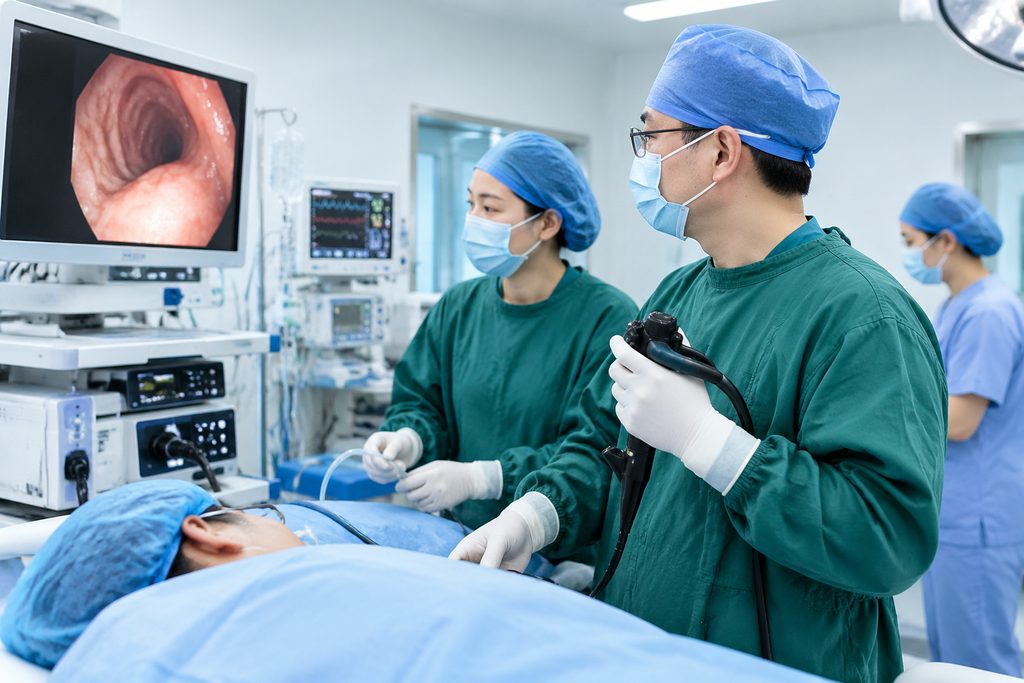
What if the biggest worry about getting an endoscopy abroad isn’t the procedure itself — but who’s holding the anesthesia syringe? That question drives more searches than almost anything else we see from international patients. And it’s a fair one.
Here’s the short answer: endoscopy cost China typically runs $300 to $1,200 for a diagnostic upper or lower GI procedure with sedation, depending on hospital tier and whether you choose a public tertiary facility or a private international one. Anesthesia is delivered by a dedicated anesthesiology team — not the gastroenterologist alone — at every hospital in our network. That’s the standard in China’s top-tier facilities, and it’s worth understanding before you book anything.
Endoscopy in China: The Short Answer
A diagnostic gastroscopy or colonoscopy with sedation at a major Chinese public hospital costs roughly $300–$600. Add a private international hospital and that figure climbs to $800–$1,200. Both include an anesthesia team.
What complicates the picture? Public hospitals rarely let you book directly from overseas. You typically need an in-person consultation first, which means either flying in earlier than expected or using a hospital’s international department to arrange a combined visit. That logistical wrinkle is the real story here — not the medicine.
Key takeaway: China’s tertiary hospitals perform endoscopy at volumes that rival anywhere in the world. The anesthesia protocols are standardized and physician-led. The friction is administrative, not clinical.
Who This Is Right For — and Who It Isn’t
Not everyone should fly across the world for a scope. Let’s be honest about that.
You’re likely a good candidate if:
- You need a diagnostic endoscopy and face a 3–6 month wait or a $3,000+ bill at home
- You’re already traveling to China for another procedure and want to combine visits
- You want a second look at a finding — a polyp, a lesion, unexplained GI bleeding — with faster scheduling
- You’re uninsured or underinsured in your home country and paying out of pocket
You should probably stay home if:
- You have active, unstable cardiac or respiratory disease that makes air travel risky
- You need an emergency scope — those can’t wait for visa processing
- Your insurance only covers in-network providers in your home country and you can’t absorb the out-of-pocket cost
- You have a bleeding disorder requiring a highly specialized coagulation team your local hospital already knows well
This isn’t a procedure anyone should treat casually. A scope is low-risk, but it isn’t zero-risk. The right call depends on your medical history, not on price alone.
The Options, Compared
Here’s how the realistic alternatives stack up for a diagnostic endoscopy with sedation.
| Option | Typical Cost (USD) | Wait Time | Anesthesia Model | Language Support |
|---|---|---|---|---|
| US hospital (insured) | $1,500–$4,000 billed | 2–6 weeks | Dedicated anesthesiologist | English native |
| US hospital (cash pay) | $2,500–$5,000 | 1–4 weeks | Dedicated anesthesiologist | English native |
| China public tertiary hospital | $300–$600 | Days to 2 weeks | Anesthesiology department team | Limited; interpreter needed |
| China private international hospital | $800–$1,200 | Days to 1 week | Dedicated anesthesiologist | English-speaking staff |
| China VIP/international dept (public) | $600–$900 | Days to 1 week | Senior anesthesiologist assigned | English coordinator available |
Which column fits you? If budget is the deciding factor and you can bring a translator, the public tertiary route delivers excellent clinical care at a fraction of Western prices. If you want zero language friction and direct insurance billing, the private international column is worth the premium. The VIP route sits in between — public hospital expertise, private-style service.
How Is Anesthesia Given During Endoscopy in China?
This is the question that keeps people up at night, so let’s walk through it properly.
At every hospital in our 340+ network, sedation for endoscopy follows a protocol where an anesthesiology physician — not the endoscopist — manages the sedation. The most common approach is propofol-based monitored anesthesia care (MAC), sometimes called “sedation anesthesia” or, in Chinese practice, “painless endoscopy” (无痛胃肠镜 — though you’ll see it in English as “painless gastroscopy/colonoscopy” on hospital materials).
What that means in practice:
- An IV line is placed before the procedure
- An anesthesiology team member monitors heart rate, blood pressure, and oxygen saturation continuously
- Propofol is titrated to keep you comfortable — most patients remember nothing
- A reversal plan and airway equipment are on standby, as in any Western facility
- Recovery is monitored for 30–60 minutes before discharge
For patients who can’t tolerate deep sedation — those with severe sleep apnea, for example — the team can adjust to lighter sedation or, in some cases, unsedated endoscopy with a thinner scope. That’s a clinical decision made case by case after reviewing your history.
Practical tip: Ask whether the hospital uses capnography (CO2 monitoring) during sedation. Top-tier Chinese hospitals generally do. It’s a small detail that signals a mature anesthesia practice.
Is Endoscopy Safe in China?
Safety data for endoscopy in China’s top hospitals is comparable to Western benchmarks, though published English-language statistics are harder to find than you’d expect.
What we can say with confidence: the hospitals in our network are ranked in the top 5% of China’s 35,000+ hospitals by the Fudan University Hospital Rankings and, in many cases, hold JCI accreditation. These are high-volume centers. A hospital performing 10,000+ endoscopies a year develops institutional muscle memory that low-volume centers simply don’t have.
Perforation rates for diagnostic colonoscopy in experienced hands sit around 0.1% or lower globally. Sedation-related complications are rare when a dedicated anesthesia team is involved. The risk profile in a top Chinese hospital is not meaningfully different from a top US or European one.
But — and this matters — “top hospital” is doing a lot of work in that sentence. A small regional Chinese clinic is not the same as a Fudan-ranked tertiary center. The hospital you choose is the single biggest variable in your safety equation.
You can browse ranked options by city on our top hospitals directory, or look at specialty rankings for gastroenterology on the departments page.
What It Costs — and What Drives the Variance
Let’s break down the cost of endoscopy in China more precisely.
| Cost Component | Public Tertiary | Private International |
|---|---|---|
| Pre-procedure consultation | $30–$80 | $150–$300 |
| Endoscopy procedure (diagnostic) | $150–$350 | $500–$800 |
| Anesthesia | $80–$150 | $200–$350 |
| Biopsy (if taken) | $30–$80 | $100–$200 |
| Pathology report | $40–$100 | $150–$300 |
| Total (typical) | $300–$600 | $800–$1,200 |
What pushes you toward the higher end? A therapeutic procedure rather than diagnostic (polyp removal, for example), a longer sedation time, additional imaging, or a hospital with a premium international department. What keeps you at the low end? A straightforward diagnostic scope at a public tertiary hospital with no complications.
These figures are estimates. Final pricing varies by hospital and case complexity, and we always confirm actual costs with the specific facility before you commit to anything.
Practical Considerations: Booking and Logistics
Now the part most articles skip. How do you actually get this done?
Records first. Before any hospital will schedule a scope, they want your existing reports — prior endoscopies, imaging, lab work, medication list. Send these ahead. A written second opinion from a Chinese specialist costs $300–$500 and can tell you whether the procedure is even necessary before you book flights.
Visa. Medical travel to China uses the S2 visa (annotated for medical treatment). Stays beyond 180 days require an S1. Accompanying family members also apply for S2. The M visa is for commercial and trade activities — it is not a medical visa, and using it for treatment purposes creates problems at immigration. Requirements shift, so always verify current rules with the nearest Chinese embassy or consulate and bring supporting hospital documentation.
Booking. You typically cannot reserve a public hospital endoscopy slot directly from overseas. The standard path is an in-person consultation first, then scheduling. Hospitals with international departments can sometimes combine these into a single trip. This is where a bilingual medical companion service becomes genuinely useful — from $300 per day, covering registration, queue management, payment, and interpretation. It’s labor and coordination, not a backdoor to a specific doctor.
Payment. Public hospitals require prepayment; insurance reimbursement happens afterward in your home country. Private international hospitals often bill insurance directly. Bring a card that works in China, and expect to pay in RMB.
After you fly home. Get your endoscopy report and any pathology slides or digital images before discharge. Your home physician will want them. Follow-up care should happen locally — a scope is a snapshot, not an ongoing treatment relationship.
If you’re still deciding between cities, our Shanghai hospital guide covers the international-department options there, which are among the most foreigner-friendly in the country.
Frequently Asked Questions
At top Chinese hospitals, yes — sedation is managed by the anesthesiology department, not the gastroenterologist. This is the same standard you’d find in a US or European tertiary center. For unsedated endoscopy, no anesthesia team is involved, but most international patients choose sedation.
Usually not directly at a public hospital. The standard rule is consultation first, procedure second. International departments and private hospitals are more flexible. Realistically, plan for one trip that includes both the consultation and the procedure, or two trips if your case needs staging.
Top-tier hospitals have emergency response protocols, ICU access, and surgical backup on site. That said, complications — bleeding, perforation, adverse sedation reactions — are rare but possible anywhere. Your pre-procedure consent discussion should cover these honestly, and you should feel free to ask about the hospital’s complication rate and emergency pathway.
Propofol-based sedation is the global standard, and Chinese tertiary hospitals use it routinely. Drug quality and monitoring equipment at Fudan-ranked and JCI-accredited facilities meet international norms. The main difference is communication — you’ll want an interpreter present for the pre-anesthesia assessment.
Endoscopy with anesthesia price Beijing generally falls in the $300–$700 range at public tertiary hospitals and $800–$1,200 at private international facilities. Beijing has 21 Fudan Top 100 hospitals, so competition keeps public pricing competitive. Exact figures depend on the hospital and whether biopsies or polyps are involved.
Your Next Step
The core message is simple: endoscopy in China is affordable, safe at top-tier hospitals, and supported by physician-led anesthesia teams. The hard part is navigation — records, visas, booking rules, and language. That’s the gap we exist to close.
We’re not a hospital and we don’t diagnose. We’re a coordination service that helps international patients find the right facility, prepare documentation, and move through the system with a bilingual companion. If you’d like to talk through your situation, start with a free consultation — no pressure, no commitment, just a clearer picture of what’s possible.
This article is for general information only and is not medical advice. Always consult a qualified physician about your individual situation before traveling for any procedure.
For more medical information and treatment options in China, visit chinamedservices.com (China Medical Services).
