Surgery in China: Blood Transfusion Questions Answered for Patients
Key Takeaways
- Blood transfusion surgery cost China is typically bundled into the overall surgical quote — top public hospitals rarely bill blood products as a separate line item for international patients, unlike the $1,000–$3,000 per-unit charges common in the U.S.
- China’s blood supply is screened under national mandatory testing for HIV, hepatitis B and C, and syphilis — the same core panel used in most high-income countries — and top-tier hospitals follow WHO-aligned protocols.
- The real barrier isn’t safety. It’s logistics: foreigners cannot directly donate to or draw from a Chinese blood bank, and hospitals require confirmed surgical need before releasing units.
- Understanding how much blood is needed for surgery in China, and how the hospital’s blood bank operates, prevents last-minute panic before an operation.
You’ve probably heard that surgery in China means compromising on quality. The reality is often the opposite — and nowhere is that gap between perception and fact wider than with blood transfusions. International patients arrive worried about two things: whether the blood is safe, and whether a foreigner can even get it. Both concerns are reasonable. Neither is a dealbreaker.
Here’s the honest picture. China runs one of the world’s largest surgical systems. Its top hospitals perform volumes that would be unimaginable in most Western countries. Blood transfusion is a routine, tightly regulated part of that system — not an exotic exception. But the rules, costs, and access pathways differ from what you’d find in the U.S. or Europe, and knowing those differences ahead of time is what separates a smooth experience from a stressful one.
Why Blood Transfusion Questions Worry International Patients
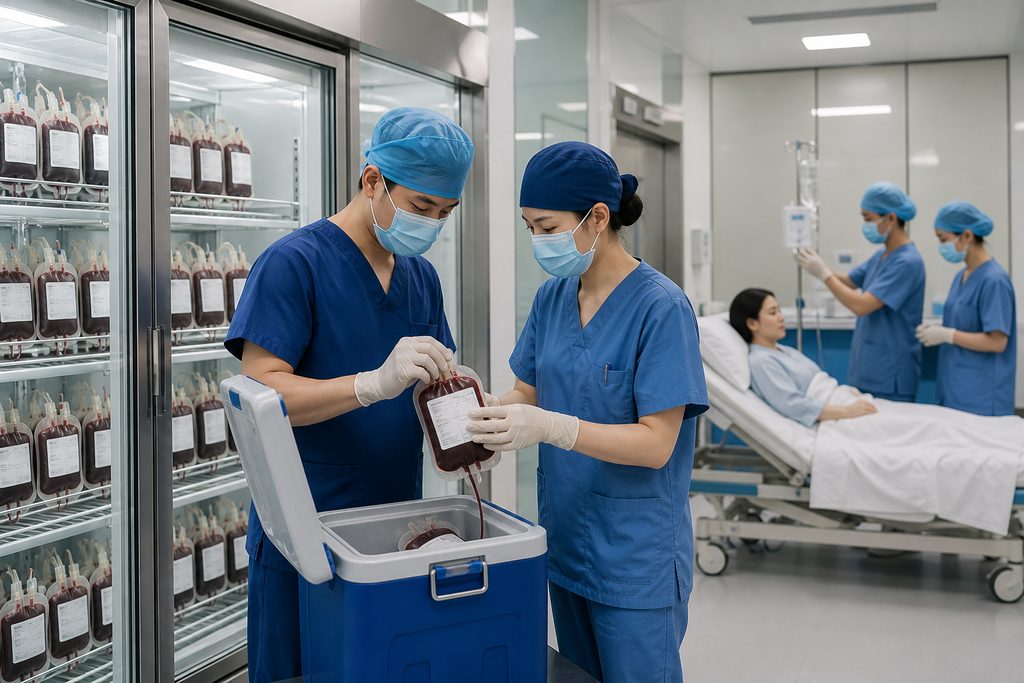
Every unit of blood collected in China undergoes mandatory nucleic acid testing (NAT) for HIV, HBV, and HCV, plus serological screening for syphilis. This is the same core panel used in the U.S. and most of the EU. Top hospitals like those ranked in the Fudan Top 100 operate their own blood banks or draw from provincial blood centers that meet national standards.
What does that mean in practice? A unit of blood that reaches a patient at a top Chinese hospital has passed through a screening chain comparable to what you’d encounter at a major American academic medical center.
Who Handles the Blood
Transfusion decisions are made by the treating surgical team, not by administrators. In Chinese public hospitals, the anesthesiologist and surgeon jointly determine whether a transfusion is needed during or after surgery, based on hemoglobin levels, blood loss, and the patient’s overall condition. The blood bank releases units only on a confirmed clinical order.
There’s no “optional” transfusion culture. Chinese surgical teams are generally conservative — they transfuse when indicated, not as a precaution.
What International Patients Should Verify
Before committing to surgery, ask the hospital’s international department three questions:
- Does the hospital have an on-site blood bank, or does it rely on a regional center?
- What is the hospital’s protocol for crossmatching and pre-operative blood reservation?
- Can they provide documentation of their blood screening standards in English?
Top hospitals answer these without hesitation. If a facility can’t, that’s a signal to look elsewhere.
How Much Blood Is Needed for Surgery in China?
The volume depends entirely on the procedure. There’s no universal number — but there are realistic ranges that help patients plan.
| Procedure Type | Typical Blood Reserved | Likely Transfused? |
|---|---|---|
| Minor orthopedic (e.g., arthroscopy) | 0–1 unit | Rarely |
| Major joint replacement (hip/knee) | 1–2 units | Sometimes |
| Cardiac bypass (CABG) | 2–4 units | Frequently |
| Complex spinal fusion | 2–4 units | Often |
| Liver resection | 2–6 units | Commonly |
These are planning estimates, not guarantees. A surgeon may reserve four units and transfuse none — or reserve two and need four. Case complexity, the patient’s baseline hemoglobin, and intraoperative findings all shift the number.
The key point: Chinese hospitals reserve blood proactively for scheduled surgeries. If you’re booked for a major procedure, the blood bank will have units crossmatched and held for you. This isn’t something you arrange yourself.
Can Foreigners Get Blood Transfusions in China?
Yes. Foreign patients receive transfusions under the same clinical criteria as Chinese citizens. There is no separate “foreigner blood supply” and no restriction based on nationality.
But here’s where it gets practical. Foreigners cannot donate blood in China, and they cannot direct-donate for a specific patient. China’s blood donation system is voluntary and non-directed — donations go into the general pool. So if you’re wondering whether a family member can “give blood for you” before surgery, the answer is no, that pathway doesn’t exist here.
What does exist: the hospital’s blood bank manages supply. For scheduled surgeries, units are reserved in advance. For emergency transfusions, the hospital draws from its own stock or the regional center. Your nationality doesn’t change the process — but it does mean you should confirm with the hospital’s international office that your surgical plan includes a blood reservation, especially for high-blood-loss procedures.
This is one of the areas where working with a bilingual medical companion genuinely helps — not because the system is unsafe, but because the communication around blood logistics is where misunderstandings happen.
What Does Blood Transfusion Surgery Cost in China?
Here’s the part that surprises most patients: in China’s top public hospitals, blood products are often bundled into the overall surgical fee rather than itemized separately.
That doesn’t mean blood is free. It means the cost structure is different. A cardiac bypass at a top Chinese public hospital might run $12,000–$20,000 total — including the surgical team, ICU stay, and any blood products used. In the U.S., the same procedure often exceeds $120,000, with blood billed separately at $1,000–$3,000 per unit.
At private international hospitals — facilities like United Family, Jiahui, or Parkway — pricing is more transparent and itemized. You may see blood products listed separately, typically at $200–$600 per unit, depending on the hospital and whether processing or irradiation is required.
Either way, the total cost of surgery with transfusion in China remains a fraction of Western pricing. The savings come from structural factors: lower labor costs, high surgical volume that spreads fixed costs, and a public health system that doesn’t price blood as a profit center.
China Hospital Blood Bank Safety for International Patients
The phrase “blood bank safety” gets thrown around loosely. Let’s be specific about what it means at a top Chinese hospital.
Blood banks at facilities serving international patients operate under China’s Ministry of Health regulations, which mandate:
- Nucleic acid testing for HIV, HBV, and HCV on every unit
- Serological screening for syphilis
- ABO and Rh typing with double-check verification
- Crossmatching before every transfusion
- Documented chain-of-custody from collection to transfusion
These aren’t aspirational guidelines. They’re inspection requirements. Hospitals that fail them lose their blood bank license.
For international patients, the practical question isn’t whether the blood bank is safe — it’s whether you can communicate with it. Language barriers can turn a routine pre-operative blood reservation into a confusing mess of forms and verbal instructions. That’s a coordination problem, not a safety problem, but it feels like one when you’re the patient.
How to Book Surgery with Blood Transfusion in China
The process follows a predictable sequence. Understanding it removes most of the uncertainty.
Step 1: Remote evaluation. You send your medical records — imaging, lab results, prior surgical notes — to the hospital’s international department or a coordination service. A specialist reviews them and confirms whether surgery is appropriate and what blood reservation the procedure typically requires.
Step 2: Written surgical plan and estimate. The hospital provides a treatment plan that includes the proposed procedure, expected length of stay, and a cost estimate. Ask specifically whether blood products are included.
Step 3: Visa and travel coordination. Foreign patients traveling for medical treatment use the S2 visa (short-stay, for medical treatment and private affairs), not the M visa — that’s for commercial and trade activities only. Accompanying family members apply for S2 as well. Processing typically takes 4–7 business days, though this varies by consulate.
Step 4: Pre-operative assessment on arrival. Once in China, you’ll undergo in-person evaluation — blood tests, imaging, anesthesia consultation. This is when the blood bank crossmatches and reserves units for your surgery.
Step 5: Surgery and transfusion if needed. The surgical team transfuses based on clinical need. If you’ve been told two units are reserved, that’s what’s held for you. Unused units return to the bank.
Step 6: Post-operative monitoring and discharge. Hemoglobin levels are tracked. Follow-up appointments are scheduled before you fly home.
The entire sequence — from first contact to surgery — typically takes 3–6 weeks for non-urgent cases. Urgent cases move faster, but the blood reservation process still requires pre-operative assessment.
Practical Considerations for International Patients
Beyond blood itself, a few logistics matter.
Documentation. Bring your complete medical records in English, including any history of transfusion reactions, anemia, or blood disorders. If you’ve had prior transfusions, note the dates and whether you experienced any adverse reactions.
Payment. Public hospitals require pre-payment for scheduled surgeries. International credit cards are accepted at most top hospitals, but transaction limits vary — some cards cap at $5,000–$10,000 per transaction. Plan for multiple transactions or a wire transfer.
Insurance. Most international insurance plans reimburse after treatment rather than paying directly, except at private international hospitals with direct-billing agreements. Check your policy’s coverage for blood products specifically — some exclude them.
Language. Blood-related consent forms, pre-operative instructions, and post-transfusion monitoring all require clear communication. If you don’t speak Mandarin, arrange interpretation before your pre-operative appointment, not on the day of surgery.
Follow-up. If you return home within days of surgery, arrange for a local physician to monitor your recovery, including hemoglobin levels. Share your discharge summary and transfusion records with them.
Frequently Asked Questions
Is blood transfusion safe in Chinese hospitals?
At top-tier hospitals serving international patients, yes. Blood screening includes nucleic acid testing for HIV, hepatitis B and C, and serological testing for syphilis — the same core panel used in the U.S. and EU. The hospitals international patients typically use also hold JCI accreditation or follow equivalent standards.
Can foreigners get blood transfusions in China hospitals?
Yes. Foreign patients receive transfusions under the same clinical criteria as Chinese citizens. There is no nationality-based restriction. However, foreigners cannot donate blood or direct-donate for a specific patient — the hospital’s blood bank manages supply.
How much does a blood transfusion add to surgery cost in China?
At public hospitals, blood products are often bundled into the overall surgical fee. At private international hospitals, expect $200–$600 per unit billed separately. Overall, surgery with transfusion in China costs roughly one-fifth to one-tenth of U.S. pricing.
What if I need a rare blood type?
Rare blood types require advance coordination. Inform the hospital’s international department as early as possible — ideally during the remote evaluation stage. Top hospitals have access to regional blood centers and can often source rare types, but it takes time. Do not assume availability without confirmation.
Can I refuse a blood transfusion during surgery in China?
Yes, but you must communicate this clearly before surgery. Chinese hospitals generally respect patient preferences, including refusal of blood products, but the surgical team needs to know in advance to adjust their approach. Discuss this during your pre-operative consultation and ensure it’s documented.
Your Next Step
Blood transfusion during surgery in China is a well-managed, routine part of care at the hospitals that serve international patients. The safety standards are solid. The costs are dramatically lower than in the West. The main challenge is navigation — understanding the process, communicating clearly, and ensuring your surgical plan accounts for blood logistics from the start.
We’re not a hospital and we don’t provide medical diagnoses. What we do is connect international patients with China’s top-ranked hospitals, coordinate appointments, and provide bilingual support through every step — including the conversations about blood reservation, cost estimates, and pre-operative planning that patients find hardest to handle alone. If you’d like a clearer picture of what your surgery would involve, start with a free consultation. No pressure, just answers.
This article is for informational purposes only and does not constitute medical advice. Treatment decisions should always be made in consultation with a qualified physician who has reviewed your individual medical history.
For more medical information and treatment options in China, visit chinamedservices.com (China Medical Services).
