Cross-Border MDT Coordination: Your Doctor on a China Tumor Board
Key Takeaways
- Cross-border MDT coordination lets your home oncologist present your case directly to a panel of Chinese specialists, eliminating the information loss that happens when records are simply forwarded.
- A joint tumor board with a top Chinese hospital starts from $1,500–2,000, and this coordination fee is fully credited if you proceed to treatment in China within 90 days.
- China’s tier-one oncology centers manage case volumes that dwarf most Western hospitals — a thoracic surgeon at a Shanghai chest hospital may perform more lobectomies in a month than a regional US center does in a year.
- This service is not a shortcut around your current treatment. It is a structured second opinion that brings your existing medical team into the room, not around it.
The Problem: Cancer Decisions Made in a Silo
What if the treatment plan you are counting on was built with incomplete information? Not because your oncologist is anything less than excellent, but because no single doctor can see every pattern, every trial, every technique emerging across global centers. A 2023 analysis in The Lancet Oncology found that multidisciplinary team review changed the diagnosis in approximately 19% of cancer cases and altered the treatment plan in roughly 32%. That is nearly one in three patients walking out of an MDT room with a different path forward than the one they walked in with.
But here is the structural problem. Most cancer patients receive care within a single hospital system. Their tumor board is local. The same colleagues, the same protocols, the same institutional habits. When a case gets complicated — rare mutation, treatment-refractory progression, a surgical question that sits right at the edge of resectability — the instinct is to seek a second opinion. Usually that means sending a CD of scans and a pathology report to another hospital. The new team reviews the records in isolation. They never talk to your doctor. Your doctor never hears their reasoning. The result is two parallel assessments that never truly intersect. You are left to reconcile them yourself.
That gap is exactly what a cross-border MDT coordination service is designed to close.
Who We Are
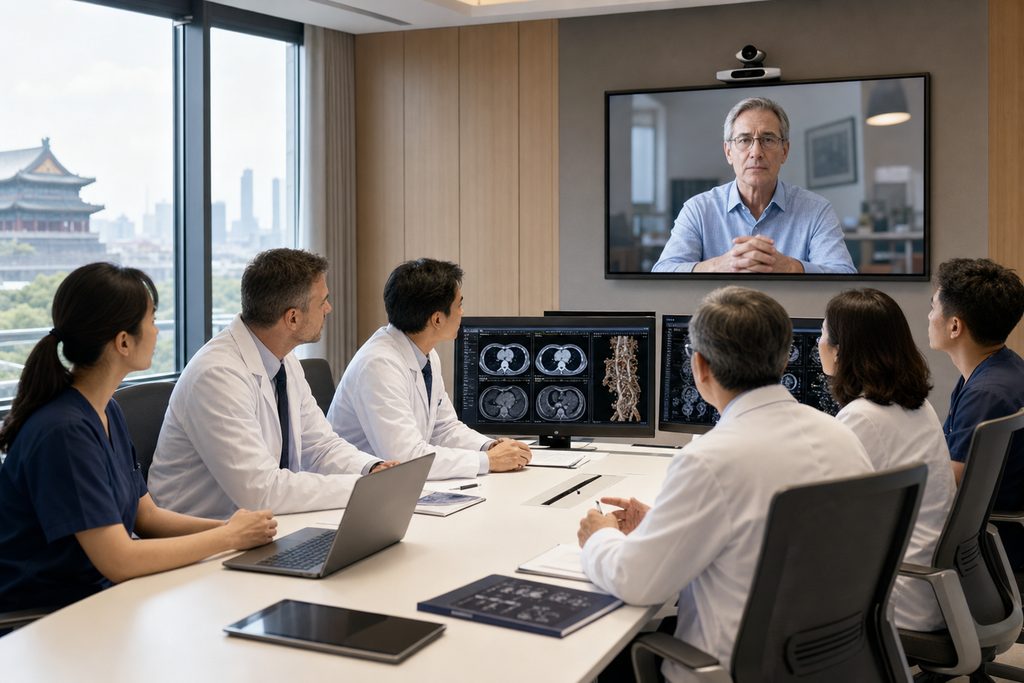
We are not a hospital. We do not employ doctors, we do not diagnose, and we do not make treatment recommendations. What we do is build the bridge. Our team is the operational layer between international patients and China’s 340+ top-ranked hospitals — we handle case preparation, specialist matching, certified translation of medical records, and the logistics of getting your home oncologist into a live, structured discussion with a Chinese tumor board. Think of us as case managers who speak both the clinical language and the hospital system. We exist so that when a panel of Chinese oncology experts reviews your file, your own doctor is in the room — literally or virtually — presenting the history, asking the hard questions, and challenging assumptions in real time.
How Does Cross-Border MDT Work for Cancer Treatment
This happens more often than you might expect. China’s regulatory environment for drug approvals and clinical trials differs from the FDA and EMA frameworks. Some therapies — particularly in targeted oncology and cell-based immunotherapy — are available in China before they reach Western markets. If the panel recommends such a treatment, the practical implication is that you would need to receive it in China. Our coordination team can then help you plan for that. If you choose not to travel, the panel’s alternative recommendations — treatments available in your home country — are also documented in the written report.
The hospitals we work with are drawn from the top 5% of China’s 35,000+ hospitals, ranked by the Fudan University Hospital Rankings — China’s most authoritative hospital evaluation system — and JCI accreditation where applicable. Specialists on these tumor boards are typically department chiefs or senior attending physicians at centers that handle case volumes unmatched by most Western institutions. You are not getting a random doctor. You are getting a panel from an institution where your specific cancer subtype may be seen dozens of times per week.
That depends entirely on your policy. Some international health insurance plans cover second opinion services, including cross-border consultations. Others do not. We recommend contacting your insurer directly and asking specifically about coverage for “international multidisciplinary second opinion services.” We can provide the documentation you need for reimbursement claims — detailed invoices, session summaries, and specialist credentials — but we do not bill insurers directly for MDT services. Payment is made upfront, and you pursue reimbursement from your carrier.
What happens if the tumor board cannot reach a
Frequently Asked Questions
Is it safe to have surgery in China?
Yes. We work with JCI-accredited and major Grade 3A tertiary hospitals that follow international safety standards comparable to top hospitals in the US and Europe. Surgical teams perform high volumes of procedures — often more than their Western counterparts — which studies show leads to better outcomes.
How much does medical treatment cost in China?
Costs vary by procedure and hospital, but international patients typically save 40-80% compared to US prices — even when factoring in travel and accommodation. A consultation with our team will give you an exact, all-inclusive quote with no hidden fees.
How do I start the process?
Send us your existing medical reports. The relevant specialty reviews them and gives you a written opinion, including treatment direction and options, before you commit to any travel. From there you can add a video consultation with the doctor, or have us attend an appointment on your behalf.
Frequently Asked Questions
Yes. We work with JCI-accredited and major Grade 3A tertiary hospitals that follow international safety standards comparable to top hospitals in the US and Europe. Surgical teams perform high volumes of procedures — often more than their Western counterparts — which studies show leads to better outcomes.
Costs vary by procedure and hospital, but international patients typically save 40-80% compared to US prices — even when factoring in travel and accommodation. A consultation with our team will give you an exact, all-inclusive quote with no hidden fees.
Send us your existing medical reports. The relevant specialty reviews them and gives you a written opinion, including treatment direction and options, before you commit to any travel. From there you can add a video consultation with the doctor, or have us attend an appointment on your behalf.
For more medical information and treatment options in China, visit chinamedservices.com (China Medical Services).
