Orthopedic Care: China vs Turkey — Cost, Hospitals, Safety
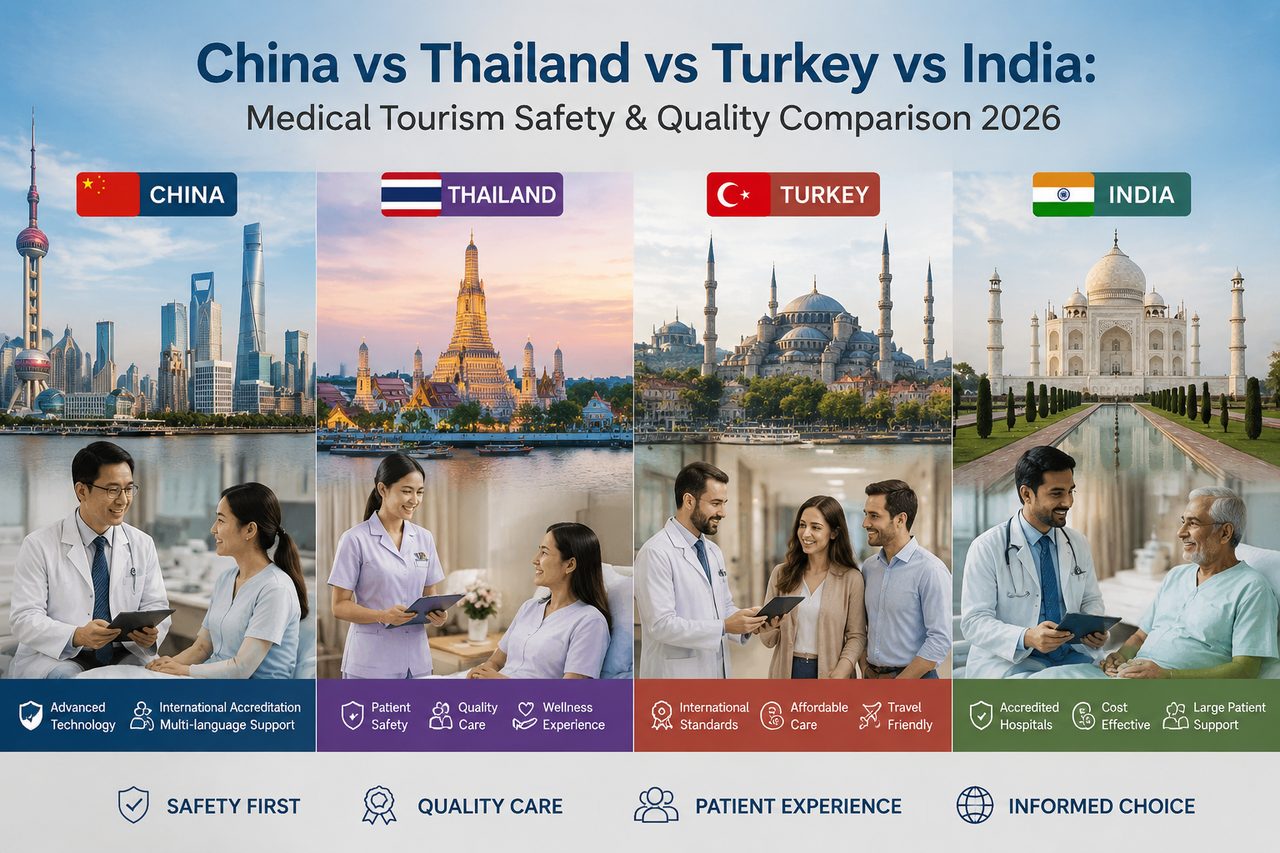
Orthopedic Care: China vs Turkey — Cost, Hospitals, and Safety Compared
Turkey has built a loud reputation in medical tourism. China has built something quieter but larger: a domestic orthopedic machine that performs more joint replacements each year than any other country on earth. If you are weighing orthopedic surgery cost in China against the Turkish packages you have seen advertised, the honest answer is that China is rarely the cheapest option — and it is often the stronger one for complex cases, revision surgery, and spine work.
That distinction matters more than any single price tag. A hip replacement is not a commodity. The implant, the surgeon’s volume, the anesthesiology team, and the rehabilitation pathway all shape your outcome. So let’s compare the two systems on the dimensions that actually decide whether you walk well two years from now.
Orthopedic Surgery Cost in China vs Turkey: The Short Answer
For a straightforward primary knee or hip replacement, Turkey typically runs $7,000–$12,000 at a private hospital, and China’s top public hospitals run roughly $10,000–$18,000 for the same procedure. Turkey wins on headline price. China wins on depth of specialist infrastructure, implant sourcing, and the sheer number of high-volume joint and spine centers.
The caveat that makes this more complicated: those Turkish prices often bundle airport transfers and hotel nights, while Chinese public hospital quotes usually cover surgery, implants, and the inpatient stay only. Strip the marketing from both and the gap narrows considerably. It never fully closes, though. If your only criterion is the lowest possible number for a routine, uncomplicated procedure, Turkey is genuinely competitive.
Who This Is Right For — and Who It Isn’t
Orthopedic care abroad is not for everyone, and a good advisor will tell you when to stay home.
China tends to make sense if you are:
- Facing a complex or revision procedure — a second knee replacement, a multi-level spinal fusion, a deformity correction
- Dealing with a condition where surgical volume matters, such as complex spine deformity or limb reconstruction
- Seeking a written second opinion from a high-volume center before committing to anything
- Comfortable with a large, busy public hospital environment and want a bilingual coordinator alongside you
You should probably not pursue this if you are:
- Medically unstable for long-haul travel — cardiac, pulmonary, or clotting issues your own doctor flags
- Expecting a Western-style private suite at a public hospital price; those are different products
- Looking for a same-week surgery date without a prior in-person consultation, which public hospitals generally require
- Unable to arrange meaningful follow-up rehabilitation after you fly home
The Options, Compared
Here is how the three realistic paths stack up for a primary total knee replacement in 2026. Figures are typical ranges and vary by hospital and case complexity.
| Factor | China (Top Public Hospital) | China (Private International) | Turkey (Private Package) |
|---|---|---|---|
| Typical knee replacement cost | $10,000–$18,000 | $25,000–$40,000 | $7,000–$12,000 |
| Implant brands available | Major international + domestic | International only | International, brand varies by package |
| English-speaking clinical staff | Limited outside international department | Yes, standard | Common at tourism hospitals |
| Insurance direct billing | Rare; pay upfront, claim later | Often available | Sometimes available |
| Booking ahead from abroad | Via international/VIP channel | Yes, direct | Yes, direct |
| Annual joint replacement volume | Very high at top centers | Moderate | Moderate to high |
Which column fits you? If budget is the binding constraint and your case is routine, Turkey’s package model is hard to beat. If your case is complex, revisionary, or you want access to surgeons who operate on hundreds of joints a year at a flagship academic center, the Chinese public column is where the depth sits. The private international column in China suits patients who prioritize English-language comfort and insurance billing over price.
Why China’s Orthopedic Depth Is Different
China’s advantage is not marketing. It is volume and specialization. Hospitals such as Beijing Jishuitan Hospital, a national reference center for orthopedics, and the major university-affiliated hospitals in Shanghai and Chengdu handle an extraordinary caseload across joint reconstruction, spine, sports medicine, and trauma.
That volume produces something specific: surgeons who have seen your rare complication before. For revision knee and hip work, complex spinal deformity, and post-traumatic reconstruction, cumulative operative experience is one of the few variables consistently linked to better outcomes. You can browse the ranked specialist centers on our department rankings page, where orthopedics sits alongside 44 other specialties with their top-tier hospitals listed.
It is also worth separating “orthopedics” into its real subfields before you choose a country, let alone a hospital. Knee and hip arthroplasty, spine surgery, sports medicine, hand surgery, and pediatric orthopedics are distinct practices with distinct referral patterns. A center that excels at joint replacement is not automatically the right place for a complex scoliosis correction.
Is Knee Replacement Safe in China?
This is the question Western patients ask most, and it deserves a direct answer rather than a sales pitch. Major joint replacement carries the same core risks anywhere: infection, blood clots, implant-related complications, and anesthetic events. The question is whether the system around the surgery manages those risks competently.
At China’s top-tier hospitals, the answer is generally yes. These are high-volume academic centers with established infection-control protocols, modern operating theaters, and intensive care backup. What differs from a Western hospital is the logistics, not the surgery. Wards are busier. English is scarcer. The pace is faster and less explained. That is precisely where a bilingual companion changes the experience.
Safety caveat: China’s hospital system is tiered. A procedure performed at a top-ranked academic center and the same procedure at a small local hospital are not comparable. The hospital you choose matters more than the country you choose.
How Much Does Hip Replacement Cost in China?
At a leading public hospital, total hip replacement typically falls in the $9,000–$16,000 range, including the implant and inpatient stay. Private international hospitals in China run higher, commonly $25,000–$40,000. For context, the same procedure in the United States frequently exceeds $40,000 even before rehabilitation.
What drives the variance? Implant choice is the biggest single factor — a premium ceramic-on-ceramic bearing costs more than a standard metal-on-polyethylene option. Surgical complexity, whether you need a revision, your length of stay, and whether you use the standard or international channel all move the number. A straightforward primary hip at a public hospital sits at the low end. A complex revision with extended recovery sits at the top.
Ask for a written itemized estimate before you commit. A quote that lists implant brand, ward type, and expected length of stay is far more useful than a single bundled figure.
Practical Considerations for Booking Orthopedic Surgery in China
Public hospitals in China generally do not allow you to book a surgery directly from overseas. The standard path is an in-person outpatient consultation first, after which the surgeon schedules the operation. To lock in a date ahead of travel, patients typically go through a hospital’s international or VIP department, which offers senior specialists and English support at roughly 1.5 to 2 times the standard channel price.
Payment is another reality to plan for. Public hospitals require prepayment, and you claim reimbursement from your insurer afterward. Private international hospitals more often bill your insurer directly.
On documentation, bring your imaging on physical media or a cloud link, plus operative notes if you have had prior surgery. For entry, medical travel to China uses the S2 visa category with a medical-treatment annotation; stays beyond 180 days fall under S1. Accompanying family members apply under S2 as well. Note that the M visa is for commercial and trade activity and has nothing to do with medical treatment. Requirements shift, so confirm current rules with the nearest Chinese embassy or consulate.
Deciding where to recover also matters. Many patients spend a few days near the hospital before flying home, and some combine rehabilitation with a traditional medicine program — our traditional Chinese medicine page covers what that involves for post-surgical recovery.
Medical Tourism Packages for Spine Surgery in China
Spine surgery is where the China-versus-Turkey comparison tilts most clearly. Complex spinal deformity, multi-level fusion, and revision spine cases require specialized instrumentation and experienced teams, and China’s flagship hospitals concentrate that expertise. Turkey offers capable spine centers too, but its medical tourism sector is weighted toward higher-volume, lower-complexity procedures.
If you are exploring medical tourism packages for spine surgery in China, be cautious of any package that promises a fixed price before a surgeon has reviewed your MRI. Real spine pricing depends on levels fused, approach, and hardware. A responsible provider will insist on imaging review first.
Frequently Asked Questions
Not directly through the standard public channel. You generally need an in-person consultation before surgery is scheduled, or you go through the hospital’s international department to arrange it in advance. A coordinator can handle that registration and communication for you.
Usually not for routine primary replacements — Turkey is often cheaper on headline price. China becomes more competitive when your case is complex, revisionary, or requires a specialist center, where the value is expertise rather than the lowest number.
Plan your follow-up before you leave. Ask for your operative report, implant documentation, and imaging in a format your home surgeon can read. Most complications after joint replacement appear in the weeks after surgery, so arrange a local orthopedic review within that window.
At international departments and private hospitals, English support exists. At standard public hospital wards, it is limited. This is the single most practical reason patients engage a bilingual medical companion — not for the surgery, but for everything around it.
Your Next Step
The core message is simple: choose the country second and the hospital first. For routine joint replacement on a tight budget, Turkey is a fair option. For complex orthopedics, revision work, and spine surgery, China’s high-volume academic centers offer depth that is hard to match at any price.
We are China Medical Services, a coordination service — not a hospital, and we do not diagnose or treat. We help international patients compare centers, obtain written second opinions, and navigate registration, language, and logistics. You can start with a no-pressure conversation through our patient consultation page, and decide from there.
This article is for general information only and is not medical advice. Treatment decisions should be made with a qualified physician who has reviewed your individual case.
For more medical information and treatment options in China, visit chinamedservices.com (China Medical Services).
