Pharmacy and Medication in China for Foreigners: What You Can Actually Buy
Pharmacy and Medication in China for Foreigners: What You Can Actually Buy
Finding a reliable pharmacy in China for foreigners is one of the first practical hurdles of any medical trip. Here is the short version: you can walk into most Chinese pharmacies and buy common over-the-counter drugs without any prescription, but anything controlled or injectable requires a doctor’s visit at a hospital, and the pharmacist almost certainly will not speak English. That gap between “available” and “accessible” is where most visitors get stuck.
China’s pharmacy system is enormous, tightly regulated, and split into two very different worlds. Community pharmacies on nearly every corner sell cold medicine, painkillers, and stomach remedies to anyone with cash or a phone. Hospital pharmacies handle the serious stuff — oncology drugs, biologics, prescription maintenance medications — and they operate on rules that surprise almost every Western patient.
The Short Answer
Can foreigners buy medication in China? Yes, and in most cases you do not need a Chinese ID or residence permit to do it. A passport works as identification at hospital registration desks, and community pharmacies rarely ask for anything at all. The complication is not your nationality. It is the drug category.
China classifies medicines into prescription drugs (处方药) and over-the-counter drugs, plus a separate controlled-substances schedule that covers opioids, strong sedatives, and some psychiatric medications. OTC items are freely purchasable. Prescription items require a Chinese physician’s order. Controlled items require a hospital visit and often a special red prescription form that only designated physicians can issue.
Who This Is Right For — and Who It Isn’t
This guide helps travelers, medical tourists, and long-stay visitors who need to manage routine medication or fill a prescription during a trip. It is also useful for patients already coordinating care through a hospital international department.
It is not the right resource if you need controlled substances urgently, if you are managing a complex regimen of biologics that require cold-chain handling, or if you are trying to source medication without a valid medical indication. Buying prescription drugs through informal channels — including online resellers — carries real legal and safety risk in China, and we never recommend it.
One more honest limitation. If your condition is stable and your medication is available at home, bringing a sufficient supply with proper documentation is almost always simpler than refilling in China.
The Options, Compared
Where you get medication depends entirely on what you need and how much time you have.
| Source | What You Can Get | Language Support | Typical Cost | Time Required |
|---|---|---|---|---|
| Community pharmacy | OTC drugs, vitamins, basic antibiotics (varies) | Rarely English | Low — often under $10 | Minutes |
| Hospital pharmacy (outpatient) | Prescription drugs, chronic-disease refills | Limited; international dept. has English | Moderate; registration fee applies | Half a day or more |
| Private international hospital | Full formulary, Western brands | English-speaking staff | Higher — often 3–5x public pricing | 1–2 hours |
| Hospital international department | Prescriptions plus specialist review | English coordinators available | Premium tier pricing | Same day, by appointment |
For a traveler with a headache or a stomach bug, the community pharmacy two blocks away is fine. For a patient on a maintenance drug for a chronic condition, the hospital route is the only legitimate one — and the international department is where the language barrier disappears.
How to Get Prescription Medicine in China as a Foreigner
This is the part that trips up nearly everyone, so let us walk through it precisely.
Public hospitals in China generally do not allow you to book an ordinary outpatient slot from overseas in advance. You register on the day, take a queue number, and wait. Once you see the physician, they examine you, write the prescription electronically, and you pay at a cashier window before collecting the medication at the hospital pharmacy. The whole loop can take three to four hours at a major hospital, and considerably longer at peak times.
The alternative is the hospital’s international department or VIP channel. There you get a senior specialist, English-speaking support staff, and a scheduled appointment rather than a queue. Pricing runs roughly 1.5 to 2 times the standard channel. For a visitor with limited time, that premium is usually worth it.
A handful of practical notes that save real frustration:
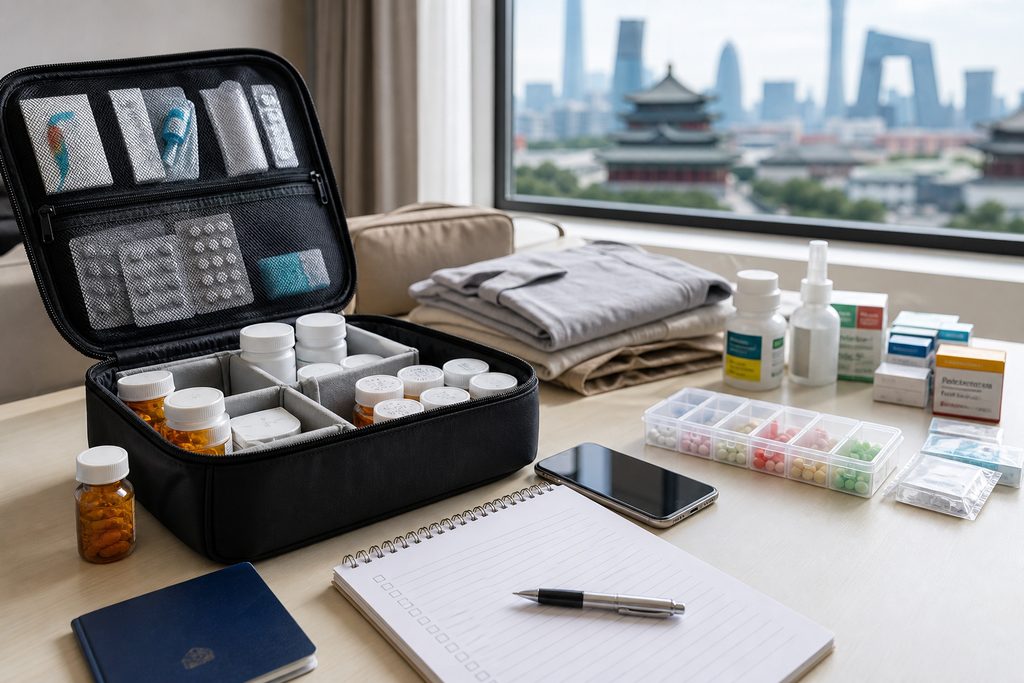
- Bring your medication in its original packaging, plus a letter from your home physician listing generic names and dosages.
- Chinese hospitals use generic (INN) names, not brand names. “Lipitor” means nothing to a pharmacist here; “atorvastatin” does.
- Payment at public hospitals is typically upfront, with insurance reimbursement handled afterward. Private international hospitals often bill insurers directly.
- Prescription quantities are usually capped at 30 days for chronic medications. Plan refills accordingly.
English Speaking Pharmacy in Shanghai and Other Major Cities
Shanghai has the deepest bench of English-capable pharmacy options in mainland China, followed by Beijing and Guangzhou. The pharmacies attached to private international hospitals — the kind of facilities listed in our guide to private international hospitals — reliably handle English prescriptions and stock Western brands. Several chains near the expatriate districts of Shanghai’s Pudong and former French Concession areas also employ bilingual staff, though this varies by branch and by shift.
Outside the tier-one cities, assume no English. Translation apps help at the counter, but they fail on medical nuance. If you are managing anything more complex than a cold, having a bilingual companion in the room changes the outcome.
What It Costs
Medication pricing in China is genuinely low by Western standards, though the range is wide. Common OTC drugs — ibuprofen, cold remedies, antacids — typically run the equivalent of $2 to $10. Generic prescription medications for chronic conditions like hypertension or type 2 diabetes often cost a fraction of U.S. retail prices, sometimes 70 to 90 percent less.
Branded and imported medications narrow that gap considerably. If you specifically need the Western brand you take at home, expect to pay closer to home-market prices, and expect availability to be inconsistent outside major cities.
What drives the variance? Three things: whether the drug is domestically manufactured or imported, whether you are purchasing through a public or private facility, and whether the item sits on the controlled-substances list, which adds administrative steps and cost.
Practical Considerations: Documentation, Visa, and Continuity
Bringing medication into China for personal use is generally permitted in reasonable quantities with proper documentation. Keep it in original packaging, carry a physician’s letter, and declare anything that looks unusual. Controlled substances — including some ADHD medications and strong painkillers — face stricter rules and in some cases are prohibited outright. Check current customs guidance before you fly.
On the visa side: medical travel to China uses the S2 category, which covers short-stay visits for medical treatment and private affairs. Accompanying family members apply under the same category. The M visa is for commercial and trade activity and has nothing to do with medical care — a distinction worth getting right, because it is a common and costly mistake. Requirements shift, so confirm details with the nearest Chinese embassy or consulate and with your supporting hospital documents.
For follow-up after you return home, ask the treating physician for a written summary in English or with a certified translation. Continuity of care depends on your home doctor being able to read what happened in China.
Frequently Asked Questions
No. Prescription drugs require an order from a licensed Chinese physician, and your home prescription does not transfer. Community pharmacies occasionally sell limited antibiotics without a formal prescription, but this is inconsistent, technically irregular, and not something to rely on.
Use a hospital international department or a private international hospital, where English-speaking coordinators handle registration and pharmacy pickup. In a standard public hospital, you will need a translator or a bilingual companion for the entire process — registration, consultation, payment, and collection.
Licensed online pharmacies exist and are regulated, but counterfeit and mislabeled products circulate through informal channels. If a seller offers prescription drugs without requiring a prescription, treat that as a warning sign rather than a convenience.
This is common with newer biologics and some psychiatric drugs. Options include switching to an equivalent available in China (only with physician approval), arranging a supply from home with proper import documentation, or timing your trip around your dosing schedule.
Your Next Step
Medication access in China is workable, but it rewards preparation over improvisation. Bring documentation, know your generic drug names, and decide in advance whether you will use the public or international channel.
We are China Medical Services, a coordination service — not a hospital, and we do not diagnose or prescribe. Our team connects international patients with more than 340 top-ranked hospitals across 37 cities, handles appointment coordination, and provides bilingual medical companions who manage registration, payment, and pharmacy pickup alongside you. If you would like help mapping out medication logistics for an upcoming trip, start with a free consultation — no pressure, just a clear picture of what your situation requires.
This article is for general information only and is not medical advice. Medication decisions should always be made with a qualified physician who knows your history. Regulations and drug availability change; verify current requirements with official sources before you travel.
For more medical information and treatment options in China, visit chinamedservices.com (China Medical Services).
