Emergency Coordination in China: A Guide for Foreign Patients
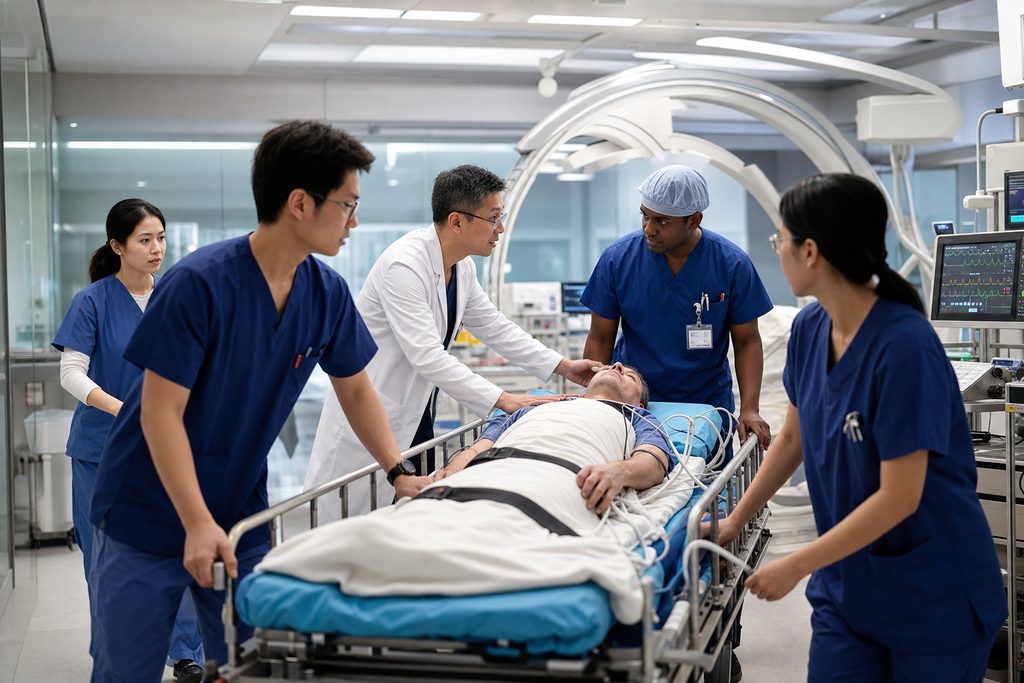
Emergency Coordination in China: A Guide for Foreign Patients
Roughly 1 in 3 international travelers will experience some form of medical issue while abroad, according to data compiled by the International Association for Medical Assistance to Travellers. Most are minor. Some are not. And when you are standing in a Beijing hotel lobby at 2 a.m. with a child running a 40-degree fever, knowing what to do — and who to call — becomes the only thing that matters. This guide explains exactly what a medical emergency in China for foreigners what to do actually looks like, from the first phone call to the hospital discharge desk.
We are not doctors. We are a bilingual coordination team that has walked hundreds of international patients through China’s hospital system. What follows is the operational truth, not the brochure version.
How This Actually Works, Step by Step
China’s emergency system is fast, capable, and almost entirely Chinese-language. That single fact shapes everything.
Step one: call 120. That is China’s national medical emergency number, equivalent to 911 in the US or 999 in the UK. Operators speak Mandarin. If you cannot communicate in Chinese, you will need someone to call on your behalf — hotel front desk staff, a colleague, or a bilingual service. For police, dial 110. For fire, 119.
Step two: an ambulance is dispatched. Response times in major cities like Beijing, Shanghai, and Guangzhou are typically 10 to 20 minutes, though this varies significantly by district and traffic conditions. Ambulances in China are generally not equipped or staffed the way Western paramedic units are. Many function primarily as transport, not as mobile treatment rooms.
Step three: you arrive at the nearest hospital emergency department. Public hospitals accept everyone. No insurance verification happens before treatment in a true emergency. This is important to understand — you will not be turned away.
Step four: registration and payment. Here is where foreign patients hit the wall. Chinese public hospitals require upfront payment or a deposit before many procedures. You will need your passport, and you will need to navigate a registration queue that operates in Chinese. A bilingual companion at this stage is not a luxury. It is the difference between a two-hour visit and a twelve-hour one.
Step five: treatment, admission, or discharge. If you are admitted, the hospital will assign a ward. Family members are typically expected to assist with basic care — bringing food, helping with mobility — which surprises many Western patients.
Public Emergency Rooms vs. Private International Clinics
This is the single most important decision you will make, and it depends entirely on severity.
If the situation is life-threatening — chest pain, severe trauma, stroke symptoms, difficulty breathing — go to the nearest public hospital emergency department. They have the equipment, the specialists, and the legal obligation to treat. Beijing’s major public hospitals handle thousands of emergency visits daily. The scale is enormous, and so is the capability.
If the situation is urgent but not life-threatening — a bad infection, a fracture that needs imaging, a persistent high fever — a private international clinic is often the better choice. These facilities have English-speaking staff, accept international insurance directly in many cases, and function more like a Western urgent care center.
Beijing, Shanghai, and Guangzhou all have established international clinics with walk-in emergency services. United Family Healthcare, Beijing United Family Hospital, and similar JCI-accredited facilities operate in multiple cities. For a broader look at private options, our private international hospitals directory lists facilities by city, insurance acceptance, and English-language capability.
| Factor | Public Hospital ER | Private International Clinic |
|---|---|---|
| Cost (basic ER visit) | $50–$200 | $300–$800 |
| English support | Limited or none | Full English service |
| Insurance direct billing | Rare — pay upfront, claim later | Common with international insurers |
| Wait time | 1–6 hours typical | 15–60 minutes typical |
| Best for | Life-threatening conditions | Urgent but stable conditions |
| Specialist depth | Extensive, all specialties | General practice, some specialists |
Note the cost gap. It is real, and it reflects a genuine trade-off: public hospitals offer world-class capability at a fraction of Western prices, but you sacrifice comfort, speed, and language support. Private clinics reverse that equation.
A Realistic Timeline
Emergencies do not follow schedules. But the administrative aftermath does. Here is what the days and weeks after an emergency visit typically look like.
| Timeframe | What Happens | What You Need to Do |
|---|---|---|
| Hour 0–1 | Emergency call, ambulance dispatch, arrival at ER | Call 120 or get someone to call for you |
| Hour 1–6 | Triage, registration, initial assessment, imaging | Passport, payment method, bilingual support |
| Day 1–3 | Treatment, possible admission, ward assignment | Arrange payment deposit, notify insurance |
| Day 3–7 | Stabilization, specialist consultations | Request English-language medical records |
| Week 2–4 | Discharge or transfer, document collection | Obtain itemized bills and discharge summary |
| Week 4–8 | Insurance claim submission, follow-up at home | Translate records, file claim with insurer |
The step most people forget: getting your medical records in English. Chinese hospitals produce records in Chinese. Your home doctor and your insurer will need translated versions. Request these before you leave the hospital, not after. Once you are back home, obtaining them remotely takes weeks.
What Can Go Wrong — and What Happens Then
Honest failure modes matter more than success stories.
Language breakdown. This is the most common problem. You arrive at a public hospital, nobody speaks English, and you cannot explain your symptoms or understand instructions. Recourse: call your embassy’s emergency line, or contact a bilingual medical companion service. Most major hospitals in tier-one cities now have an international department, though it may not be staffed 24/7.
Payment disputes. Public hospitals may demand a deposit before treatment. If you cannot pay immediately, treatment may be delayed for non-life-threatening conditions. Recourse: carry a credit card that works in China (Visa and Mastercard are accepted at most large hospitals), or have a travel insurance emergency contact who can arrange a payment guarantee.
Ambulance limitations. Chinese ambulances are not mobile ICUs. If you need advanced life support during transport, this is a genuine gap. Recourse: for critical conditions, a private international clinic may arrange a better-equipped transfer, though at significantly higher cost.
Insurance rejection. Many travel insurance policies require pre-authorization for non-emergency treatment. If you receive care without notifying your insurer first, your claim may be denied. Recourse: call your insurer’s emergency line as soon as you are stable — most have 24/7 international numbers.
Understanding Ambulance and Emergency Costs
Ambulance cost in China for tourists is lower than most Western visitors expect. A standard ambulance ride within a city typically costs 100 to 300 RMB (roughly $15–$45), depending on distance and whether advanced equipment is used. This is a fraction of the $1,000+ ambulance bills common in the United States.
But the ambulance is the cheap part. Emergency room fees, imaging, lab work, medications, and any procedures add up quickly. A fracture requiring X-rays, a cast, and follow-up might cost $500–$1,500 at a public hospital. The same injury at a private international clinic could run $2,000–$4,000.
For context on how China’s broader medical pricing compares, our guide to specialty departments and top-ranked hospitals breaks down costs by procedure category. The pattern holds: China’s top public hospitals deliver care at roughly one-fifth to one-tenth of US prices, even before insurance.
Practical Considerations: Insurance, Records, and Follow-Up
Before you travel, verify three things. First, does your travel insurance cover medical emergencies in China? Second, does it require pre-authorization, and what is the emergency contact number? Third, does it pay providers directly or reimburse you afterward?
Most travel insurance policies reimburse. That means you pay upfront and claim later. Keep every receipt, every discharge summary, every prescription. Chinese hospitals issue itemized bills, but you must request them — they are not automatically provided in a format your insurer will accept.
If your condition requires ongoing treatment after you return home, arrange a records transfer before you leave China. Ask the hospital’s international department for a complete discharge summary in English, including imaging reports and medication lists. If no English version exists, a certified translation service can produce one, typically within 3 to 5 business days.
For patients whose emergency evolves into a planned procedure, China’s top-tier hospitals offer genuine advantages in cost and specialist volume. Fuwai Hospital in Beijing, for example, performs over 14,000 cardiac surgeries annually — the highest volume in the world. But accessing that capability requires coordination that most foreign patients cannot arrange on their own. Our overview of how medical coordination works in China explains the pathways.
Frequently Asked Questions
Dial 120 for medical emergencies. Operators speak Mandarin, so if you do not speak Chinese, have a hotel staff member, colleague, or bilingual service call on your behalf. For police, dial 110; for fire, dial 119.
In a life-threatening emergency, yes — public hospitals are legally required to provide emergency treatment regardless of payment status. For non-emergency care, hospitals typically require a deposit before treatment. Private international clinics generally require payment or insurance verification before seeing you.
Most private international clinics in Beijing accept walk-in emergency patients during operating hours. After-hours availability varies by facility. It is worth saving the address and phone number of the nearest clinic to your accommodation before you need it.
A standard in-city ambulance ride costs roughly 100–300 RMB ($15–$45), depending on distance and equipment. This is significantly lower than in the US or Europe. The hospital treatment that follows is where the real costs accumulate.
It depends entirely on your policy. Check whether your plan covers China, whether it requires pre-authorization, and whether it pays providers directly or reimburses you. Call your insurer’s emergency line as soon as you are stable — most international policies have 24/7 assistance numbers.
Your Next Step
The core message is simple: China’s emergency medical system is capable and affordable, but it operates in Chinese and expects upfront payment. Preparation — a saved phone number, a verified insurance policy, a known clinic address — turns a crisis into a manageable situation.
Our team connects international patients with China’s top-ranked hospitals, coordinates appointments, and provides bilingual medical companions who handle registration, payment, and translation on the ground. We do not provide medical advice or guarantee treatment outcomes. We handle the logistics so you can focus on recovery. If you are planning a trip to China or currently navigating a medical situation here, reach out for a free consultation — no pressure, just a conversation about what you need.
This article is for informational purposes only and does not constitute medical advice. Always consult a qualified healthcare provider for diagnosis and treatment. Emergency situations require immediate professional attention — call 120 or go to the nearest hospital emergency department.
For more medical information and treatment options in China, visit chinamedservices.com (China Medical Services).
