Medical Concierge in Shanghai: Where to Start Your Care Journey
Key Takeaways
- Shanghai is home to 18 hospitals on the Fudan Top 100 list — the second-highest concentration in China after Beijing.
- A bilingual medical companion starts at around $300 per day, and hospital appointment coordination starts at $300 — far less than most patients expect.
- Public hospital outpatient departments cannot be booked from overseas in advance. Surgery requires an in-person consultation first. That single rule reshapes every travel plan.
- Written second opinions ($300–500) and video consultations ($100–800) let you get real answers before you book a flight.
You have probably heard that going to China for medical care means gambling on quality, wrestling with a language you don’t speak, and hoping someone honest shows up. The reality runs closer to the opposite. Shanghai alone holds 18 hospitals ranked in China’s Fudan Top 100, and the city’s international departments were built specifically for patients like you. What trips most people up isn’t the medicine. It’s the logistics — and that’s exactly where a medical concierge service in Shanghai earns its keep.
This guide walks through what coordination actually costs, how the system works, and where a sensible first step begins.
The Problem: You Can’t Just Book a Chinese Hospital Online
Here’s the part that surprises nearly every international patient. In China’s public hospitals, you cannot reserve an ordinary outpatient slot from abroad. Registration happens on the day, in person, at the hospital. And no surgeon will schedule an operation without seeing you face to face first.
Now picture the scale you’re walking into. China has more than 35,000 hospitals. The top 5% — the ones ranked by Fudan University and accredited by JCI — handle outpatient volumes that routinely exceed 10,000 visits per day at the largest institutions. Signage is in Chinese. Registration queues start before dawn. Payment systems assume a domestic bank card or a local app.
For a patient flying in from Los Angeles or Dubai with a folder of MRI scans and a two-week window, that environment is close to unnavigable alone. Not because the care is poor — because the entry process was never designed with foreigners in mind.
How Does Medical Concierge Work in China?
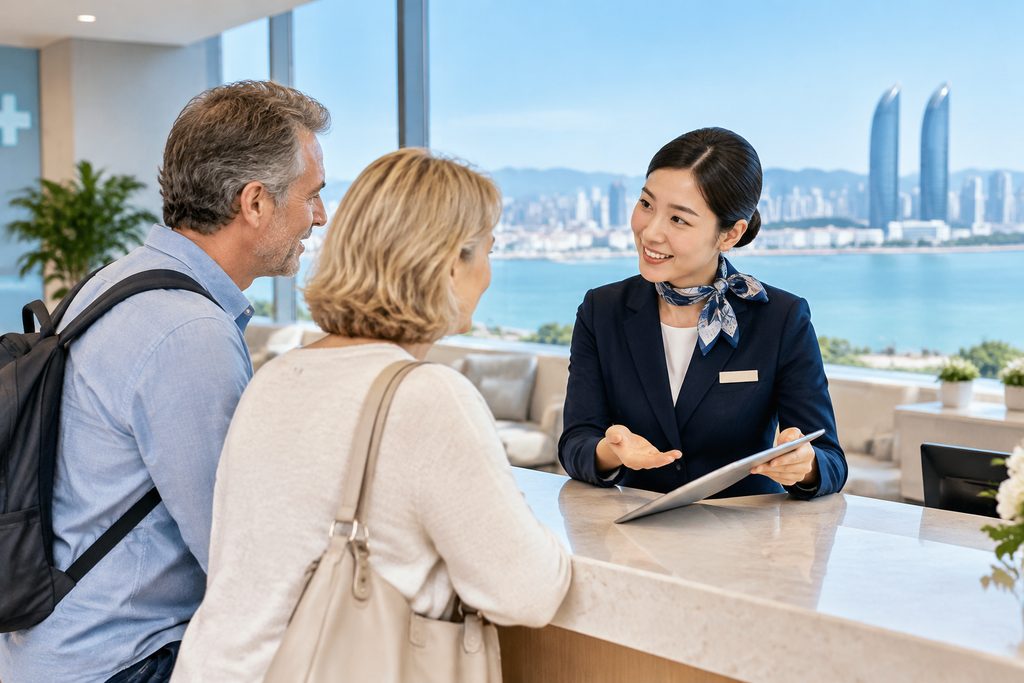
Strip away the marketing language and a concierge service does three things: it translates your medical records, it coordinates an appointment through a hospital’s official international or VIP channel, and it puts a bilingual human next to you on the day.
That last distinction matters. We describe our own role as case management, not as an access fee. There is no back door into a Chinese operating room, and anyone who tells you otherwise is selling something that doesn’t exist. What exists is a legitimate channel — the international department — and a coordination layer that makes it usable.
Written second opinion: the lowest-risk starting point
You send your existing examination reports. The relevant Chinese specialty reviews them and returns a written analysis with treatment suggestions and direction. Cost runs $300–500 at top-tier hospitals. No travel. No commitment. Just a professional read on whether China is even the right answer for your case.
Video consultation: hearing it directly
Here you send records and then speak online with the Chinese specialty team. You explain your symptoms and goals; they explain what they’d recommend. A standard international department consultation runs $100–300. A top-specialist session runs $500–800. A full multidisciplinary team review, where several departments weigh in together, sits at $1,500–2,000.
Proxy consultation and in-person coordination
Some patients want a specific city, hospital, department, or specialist. We can assist with registration, creation of the hospital medical card, and an in-person proxy visit using your materials. If you later travel, we coordinate arrival support and hospital communication. Admission itself always remains subject to hospital rules — we never promise it, and neither should anyone else.
What Does a Medical Concierge Service in Shanghai Cost?
Transparency here saves everyone time. Below are the reference ranges we publish. Final quotes depend on your condition, the hospital, and case complexity.
| Service | Reference Price (USD) | What It Covers |
|---|---|---|
| Bilingual medical companion | from $300/day | Registration, queuing, payment, wayfinding, interpretation, accompaniment |
| Airport transfer | $200 round-trip | Both directions |
| Written second opinion | $300–500 | Specialist review of existing reports, written analysis |
| Video consultation (standard) | $100–300 | Online discussion with international department |
| Top-specialist video consultation | $500–800 | Senior specialist, extended session |
| Multidisciplinary team (MDT) | $1,500–2,000 | Multiple specialties reviewing together |
| In-person top-specialist coordination | $800–1,200 | Scheduling and accompaniment for a senior consultant visit |
| Hospital appointment coordination | from $300 | Registration, medical card, scheduling. Full refund if the listed appointment cannot be secured |
| VIP end-to-end coordination | $5,000–8,000 | Full journey management for premium and Gulf-region clients |
One mechanism is worth flagging. Any consultation fee is credited in full toward on-the-ground coordination if you upgrade within 90 days. It applies once, to the coordination fee only, and never toward hospital treatment charges. So a $500 second opinion isn’t sunk money if you decide to proceed — it becomes part of the larger service.
Best Hospitals in Shanghai for International Patients
Shanghai’s landscape splits into three practical categories, and knowing which one fits your situation is half the battle.
Top public hospitals with international departments. These carry the clinical weight. Fudan University’s Zhongshan Hospital and Ruijin Hospital both appear prominently in national rankings, and the city’s 18 Fudan Top 100 institutions span nearly every major specialty. International or VIP channels here give you senior specialists and English-speaking staff. Expect to pay roughly 1.5 to 2 times the standard channel price for that access.
Private international hospitals. Facilities like United Family, Jiahui, Parkway, and Raffles operate with English-speaking staff, JCI accreditation, and direct insurance billing. For straightforward procedures, executive health screenings, or when you want a Western-style experience from the front desk onward, these are genuinely comfortable. You can browse the full list on our private international hospital directory.
Traditional Chinese medicine. Acupuncture, tuina massage, and herbal formulas have a real following among international patients managing chronic conditions and rehabilitation. Shanghai’s TCM hospitals are part of the public system and often overlooked by foreign visitors. Our traditional Chinese medicine guide covers what TCM does well and what it doesn’t.
If you’re comparing cities rather than just hospitals, our Fudan Top 100 hospital rankings by city group all 340+ institutions we track across 37 cities. Shanghai’s dedicated city page breaks down the local options in more detail.
Is Medical Tourism in China Safe?
The honest answer is that safety depends less on the country than on the specific hospital, department, and physician — and on whether you understood what you agreed to.
China’s leading hospitals perform volumes that most Western centers can’t match. Fuwai Hospital in Beijing, for instance, is widely cited as handling over 14,000 cardiac surgeries annually, the highest volume globally. High volume correlates with refined technique and experienced teams. That’s a structural advantage, not a marketing claim.
What you should verify before committing: the hospital’s accreditation status, whether your procedure will be handled by the department you actually consulted with, the full cost estimate in writing, and what happens if complications extend your stay. Public hospitals require prepayment, with insurance reimbursement handled afterward. Private international hospitals typically bill your insurer directly.
Cost is where China’s advantage is most concrete. A coronary artery bypass graft at a top Chinese public hospital typically runs $12,000–20,000. The same procedure in the United States frequently exceeds $120,000. That gap reflects labor economics, hospital efficiency, and surgical volume — not corner-cutting. For most major procedures, you’re looking at one-fifth to one-tenth of US pricing.
Practical Considerations Before You Start
Visas. Medical treatment in China falls under the S2 visa, annotated for medical purposes. Stays exceeding 180 days require the S1 category. Accompanying family members also apply under S2. Note that the M visa is strictly for commercial and trade activity — it has nothing to do with medical treatment. Requirements shift, so confirm current documentation with your nearest Chinese embassy or consulate, and expect to submit supporting hospital documents.
Medical records. Bring your imaging on physical media or a cloud link, plus translated summaries. Chinese specialists work fast and want the raw data, not just a referring physician’s letter.
Payment. Public hospitals collect payment upfront. International credit cards work in some international departments but not all. Private hospitals are more flexible. Confirm before you arrive.
Language. This is where a bilingual medical companion changes the experience. Registration counters, pharmacy windows, and payment terminals all move quickly and in Chinese. Having someone beside you who handles the queue, the paperwork, and the conversation removes the single largest source of stress.
Timing. Build in a buffer. A first consultation, diagnostic workup, and surgical scheduling can span one to three weeks depending on the department’s calendar.
Frequently Asked Questions
Not through the ordinary public channel. Standard outpatient registration happens in person on the day. What you can arrange in advance is a consultation through a hospital’s international or VIP department, which is the legitimate route for foreign patients. That’s what appointment coordination services handle.
Most patients spend between $300 and $1,200 on coordination and companion services for a single trip, depending on how many days of accompaniment they need and whether a specialist consultation is involved. Complex, multi-week engagements with VIP end-to-end management run $5,000–8,000. Hospital treatment costs are entirely separate.
For hospital appointment coordination, if we cannot secure the appointment listed in your order, you receive a full refund. We don’t guarantee a specific named specialist or a specific surgical date — no one legitimately can — but we do guarantee that you’re not paying for something you didn’t get.
For a private international hospital, no. For a top public hospital, practically yes — or you need someone with you. The clinical teams are excellent, but the operational environment is Chinese-language throughout.
For most surgical questions, yes. A $300–500 written second opinion can tell you whether the procedure is even necessary, whether a less invasive option exists, and whether China is the right setting for your case. That’s a small price against a long-haul flight and a two-week stay.
Your Next Step
Shanghai’s medical system rewards preparation. Get your records reviewed first, understand the real costs, and only then decide whether to travel. The sequence matters more than the destination.
We’re China Medical Services — a coordination team, not a hospital. We don’t diagnose, we don’t treat, and we don’t promise outcomes. We connect international patients with the right Chinese hospitals, handle the logistics, and stand beside you through the process. When you’re ready, you can start with a free consultation and we’ll help you figure out whether this path makes sense for your situation.
For more medical information and treatment options in China, visit chinamedservices.com (China Medical Services).
