Cancer Rehabilitation Service China: Restoring Quality of Life After Treatment
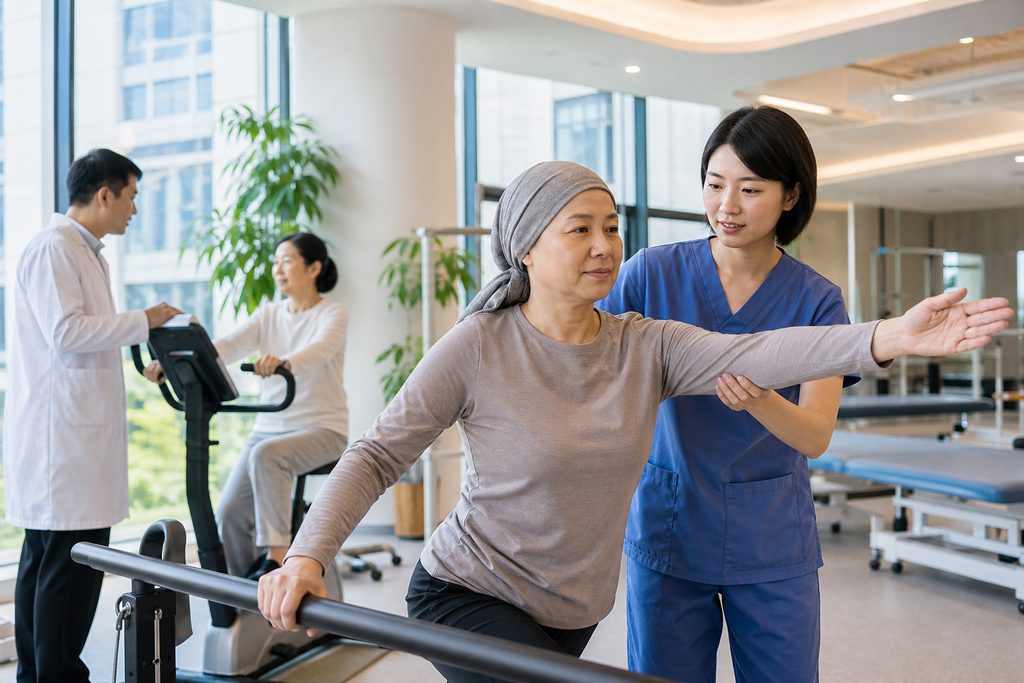
A cancer diagnosis reshapes everything. But what happens after the treatment ends? The chemotherapy stops. The radiation sessions are complete. The surgery scars begin to heal. And then you are left standing in a quiet room, wondering why you still feel exhausted, weak, and nothing like your old self.
That is the reality for roughly 70% of cancer survivors. The American Cancer Society’s research shows that most patients face significant physical and cognitive impairments long after the active treatment phase ends. Fatigue that sleep does not fix. Pain that lingers. A brain fog so thick it has its own medical name — “chemo brain.”
Rehabilitation is not a luxury. It is the bridge between surviving cancer and actually living again.
Our team at China Medical Services has spent years connecting international patients with rehabilitation programs across 340+ top-ranked hospitals in 37 Chinese cities. We do not provide medical treatment. We are the logistical architects who make your recovery journey possible — from visa paperwork to hospital selection to having a bilingual companion at your side during every appointment. This article explains what cancer rehabilitation in China actually looks like, what it costs, and how to access it safely.
Key Takeaways
- Cancer rehabilitation programs in China’s top-tier hospitals integrate Western oncology protocols with Traditional Chinese Medicine modalities — acupuncture, therapeutic massage, and herbal medicine — at roughly 60-80% less than equivalent Western programs.
- China’s Fudan University-ranked oncology hospitals handle patient volumes that dwarf most Western cancer centers, creating deep clinical experience in managing post-treatment complications like lymphedema, peripheral neuropathy, and cancer-related fatigue.
- Language barriers and hospital navigation are real obstacles. Without a bilingual companion, a non-Chinese-speaking patient will struggle with everything from registration to understanding rehabilitation instructions. This is not a minor inconvenience — it is a structural barrier.
- Visa requirements are specific and non-negotiable. You need an S2 visa annotated for medical treatment purposes. Business visas do not apply. Getting this wrong means being turned away at the border.
The Problem: Recovery Is Where the Real Work Begins
A 2023 study published in CA: A Cancer Journal for Clinicians found that approximately 1 in 3 cancer survivors report unmet physical rehabilitation needs five years after diagnosis. Five years. That is half a decade of struggling to climb stairs, to concentrate at work, to sleep through the night without pain.
The standard Western oncology model is brilliant at treating tumors. It is less effective at treating the person who remains afterward. A patient who underwent a mastectomy may be declared cancer-free within months. But she might spend years dealing with shoulder immobility, lymphedema swelling, and nerve pain that makes wearing clothing unbearable. Insurance often covers the surgery. It rarely covers the full rehabilitation pathway needed to restore function.
Wait times compound the problem. In Canada, the median wait for publicly funded physiotherapy after cancer surgery stretches to several weeks or months. In the UK, NHS rehabilitation services are stretched thin — patients often receive a leaflet of exercises and a single follow-up appointment. The US system offers more access for those with premium insurance. But out-of-pocket costs for comprehensive cancer rehabilitation can easily exceed $30,000-50,000 for an intensive program.
Patients fall through the cracks. They are told to “take it easy” by oncologists who are trained to monitor tumor markers, not functional recovery. And so the survivor limps along, accepting a diminished quality of life as the price of being alive.
It does not have to be this way.
Who We Are
We are not a hospital. We do not employ doctors, prescribe treatments, or make clinical decisions. China Medical Services is a medical concierge organization — we are the operational layer between international patients and China’s top-tier hospitals. Our database covers 340+ hospitals across 37 cities, all ranked within the top 5% of China’s 35,000+ medical institutions by the Fudan University hospital rankings and JCI accreditation standards. We handle hospital matching, appointment coordination, bilingual medical companionship, visa guidance, and recovery logistics. You focus on healing. We handle everything else.
Why Cancer Rehabilitation in China Delivers Results
Clinical Volume Creates Pattern Recognition
China’s top oncology hospitals treat patient volumes that are difficult to comprehend from a Western perspective. Fudan University Shanghai Cancer Center records over 1.5 million outpatient visits annually. The cancer center at Peking Union Medical College Hospital manages a caseload that exposes its rehabilitation specialists to rare post-treatment complications most Western therapists encounter only in textbooks.
Volume matters in rehabilitation. A physical therapist who has managed post-mastectomy lymphedema in 500 patients develops an intuitive grasp of treatment progression that no protocol manual can teach. When you work with a rehabilitation team inside a high-volume Chinese cancer hospital, you access clinicians whose pattern recognition has been forged by sheer repetition. They have seen your complication before. Many times.
This is not speculation. Research consistently links hospital procedure volume to better patient outcomes. A 2017 analysis in The Lancet Oncology demonstrated that for complex cancer surgeries, every doubling of hospital volume was associated with measurable reductions in postoperative mortality. The same principle extends to rehabilitation — high-volume centers simply see more, learn more, and achieve more consistent results.
Integration of Western and Traditional Chinese Medicine
Here is something you will not find in a typical Western cancer rehab program: acupuncture for chemotherapy-induced peripheral neuropathy. Multiple randomized controlled trials, including a 2020 study in JAMA Oncology, have demonstrated that acupuncture significantly reduces neuropathic pain and improves nerve conduction in cancer survivors. In China, this is not an alternative therapy — it is a standard component of oncology rehabilitation, delivered in the same hospital by practitioners who collaborate with your oncologist.
The integration runs deeper. Tai chi and qigong — movement practices with growing Western evidence for reducing cancer-related fatigue — are prescribed alongside conventional physiotherapy. Herbal medicine formulations, prepared according to standardized hospital protocols, address side effects like appetite loss and insomnia that Western medicine often manages with additional pharmaceuticals. Tuina therapeutic massage targets soft tissue restrictions after radiation therapy.
This is not “either-or” medicine. It is “both-and.” And for patients who have exhausted Western rehabilitation options without full recovery, this integrated model opens doors that remained stubbornly closed.
The Cost Reality: Structural Advantages, Not Quality Trade-Offs
Let us address the elephant in the room directly. The cancer rehabilitation cost China offers is substantially lower than Western equivalents — typically 60-80% less for comparable programs. A comprehensive four-week inpatient rehabilitation program at a top-tier Chinese hospital might range from $8,000 to $15,000, depending on the hospital and complexity of care. An equivalent program in the United States would easily reach $40,000-70,000.
Why the gap? Not because of lower quality. China’s labor economics mean that clinical staff salaries, facility costs, and operational overhead are structurally lower. A senior physiotherapist in Shanghai earns a fraction of what their counterpart in Boston commands — but their training is rigorous, their patient volume is higher, and their clinical outcomes are comparable. Hospital construction costs, pharmaceutical pricing, and administrative overhead all follow the same pattern.
Also, China’s top hospitals operate at enormous scale. Fuwai Hospital performs over 14,000 cardiac surgeries annually. That operational efficiency — spreading fixed costs across massive patient volumes — translates directly into lower per-patient pricing without cutting corners on care quality.
| Rehabilitation Service | Estimated Cost in China (USD) | Estimated Cost in US (USD) |
|---|---|---|
| 4-week inpatient comprehensive rehab program | $8,000 – $15,000 | $40,000 – $70,000 |
| Individual physiotherapy session (1 hour) | $40 – $80 | $150 – $350 |
| Acupuncture session (hospital-based) | $30 – $60 | $75 – $200 |
| Lymphedema therapy session | $50 – $100 | $120 – $300 |
| Written second opinion (top specialist) | $300 – $500 | $1,000 – $3,000+ |
Costs vary by hospital and case complexity. Figures are estimates for planning purposes — final pricing confirmed after hospital evaluation.
What You Need to Know Before Going Alone
We tell every prospective patient the same thing: China’s medical system offers extraordinary value, but it is not designed for independent foreign navigation. The barriers are real. Here is what you face if you attempt this without support.
- Visa Requirements Are Specific: Medical treatment in China requires an S2 visa annotated with the purpose of medical treatment. Your accompanying family members also need S2 visas. This is not a business trip — an M visa will not work, and showing up with the wrong documentation means a denied entry. The application requires an invitation letter from the Chinese hospital, medical records translated into Chinese, and proof of financial means. Getting the invitation letter alone can take weeks of back-and-forth with hospital administration if you do not have an established contact.
- Payment Systems Do Not Work Like Home: Chinese public hospitals operate on a prepaid deposit system. You load money onto a hospital card, and services deduct from that balance. International credit cards are not universally accepted — WeChat Pay and Alipay dominate, and linking a foreign card to these platforms is not always straightforward. Many hospitals accept international wire transfers for large deposits, but the process takes days. If your deposit runs out mid-treatment, services pause until you reload. This is not a scam — it is just how the system works. But it can feel jarring if you are not prepared.
- Language Is a Structural Barrier, Not a Minor Inconvenience: Top Chinese hospitals see thousands of patients daily. Registration kiosks display Chinese characters. Queue numbers are called in Mandarin. Rehabilitation instructions — exercise protocols, medication schedules, dietary guidelines — are written in Chinese. Even hospitals with “international departments” have limited English-speaking staff relative to patient volume. You will need someone who can translate medical terminology accurately, not just conversational phrases. “Lymphedema” and “peripheral neuropathy” are not words you want lost in translation.
How We Help You Navigate This
These barriers are structural, not insurmountable. Our role is to handle every logistical layer so you arrive in China focused on recovery — not on figuring out how to reload a hospital deposit card.
Before you travel, we match your diagnosis and rehabilitation needs to the right hospital. Our database includes Fudan-ranked oncology departments, JCI-accredited international hospitals, and specialized Traditional Chinese Medicine centers — each suited to different patient profiles. We coordinate with the hospital’s international department to secure your invitation letter for the S2 visa application. We translate and submit your medical records, ensuring the rehabilitation team understands your full treatment history before you arrive.
During your stay, a bilingual medical companion accompanies you to every appointment. This is not a translator app on a phone. It is a trained professional who knows hospital workflows — where to register, which window processes payments, how to read the queue display, what the physiotherapist’s instructions actually mean in practical terms. Our companions handle registration, payment reloads, prescription pickups, and navigation. You focus entirely on your rehabilitation sessions.
After your program concludes, we coordinate discharge documentation, medication summaries translated into English, and follow-up telehealth arrangements with your home oncologist. The goal is continuity — your recovery does not end when you board the flight home.
For patients who begin with a remote consultation — a video session with a rehabilitation specialist or a written second opinion — any fees paid are credited in full toward on-the-ground coordination services if you decide to travel within 90 days. This is a one-time credit applied to coordination fees only, never to hospital treatment charges. It lets you test the waters without financial penalty.
How Long Does Cancer Rehabilitation Take After Treatment?
There is no single answer — recovery timelines depend on the cancer type, treatment intensity, pre-existing health, and rehabilitation goals. But we can offer realistic frameworks based on what our partner hospitals typically structure.
For a patient recovering from breast cancer surgery with axillary lymph node dissection, a focused rehabilitation program addressing shoulder mobility and lymphedema prevention might run 3-6 weeks of daily therapy. Someone rebuilding strength after colorectal cancer surgery and chemotherapy might need 4-8 weeks of graduated exercise therapy, nutritional support, and fatigue management. Head and neck cancer patients dealing with swallowing dysfunction and speech impairment often require 6-12 weeks of specialized therapy.
Some patients book structured inpatient programs — 2 to 4 weeks of intensive daily rehabilitation, then return home with a detailed maintenance plan. Others stay longer, combining rehabilitation with TCM modalities like acupuncture and herbal medicine for a more gradual recovery. The best cancer recovery hospitals in China will assess your functional baseline at admission and set measurable goals — not vague promises, but specific targets like “climb two flights of stairs without rest” or “reduce lymphedema arm circumference by X centimeters.”
What matters is that rehabilitation starts early. Research shows that patients who begin structured rehab within weeks of completing active treatment achieve better functional outcomes than those who wait months, hoping symptoms resolve on their own. They usually do not.
Is Cancer Rehabilitation in China Safe for International Patients?
This question deserves a direct answer. The top-tier hospitals we work with — those ranked in the Fudan University hospital listings and holding JCI accreditation — operate at standards comparable to major Western teaching hospitals. Their oncology departments publish in international peer-reviewed journals. Their rehabilitation protocols are evidence-based. Their infection control practices meet JCI benchmarks.
Safety concerns that are legitimate to raise: language barriers can lead to miscommunication about medication dosages or exercise contraindications. This is why we never recommend navigating independently. A bilingual companion who understands medical terminology is not optional — it is a safety requirement. Also, patients with complex medical histories should bring complete records, including imaging files on CD or USB, not just written reports. Chinese specialists will want to review the raw data, not just the conclusions of your home oncologist.
One practical note: air quality in major Chinese cities can fluctuate. If you have respiratory compromise from lung cancer treatment or bleomycin chemotherapy, discuss this with your sending oncologist before booking. Some patients choose hospitals in cities with better average air quality — our team can advise on location-specific considerations.
Post Cancer Treatment Recovery Retreats China
Not every patient needs or wants a hospital-based rehabilitation program. Some are looking for something closer to a recovery retreat — a structured environment that combines gentle rehabilitation with nutrition, stress reduction, and Traditional Chinese Medicine modalities in a setting that feels more restorative than clinical.
Several of our partner institutions offer hybrid models. These are not luxury spas — they are medically supervised programs housed in hospital-affiliated rehabilitation centers, often located outside city centers where air is cleaner and surroundings are quieter. A typical day might include morning physiotherapy, an acupuncture session for neuropathy, a nutritional consultation, tai chi practice in a garden courtyard, and an evening herbal medicine preparation. The pace is slower than an inpatient hospital program, but the clinical oversight is real — rehabilitation physicians review progress weekly, and any concerning symptoms trigger immediate medical evaluation.
These programs appeal particularly to patients who have completed active treatment months or years ago but still struggle with persistent side effects. Cancer-related fatigue, chemo brain, and chronic pain do not always resolve on a hospital timeline. A recovery retreat offers the time and integrated approach that a rushed outpatient system back home cannot provide.
To book cancer rehabilitation program China options — whether hospital-based intensive rehab or a recovery retreat model — the process starts with a consultation. We review your medical history, understand your functional limitations and goals, and match you to appropriate programs. You receive detailed program descriptions, cost estimates, and timelines before committing to anything. There is no pressure and no obligation. You decide if and when to move forward.
Frequently Asked Questions
Yes — but only through the hospital’s international department or VIP channel. Standard public outpatient departments do not accept advance bookings from overseas. Our team coordinates directly with international patient centers to secure your program slot, accommodation if the hospital offers it, and a preliminary rehabilitation plan before you travel. We cannot guarantee a specific therapist or an exact start date down to the day, but we confirm the program framework and timeline. If we cannot secure a booking that meets your needs, any coordination fees are refunded in full.
This is a fair concern. The hospitals we partner with are full-service medical centers — not standalone rehab facilities. If you develop a complication — an infection, a cardiac issue, a recurrence concern — you are already inside a major hospital with oncology, cardiology, and emergency departments on-site. Your rehabilitation physician can escalate care immediately. Our bilingual companion stays with you through any emergency department visit, ensuring communication is clear and your medical history is accurately conveyed. We also maintain contact with your home oncologist so that any significant developments are communicated back to your primary care team.
Will my insurance cover cancer rehabilitation in China?
Most Western insurance plans — including US commercial insurers, European statutory plans, and Canadian provincial coverage — do not directly reimburse for elective international medical treatment. Some international health insurance plans (like those from Cigna Global, Allianz International, or Bupa Global) may offer partial coverage for treatment at JCI-accredited facilities in China. We recommend contacting your insurer before booking. We
For more medical information and treatment options in China, visit chinamedservices.com (China Medical Services).
