Huntington Disease Care in Shanghai: How We Help Families
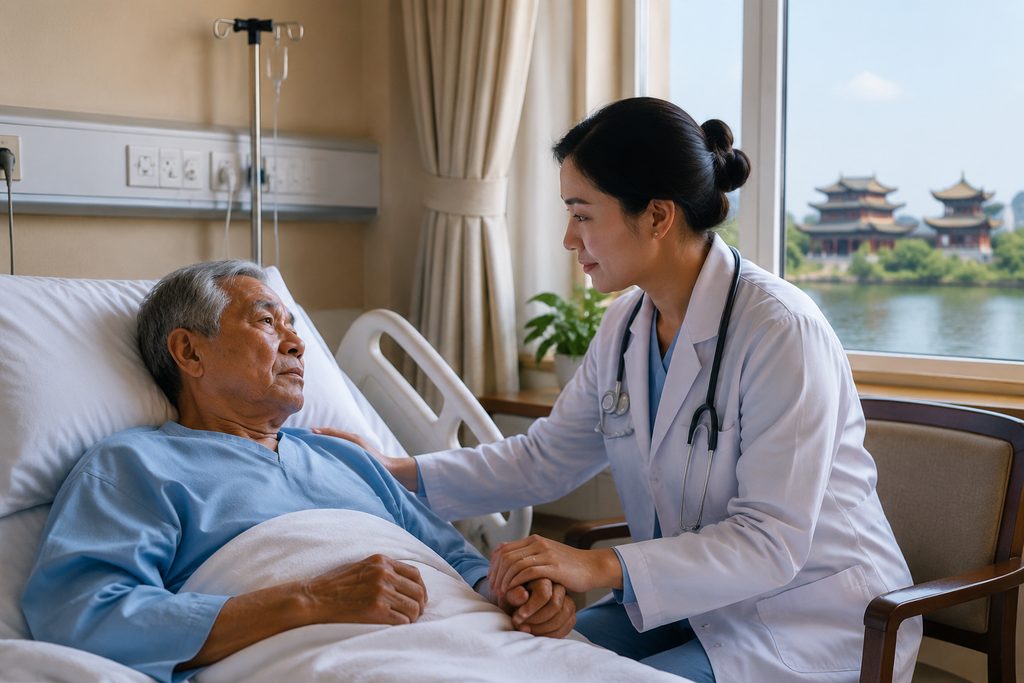
You have probably read that China is a place for heart surgery and dental implants, not for a disease as complicated as Huntington’s. That assumption deserves a second look. Shanghai’s neurology departments handle rare, inherited neurodegenerative conditions every week, and the Huntington disease treatment cost Shanghai families actually pay is a fraction of U.S. pricing. What follows is an honest walkthrough of what is available, what it costs, and where our team fits in.
Huntington Disease Care in Shanghai: The Short Answer
Yes, care is available. Shanghai’s top-tier public hospitals and international clinics run neurology and movement disorder programs that manage Huntington’s disease with the same drug classes used in the U.S. and Europe — tetrabenazine and its newer derivatives, antipsychotics for chorea and psychiatric symptoms, antidepressants, and multidisciplinary rehabilitation. What Shanghai does not offer is a cure. Neither does anywhere else.
That caveat matters more here than in most articles. Huntington’s is a genetic, progressive condition. No approved therapy slows the underlying disease process, and any clinic promising otherwise is selling something. The realistic goals are symptom control, functional preservation, genetic counseling for the family, and participation in trials where eligible. If that framing sounds sober, good — it is the one you should trust.
Key takeaway: Shanghai is a credible destination for Huntington’s symptom management and specialist evaluation, at roughly one-fifth to one-tenth of Western costs. It is not a place to find a cure, and no coordinator should tell you otherwise.
Who This Is Right For — and Who It Isn’t
Huntington’s families come to us with very different situations, and the fit is not universal. Being blunt about that saves everyone time and money.
Typically a reasonable fit:
- Families already diagnosed who want a second specialist opinion without a six-month Western neurology wait
- Patients whose medication costs at home are unsustainable and who need a documented, affordable maintenance plan
- People with a family history considering predictive genetic testing in a setting with counseling attached
- International residents in Asia who need continuity of neurologic care close to home
- Families researching whether a clinical trial in China might accept a foreign participant
Probably not the right move:
- Anyone in an acute psychiatric crisis — that needs local emergency care, not a flight
- Patients in late-stage disease for whom travel itself carries real risk; home-based palliative care usually serves better
- Families seeking an unproven intervention. We will not coordinate stem cell “treatments” or similar offerings, and you should be wary of anyone who will
- Anyone expecting a single trip to produce a definitive management plan. Huntington’s care is longitudinal by nature
The Options, Compared
Before committing to anything, it helps to see the landscape side by side. These are the realistic paths for a Western family, with representative figures.
| Path | Typical wait for specialist | Cost of initial evaluation | Ongoing medication cost | Language support |
|---|---|---|---|---|
| U.S. academic neurology center | 2–6 months | $800–$2,500 | $1,500–$6,000+/month | Native |
| Western Europe (public system) | 1–4 months | Low or covered | Often subsidized | Local language |
| Shanghai public hospital, international department | Days to 2 weeks, via coordination | $300–$900 | Often $200–$800/month | Requires interpreter |
| Shanghai private international clinic | Same week | $500–$1,200 | Higher, closer to Western pricing | English-speaking staff |
Which column fits you depends on two things: how much you value speed versus price, and whether you need English throughout or can work with an interpreter. Families on a fixed budget usually land on the public hospital international department with a bilingual companion. Families with insurance that reimburses internationally often prefer the private clinics for convenience.
Is Huntington Disease Treatment Available in Shanghai Hospitals? What the System Actually Looks Like
This is the question we get most often, and the honest answer has three layers.
The first layer is the public system. Shanghai has 18 hospitals in the Fudan Top 100 ranking, the second-highest concentration in China after Beijing. Several of these — including Ruijin Hospital, affiliated with Shanghai Jiao Tong University School of Medicine, and Huashan Hospital, long associated with neurology — run dedicated neurology departments with movement disorder expertise. Fudan’s specialty reputation rankings place several Shanghai neurology programs among China’s top ten for the specialty. That is a real signal, not marketing.
The second layer is practical access. Public hospital outpatient registration generally cannot be booked from overseas in advance; you queue on the day. Surgery and inpatient admission require an in-person consultation first. For a Huntington’s family flying in, that means the trip has to be structured around a consultation, not a procedure. This is exactly the kind of logistics our team handles.
The third layer is what “treatment” means in practice. A Shanghai neurologist will review your records, examine the patient, order imaging if needed, adjust the medication regimen, and write a plan your home neurologist can continue. Genetic counseling and testing are available. Rehabilitation — speech therapy, physical therapy, occupational therapy — exists in the larger hospitals and in dedicated rehabilitation facilities. What does not exist is a disease-modifying therapy, because none exists anywhere.
Practical tip: Bring your full medical record — genetic test results, MRI discs, medication history with dosages, and psychiatric notes if applicable. A Chinese specialist working from a partial file will give you a partial opinion.
How Much Does Huntington Disease Care Cost in China?
Cost is where China’s advantage is most concrete. The numbers below reflect what families typically pay for the services themselves, in U.S. dollars. Actual figures vary by hospital and case complexity.
- Specialist consultation (public hospital international department): $300–$900
- Specialist consultation (private international clinic): $500–$1,200
- Genetic testing and counseling: $400–$1,500 depending on panel breadth
- MRI brain imaging: $150–$500
- Monthly medication costs: frequently $200–$800, versus $1,500–$6,000+ in the U.S. for comparable regimens
- Rehabilitation sessions: $30–$80 each
Add our coordination layer and the picture stays reasonable. A written second opinion from a top-hospital specialist runs $300–$500. A video consultation is $100–$300 with a standard international department, or $500–$800 with a top specialist. A multidisciplinary team review, which is genuinely useful for a condition touching neurology, psychiatry, and genetics, is $1,500–$2,000. Bilingual medical companion support is from $300 per day, and hospital appointment coordination starts at $300.
One mechanism worth knowing: any consultation fee you pay is credited in full toward on-the-ground coordination if you come to China within 90 days. It is a one-time credit applied to the coordination fee only, never to hospital charges.
Practical Considerations: Records, Visas, Payment, and Follow-Up
Four logistics decide whether a trip goes smoothly.
Records first. Nothing productive happens until a Chinese specialist has your file. We arrange translation of medical records into Chinese, which is not optional — hospital departments work in Chinese, and an untranslated file slows everything down.
The visa question. Foreign patients coming to China for medical treatment use the S2 visa, which covers short-stay private affairs including medical treatment, subject to the latest embassy and consulate requirements and supporting hospital documents. Accompanying family members apply under the same category. One warning: the M visa is for commercial and trade activity and has nothing to do with medical care. If a service tells you to apply for an M visa for treatment, that is a red flag. Stays beyond 180 days involve the S1 category instead. We provide documentation guidance; the decision always rests with the consulate.
Payment. Public hospitals require prepayment, with insurance reimbursement handled afterward by you. Private international hospitals often bill insurers directly. Bring a payment method that works in China and confirm limits with your bank before traveling.
Follow-up after you go home. The most valuable output of a Shanghai evaluation is a written plan your local neurologist can execute. Ask for it in English, and ask for the medication names in both generic and brand form so nothing gets lost in translation.
Frequently Asked Questions
Yes, with a caveat. Public hospital general outpatient slots are not bookable from abroad in advance — you register on the day. What can be arranged ahead of time is access through a hospital’s international or VIP department, which offers senior specialists and English-capable staff at roughly 1.5 to 2 times the standard fee. We coordinate that pathway, but we do not promise a specific named doctor or a specific date.
For medications, consultations, imaging, and rehabilitation, yes — often by a wide margin. Comparable surgical or inpatient costs in China’s top public hospitals typically run one-fifth to one-tenth of U.S. charges. But be careful with the comparison: you are also paying for flights, accommodation, interpreters, and your own time. For a single consultation, the savings may not cover the trip. For ongoing medication management, they frequently do.
This is a fair worry and we answer it plainly. Huntington’s has no cure, so no trip will change the underlying trajectory, and we will never suggest otherwise. What can go wrong logistically — a missed appointment, a hospital that cannot accommodate your case — is partly what coordination exists to prevent. If we cannot secure the appointment you were quoted, the coordination fee is refunded in full. Medical outcomes are never guaranteed by anyone, including us.
We do not sell fixed packages, and you should be skeptical of anyone who does for a condition this variable. What we offer is staged support: a written second opinion first, then a video consultation if useful, then travel coordination only if a plan makes sense. That sequence exists to reduce unnecessary early travel and to let you build trust before making a larger commitment.
Your Next Step
The core message is simple: Shanghai offers genuine specialist expertise and meaningful cost savings for Huntington’s symptom management, and it offers no cure. Families who understand that distinction get real value from the trip.
Our team is not a hospital and we do not diagnose or treat anyone. We translate records, coordinate appointments through official hospital channels, arrange bilingual companionship, and guide you through the visa paperwork — the connective tissue between you and the doctors. If you would like to start with a low-commitment conversation about your situation, a free consultation is the place to begin, and you can browse China’s top-ranked hospitals by city while you think it over.
This article is for general information only and is not medical advice. Huntington’s disease requires individualized care from a qualified physician. Always consult your treating neurologist before changing any treatment plan or traveling for care.
For more medical information and treatment options in China, visit chinamedservices.com (China Medical Services).
