Trigeminal Neuralgia Second Opinion in China: Costs, Surgeons, and How to Start
Trigeminal Neuralgia Second Opinion in China: What It Costs and How to Get One
When 47-year-old David from Ohio was diagnosed with classic trigeminal neuralgia, his neurologist started him on carbamazepine and told him to “wait and see.” Six months later, the electric-shock pain on the right side of his face was waking him at night, the medication was making him dizzy, and he had no idea whether he should be considering surgery — or which surgery. That is the moment most people start searching for a trigeminal neuralgia second opinion in China. Not because they have given up on their home system, but because they want a clear answer to one question: what are my actual options, and who is qualified to perform them?
A second opinion is not a rejection of your current doctor. It is a review of your imaging, your medication history, and your symptom pattern by a specialty team that treats this condition every week. In China, that review can happen without a flight, and the price of the review itself is often less than a single specialist copay in the United States.
How This Actually Works, Step by Step
The process starts with documents, not travel. Here is the real sequence.
Step one — you send what you already have. That means your MRI (ideally a high-resolution T2/FIESTA or CISS sequence, which is what neurosurgeons need to see a neurovascular conflict), your current medication list with dosages, a short written description of where the pain is and what triggers it, and any prior procedures. Records go to our team, we translate them into Chinese, and they are routed to the relevant neurosurgery or neurology department.
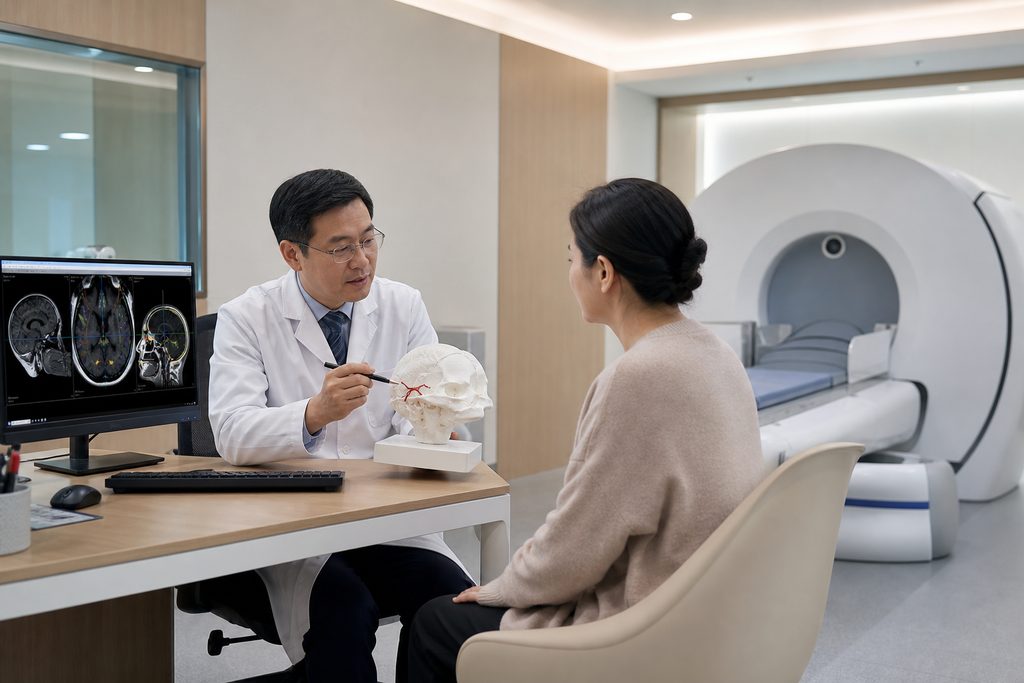
Step two — the specialty reviews your file. A written second opinion comes back in English. It typically addresses whether your imaging shows a vessel compressing the trigeminal nerve root, whether you are a candidate for microvascular decompression, whether a percutaneous procedure or radiosurgery is more appropriate given your age and health, and what the team would recommend as a next step. Written opinions at top-tier hospitals run $300–500. They are for reference only, not a prescription.
Step three — you speak with the team directly, if you want to. A video consultation adds a live conversation. You describe your symptoms, ask your questions, and hear the surgeon’s reasoning. Video consultations with a standard tertiary hospital international department or private international clinic run $100–300. A top-specialist video consultation runs $500–800. A multidisciplinary team review, where neurosurgery, neurology, and pain medicine sit in together, runs $1,500–2,000.
Step four — you decide whether to travel. Nothing obliges you to. If the remote review produces a plan you want to pursue in China, we coordinate the appointment, the medical card, and the arrival logistics. If it does not, you have paid for an opinion and nothing else.
What a Trigeminal Neuralgia Second Opinion in China Actually Adds
Microvascular decompression is a well-established procedure performed at high-volume Chinese neurosurgery centers, and published outcomes at experienced centers are broadly comparable to international benchmarks. Safety depends heavily on surgeon volume, your imaging findings, your age, and your comorbidities. No one can promise an outcome, and any provider who does should be treated with caution. Ask how many MVDs the treating surgeon performs annually.
Gamma Knife radiosurgery at a top Shanghai facility typically falls in the $6,000–12,000 range, varying by hospital, whether treatment is single-session or fractionated, and whether you are in a public or private setting. You need a current MRI before anyone can give you a meaningful quote.
Yes, and most patients start there. You send existing imaging and records, the specialty reviews them, and a written opinion comes back in English. A video consultation is optional and can be added at any stage. Travel only becomes necessary if you decide to pursue treatment in China.
Short-stay medical travel uses the S2 visa, with supporting documents from the treating hospital. Stays exceeding 180 days use S1, and accompanying family members apply for S2 as well. Requirements vary by consulate and change over time, so confirm with the latest embassy guidance. The M visa is for commercial and trade activities and is not a medical visa.
Your Next Step
A second opinion is a low-cost way to replace uncertainty with a clear picture of your options — and in trigeminal neuralgia, where the choice between MVD, radiosurgery, and percutaneous procedures depends on details visible only in good imaging, that clarity is worth having before you commit to anything.
We are China Medical Services. We translate records, route them to the right specialty department, coordinate appointments through official hospital international channels, and provide bilingual companions on the ground. We are not doctors, we do not diagnose, and we do not promise admission, a specific surgeon, or a clinical outcome. If you would like to start with a written review of your existing reports, you can request a free consultation and we will tell you honestly what is possible.
This article is for general information only and is not medical advice. Treatment decisions should be made with a qualified physician who has reviewed your individual case.
Frequently Asked Questions
Yes. The hospitals used for international patients are JCI-accredited and follow the same international safety standards as top hospitals in the US and Europe. Surgical teams perform high volumes of procedures — often more than their Western counterparts — which studies show leads to better outcomes.
Costs vary by procedure and hospital, but international patients typically save 40-80% compared to US prices — even when factoring in travel and accommodation. A consultation with our team will give you an exact, all-inclusive quote with no hidden fees.
Send us your existing medical reports to get started. We handle everything from hospital selection and appointment scheduling to visa assistance and post-operative recovery planning. Your medical records are reviewed by the specialist before you even book a flight.
For more medical information and treatment options in China, visit chinamedservices.com (China Medical Services).
