Endoscopy in China: Prep for Two Tests, Costs, and Booking
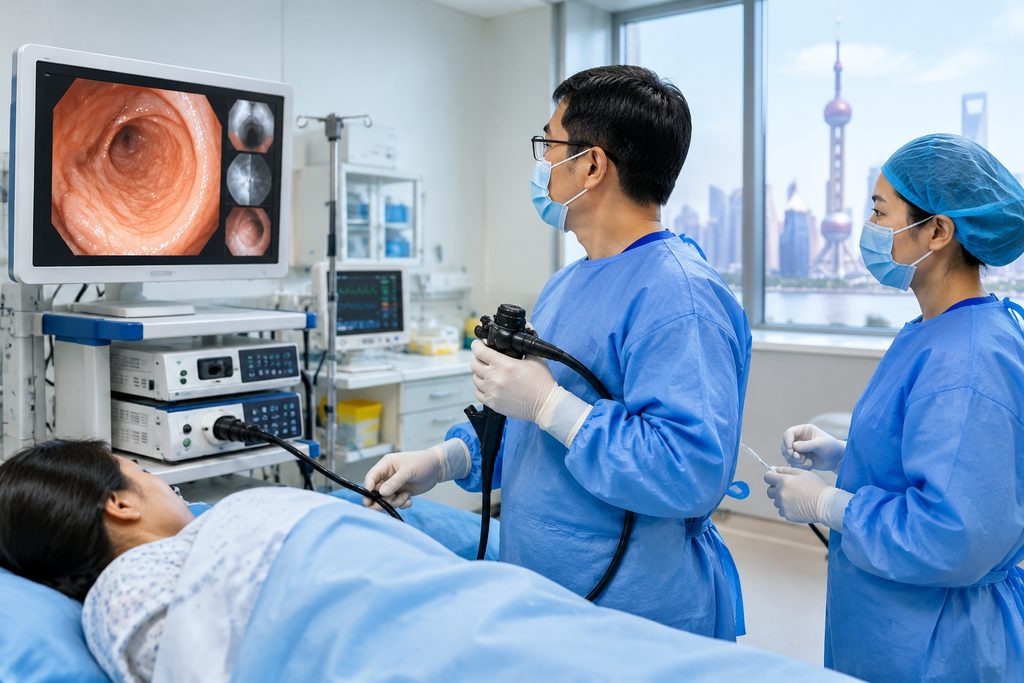
You have probably heard that flying abroad for a medical procedure means cutting corners. For a screening colonoscopy, the assumption sounds reasonable. Yet the numbers tell a different story. An endoscopy cost China hospitals quote often runs a fraction of the U.S. price, while the scopes, the sedation protocols, and the pathology labs are the same generation of equipment you would find in a Western academic center. What actually trips people up is not quality. It is preparation. Two tests, one session, and a set of instructions that must be followed precisely — or the whole trip is wasted.
This guide walks through both procedures, the prep timeline, real price ranges, and how booking works at Chinese public and private hospitals. It is written for international patients who want facts, not a sales pitch.
Key Takeaways
- A combined gastroscopy and colonoscopy at a top Chinese hospital typically costs $250–$700, versus $2,500–$6,000 in the United States for the same two procedures.
- China’s largest hospitals perform tens of thousands of endoscopic procedures annually, and Fudan-ranked gastroenterology departments appear on the national specialty reputation list.
- The hardest part is not the procedure — it is the bowel prep. A colonoscopy with poor preparation can miss polyps larger than 10 mm, and repeat scopes mean repeat travel.
- Public hospital general clinics cannot be booked from overseas in advance. International departments and private hospitals can, usually at 1.5–2x the standard price.
The Problem: Why Two Scopes Feel Like a Logistics Nightmare
Roughly 1 in 24 Americans will be diagnosed with colorectal cancer in their lifetime, according to American Cancer Society estimates. Screening colonoscopy is the gold standard for catching it early. And yet a 2023 survey from the National Cancer Institute found that cost concerns caused a meaningful share of adults to delay or skip recommended screenings entirely.
The math is brutal. A diagnostic colonoscopy in the U.S. without insurance runs $2,000–$4,500 at a hospital outpatient facility. Add an upper endoscopy for reflux, anemia, or unexplained weight loss, and you are looking at $5,000–$7,000 before anesthesia fees and pathology. Insurance may cover it — if you meet screening criteria, if your deductible is met, if the facility is in network.
Wait times add another layer. In parts of Canada and the UK, non-urgent endoscopy waits stretch past six months. That is a long time to sit with a symptom and no answer.
So patients start searching. And they find that China runs 35,000+ hospitals, that its top 5% are ranked by Fudan University and JCI, and that endoscopy there costs less than a single U.S. facility fee. The question shifts from “can I afford this” to “how do I actually make it happen.”
Why Chinese Hospitals Deliver Strong Endoscopy Outcomes
Volume matters in endoscopy. A gastroenterologist who performs 2,000 scopes a year spots subtle lesions faster than one who performs 300. China’s top hospitals are volume machines, and that shows up in detection rates.
Clinical Volume and Detection Skill
Gastroenterology departments at Fudan-ranked hospitals handle enormous case loads. Zhongshan Hospital Fudan University, Peking Union Medical College Hospital, and West China Hospital all sit in the Fudan Top 100 across multiple specialties. Their endoscopy units run daily lists that would be considered unmanageable in most Western systems. The upside for patients: experienced hands, standardized protocols, and rapid pathology turnaround — often 3–5 working days for biopsy results.
Equipment and Sedation Standards
High-definition and image-enhanced endoscopy (NBI, chromoendoscopy) is standard in major Chinese centers. Sedation practice varies: many public hospitals use conscious sedation with midazolam and fentanyl, while private international hospitals typically offer propofol-based monitored anesthesia care, closer to U.S. norms. If sedation depth matters to you, that is a question to settle before booking — not on the day.
Cost Structure Without Quality Compromise
Lower prices do not come from cutting corners. They come from labor economics, hospital scale, and a reimbursement system that keeps procedure fees low. A senior endoscopist in China earns a fraction of a U.S. gastroenterologist’s salary. The hospital buys scopes in bulk. The result is a $300 colonoscopy that uses the same Olympus or Fujifilm equipment as a $3,000 one in Ohio.
What the Two Procedures Actually Involve
Gastroscopy (upper endoscopy) examines the esophagus, stomach, and duodenum. A thin flexible tube enters through the mouth. It takes 10–20 minutes. Colonoscopy examines the full large intestine and often the terminal ileum. It takes 20–45 minutes. When both are done in one session — sometimes called a “bidirectional endoscopy” or “double scope” — you go under sedation once and recover once.
That combined approach is common in China and saves both time and money. It is also why prep instructions matter so much. The stomach must be empty. The colon must be clean. Miss either, and the doctor may abort or repeat the exam.
How to Prepare for Endoscopy and Colonoscopy: A Day-by-Day Timeline
Prep is where most patients stumble. Here is the standard protocol used at major Chinese hospitals, though your specific instructions will vary based on your doctor and your case.
- 7 days before: Stop iron supplements, fish oil, and any blood thinners if your prescribing doctor approves. Confirm this in writing — do not stop cardiac medications on your own.
- 3 days before: Low-fiber diet. No seeds, nuts, popcorn, raw vegetables, or fruit with skin. White rice, eggs, chicken, and clear broth are fine.
- 1 day before: Clear liquids only after lunch. This means water, clear broth, black tea, apple juice, and clear gelatin. No red or purple liquids — they can look like blood on the scope.
- Evening before: First bowel prep dose. Typically polyethylene glycol (PEG) solution, 2–3 liters, drunk over 2–4 hours. Expect to be in the bathroom within 30–60 minutes.
- Morning of: Second prep dose, usually 4–6 hours before the procedure. Nothing by mouth after that — including water — unless your doctor says otherwise.
The prep is unpleasant. There is no polite way to say it. But the quality of your colonoscopy depends almost entirely on how clean the colon is. A 2021 study in Gastrointestinal Endoscopy found that inadequate bowel preparation was associated with a significantly higher rate of missed adenomas. Translation: bad prep equals a wasted scope.
Gastroscopy and Colonoscopy Price Shanghai vs. Other Cities
Prices vary by hospital tier, city, and whether you use the general clinic or the international department. Below are representative ranges for international patients at top-tier hospitals. These are estimates only — final quotes depend on hospital and case complexity.
| Procedure / Service | Public Hospital (International Dept.) | Private International Hospital | U.S. Comparison |
|---|---|---|---|
| Diagnostic gastroscopy | $150–$350 | $400–$900 | $1,200–$2,500 |
| Diagnostic colonoscopy | $200–$450 | $500–$1,200 | $2,000–$4,500 |
| Combined gastroscopy + colonoscopy | $250–$700 | $800–$1,800 | $2,500–$6,000 |
| Biopsy (per site) | $30–$80 | $80–$200 | $200–$500 |
| Pathology report | $50–$150 | $150–$400 | $300–$800 |
| Sedation / anesthesia | $80–$200 | $200–$500 | $500–$1,500 |
Shanghai and Beijing tend to sit at the higher end of these ranges because of demand. Chengdu, Wuhan, and Hangzhou can be 10–20% cheaper for equivalent care. If you are flexible on city, that flexibility has a price tag attached — in your favor.
Booking an Endoscopy Appointment at a China Hospital
Here is the part nobody tells you upfront. General outpatient clinics at Chinese public hospitals do not accept overseas advance bookings. You show up, queue, register, and see a doctor the same day. Procedures are scheduled after that in-person consultation. For a patient flying in from abroad, that is a real logistical problem.
There are two workable paths:
- International department or VIP channel: These units are designed for foreign patients, have English-speaking staff, and can often schedule endoscopy in advance. Expect to pay 1.5–2x the standard fee.
- Private international hospital: Facilities like United Family, Jiahui, Parkway, and Raffles offer direct insurance billing, English-language care, and predictable scheduling. Higher cost, smoother process.
What about the middle ground? A written second opinion or video consultation with a Chinese gastroenterology team can clarify whether you actually need both scopes, what prep protocol applies to your medications, and which hospital fits your case. That step costs far less than a wasted flight. You can explore department rankings and hospital profiles through our specialty rankings by department and Fudan Top 100 hospitals by city.
Safety, Sedation, and What to Ask Before You Book
Is endoscopy safe in China hospitals? For routine diagnostic scopes at accredited institutions, yes. Perforation risk for diagnostic colonoscopy sits around 1 in 1,000–2,000 in published international literature, and major Chinese centers report complication rates in line with global benchmarks. But “safe” depends on where you go and who holds the scope.
Questions worth asking before you commit:
- Who performs the procedure — a staff gastroenterologist or a trainee?
- What sedation is used, and is an anesthesiologist present?
- How are biopsy results delivered, and in what language?
- What is the hospital’s policy if a polyp requires immediate removal?
- Is there an English-speaking nurse for recovery?
Practical Considerations: Visas, Payment, and Follow-Up
Expect $250–$700 at a top public hospital’s international department and $800–$1,800 at a private international hospital. Final pricing varies by hospital and case complexity, and biopsies or polyp removal add to the total.
It happens, and it means a repeat procedure. That is why the diet and split-dose prep instructions matter more than any other part of the trip. If your colon is not clean, the doctor will tell you — and you will need to reschedule, which for an international patient usually means extending the stay.
Private international hospitals often do, including direct billing. Public hospitals generally require upfront payment and provide documentation for later reimbursement. Confirm coverage with your insurer before booking, and ask specifically about pre-authorization requirements.
Yes, when performed by an experienced team with proper monitoring. Combined scopes are routine in China. The main considerations are total sedation time and your underlying health, which the anesthesiology team will assess beforehand.
Your Next Step
Two scopes in one trip is manageable — if the prep is right, the hospital is right, and the scheduling actually works for an international patient. The savings are real, and the clinical standards at China’s top gastroenterology departments are strong. What most patients lack is someone who knows which hospitals accept overseas bookings, how to time the prep around a flight, and what to do when a biopsy result arrives after they have gone home.
We are China Medical Services. We connect international patients with 340+ top-ranked hospitals across 37 cities, coordinate appointments through official international departments, and provide bilingual medical companions for the days that matter. We are not a hospital and we do not diagnose or treat. If you want help mapping out an endoscopy trip — or just a straight answer about whether it makes sense for your case — start with a free consultation at our patient services page.
This article is for general information only and is not medical advice. Endoscopy preparation and sedation decisions must be made with a qualified physician who knows your history. Prices are estimates and vary by hospital and case complexity.
Frequently Asked Questions
Yes. The hospitals used for international patients are JCI-accredited and follow the same international safety standards as top hospitals in the US and Europe. Surgical teams perform high volumes of procedures — often more than their Western counterparts — which studies show leads to better outcomes.
Costs vary by procedure and hospital, but international patients typically save 40-80% compared to US prices — even when factoring in travel and accommodation. A consultation with our team will give you an exact, all-inclusive quote with no hidden fees.
Send us your existing medical reports to get started. We handle everything from hospital selection and appointment scheduling to visa assistance and post-operative recovery planning. Your medical records are reviewed by the specialist before you even book a flight.
For more medical information and treatment options in China, visit chinamedservices.com (China Medical Services).
