Sedated Colonoscopy in China: How It Works, Costs, and Top Hospitals
Key Takeaways
- A sedated colonoscopy in China typically runs $300–$1,200 at top-tier public hospitals — often one-fifth of the U.S. price for the same procedure.
- Gastroenterology departments at Fudan-ranked hospitals handle tens of thousands of endoscopies a year, which is why complication rates stay low.
- The hard part is not the procedure. It is the booking system: most public hospitals do not let you reserve a general outpatient slot from overseas in advance.
- You will need an S2 visa for medical treatment, not an M visa, and a bilingual companion is close to essential in a hospital that sees 10,000+ outpatients a day.
The Problem: A Screening Test People Keep Postponing
When 52-year-old David from Manchester was told by his GP that he needed a colonoscopy, his first reaction was not fear of the result. It was fear of the wait. His local NHS trust quoted 11 weeks for a routine diagnostic slot — and that was before any follow-up. He had already been putting the test off for two years, partly because of the cost of going private in the UK (roughly £2,000–£3,500) and partly because the idea of being awake during the procedure unsettled him.
David’s situation is not unusual. Colorectal cancer is the third most common cancer worldwide, and screening uptake remains stubbornly low across Western countries. In the United States, only about 59% of adults aged 45–75 are up to date with colorectal screening, according to CDC data. Cost, waiting lists, and anxiety about an unsedated procedure are the three reasons patients give most often.
So a growing number of international patients are asking a different question: what if I fly to China, get it done this month, under sedation, and pay less than my private insurance excess?
Why China Delivers Results for Sedated Endoscopy
China’s top hospitals are not a budget alternative with hidden compromises. They are high-volume academic medical centers that perform endoscopy at a scale few Western hospitals can match.
Clinical Volume and Sedation Experience
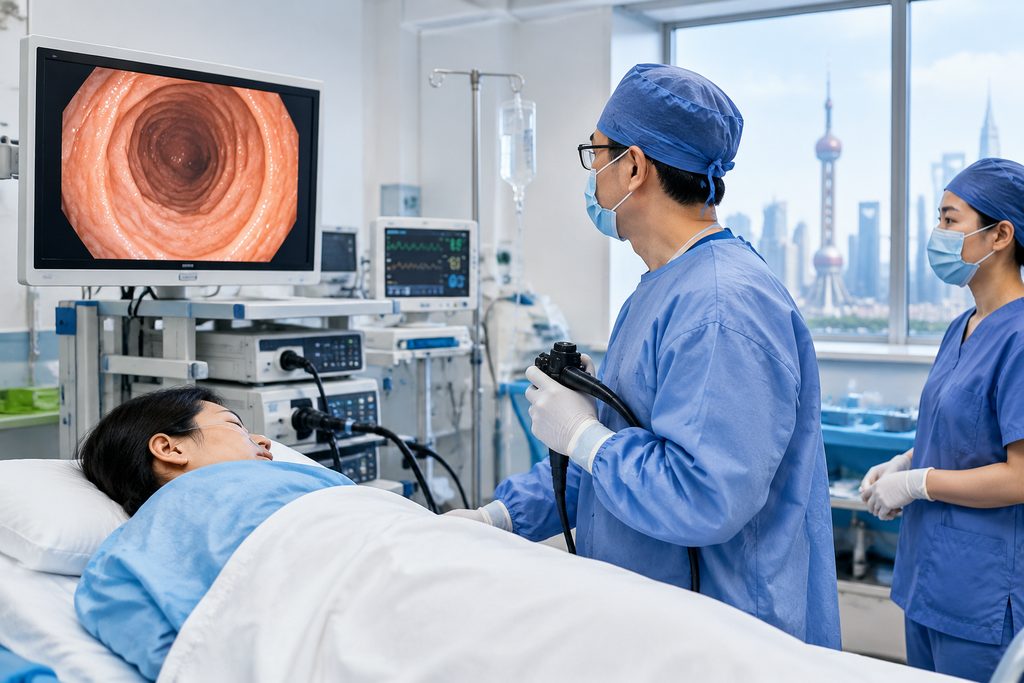
Major Chinese gastroenterology departments — at hospitals like Zhongshan Hospital Fudan University, Ruijin Hospital, and Peking Union Medical College Hospital — run dedicated endoscopy units that process hundreds of procedures per day. That volume translates into anesthesiology teams who sedate patients every single working day, not occasionally. Propofol-based conscious sedation is the standard, administered by an anesthesia professional with continuous monitoring of heart rate, blood pressure, and oxygen saturation. This is the same protocol used in Western ambulatory surgery centers.
Technology and Efficiency at Scale
High-definition and magnifying colonoscopes, narrow-band imaging, and same-session polypectomy are routine at the top tier. If a polyp is found, it is usually removed during the same procedure — no separate booking, no second sedation. Chinese endoscopy units also run tight scheduling: a patient with a confirmed appointment often moves from prep room to recovery in under three hours total.
Sedated Colonoscopy Cost China — Why the Price Gap Is Real
Lower cost does not mean lower quality here. It reflects labor economics and hospital throughput. An anesthesiologist’s time, nursing support, and facility fees are priced on a domestic scale, while the equipment and clinical protocols match international standards. A sedated colonoscopy at a top public hospital commonly falls in the $300–$1,200 range depending on whether polyps are removed, whether biopsies are taken, and whether you use the standard or international/VIP channel. Private international hospitals charge more — often $1,500–$3,000 — but offer English-speaking staff and direct insurance billing.
What Actually Happens, Step by Step
Here is the real sequence at a Chinese public hospital, so there are no surprises.
Day 0 — Pre-assessment. You meet the gastroenterologist in person. This face-to-face consultation is mandatory before any procedure. The doctor reviews your history, confirms the indication, and writes the endoscopy order.
Day 0–1 — Bowel prep. You receive a written prep protocol, usually a split-dose polyethylene glycol regimen. Instructions may be in Chinese, which is where a bilingual companion earns their fee.
Procedure day. You arrive fasting, change, and an IV line is placed. Propofol is titrated until you are comfortably asleep. A diagnostic colonoscopy takes roughly 20–40 minutes; with polypectomy, plan on 45–60 minutes. Recovery is typically 30–60 minutes.
Same day or next day. Preliminary findings are explained. Biopsy or pathology results, if taken, usually return within 3–7 working days.
How Long Does a Sedated Colonoscopy Take — and How Long Should You Stay?
The procedure itself is short. The trip is not. For a straightforward screening with no findings, a 5–7 day stay in China is realistic: arrival, consultation, prep, procedure, results review, fly home. If polyps are removed and sent for pathology, add 3–5 days to collect the report. Build in a buffer. Do not book a flight home for the day after your procedure.
| Item | Typical Cost in China (USD) | Comparison (US/UK) |
|---|---|---|
| Sedated diagnostic colonoscopy (public, standard channel) | $300–$700 | US: $2,500–$6,000 |
| With polypectomy and pathology | $600–$1,200 | US: $4,000–$8,000+ |
| Private international hospital | $1,500–$3,000 | UK private: £2,000–£3,500 |
| Bilingual medical companion | from $300/day | — |
| Airport transfer (round trip) | $200 | — |
All figures vary by hospital and case complexity. Final pricing is confirmed only after the in-person consultation.
Is Sedated Colonoscopy Safe in China — and How Do You Judge a Hospital?
Sedation safety in China rests on the same pillars as anywhere else: a qualified anesthesia provider, continuous monitoring, and a facility equipped to manage complications. Top-tier hospitals meet all three. The variable is which hospital you choose.
Use these filters:
- Gastroenterology ranking — check the Fudan specialist reputation list, which ranks the top 10 hospitals per specialty. Our department directory maps this for you.
- Endoscopy volume — a unit doing hundreds of procedures weekly has seen every variation.
- Anesthesia staffing — confirm sedation is given by an anesthesia professional, not the endoscopist alone.
- Language support — either an international department or a companion who can translate consent forms and prep instructions accurately.
Who is this NOT suitable for? Patients on high-dose anticoagulants, those with severe cardiac or respiratory disease, and anyone whose sedation risk needs a full pre-anesthetic evaluation. That evaluation is exactly what the mandatory in-person consultation is for. If the anesthesiologist says no, the answer is no.
Practical Considerations for International Patients
Visa first. Medical treatment in China falls under the S2 visa, which covers short-stay private affairs including medical treatment; stays over 180 days use S1. Accompanying family members apply for S2 as well. The M visa is a commercial and trade category and has nothing to do with medical care — do not let anyone tell you otherwise. Requirements change, so verify current rules with the nearest Chinese embassy or consulate and bring supporting hospital documents.
Payment. Public hospitals require prepayment; you settle the bill at a cashier or via mobile payment. International credit cards are accepted at some but not all counters, so carry a backup method. Private international hospitals often bill insurance directly. For reimbursement back home, request an itemized invoice and the pathology report in English — ask before you leave, not after.
Records. Bring your prior colonoscopy reports, imaging, medication list, and allergy history. If you want a specialist’s opinion before you travel, a written second opinion or video consultation can clarify whether the trip is even necessary.
Follow-up. Arrange how your home physician will receive the results. A translated pathology report and a discharge summary are usually enough.
Frequently Asked Questions
Most sedated colonoscopies in China use conscious sedation with propofol, which means you are deeply relaxed and typically have no memory of the procedure. It is not general anesthesia with a breathing tube. You will wake up in the recovery area within an hour.
General outpatient slots at public hospitals cannot usually be reserved from overseas in advance — registration happens on the day. To lock in a specific date and specialist, patients go through the hospital’s international or VIP channel, which costs roughly 1.5–2 times the standard fee. Coordination services can help arrange this, but no one can guarantee a specific doctor or date.
Polyps are usually removed during the same procedure. If a malignancy is suspected, biopsies are taken and the case is referred to the hospital’s oncology or surgery department. You would then decide, with your family and your home physician, whether to continue treatment in China or return home. No treatment decision should be made in a single appointment.
It depends on your wait time and budget. If your home wait is under a month and your insurance covers it, staying home is simpler. If you are facing a 10-week wait, a £3,000 private bill, or an unsedated procedure, the math changes fast. A package bundling consultation, procedure, and companion support often costs less than a single private scan in the UK.
Your Next Step
Getting a sedated colonoscopy in China is straightforward once you understand the sequence: consultation first, procedure second, results third. The barrier is logistics, not medicine. China Medical Services is a coordination service — we are not a hospital and we do not provide diagnoses or treatment. We match you with ranked hospitals, arrange appointments through official international channels, and provide bilingual companions on the ground. If you want to understand your options before committing to anything, start with a free consultation at our patient services page.
For more medical information and treatment options in China, visit chinamedservices.com (China Medical Services).
