Sinus CT in China: What to Expect, What It Costs, and How to Book
What if the scan you need is straightforward, but getting it done in a foreign country feels like the hard part?
If you are searching for the sinus CT scan cost China hospitals charge, you are probably not just curious about money. You want to know whether a scan here is safe, fast, and worth the trip. This guide answers that directly.
A sinus CT (also called a paranasal sinus CT or sinus computed tomography) is a non-invasive imaging study that produces detailed cross-sectional images of your nasal passages, sinus cavities, and surrounding bone. It is the standard tool for chronic sinusitis, nasal polyps, deviated septum assessment, and pre-surgical planning. In China, it is widely available, fast, and inexpensive by Western standards.
Here is what international patients actually need to know.
How This Actually Works, Step by Step
Most people imagine they can pick a hospital online, click a date, and show up. That is not how Chinese public hospitals work for outpatients. Here is the real sequence.
Step 1 — You send your existing records. Your prior CT or MRI images, a recent ENT consultation note, symptom history, and any allergy or medication list. If you have a referral letter from your home doctor, include it. Everything gets translated into Chinese by the coordinating team, because radiology requisitions and hospital registration systems operate in Chinese.
Step 2 — A Chinese ENT specialist reviews the file remotely. This can happen as a written second opinion or a video consultation with the relevant department. The specialist confirms whether a sinus CT is actually the right study, or whether you need something else — a nasal endoscopy, an MRI, or a plain X-ray. This step prevents wasted travel.
Step 3 — Appointment coordination. If imaging is appropriate, the coordination team registers you through the hospital’s international or VIP channel where one exists, or books a standard outpatient slot. You receive a confirmed date range, not a guaranteed single hour. Public hospital imaging queues move fast — often same-day or next-day for CT — but the exact slot depends on the hospital’s schedule.
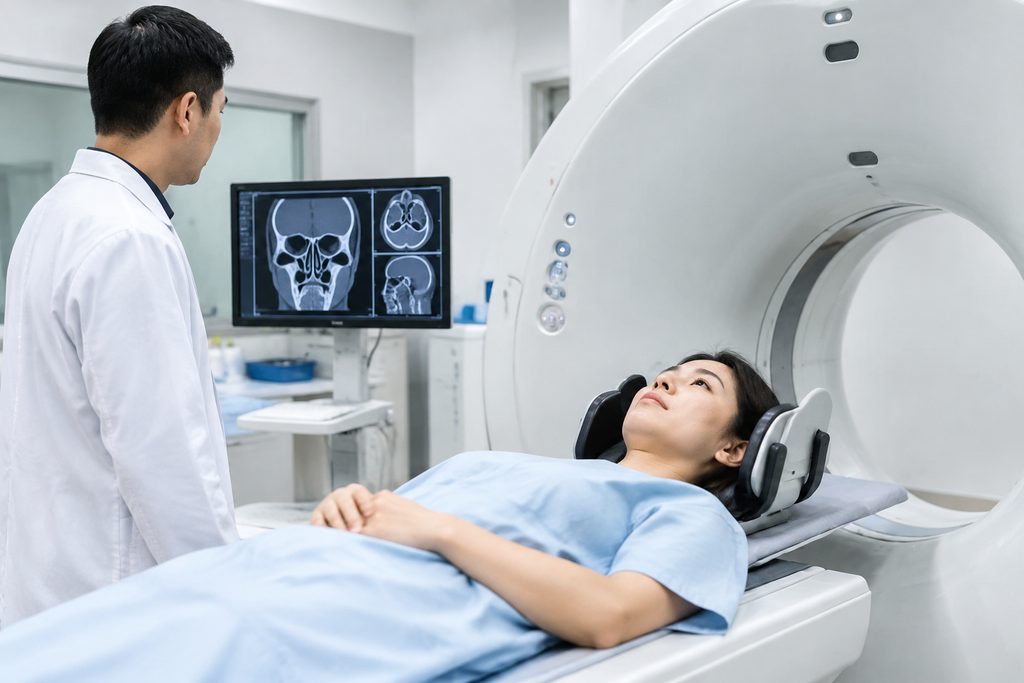
Step 4 — You arrive and are accompanied. A bilingual medical companion meets you, handles registration, pays the imaging fee on your behalf or guides you through payment, walks you to the radiology department, and translates the technologist’s instructions. The scan itself takes about 10 to 15 minutes. You lie still on a table, the machine rotates around your head, and you are done. No injection is needed for a standard sinus CT.
Step 5 — Results. A radiologist’s written report is usually ready within 24 to 48 hours, sometimes the same day. If you have a follow-up ENT consultation scheduled, the specialist reads the images with you and explains findings. If you are flying home, the images and report can be provided digitally for your doctor abroad.
What Does a Sinus CT Scan Cost in China?
This is the question that brings most readers here. The sinus CT scan cost China hospitals charge is dramatically lower than in the United States or Western Europe — but the number varies by hospital tier, city, and whether you use a standard or international channel.
| Setting | Typical Price Range (USD) | Notes |
|---|---|---|
| Public tertiary hospital, standard outpatient | $50 – $120 | Lowest cost; Chinese-language registration required |
| Public hospital international / VIP department | $120 – $300 | English-speaking staff, faster scheduling |
| Private international hospital | $300 – $700 | Direct insurance billing, Western-style service |
| United States (for comparison) | $800 – $3,000+ | Varies widely by facility and insurance |
So when people ask how much does a sinus CT scan cost in Shanghai, the honest answer is: somewhere between roughly $50 and $300 for most public hospital settings, and higher at private international facilities. Shanghai’s top-tier hospitals — Ruijin, Zhongshan, and the ENT departments at Fudan-affiliated institutions — sit in the middle of that range. Beijing is comparable. Second-tier cities like Chengdu or Wuhan can be cheaper still.
One important note: these figures cover the scan itself. They do not include the physician consultation, translation, companion service, or travel. If you are comparing total trip cost, factor those in.
A Realistic Timeline
People underestimate the waiting steps. Here is what a typical international patient timeline looks like, from first inquiry to having images in hand.
| Stage | Typical Duration | What Happens |
|---|---|---|
| Records gathering and translation | 2 – 5 days | You send files; team translates and formats them |
| Remote specialist review | 3 – 7 days | ENT specialist confirms the scan is appropriate |
| Appointment coordination | 3 – 10 days | Hospital slot confirmed; visa documents prepared if needed |
| Visa processing (if traveling) | 1 – 3 weeks | S2 visa for medical treatment, subject to embassy requirements |
| Travel and scan day | 1 – 3 days on the ground | Registration, scan, radiologist report |
| Report delivery | 24 – 48 hours after scan | Written report and digital images |
Total realistic window from first contact to holding a report: about two to five weeks if you need a visa, or under two weeks if you are already in China or visa-exempt.
What Can Go Wrong — and What Happens Then
Honesty matters more than reassurance here, so let us be direct about the failure modes.
The scan turns out to be the wrong test. This happens more than people expect. A patient arrives convinced they need a sinus CT, but the specialist determines the symptoms point to something else — dental origin, migraine, or a neurological issue. The remote review step exists precisely to catch this before you fly. If it happens after arrival, the specialist will redirect you to the correct study, and you may pay for a different scan.
The appointment is not available on your preferred date. Public hospital imaging slots fill unpredictably. Coordination can secure a date range, not a guaranteed hour. If the exact slot you wanted is unavailable, the options are to shift your travel dates or use a private international hospital, which has more scheduling flexibility at higher cost.
The visa is delayed or refused. No service can guarantee visa approval. S2 visas for medical treatment require supporting hospital documents and are subject to the latest embassy or consulate requirements. If a visa is delayed, the appointment can usually be rescheduled. If it is refused, the coordination fee is refunded in full where the appointment cannot be secured.
You need follow-up surgery and assumed it would be arranged on the spot. It will not be. In Chinese public hospitals, surgical scheduling requires an in-person consultation first. A scan alone does not reserve an operating room. Anyone promising otherwise is not being straight with you.
Is a Sinus CT Scan Safe in China, and Which Hospitals Are Best?
On safety: a sinus CT uses ionizing radiation, as it does anywhere in the world. A standard sinus CT delivers a low dose — roughly comparable to a few months of background radiation, far below the levels associated with any measurable risk. Modern Chinese tertiary hospitals use multi-slice scanners with dose-reduction protocols. The equipment at top-tier facilities is the same Siemens, GE, and Philips hardware used in Western hospitals.
So is a sinus CT scan safe in China? Yes, at accredited hospitals, with the same caveats that apply anywhere: inform the technologist if you are pregnant, and disclose any contrast allergy if contrast is planned.
On the best hospital for sinus CT scan Beijing: the strongest ENT departments cluster at Peking Union Medical College Hospital, Beijing Tongren Hospital (renowned for otolaryngology), and several other tertiary facilities. In Shanghai, Fudan-affiliated hospitals and Ruijin are strong choices. You can browse ranked departments and city listings on our top hospitals directory, which groups Fudan-ranked facilities by city and specialty tier.
For patients who prioritize English service and direct insurance billing over lowest cost, private international hospitals in Beijing and Shanghai are a reasonable alternative. They charge more but remove most language friction.
Practical Considerations: Records, Visa, Payment, and Follow-Up
Records. Bring your prior imaging on a CD or USB drive if you have it, plus any written reports. Chinese radiologists can compare new images against old ones, which improves accuracy. If your prior scans are only on a hospital portal abroad, request a physical copy before you travel.
Visa category. Foreign nationals coming to China for medical treatment typically apply for the S2 visa, which covers short-stay private affairs including medical treatment, with accompanying family members applying under the same category. Stays exceeding 180 days generally fall under S1. Requirements change, so confirm current rules with the nearest Chinese embassy or consulate. Note that the M visa is for commercial and trade activity and is not the correct category for medical travel.
Payment. Public hospitals require prepayment; you then seek reimbursement from your insurer afterward. Private international hospitals often bill insurance directly. Bring a card that works internationally, and confirm accepted payment methods in advance.
Language. This is the single biggest practical barrier. Top Chinese hospitals see enormous daily patient volumes, and signage, registration systems, and staff communication are predominantly in Chinese. A bilingual medical companion handles registration, queueing, payment, wayfinding, and translation so you are not navigating a 10,000-patient-per-day facility alone.
Follow-up at home. Ask for your images and report in digital format before you leave. Most hospitals can provide DICOM files on a disc or via download. Your doctor at home can then review the actual images, not just the written summary.
Frequently Asked Questions
You can initiate the process remotely by sending your records for specialist review and having an appointment coordinated through the hospital’s international channel. What you cannot do is walk into a standard public outpatient clinic and reserve a specific scan slot from abroad — that channel requires in-person registration. Coordination services bridge this gap.
In practice, yes. A physician’s requisition is required before imaging is performed. If you arrive without one, you will first need an ENT consultation, which can often be arranged the same day at larger hospitals. Sending records ahead lets the specialist confirm the scan is appropriate and issue the requisition before you travel.
Radiology reports are typically ready within 24 to 48 hours. Reports are issued in Chinese; translation into English is part of coordination support. The images themselves are language-neutral and can be read by any radiologist worldwide.
For a scan alone, probably not — the savings rarely justify international travel. It makes more sense when the scan is part of a broader treatment plan, such as sinus surgery, where the cost difference is substantial. Think of the CT as one step in a larger decision.
That is a legitimate and common choice. A written second opinion from a Chinese specialist, based on your existing images, costs far less than traveling and can tell you whether surgery is even necessary. Many patients start there.
Your Next Step
A sinus CT in China is fast, safe at accredited hospitals, and inexpensive — but the logistics around it are where international patients get stuck. The scan is the easy part. Registration, language, scheduling, and knowing whether you even need it are the real work.
China Medical Services connects international patients with more than 340 top-ranked hospitals across 37 cities, ranked by Fudan and JCI standards. We are not doctors and we do not provide medical advice. What we do is translate your records, coordinate appointments through official hospital channels, and accompany you through every step in your language.
If you are weighing whether a scan, a second opinion, or a full treatment trip makes sense, start with a conversation. There is no pressure and no obligation — just a clear picture of your options.
This article is for general informational purposes only and does not constitute medical advice. Always consult a qualified physician about your individual condition. Prices are estimates and vary by hospital and case complexity.
For more medical information and treatment options in China, visit chinamedservices.com (China Medical Services).
