CT in China: Radiation and Safety Questions Answered
Key Takeaways
- A CT scan in China’s top-tier hospitals typically costs $80–$350 — roughly one-tenth of the U.S. average for the same study.
- Chinese tertiary hospitals run the same 64- to 256-slice scanners used in Western academic centers, mostly from Siemens, GE, Philips, and Canon.
- Radiation exposure is comparable to Western protocols — but “comparable” still means a single abdominal CT can equal 200–500 chest X-rays.
- You cannot book a public-hospital CT slot from overseas in advance. Understanding how scheduling really works will save you a wasted trip.
A CT scan — computed tomography — is a rotating X-ray machine that builds cross-sectional pictures of your body, slice by slice. Nothing more mystical than that. It is fast, painless, and one of the most useful diagnostic tools in modern medicine. It also delivers ionizing radiation, and that is the part patients ask us about most.
When international patients research CT scan cost China alongside safety, they usually have two fears running at once. The first is financial: what will this actually cost? The second is quieter and harder to voice: am I exposing myself to something dangerous in a system I do not fully understand?
Both questions deserve straight answers. Here they are.
The Problem: Fear of the Unknown, Priced in Dollars
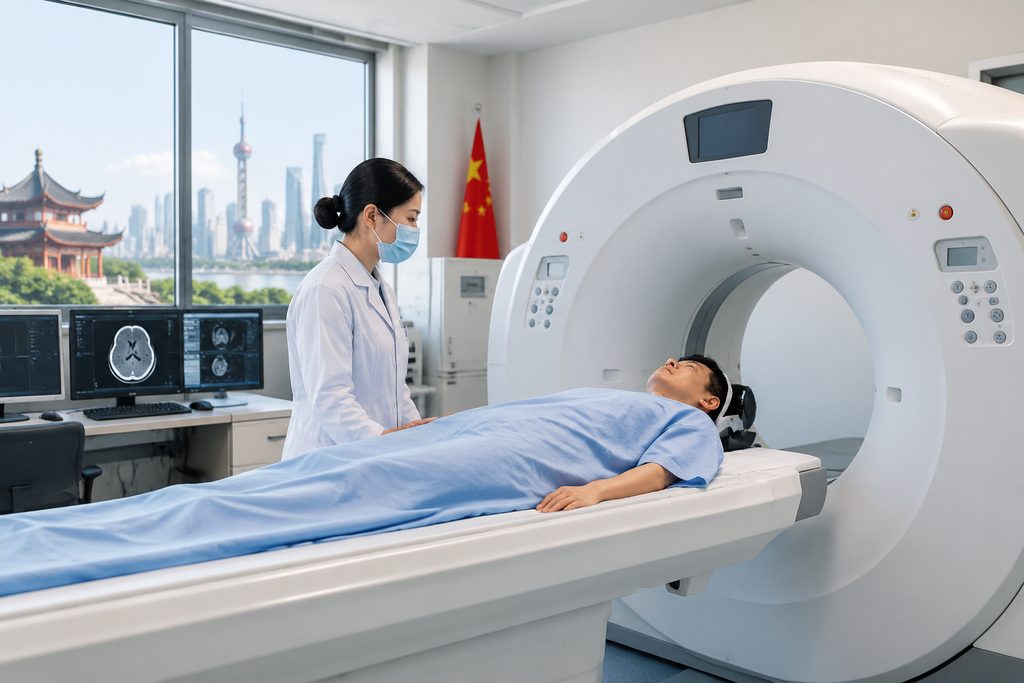
The 340+ top-ranked hospitals in our database — the top 5% of China’s 35,000+ hospitals, ranked by Fudan University and JCI accreditation — operate the same imaging hardware as major Western medical centers. Siemens SOMATOM, GE Revolution, Philips Incisive, and Canon Aquilion platforms are standard in tertiary hospitals. A 256-slice scanner in Shanghai produces the same image quality as a 256-slice scanner in Boston.
Here is a number worth sitting with. A large Chinese tertiary hospital may perform several hundred CT studies per day. Fuwai Hospital in Beijing, the world’s busiest cardiac surgery center with over 14,000 operations annually, generates imaging volume that would overwhelm most Western departments.
What does that mean for you? Radiologists at these institutions read thousands of studies per year in their specialty. Pattern recognition improves with repetition. That is not marketing — it is how diagnostic medicine works.
Regulatory oversight is real, not decorative
China’s National Health Commission sets radiation protection standards through GBZ 130, the national standard for radiological diagnosis and treatment protection. Hospitals are inspected. Dose limits for occupational workers follow International Atomic Energy Agency guidance. This is a regulated system, not a free-for-all.
Does that mean every hospital is equal? No. Standards are enforced more consistently at the top than at the periphery. That is true in every country, including yours.
How Much Radiation Is in a CT Scan — and Does Location Change It?
This is the question that keeps people up at night. Let us put real numbers on it.
Radiation dose is measured in millisieverts (mSv). For context, the average person receives about 3 mSv per year from natural background sources — radon, cosmic rays, the ground beneath your feet.
| Study | Typical Effective Dose (mSv) | Equivalent Chest X-Rays |
|---|---|---|
| Chest X-ray (single view) | 0.1 | 1 |
| Dental panoramic X-ray | 0.01 | 0.1 |
| CT head | 2 | 20 |
| CT chest (low-dose screening) | 1.5 | 15 |
| CT chest (standard) | 7 | 70 |
| CT abdomen and pelvis | 10 | 100 |
| CT coronary angiography | 12 | 120 |
These figures come from the American College of Radiology and the Health Physics Society. They are not China-specific because radiation physics does not change at the border. A 10 mSv abdominal CT is 10 mSv whether the scanner sits in Houston or Hangzhou.
What does vary is protocol. Modern scanners adjust dose automatically based on patient size — a technique called automatic exposure control. Low-dose protocols exist for lung cancer screening, kidney stone evaluation, and pediatric imaging. Chinese tertiary hospitals use these protocols, but you should ask. Always ask.
Is CT Scan Safe in China? What the Evidence Actually Shows
Let us be honest about risk instead of pretending it does not exist.
The linear no-threshold model — the conservative framework used by international radiation protection bodies — assumes that any radiation dose carries some theoretical cancer risk, with no safe threshold. Under this model, a single 10 mSv CT raises lifetime cancer risk by roughly 0.05%. For comparison, your baseline lifetime cancer risk is approximately 40%.
That is not zero. It is also not a reason to refuse a medically necessary scan. A CT that detects a treatable tumor at an early stage saves far more lives than the theoretical risk it introduces. The calculation flips entirely when the scan is unnecessary — which is why the real safety question is not “China or not” but “is this scan indicated at all.”
So: is CT scan safe in China? The honest answer is that the technology, protocols, and regulatory framework are equivalent to Western standards at the top-tier hospitals. The variable is not the country. The variable is the specific facility and the specific clinical justification.
CT Scan Cost China: Real Prices in Beijing and Shanghai
Now the numbers you came for. These are typical ranges at tertiary public hospitals and private international hospitals. Actual pricing varies by hospital, body part, contrast use, and case complexity.
| Study Type | Public Tertiary Hospital | Private International Hospital | U.S. Average |
|---|---|---|---|
| CT head, no contrast | $60–$120 | $250–$500 | $800–$1,500 |
| CT chest, no contrast | $80–$160 | $300–$600 | $900–$1,800 |
| CT abdomen/pelvis with contrast | $150–$350 | $500–$1,000 | $1,500–$3,500 |
| CT coronary angiography | $250–$500 | $800–$1,500 | $2,000–$4,000 |
| Low-dose lung screening CT | $60–$130 | $250–$450 | $500–$1,200 |
For a CT scan price Beijing hospital comparison, expect the lower end of these public ranges at institutions like Peking Union Medical College Hospital. Shanghai’s Ruijin and Zhongshan hospitals sit in similar territory. Private international hospitals — United Family, Jiahui, Parkway — charge more but offer English-speaking staff, shorter waits, and direct insurance billing.
What about medical imaging packages China? Some private facilities bundle a full-body screening — CT, ultrasound, bloodwork, sometimes MRI — into packages ranging from $800 to $3,000. These are popular with health-conscious travelers, though we would gently note that whole-body CT screening without clinical indication exposes you to radiation for unclear benefit. Discuss it with a physician first.
How Booking Actually Works — and Where People Get Stuck
This is the section that saves you a wasted flight.
Chinese public hospitals generally do not allow overseas patients to pre-book an outpatient CT slot from abroad. Registration happens on the day, in person, at the hospital. You queue, you take a number, you see the doctor, and the doctor orders the scan. For a CT alone, this can often be completed within a day or two at a large hospital.
Want to book CT scan in Shanghai in advance, with a confirmed appointment time and an English-speaking coordinator? That path exists — through hospital international departments and VIP channels. The trade-off is cost: roughly 1.5 to 2 times the standard rate. For some patients, that premium buys exactly what they need. For others, it is unnecessary.
The rules are different for anything involving admission or surgery. A surgical plan requires an in-person consultation first. No reputable Chinese hospital will schedule an operation based on overseas records alone. This is not bureaucracy — it is standard surgical practice worldwide.
If you want a specialist’s read on your existing imaging before deciding whether to travel at all, a written second opinion from a top Chinese hospital runs $300–$500. Video consultations range from $100 to $800 depending on the specialist tier, and multidisciplinary team reviews run $1,500–$2,000.
Practical Considerations for International Patients
Bring your records. Prior imaging on CD or DICOM files, radiology reports in English or with translation, medication lists, and relevant lab work. Chinese radiologists can read outside studies, but comparison with prior imaging improves accuracy substantially.
Visa category matters. For medical treatment in China, the applicable short-stay category is the S2 visa, which covers medical treatment and private affairs. Your accompanying family member also applies under S2. Requirements are set by the latest embassy or consulate guidance, and supporting hospital documentation is typically needed. Note clearly: the M visa is for commercial and trade activities — it is not a medical visa, despite what some outdated sources claim. Longer stays beyond 180 days fall under S1.
Payment and insurance. Public hospitals require prepayment; you then file for reimbursement with your insurer afterward. Private international hospitals often bill insurance directly. Bring a payment method that works in China — international credit cards are accepted at larger hospitals, but mobile payment dominates daily life.
Language. A large tertiary hospital may see 10,000+ outpatient visits per day. Signage is predominantly in Chinese. Radiology technicians will give you breathing instructions in Mandarin. Without language support, the process is navigable but stressful. Bilingual medical companions handle registration, queuing, payment, wayfinding, and translation — from $300 per day for a half or full day.
Follow-up after you return home. Request your images and reports on CD or via cloud link before departure. Your home physician will want them. Chinese hospitals issue reports in Chinese; ask for an English version or arrange translation.
Frequently Asked Questions
Is a CT scan in China as safe as one in my home country?
At top-tier Chinese hospitals, yes — the scanners, protocols, and regulatory standards are equivalent. The equipment comes from the same global manufacturers. The variable to watch is facility quality, which is why we focus on the top 5% of hospitals rather than the general pool.
Can I book a CT scan in China before I arrive?
Generally not at public hospitals, where same-day in-person registration is the norm. Private international hospitals and hospital VIP channels can sometimes arrange advance appointments at higher cost. Plan for flexibility in your first day or two.
What if the scan finds something serious?
This is the question that matters most. A serious finding means you need a treatment plan, and that requires an in-person specialist consultation. Chinese tertiary hospitals can typically arrange this quickly for international patients through their international departments. We help coordinate that next step, but we do not diagnose, and no service can guarantee a particular clinical outcome.
Do I need a referral to get a CT in China?
In practice, yes — a physician at the hospital orders the scan during your consultation. You cannot typically walk into a radiology department and request a CT directly. This is similar to most national health systems.
How much radiation is in a CT scan compared to other imaging?
A standard chest CT delivers about 7 mSv — roughly 70 chest X-rays, or about two years of natural background radiation. MRI and ultrasound use no ionizing radiation at all. If your clinical question can be answered by MRI or ultrasound, ask your physician whether CT is truly necessary.
Your Next Step
The core message is simple: CT imaging in China’s top hospitals is technically equivalent to Western standards, dramatically less expensive, and subject to real regulatory oversight. The friction is not quality — it is navigation.
We are China Medical Services. Our team connects international patients with 340+ top-ranked hospitals across 37 cities, and we handle the parts that are genuinely hard from abroad: hospital matching, appointment coordination, bilingual accompaniment, and visa guidance. We are not a hospital and we do not provide diagnoses or medical advice.
If you want to understand your options before committing to travel, start with a conversation. A written second opinion or video consultation can tell you whether a trip is even necessary — and any consultation fee is credited in full toward on-the-ground coordination if you decide to come within 90 days. No pressure, no obligation. Just clarity.
For more medical information and treatment options in China, visit chinamedservices.com (China Medical Services).
