Ultrasound-Guided Biopsy in China: What to Know Before You Go
Key Takeaways
- A core-needle or fine-needle biopsy with ultrasound guidance at a top-tier Chinese public hospital typically runs $300–$1,200 for the procedure itself, before pathology and imaging add-ons — a fraction of U.S. pricing for the same test.
- China’s leading hospitals perform these procedures at enormous volume, which is exactly why the complication rates at the top centers compare well with Western benchmarks.
- The hard part is not the needle. It is getting an appointment as a foreigner who does not speak Mandarin, in a hospital that may see 10,000 outpatients in a single day.
- Most biopsies require a prior in-person consultation with the ordering specialist. You cannot simply fly in and be scanned the next morning.
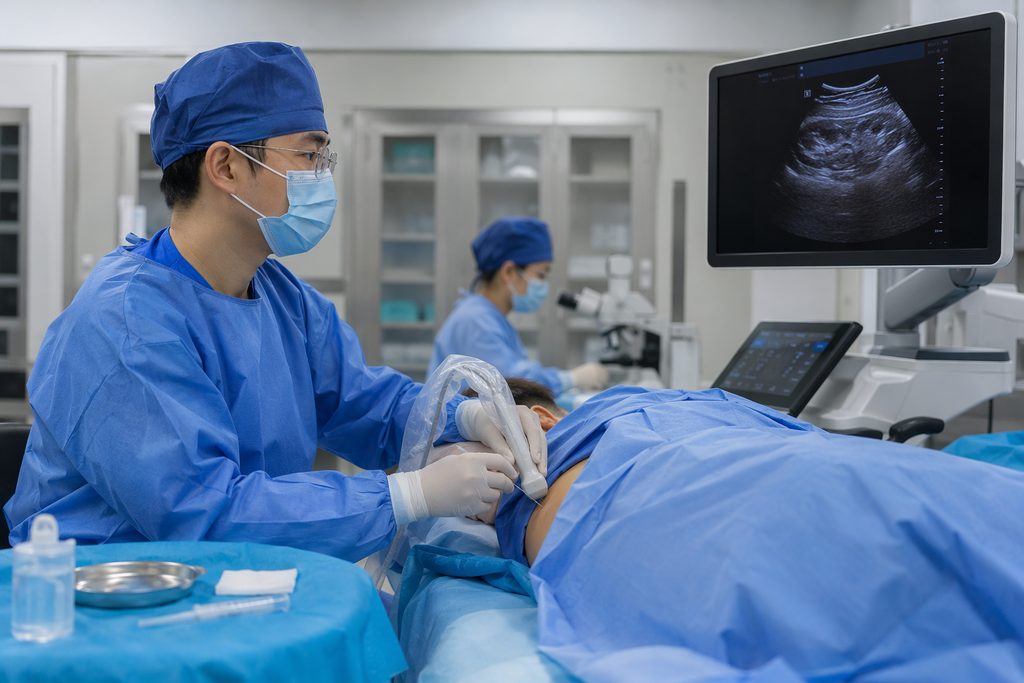
An ultrasound-guided biopsy is a small procedure that answers a big question. A doctor uses live ultrasound images as a map, guides a thin needle into a suspicious lump or organ, and removes a tiny sample of tissue. That sample goes to a pathologist, who tells you whether the mass is benign, malignant, or something in between.
Simple in principle. Stressful in practice — especially when you are weighing the ultrasound guided biopsy cost China hospitals charge against what you would pay at home, and wondering whether a foreigner can even navigate the system.
That is what this guide is for. We are China Medical Services, and our job is connecting international patients with China’s top-ranked hospitals. We are not doctors, and nothing here is medical advice. But we can explain, plainly, how this procedure works in China, what it costs, and what the process actually looks like on the ground.
The Problem: A Suspicious Scan and a System That Won’t Wait for You
You have a finding. Maybe a thyroid nodule, a breast lump, a liver lesion, an enlarged lymph node. Your doctor says the next step is a biopsy, and then the waiting begins. In the United Kingdom’s NHS, diagnostic waits for suspected cancer have repeatedly breached the 62-day referral-to-treatment standard in recent years. In Canada, median wait times from referral to a specialist consultation run past 20 weeks in several provinces. In the United States, the bottleneck is rarely the wait — it is the bill.
A single ultrasound-guided core needle biopsy in a U.S. hospital can land between $1,500 and $4,000 before pathology, and that pathology read can add another $500 to $2,000 depending on staining and molecular testing. Insurance may cover it. It may not. High-deductible plans leave patients holding thousands of dollars for a test that took fifteen minutes.
So patients start searching. And China shows up. Then the questions arrive fast: Is it safe? Who do I call? Do I need a visa? Can I just book it online?
The honest answer to that last one is no — not the way you would book a dental cleaning in Bangkok. China’s public hospital system is not built around walk-in international self-pay patients. Understanding that upfront saves a lot of frustration later.
Why China’s Top Hospitals Deliver Reliable Biopsy Results
China’s top tertiary hospitals are enormous by any Western standard. A single major center may run more than 10,000 outpatient visits in a day. Interventional radiology and ultrasound departments at these hospitals perform biopsies continuously, all day, across every organ system — thyroid, breast, liver, kidney, prostate, lymph nodes, soft tissue.
That repetition matters. Operator experience is one of the strongest predictors of diagnostic yield and complication rate in image-guided biopsy. A radiologist who performs dozens of thyroid fine-needle aspirations a week develops a feel that a low-volume operator simply cannot replicate. The Royal College of Radiologists and similar bodies have long noted that higher procedural volume correlates with fewer inadequate samples — the frustrating outcome where the pathologist cannot make a diagnosis and the patient has to repeat the whole thing.
Equipment and pathology depth
Top Chinese hospitals run current-generation ultrasound platforms with elastography and contrast-enhanced imaging, plus CT and MRI fusion guidance for lesions that are hard to reach. That is the same hardware you would find at a major U.S. academic medical center.
The less obvious strength is pathology. A biopsy is only as useful as the lab behind it. China’s leading centers have dedicated pathology departments with immunohistochemistry, molecular panels, and — at the biggest cancer centers — next-generation sequencing capacity. For a patient who needs not just a diagnosis but a full biomarker profile to guide treatment, that depth is the difference between one procedure and three.
Cost structure, not cost cutting
Here is the objection worth addressing head-on: lower price must mean lower quality, right?
Not in this case. The cost gap comes from structural economics — physician compensation levels, hospital operating costs, and the sheer throughput of the system — not from skipping sterile technique or using older needles. A top-tier Chinese public hospital charges a fraction of U.S. rates for the identical procedure because its cost base is a fraction of the U.S. cost base. Same procedure. Different economy.
What Ultrasound-Guided Biopsy Cost in China Actually Looks Like
Numbers first, caveats after. The table below reflects typical ranges at major public tertiary hospitals and private international hospitals. Final pricing depends on the hospital, the organ being sampled, whether contrast or fusion guidance is used, and how much pathology work is required.
| Cost Component | Public Tertiary Hospital | Private International Hospital | Typical U.S. Range |
|---|---|---|---|
| Ultrasound-guided FNA (fine needle) | $150 – $400 | $500 – $1,000 | $800 – $2,000 |
| Ultrasound-guided core needle biopsy | $300 – $1,200 | $900 – $2,200 | $1,500 – $4,000 |
| Pre-procedure ultrasound / imaging | $50 – $150 | $150 – $400 | $300 – $900 |
| Basic pathology report | $80 – $250 | $200 – $500 | $400 – $1,200 |
| Immunohistochemistry panel | $150 – $600 | $400 – $1,000 | $800 – $3,000 |
| Coagulation and pre-op labs | $30 – $100 | $100 – $250 | $200 – $600 |
A straightforward thyroid or breast core biopsy with standard pathology at a public hospital often lands in the $400 to $1,000 range all-in. At a private international hospital with English-speaking staff and direct insurance billing, expect roughly double. Either way, the arithmetic against U.S. pricing is not subtle.
Currency and payment matter too. Public hospitals generally require prepayment and settle in RMB; foreign cards work at some counters and not others. Private international hospitals usually accept international cards and can bill insurers directly. Plan your payment method before you arrive, not at the cashier window.
Is Ultrasound-Guided Biopsy Safe in China? What the Evidence Says
This is the question that decides everything, and it deserves a straight answer.
Ultrasound-guided biopsy is a well-established, low-risk procedure wherever it is performed competently. Major complication rates for core needle biopsy of superficial organs such as thyroid and breast are consistently reported in the low single digits per thousand procedures — bleeding, infection, and rarely needle-tract seeding. The technique itself is standardized internationally, and Chinese training programs for interventional radiology at top centers follow comparable protocols.
What varies is not the country. It is the institution and the operator.
So the safety question becomes a hospital-selection question. Three things to verify:
- Coagulation screening before the needle. Any reputable center checks platelet count and INR first. If a hospital skips this, walk away.
- Pathology accreditation and turnaround. Ask how many working days the report takes and whether immunohistochemistry is done in-house.
- Who holds the needle. At top centers, image-guided biopsies are performed by dedicated interventional radiologists or organ-specialist physicians, not by whoever is on shift.
One honest caveat: communication is the real risk in China, not the procedure. If you cannot describe your anticoagulant medication or your allergy history accurately, you are exposed. That is a language problem, and it is solvable — but only if you plan for it.
How Long Does Ultrasound-Guided Biopsy Take, Start to Finish?
The needle portion is quick. The surrounding logistics are not.
The procedure itself usually takes 15 to 30 minutes, including positioning, sterile prep, local anesthetic, and a short observation period afterward. Some patients are in and out of the procedure room within an hour. If you are counting only the hands-on time, that is your answer.
The full arc looks more like this:
- Day 1: Outpatient consultation with the ordering specialist. They review your existing imaging and labs, confirm the target lesion, and write the biopsy order.
- Day 1–3: Pre-procedure labs — coagulation panel, blood count, sometimes infectious disease screening.
- Day 2–5: The biopsy appointment itself. At busy public hospitals, scheduling depends on department load.
- Day 3–10: Pathology. A basic report may come in 2 to 4 working days; a full immunohistochemistry panel commonly takes 5 to 10.
Total realistic window from first consultation to pathology report: roughly one to two weeks. A well-coordinated trip can compress this considerably, but nobody should book a five-day round trip and expect a complete molecular workup.
Choosing the Best Hospital for Ultrasound-Guided Biopsy in China
There is no single “best hospital.” There is a best hospital for your specific organ and suspected condition.
China’s Fudan Hospital Rankings publish specialty-by-specialty reputation lists across 45 disciplines. For a thyroid nodule, you want a hospital ranked highly in endocrinology or head-and-neck surgery. For a liver lesion, look at hepatobiliary surgery and gastroenterology. For breast, general surgery and oncology. Our department-by-department top 10 lists map these rankings directly.
Geography matters almost as much. Fudan’s Top 100 hospitals cluster in 23 cities, with Beijing hosting 21, Shanghai 18, and Guangzhou 10. If you are traveling from Southeast Asia, Guangzhou or Shenzhen may be far more practical than Beijing. If you are coming from Europe or the Middle East, Shanghai and Beijing have the deepest international patient infrastructure.
Three selection criteria that matter more than rankings:
- Does the hospital have an international department or VIP channel? This is where English-speaking staff, faster scheduling, and coordinated billing live. Expect to pay roughly 1.5 to 2 times the standard channel price.
- Can they produce the pathology you need? A hospital that diagnoses but cannot run the molecular panel you need for treatment planning means a second trip or a sample shipped elsewhere.
- What happens after the result? A biopsy is a means to an end. If the finding is malignant, you want the diagnosis and the treatment plan to come from the same team where possible.
If you are considering a bundled arrangement, be careful with the phrase “medical tourism biopsy package China.” Some packages wrap consultation, procedure, and pathology into one price — which can be genuinely convenient — but you should still see the itemized breakdown. A package that hides which hospital and which department is doing the work is not a package worth buying.
Practical Considerations: Visas, Records, and Follow-Up
Start with the paperwork you already have. Bring your original imaging on disc or DICOM files, prior pathology reports if any, a current medication list including anticoagulants and antiplatelets, and your allergy history. Have these translated into Chinese by a qualified translator. Chinese clinicians read English, but the official record needs to be in Chinese for the hospital system.
On the visa question, this is where a lot of online information is simply wrong. Medical travel to China falls under the S2 visa, the short-stay category for medical treatment and private affairs. Accompanying family members apply under S2 as well. If treatment is expected to require a stay beyond 180 days, the S1 category applies instead. Requirements and supporting documents should always be confirmed with the latest embassy or consulate guidance, and you will typically need an invitation or supporting letter from the receiving hospital.
One correction worth stating clearly: the M visa is for commercial and trade activities. It is not a medical visa. Anyone telling you otherwise is giving you bad information.
On payment, public hospitals generally require prepayment in RMB and reimburse through your insurer afterward. Private international hospitals often bill insurers directly. If you are relying on reimbursement, confirm coverage with your insurer before travel and keep every itemized receipt and pathology report.
Finally, plan the follow-up. If your biopsy comes back benign, you may simply fly home with a report. If it comes back malignant, you will want a treatment discussion — and that conversation is far easier if you have already established a relationship with the treating team. Our guide to private international hospitals in China covers which facilities handle direct insurance billing and English-language care.
Frequently Asked Questions
Can I book an ultrasound-guided biopsy in China directly from overseas?
Not directly, and this is the most common misunderstanding. Public hospital outpatient registration typically happens in person on the day, and the biopsy itself requires a prior consultation with the ordering specialist. What can be arranged in advance is a consultation appointment — often through the hospital’s international department — with the biopsy scheduled afterward. Private international hospitals are more flexible and can sometimes coordinate the full sequence before you fly.
How much should I budget in total, including travel?
For the medical portion alone, budget $400 to $1,200 at a public tertiary hospital or roughly double at a private international hospital, covering consultation, labs, the procedure, and standard pathology. Add $150 to $600 if immunohistochemistry is required. Travel, accommodation, and visa costs sit outside that. Final figures vary by hospital and case complexity, so request a written estimate from the specific hospital before committing.
What if the biopsy result is inconclusive or something goes wrong?
Inconclusive results happen everywhere — typically because the sample was insufficient or the lesion was hard to reach. At a high-volume center, the repeat rate is lower, but it is not zero. If a repeat is needed, it is usually performed at no additional procedure charge within a short window, though pathology may be billed again. For complications such as bleeding, top hospitals have on-site emergency and interventional radiology backup. This is precisely why hospital selection matters more than price. We would rather tell you to choose the safer center than the cheaper one.
Do I need a medical visa, and how long does it take?
Medical travel uses the S2 visa, with S1 for stays expected to exceed 180 days. Processing times vary by consulate and season, and documentation requirements change. Confirm current requirements with your nearest Chinese embassy or consulate and allow more time than you think you need. Do not book flights before the visa is in hand.
Your Next Step
The short version: an ultrasound-guided biopsy in China is a fast, low-risk, well-established procedure at a fraction of Western pricing — and the hard part is never the needle, it is the navigation.
We are China Medical Services, a coordination service that connects international patients with 340+ top-ranked hospitals across 37 cities. We do not diagnose, we do not treat, and we are not a hospital. We handle the parts that trip people up: hospital matching, appointment coordination, bilingual accompaniment, and visa guidance. If you would like a written second opinion or a video consultation with a Chinese specialty team before deciding anything, our team can walk you through the options — no pressure, no obligation. Start with a free consultation whenever you are ready
For more medical information and treatment options in China, visit chinamedservices.com (China Medical Services).
