Pelvic MRI in China: How to Book It and What It Really Costs
Key Takeaways
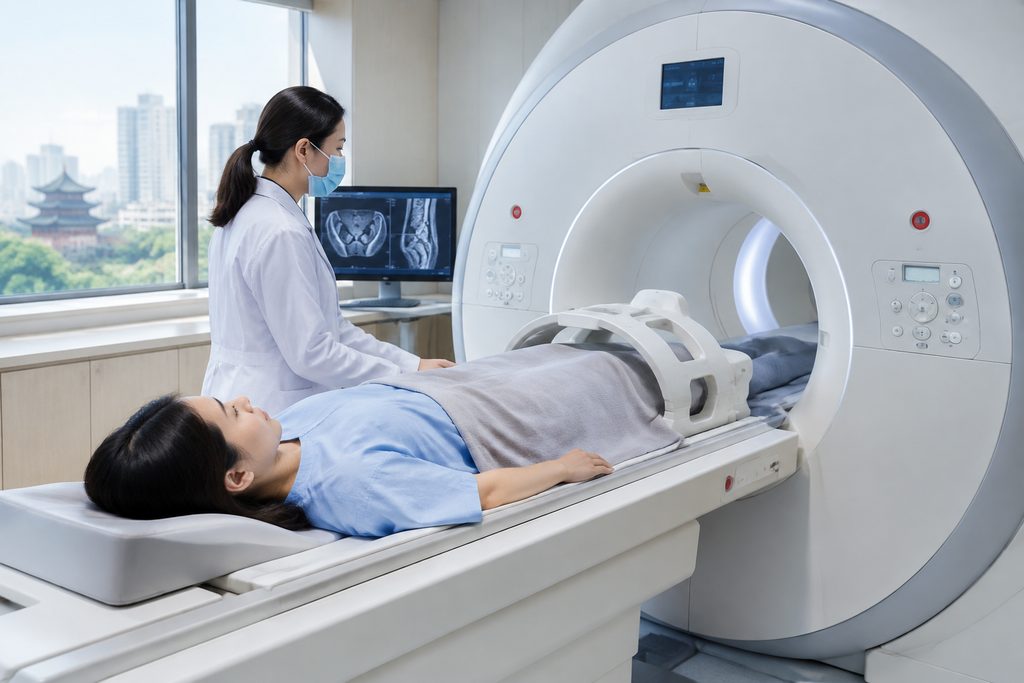
- A pelvic MRI at a top-tier Chinese public hospital typically runs $300–$800, compared with $1,500–$4,000 in the United States for the same scan without contrast.
- China’s best imaging centers use the same 3-Tesla and 1.5-Tesla machines as Western hospitals — Siemens, GE, Philips — so the technology gap many patients imagine does not exist.
- The real obstacle is not quality or price. It is access: ordinary outpatient slots cannot be reserved from overseas, and public hospital imaging queues move on a same-day registration system.
- Understanding the difference between a standard public appointment and an international-department channel is the single most important thing before you book anything.
The Problem: The Scan You Need Is Priced Like a Mortgage Payment
What if the imaging test your specialist ordered costs more than a used car?
In the United States, a pelvic MRI without contrast averages roughly $1,500 to $4,000 depending on the facility, and hospital-based imaging sits at the top of that range. A 2023 analysis of national claims data found that MRI prices in the U.S. vary by more than 1,000% between the cheapest and most expensive providers in the same metropolitan area. For an uninsured patient, or someone carrying a high-deductible plan, that single scan can wipe out a savings account before treatment even begins.
Wait times compound the pain. In Canada and the UK, non-urgent MRI waits routinely stretch past 8 to 12 weeks. In the U.S., scheduling is faster but the bill arrives first. And for patients in the Middle East, Southeast Asia, or Russia who want a second look at a complex pelvic finding — endometriosis, a uterine fibroid, a suspected prostate lesion, a staging question after a cancer diagnosis — the options at home may be limited by cost, queue, or both.
That is the gap China fills. Not because Chinese medicine is exotic, but because the arithmetic is different.
Why Pelvic MRI in China Delivers Results at a Fraction of Western Prices
The pelvic MRI cost China advantage is not a marketing claim. It comes from structural economics that have nothing to do with cutting corners.
Imaging Volume That Keeps Machines Running Around the Clock
China’s top hospitals are enormous. A single major tertiary hospital may perform more than 100,000 MRI examinations per year across its scanners. That volume spreads equipment depreciation, staffing, and maintenance across far more patients than a typical Western imaging center handles. When a 3T scanner runs 14 hours a day instead of 8, the per-scan cost falls — and that saving shows up in your bill, not in a lower-quality image.
The equipment itself is imported. Siemens Healthineers, GE Healthcare, and Philips dominate the installed base at top Chinese hospitals, and many centers run the same software platforms used at academic medical centers in Boston or Heidelberg. A radiologist reading your pelvic MRI in Shanghai is looking at the same resolution, the same sequences, and the same contrast behavior as one reading it in Chicago.
Subspecialty Radiology, Not General Reading
Here is where China’s big hospitals quietly outperform. Because case volumes are so high, radiology departments split into narrow subspecialties. Abdominal and pelvic imaging is its own reading group. Genitourinary MRI — prostate, bladder, uterus, ovaries, rectum — is read by radiologists who see these cases daily, not occasionally. For something like deep infiltrating endometriosis or rectal cancer staging, that repetitive exposure matters. Studies on diagnostic accuracy consistently show that subspecialty readers outperform general radiologists on complex pelvic pathology.
Cost Without the Quality Trade-Off
Address the obvious objection directly: lower price does not mean lower standard. Labor economics explain most of the difference. Physician salaries, facility overhead, and administrative costs in China are a fraction of U.S. levels. Malpractice insurance — a major line item in American imaging pricing — is negligible by comparison. None of these factors change the physics of the magnet or the training of the reader.
What you give up is convenience and English-language infrastructure at the general-public level. That is a real trade-off, and it is the reason most international patients use the international department or a coordination service rather than walking into a standard outpatient hall.
What a Pelvic MRI Actually Costs in China: Real Numbers
Prices vary by hospital tier, city, and whether contrast is used. The table below reflects typical ranges at top-ranked public hospitals and private international hospitals. Figures are in USD and exclude coordination or interpretation services.
| Setting | Pelvic MRI (no contrast) | With contrast | Report in English |
|---|---|---|---|
| Top public hospital, Beijing or Shanghai | $300–$550 | $450–$800 | Usually extra, $50–$150 |
| Second-tier city public hospital | $200–$400 | $350–$600 | Often unavailable |
| Private international hospital | $700–$1,500 | $900–$1,800 | Included |
| United States (comparison) | $1,500–$4,000 | $2,000–$5,000 | Included |
So how much does pelvic MRI cost in Shanghai specifically? At a major public tertiary hospital such as Ruijin or Zhongshan, a non-contrast pelvic scan usually falls between $300 and $550. Add contrast and you are looking at $450 to $800. At a private international facility like United Family or Jiahui, expect $700 to $1,500 — higher, but with English-speaking staff, direct insurance billing, and same-week scheduling.
Is Pelvic MRI Safe in China? What the Standards Actually Look Like
The question “is pelvic MRI safe in China” usually hides two separate worries: equipment safety and diagnostic reliability. Both have clear answers.
MRI itself carries no ionizing radiation, so the scan is inherently low-risk wherever it is performed. The genuine safety considerations are contrast agents and screening protocols. Chinese top-tier hospitals follow gadolinium contrast guidelines consistent with international practice, and they screen for kidney function, pregnancy, and metallic implants before every contrast study. If you have a pacemaker, cochlear implant, or ferromagnetic surgical clip, that screening is not optional — and reputable centers enforce it.
On reliability: Chinese radiology reports from major hospitals are accepted by clinicians worldwide, particularly when accompanied by the DICOM image files. Ask for the images on a disc or via secure download, not just the written report. Any specialist abroad can then re-read them.
How to Book Pelvic MRI in China for International Patients: The Step-by-Step Reality
This is where expectations meet the actual system, and where most overseas patients get stuck.
Ordinary public hospital outpatient imaging cannot be reserved from abroad in advance. The standard workflow is same-day registration: you arrive, take a queue number, see a physician who writes the imaging order, pay, then schedule the scan — often days later. For a visitor with a two-week trip, that sequence is workable but tight.
The alternative is the hospital’s international department or VIP channel. These units accept advance scheduling, provide English-speaking staff, and can often complete consultation, imaging, and reporting within a few days. The trade-off is price: expect roughly 1.5 to 2 times the standard public rate. For many international patients, that premium buys exactly what they need — predictability.
Here is the practical sequence most patients follow:
- Gather your existing records — prior imaging, lab work, referral note, and a clear statement of what question the scan needs to answer.
- Choose a city and hospital tier. Beijing and Shanghai have the deepest subspecialty radiology, but cities like Chengdu, Guangzhou, and Hangzhou also host top-ranked centers with shorter queues.
- Secure an appointment through the international department or a coordination service. This is the step that cannot be improvised on arrival.
- Bring your passport, your visa, and payment. Public hospitals require prepayment; private international hospitals often bill insurance directly.
- Collect both the written report and the DICOM images before you leave the country.
For a broader look at how hospital selection works across specialties, our guide to China’s top-ranked departments by specialty breaks down which centers lead in radiology-adjacent fields like oncology and gynecology.
Public Hospital vs. Private International Hospital: Choosing the Right Channel
Neither option is universally better. The right choice depends on what you value most.
Choose a top public hospital if cost is the priority and you can accept a less English-friendly environment. You get world-class subspecialty reading at the lowest price. You will likely need language support for registration, payment, and wayfinding — these hospitals see tens of thousands of outpatients daily, and navigation is genuinely difficult without Chinese.
Choose a private international hospital if you want speed, English service, and direct insurance billing. You pay two to three times more, and for very rare or complex pelvic pathology, the subspecialty depth may be thinner than at a flagship public center.
There is a hybrid many patients use: imaging at a top public hospital for accuracy and price, with a bilingual companion handling logistics. That combination often delivers the best of both. Our overview of top-ranked Chinese hospitals by city can help you see what is available where.
Practical Considerations Before You Fly
Visa category matters. For short medical visits, the S2 visa is the applicable category used for medical treatment and private affairs, and accompanying family members apply under the same category. Requirements shift, so confirm current rules with the nearest Chinese embassy or consulate and bring supporting hospital documentation. Note that the M visa is for commercial and trade activity — it is not a medical visa.
Payment is another detail to plan. Public hospitals require prepayment, typically by card or mobile payment; foreign credit cards work at international departments but not always at general cashiers. Private hospitals usually settle directly with international insurers, but verify your policy’s China coverage before relying on it.
Timing deserves honesty. A realistic trip for a single pelvic MRI plus a specialist consultation runs 5 to 10 days including travel and reporting. Rushing it risks leaving without your images.
Frequently Asked Questions
At public hospitals, yes — a physician must write the imaging order, which is why most international patients book a consultation and the scan together. Private international hospitals are more flexible and may accept a direct imaging request, but a written clinical question from your home doctor still produces a far more useful report.
At international departments and top-tier hospitals, usually yes — many specialists trained abroad or read English literature routinely. For general public departments, assume not, and arrange translation of your key records in advance. A clear clinical question in Chinese dramatically improves report quality.
Some international policies reimburse overseas imaging, but most require pre-authorization and itemized receipts. Public hospitals issue formal invoices that satisfy most reimbursement requirements. Confirm with your insurer before traveling, and keep every receipt and the imaging report.
At top public hospitals, a formal report typically takes 1 to 3 working days; urgent cases can be faster. Private international hospitals often return preliminary findings within 24 hours. Always request the DICOM image files alongside the report — they let any physician anywhere re-read the study.
Your Next Step
A pelvic MRI in China can cost a fifth of what you would pay in the United States, on equivalent equipment, read by subspecialists who see these cases every day. The barrier is not quality — it is navigating a system that was not designed for overseas patients.
We are China Medical Services, a coordination team that connects international patients with top-ranked Chinese hospitals. We are not a hospital and we do not provide diagnoses or medical advice; we handle hospital matching, appointment coordination, bilingual accompaniment, and visa guidance so you can focus on your health. If you would like to understand your options, start with a free consultation at our patient services page — no pressure, just clear answers.
This article is for general information only and does not constitute medical advice. Imaging decisions should always be made with a qualified physician who knows your individual history.
For more medical information and treatment options in China, visit chinamedservices.com (China Medical Services).
