Wrist MRI in China: How to Book It and What It Really Costs
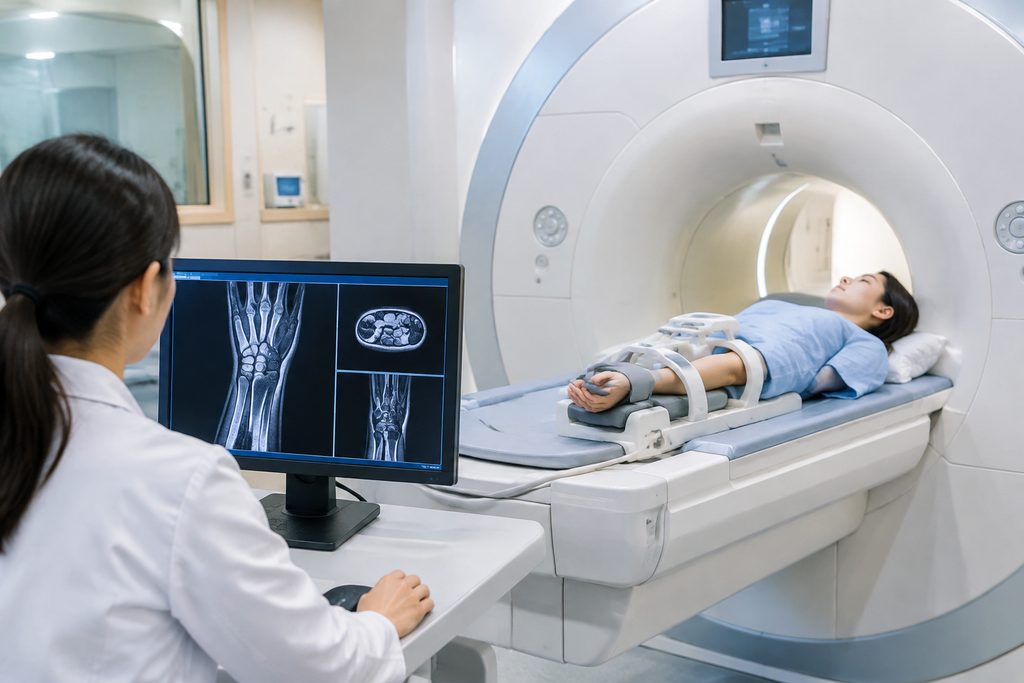
Wrist MRI in China: How to Book It and What It Really Costs
You have probably been told that getting a wrist MRI in China means compromising on either quality or convenience. The reality runs in the opposite direction. A wrist MRI cost in China typically lands between $150 and $500 at a top-tier public hospital, compared with $1,200 to $3,000 in the United States for the same scan on comparable equipment. The machines are the same Siemens, GE, and Philips units you would find in a Boston or Munich radiology department. What differs is the price, the queue, and the language barrier you will need help crossing.
This guide walks through exactly how to book a wrist MRI in China, what the scan involves, how long it takes, and where the friction points hide.
How This Actually Works, Step by Step
Booking a wrist MRI from overseas is not the same as booking one from your neighborhood clinic. Chinese public hospitals do not open their standard appointment systems to foreign patients in advance. Here is the real sequence.
Step one — you send us your existing records. That means your referral note, any prior X-rays or CT scans, and a short description of your symptoms. A hand surgeon or musculoskeletal radiologist at the Chinese hospital reviews this material before anything gets scheduled.
Step two — the hospital tells us what protocol is needed. A wrist MRI is not one scan. It could be a standard non-contrast study, an MR arthrogram for ligament tears, or a dedicated cartilage protocol. The radiologist decides based on your history. Getting this wrong wastes a trip.
Step three — we coordinate the appointment through the hospital’s international office. This is where the booking actually happens. The international department holds a small number of slots for foreign patients, and those slots move faster than the general queue. Expect a lead time of three to ten business days for a routine scan, longer if you need a specific subspecialist to read it.
Step four — you arrive, register, and get scanned. The scan itself takes 20 to 45 minutes depending on the protocol. You will have a bilingual companion with you for registration, payment, and the walk to the imaging suite.
Step five — the report comes back. Most hospitals issue a written radiology report within 24 to 48 hours. If you need it translated for your doctor at home, that can be arranged.
Why the Price Gap Is So Wide — and What It Does Not Cover
The wrist MRI cost China patients pay reflects a different cost structure, not lower quality. Chinese public hospitals run imaging equipment at very high utilization. A single 3T MRI scanner in a major Shanghai or Beijing hospital may perform 40 to 60 scans per day. That volume spreads the equipment cost across far more patients than a typical Western hospital achieves.
Government price caps on diagnostic imaging also keep the sticker price down. A non-contrast wrist MRI at a top public hospital in Beijing or Shanghai generally falls in the $150 to $350 range. At a private international hospital like United Family or Jiahui, you will pay $400 to $800 for the same study, but you get English-speaking staff, direct insurance billing, and a much shorter wait.
| Setting | Typical Price (USD) | Wait Time | English Support |
|---|---|---|---|
| Top public hospital (Beijing/Shanghai) | $150 – $350 | 3–10 business days | Limited; companion needed |
| Public hospital international/VIP channel | $300 – $550 | 2–5 business days | Yes |
| Private international hospital | $400 – $800 | 1–3 business days | Yes, direct billing |
| United States (comparison) | $1,200 – $3,000 | 1–3 weeks | Yes |
What that price does not cover: contrast dye if needed (add $80–$150), a second read by a subspecialist, translation of the report, or the cost of getting to the hospital. Those add up. Budget $500 to $900 all-in for a public hospital scan with companion support and translation.
A Realistic Timeline
Here is how a wrist MRI trip actually unfolds, with the waiting steps people forget.
| Stage | What Happens | Realistic Duration |
|---|---|---|
| Records review | You send reports; Chinese specialist reviews | 2–5 days |
| Appointment coordination | International office books the slot | 3–10 business days |
| Visa (S2 category) | Apply with hospital invitation letter | 5–15 business days |
| Travel and arrival | Flight, hotel, jet lag recovery | 1–2 days |
| Scan day | Registration, scan, payment | Half a day |
| Report issued | Radiologist writes and releases report | 24–48 hours |
| Translation (optional) | Certified English version for your doctor | 2–4 days |
Total from first contact to report in hand: roughly three to five weeks if you need a visa. If you are already in China on a valid visa, you can compress this to seven to twelve days. The visa step is the one most people underestimate. You need an S2 visa for medical treatment, not an M visa — the M category is for commercial and trade activities and will not cover a hospital visit.
What Can Go Wrong — and What Happens Then
Honesty matters more than reassurance here. Several things can derail a wrist MRI trip.
The hospital cannot fit you in during your travel window. This happens during peak periods. The recourse is straightforward: we shift the booking to a partner hospital in the same city, or you adjust your dates. No scan, no coordination fee beyond the deposit.
Your prior imaging is not compatible. Some hospitals will not accept outside CDs or DICOM files without re-reading them first. If your home scans are more than six months old, the radiologist may ask for a fresh X-ray before the MRI. That adds a day.
The scan reveals something that needs a surgeon. A wrist MRI can show a scapholunate ligament tear or a TFCC injury that requires arthroscopy. If that happens, you are now in a treatment decision, not just a diagnostic one. The radiologist will flag it, and you can request a surgical consultation — but that is a separate appointment and a separate cost.
Language breakdown at registration. This is the most common failure point. Public hospital registration desks rarely have English-speaking staff. Without a companion, patients get stuck at the payment window or sent to the wrong floor. A bilingual medical companion solves this for a flat daily rate.
Choosing the Right Hospital for Your Wrist MRI
The best hospital for wrist MRI in Shanghai is not necessarily the best one in Beijing, and the right choice depends on what you need done with the result.
If you need a straightforward diagnostic scan and a report to take home, a top public hospital radiology department is the most cost-effective option. Look for hospitals with a dedicated musculoskeletal radiology section and a 3T scanner. Higher field strength matters for small joints like the wrist — the ligaments and triangular fibrocartilage complex are tiny structures, and 3T gives better resolution than 1.5T.
If you suspect a ligament tear or need a surgical opinion alongside the scan, choose a hospital with a strong hand and upper-extremity surgery department. In Beijing, several tertiary hospitals have dedicated hand surgery units. In Shanghai, the major teaching hospitals have comparable programs. You can browse the specialty rankings by department to see which hospitals lead in orthopedics and hand surgery.
If you want everything in English with direct insurance billing, a private international hospital is the smoother path. You will pay two to three times more, but the process is closer to what you know from home.
One practical note: ask whether the radiologist who reads your scan specializes in musculoskeletal imaging. A general radiologist can read a wrist MRI, but a subspecialist catches more. This is worth confirming before you book.
Practical Considerations: Records, Visa, Payment, and Follow-Up
Records. Bring your prior imaging on a CD or USB drive, plus printed reports. Chinese hospitals can read standard DICOM files, but having physical media avoids delays. If your reports are in English, that is fine — most radiologists at top hospitals read English fluently.
Visa. Apply for an S2 visa for short-stay medical treatment. You will need an invitation letter or appointment confirmation from the hospital. Processing takes five to fifteen business days depending on your consulate. Do not book flights until the visa is approved. Family members accompanying you apply for the same S2 category.
Payment. Public hospitals require prepayment before the scan. Cash, international credit cards, and Alipay are usually accepted at the international office, but not always at general registration windows. Private hospitals take international insurance directly. If you are using travel insurance, confirm coverage before you arrive — most policies do not cover elective diagnostic imaging abroad.
Language. This is the single biggest friction point. Even a simple scan involves registration, consent forms, payment, and instructions from the technologist. A bilingual companion handles all of it. Our patient consultation page explains how that works.
Follow-up at home. Ask for the DICOM files on a disc before you leave. Your orthopedic surgeon at home can review the raw images, not just the written report. This is important — a report is an interpretation, and your doctor may see something different.
Frequently Asked Questions
Yes. MRI is a non-invasive imaging technique with no ionizing radiation. The safety profile is identical to an MRI anywhere else in the world. The main contraindication is implanted metal devices, which you should disclose before the scan. Chinese hospitals follow the same screening protocols used internationally.
The scan itself takes 20 to 45 minutes, depending on whether contrast is used and how many sequences the radiologist requests. Add 30 to 60 minutes for registration, payment, and waiting. Plan for a half-day at the hospital, especially at a large public institution.
Not easily on your own. Public hospital appointment systems and registration desks operate in Chinese. You can book through a hospital’s international office, which has English-speaking staff, or use a bilingual companion service. The international office route is cheaper but has fewer available slots.
Not necessarily. A package makes sense if you want the scan, a specialist consultation, and translation bundled together. If you only need the imaging and a report, booking the scan directly through a hospital’s international office is simpler and less expensive.
A public hospital in China charges roughly $150 to $350. The same scan in the US runs $1,200 to $3,000. Private international hospitals in China fall in the $400 to $800 range, still well below US pricing. Final cost varies by hospital and case complexity.
Your Next Step
A wrist MRI in China is faster and cheaper than most patients expect, but the booking process rewards preparation. Get your records ready, confirm your visa category, and decide whether you want the public hospital price or the private hospital convenience. We are China Medical Services — we help international patients navigate Chinese hospitals, from imaging appointments to surgical coordination. We do not provide medical advice or guarantee clinical outcomes. If you want help figuring out which hospital fits your case, start with a free consultation and we will walk you through the options.
For more medical information and treatment options in China, visit chinamedservices.com (China Medical Services).
