Checkup in China: Remote Report Review Before You Fly
Key Takeaways
- A written second opinion from a top-tier Chinese hospital typically runs $300–500, and that fee is credited in full toward on-the-ground coordination if you travel within 90 days.
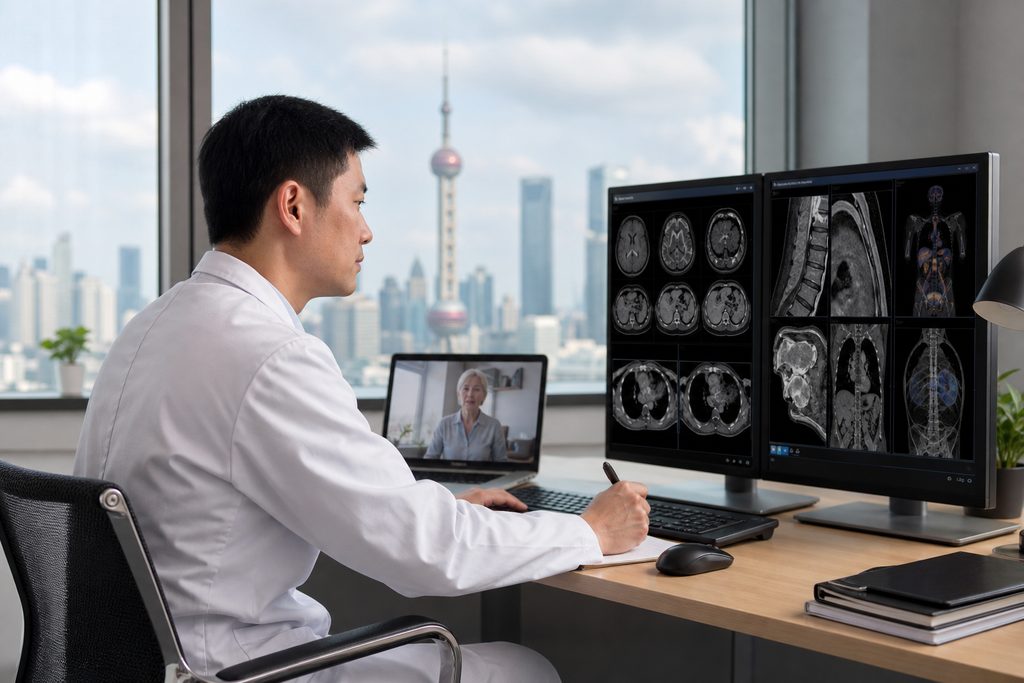
- Remote report review lets a Chinese specialty team study your existing scans and labs before you commit to flights, hotels, or a hospital deposit.
- Public hospital outpatient slots cannot be reserved from overseas in most cases — you queue on the day, and surgery is only scheduled after an in-person consultation.
- Nothing here is a diagnosis. A remote review is an opinion, and any treatment decision belongs to you and a licensed physician who has examined you.
The Problem: You Have Reports, But No Readable Answer
Roughly one in three adults in the United States has at least one chronic condition serious enough to warrant specialist follow-up, according to CDC surveillance data. Many of them are handed a folder of imaging and lab results and told to “come back in three months.”
That folder is where the anxiety lives. A 2023 survey by the American Medical Association found that patients wait an average of 26 days for a specialist appointment in major US metro areas — and that is before any second opinion. In Canada and the UK, waits for elective specialist review routinely stretch past 20 weeks.
So people start looking outward. They hear that a top Chinese hospital can review the same MRI in days, not months, and that the price of a full executive workup is a fraction of what a US hospital bills. Then the practical questions arrive. Who reads the file? How do they read it if they have never examined me? Is any of this safe?
Those are fair questions. And they have concrete answers.
How Remote Report Review Actually Works for a Checkup in China
Imaging files (DICOM on a disc or cloud link), pathology slides or reports, lab panels, discharge summaries, medication lists, and a short written history. Translation into Chinese is handled on our side. The hospital’s international department receives a clean, indexed file rather than a stack of loose PDFs.
This is where the value sits. At a Fudan-ranked hospital, the reviewer is a physician in the relevant department — cardiac surgery, oncology, orthopedics, reproductive medicine, and so on. They are not generalists skimming a summary.
Expect a document covering the interpretation of your existing findings, whether additional testing is warranted, what treatment directions are reasonable, and — importantly — whether traveling to China would change anything at all. Sometimes the honest answer is no.
If you want to ask questions directly, a video consultation adds $100–300 at a standard international department, or $500–800 with a top specialist. Multidisciplinary team reviews, where several departments confer together, run $1,500–2,000.
What a Medical Checkup Cost China — Real Numbers
Cost is the question everyone asks first, so here is the honest version. A medical checkup cost China comparison depends heavily on the tier of hospital and the depth of the package. The table below reflects typical ranges for international patients.
| Service | Typical Cost in China (USD) | Comparable US Cost (USD) |
|---|---|---|
| Written second opinion (top-tier hospital) | $300–500 | $500–1,500 |
| Video consultation (standard international dept.) | $100–300 | $300–800 |
| Top-specialist video consultation | $500–800 | $800–2,000 |
| Executive checkup package (basic) | $400–900 | $2,000–5,000 |
| Executive checkup package (comprehensive, imaging included) | $1,200–3,000 | $5,000–15,000 |
| Cardiac bypass surgery (reference point) | $12,000–20,000 | $120,000+ |
Every figure varies by hospital and case complexity. A comprehensive package at a private international hospital in Beijing will sit at the top of its range; the same panel at a public tertiary hospital’s international wing can land far lower. Neither is “better” in the abstract — they solve different problems.
Is a Health Checkup in China Safe for Foreigners?
This is the question that decides whether people book or walk away, and it deserves a direct answer rather than reassurance.
China’s top-tier hospitals are accredited, heavily audited, and perform procedure volumes that most Western centers cannot match. Fuwai Hospital in Beijing, for example, performs more than 14,000 cardiac surgeries annually — the highest volume in the world. High volume correlates with refined protocols and experienced teams. That is a structural fact, not a marketing claim.
What makes it feel unsafe is not the medicine. It is the navigation.
A major Chinese public hospital can see over 10,000 outpatients in a single day. Signage is in Chinese. Registration systems assume a national ID or a local medical card. Payment is upfront, with insurance reimbursed afterward rather than settled at the counter. For a patient who speaks no Mandarin, the experience is genuinely disorienting — and disorientation is where mistakes happen.
Book a Medical Checkup China With Remote Consultation: Choosing the Right Hospital
There are three distinct tiers, and picking the wrong one wastes money or time.
Public tertiary hospitals (top 5% nationally). These are the Fudan-ranked institutions — Peking Union Medical College Hospital, Zhongshan Hospital Fudan University, West China Hospital, Ruijin Hospital. Best for complex diagnostics and serious surgical evaluation. Expect scale, crowds, and excellent clinical depth. Our directory of top-ranked Chinese hospitals by city groups them by tier so you can see what exists in Beijing, Shanghai, or Guangzhou before you commit.
Private international hospitals. United Family, Jiahui, Parkway, Raffles. English-speaking staff, JCI accreditation, direct insurance billing, Western-style appointment scheduling. Best for executive checkups, routine screening, and anyone who values a calm environment over the lowest possible price. See the private international hospital listings for the full picture.
Traditional Chinese Medicine hospitals. Acupuncture, tuina, and herbal formulation — most relevant for chronic condition management and rehabilitation rather than acute diagnostics. The TCM hospital section covers what these institutions actually treat well.
Best Hospitals in Beijing for Executive Checkups
Beijing holds 21 of the Fudan Top 100 hospitals — more than any other Chinese city. For executive checkups specifically, the practical split is between public tertiary international wings (stronger diagnostics, higher volume, less hand-holding) and private international hospitals (smoother experience, faster scheduling, English-first service). Both are legitimate. Your choice should follow what you need the checkup to accomplish.
China Medical Checkup Package for International Patients: What Should Be Inside
A package is only as good as its components. Watch for these inclusions when comparing offers.
- Baseline bloodwork including lipid panel, fasting glucose, liver and kidney function, and complete blood count
- Imaging appropriate to age and risk — low-dose chest CT is common in Chinese executive packages and far more sensitive than chest X-ray
- Cardiac screening: ECG, echocardiography, and carotid ultrasound where indicated
- Cancer marker panels, interpreted with the caveat that markers alone are not diagnostic
- Gastroenterology options — endoscopy and colonoscopy are frequently included and priced far below Western rates
- A written report in English, plus a physician debrief
What is often missing? A clear statement of what happens if something abnormal turns up. Ask before you book. A good package includes a pathway, not just a printout.
Practical Considerations Before You Commit
Visa. For medical treatment in China, the applicable short-stay category is the S2 visa, issued for medical treatment and private affairs. Stays beyond 180 days fall under S1. Accompanying family members apply under S2 as well. Requirements shift, so confirm current documentation with the nearest Chinese embassy or consulate and secure supporting letters from the hospital. Note that the M visa is for commercial and trade activity — it is not a medical visa, and using it for treatment creates problems at entry.
Payment. Public hospitals require prepayment. International cards are accepted at international departments but not universally at general counters. Private international hospitals frequently bill insurers directly. Bring a backup payment method and confirm limits with your bank before departure.
Records. Request your imaging on DICOM format, not just the radiologist’s report. A Chinese specialist reading the actual images will give you a far more useful opinion than one reading a summary.
Follow-up. Ask how results will be communicated after you return home, and whether the hospital will release records in English. Get this in writing.
Frequently Asked Questions
Can a Chinese doctor really give a useful opinion without examining me?
For many conditions, yes — imaging, pathology, and lab data carry most of the diagnostic weight. But there are limits. Anything requiring palpation, real-time ultrasound, or functional assessment cannot be fully evaluated remotely. A responsible reviewer will tell you what they cannot determine from documents alone.
What if the remote review says I do not need treatment in China?
That happens more often than you might expect, and it is a good outcome. You have spent a few hundred dollars instead of several thousand on flights and hotels. A second opinion that closes a question is worth as much as one that opens a treatment path.
Is the consultation fee refundable if I decide not to travel?
The fee covers work already performed, so it is not refunded. The 90-day credit applies only if you proceed to on-the-ground coordination. Hospital appointment coordination is different — if we cannot secure the appointment described in your order, that fee is refunded in full.
Do I need to speak Mandarin?
At private international hospitals, no. At public tertiary hospitals, you will need interpretation for registration, payment, pharmacy, and clinical conversations. Bilingual medical companion support starts from $300 per day, covering queueing, registration, payment, wayfinding, and translation.
How long does a remote review take?
Once a complete file reaches the international department, written opinions typically return within several business days. Incomplete files are the main cause of delay — missing imaging or untranslated pathology reports push timelines out considerably.
Your Next Step
Remote report review exists to answer one question honestly: is traveling to China worth it for your situation? Sometimes the answer is yes, sometimes it is no, and sometimes it is “not yet.” All three are useful.
China Medical Services is a coordination service, not a hospital and not a diagnostic provider. We handle record translation, appointment coordination through official international departments, and bilingual accompaniment — nothing more, and we never promise a specific specialist or a guaranteed surgery date. If you would like your existing reports reviewed by a Chinese specialty team, start with a free consultation and we will tell you plainly whether a remote review makes sense for your case.
For more medical information and treatment options in China, visit chinamedservices.com (China Medical Services).
