Lymphedema Surgery China: Supermicrosurgery Breakthrough After Cancer
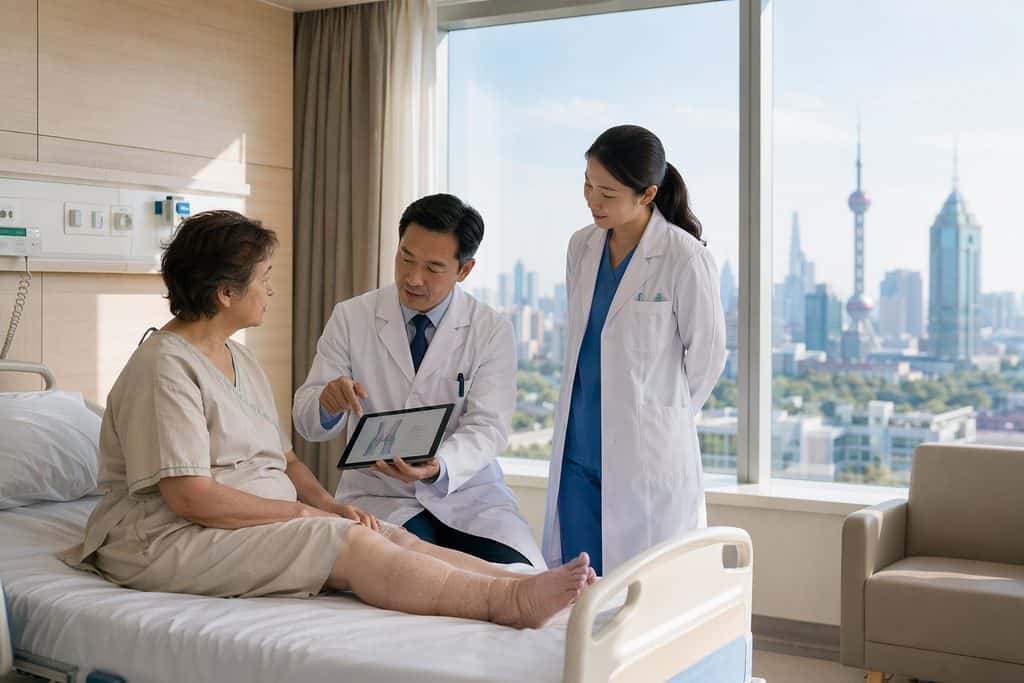
You have probably heard the stories. A woman beats breast cancer after a grueling year of treatment, only to wake up months later with an arm that is swollen, heavy, and unrecognizable. She is told she has lymphedema. She is told she just has to live with it. That narrative is outdated. A precise, highly technical field of supermicrosurgery has matured in China, and it is giving patients something they thought they had lost forever: a limb that looks and feels normal again. The lymphedema surgery cost China makes this option accessible to patients who have been quoted six figures elsewhere, but the real conversation goes far deeper than price.
Key Takeaways
- Lymphatic-Venous Anastomosis (LVA) supermicrosurgery redirects lymph fluid into veins, reducing swelling by 30–60% in over 85% of properly selected patients.
- China’s top microsurgery centers perform hundreds of LVA procedures annually — a case volume that directly correlates with better patency rates and fewer complications.
- Total lymphedema surgery cost China ranges from $8,000 to $18,000 for LVA, compared to $50,000–$100,000 in the United States, without sacrificing surgical quality.
- Independent international patients face real barriers: no Mandarin, no direct booking with public hospital experts, and S2 visa requirements that demand formal medical invitation letters.
The Problem: Lymphedema Is Not Just Swelling — It Is a Progressive Disease
Approximately 1 in 5 women who undergo axillary lymph node dissection for breast cancer will develop clinically significant lymphedema. That statistic, drawn from a 2022 meta-analysis in The Lancet Oncology, translates to hundreds of thousands of new cases globally each year. The arm gets heavy. Rings stop fitting. Infections strike — cellulitis that lands patients in the hospital for IV antibiotics. Compression garments become a permanent, sweaty second skin. And, until relatively recently, the surgical options were limited to debulking procedures that removed tissue but did nothing to restore physiological drainage.
What many patients do not know is that lymphedema is not a static condition. Without intervention, the stagnant, protein-rich fluid triggers fat deposition and fibrosis. The limb hardens. The window for minimally invasive surgery narrows. This is why the question is not just “can surgery help?” but “how soon can I get evaluated?”
Who We Are
We are not a hospital. We do not perform surgery, offer medical diagnoses, or make clinical promises. Our team functions as your logistical architects — we bridge the gap between you and China’s top-tier microsurgery departments. We handle hospital matching, appointment coordination through official international medical channels, bilingual medical companion services, visa invitation letters, and post-operative recovery logistics. Think of us as the people who make sure you are in the right operating room with the right surgeon, without spending months trying to navigate a foreign healthcare system alone.
Why LVA Supermicrosurgery in China Delivers Results
Volume Creates Technical Precision
Lymphatic-Venous Anastomosis is not a procedure a surgeon does occasionally. It requires suturing vessels 0.3 to 0.8 millimeters in diameter — smaller than a grain of rice — under a high-powered operating microscope. The learning curve is steep. A study published in the Journal of Reconstructive Microsurgery found that surgeons need at least 50 cases to achieve consistent patency rates above 90%. In China, a dedicated lymphedema microsurgery center may complete 200 to 400 LVA cases per year. That volume is hard to match in North America or Europe, where a surgeon might perform 20 or 30 annually. Repetition builds speed, and speed matters: shorter operating times mean fewer anesthetic complications and more precise anastomoses.
How Successful Is Supermicrosurgery Lymphedema After Cancer?
This is the question every patient asks, and the data is encouraging. A 2023 systematic review covering 1,247 patients who underwent LVA for cancer-related lymphedema reported an average circumferential reduction of 29.4% in the affected limb at 12-month follow-up. More importantly, 83% of patients reported a meaningful improvement in quality-of-life scores. Episodes of cellulitis dropped by roughly 70% postoperatively. These are not cure rates — lymphedema is a chronic condition — but they represent functional restoration that compression therapy alone cannot deliver.
Super microsurgery is not magic. It works best in earlier-stage lymphedema, when the lymphatic vessels are still functional enough to be redirected. Patients with advanced, fibrotic lymphedema may need a different approach — vascularized lymph node transfer (VLNT) — which is also available in China’s top centers. The key is getting a proper ICG lymphography assessment before anyone books an operating room.
Can LVA Surgery Cure Arm Lymphedema?
No. Let us be direct about this. No ethical surgeon uses the word “cure.” LVA creates new drainage pathways, but it does not regenerate the lymphatic system. What it can do is reduce dependency on compression garments, lower infection risk, and restore a limb circumference that fits into normal clothing. For many patients, that feels close enough to a cure. But setting realistic expectations is critical — and that is exactly what a thorough pre-operative consultation with a best lymphatic-venous anastomosis surgeon Shanghai or Beijing should provide.
The Cost Reality: Why the Numbers Are So Different
Let us address the elephant in the room. A comprehensive LVA procedure in the United States, including surgeon fees, hospital charges, and anesthesia, typically runs between $50,000 and $100,000. In Europe, the range is €30,000 to €60,000. The lymphedema surgery cost China, by contrast, falls between $8,000 and $18,000 for a unilateral LVA, depending on the number of anastomoses and the hospital tier. Bilateral cases run higher. VLNT costs more than LVA. These figures include surgeon fees, operating theater costs, and a standard hospital stay — but not travel, accommodation, or post-operative garments.
Why the gap? Structural economics, not quality shortcuts. China’s top-tier public hospitals operate at enormous scale, with lower administrative overhead per case. Surgeon salaries, while competitive domestically, are a fraction of Western equivalents. The supply chain for microsurgical instruments and ICG imaging equipment is mature and cost-efficient. None of this implies inferior care. Many of China’s leading microsurgeons trained in Japan, Taiwan, or Europe, where LVA techniques were pioneered, and brought those protocols back to high-volume domestic practices.
| Procedure | China (USD) | USA (USD) | Europe (EUR) |
|---|---|---|---|
| Unilateral LVA (3-5 anastomoses) | $8,000–$14,000 | $50,000–$80,000 | €30,000–€50,000 |
| Bilateral LVA | $12,000–$18,000 | $70,000–$100,000 | €45,000–€65,000 |
| VLNT (lymph node transfer) | $15,000–$22,000 | $80,000–$120,000 | €50,000–€70,000 |
| ICG Lymphography (diagnostic) | $300–$600 | $2,000–$4,000 | €1,500–€3,000 |
Note: All prices are estimates and vary by hospital, surgeon seniority, and case complexity. These figures reflect the hospital and professional fees only — travel, accommodation, and post-operative garments are additional.
What You Need to Know Before Going Alone
We have seen patients try to arrange this independently. Some succeed. Many do not. The barriers are not insurmountable, but they are real, and underestimating them leads to wasted flights and missed surgical slots.
- Visa Requirements Are Specific: Medical treatment in China requires an S2 visa with a formal invitation letter from the treating hospital. You cannot apply for this on a tourist (L) visa or a business (M) visa. The hospital’s international department must issue the invitation, and processing times vary. Without the right paperwork, you will be turned away at the consulate.
- Public Hospitals Do Not Accept Direct Overseas Booking: China’s top-ranked public hospitals — the ones with the highest LVA case volumes — do not have online portals where an international patient can browse surgeon profiles and book a slot. You must first have an in-person consultation. That means arriving in China, navigating registration in Mandarin, and hoping the surgeon you want has availability. The international VIP departments offer a workaround, but they operate on a different fee structure and still require coordination.
- Language Is a Clinical Barrier, Not Just an Inconvenience: Informed consent for supermicrosurgery is complex. You need to understand the risks — anastomosis failure, need for revision surgery, continued need for compression in some cases. Relying on a translation app during a pre-operative discussion is not safe. A qualified medical interpreter who understands microsurgical terminology is essential.
How We Help You Navigate This
These barriers exist for structural reasons, not because the system is hostile to foreigners. China’s hospitals are designed to serve a domestic population of 1.4 billion people efficiently. International patients are an exception to that workflow. Our role is to make you fit into that workflow without friction.
Before you travel, we gather your medical records, imaging, and surgical history. We translate these into clinical Chinese and submit them to the international departments of hospitals with strong microsurgery programs — the kind of centers that appear on our specialty department rankings. We secure the formal invitation letter required for your S2 visa application. We confirm consultation dates and surgical scheduling windows.
During your stay, a bilingual medical companion meets you at the hospital. They handle registration, queue management, payment processing, and — critically — real-time interpretation during surgeon consultations. You ask questions. You get answers in English. You understand exactly what the surgeon proposes to do, how many anastomoses are planned, and what the post-operative protocol looks like.
After surgery, we coordinate follow-up visits, compression garment fitting, and any necessary rehabilitation sessions. If you are exploring broader treatment options, we can connect you with China’s top-ranked hospitals across multiple specialties. The goal is continuity — no dropped handoffs, no lost-in-translation moments when complications need urgent attention.
For patients who want to book supermicrosurgery lymphedema China without the logistical headaches, our coordination service covers the full arc from initial inquiry to post-operative clearance. We also support those seeking comprehensive lymphedema microsurgery packages abroad that bundle hospital fees, accommodation recommendations, and ground support into a single, transparent plan.
Frequently Asked Questions
Candidate selection hinges on ICG lymphography findings. This imaging test maps your remaining lymphatic channels and classifies your lymphedema stage. Patients with linear or splash patterns on ICG generally respond well to LVA. Those with diffuse dermal backflow and significant fibrosis may need VLNT instead. A proper evaluation must happen before any surgical commitment — and we ensure that evaluation happens with a surgeon who performs these assessments weekly, not occasionally.
Patency rates — meaning the anastomosis stays open — exceed 90% in experienced hands. But no surgery is guaranteed. If results are suboptimal, revision surgery or conversion to VLNT may be discussed. This is why choosing a center with experience in both LVA and VLNT matters. You want a surgeon who can pivot intraoperatively or post-operatively based on what the anatomy demands, not someone locked into a single technique.
Plan for 10 to 14 days minimum. This includes pre-operative consultation and ICG imaging (1–2 days), the surgery itself (typically a 3–5 hour procedure with a 2–3 day hospital stay), and at least one week of post-operative monitoring. Sutures are usually removed around day 10. Your surgeon will want to see you before you fly home. Rushing this timeline is not advisable — post-operative complications like wound dehiscence or early infection need to be caught and managed locally.
This varies widely. Some national health systems will provide post-operative monitoring and compression therapy; others may refuse to manage complications from surgery performed abroad. Before booking, we recommend contacting your local lymphedema therapist or primary care physician to establish a follow-up plan. We provide detailed operative notes and discharge summaries in English to facilitate that handoff. You are not left without documentation.
Your Next Step
Lymphedema after cancer is not something you have to accept as a permanent sentence. Supermicrosurgery has changed the landscape, and China’s high-volume centers offer technical proficiency at a cost that makes treatment accessible to patients who have been priced out elsewhere. The barriers to accessing that care are navigable — but only with the right support structure in place. If you are ready to explore whether LVA is right for your specific case, we are here to connect you with the right evaluation, the right surgeon, and a clear path forward. Request a free consultation to discuss your situation and learn what is possible.
For more medical information and treatment options in China, visit chinamedservices.com (China Medical Services).
