Proton Therapy China: How Shanghai Treats Inoperable Tumors
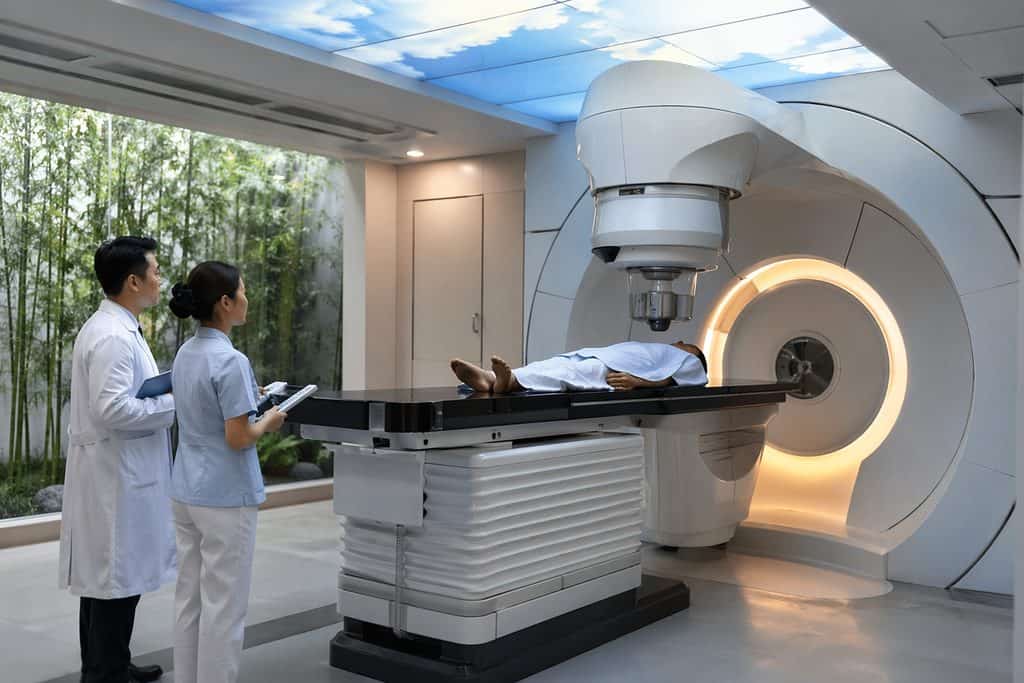
When David, a 58-year-old engineer from Manchester, was told his skull-base chordoma was inoperable, the silence in the room was deafening. Standard radiation, his oncologist explained, would pose an unacceptable risk to his optic nerves and brainstem. He was handed a pamphlet on managing symptoms. That was three years ago. Last spring, David walked the Bund in Shanghai, treatment complete, with no evidence of disease progression. The difference was a particle physics approach to cancer care that most Western patients never hear about until they go searching for it themselves.
For tumors wrapped around critical structures—the spinal cord, the brainstem, the optic chiasm—conventional photon radiation deposits energy along its entire path. The tumor gets a dose. So does everything behind it and in front of it. Proton and heavy ion beams behave differently. They stop. The proton therapy cost Shanghai represents a fraction of what American centers charge, but the physics is identical. The challenge is access. That is where understanding the program becomes essential.
Key Takeaways
- The Shanghai Proton and Heavy Ion Center (SPHIC) has treated over 6,000 patients since opening, with 5-year local control rates exceeding 80% for several traditionally inoperable tumor types.
- Full-course proton therapy in Shanghai typically ranges from $40,000 to $70,000 USD—compared to $150,000 to $200,000+ in the United States—with comparable technology and clinical protocols.
- International patients cannot simply book a slot online. Treatment requires on-site evaluation, a confirmed diagnosis, and navigating a hospital system with limited English-language infrastructure.
- Heavy ion therapy (carbon ion) is available at only a handful of centers worldwide. Shanghai is one of them, and the biological effectiveness against radioresistant tumors is a genuine differentiator.
The Problem: When Surgery Is Not an Option
Approximately 20% of cancer patients will, at some point, face a tumor deemed surgically unresectable. The reasons vary: the tumor encases a major artery. It infiltrates the brainstem. Removing it would cause catastrophic functional loss. For these patients, the standard pathway narrows sharply. Conventional radiotherapy can control some tumors, but the dose is limited by what surrounding normal tissue can tolerate. In many cases, the curative dose exceeds the safe dose. That is the therapeutic window slamming shut.
A 2020 analysis published in Radiotherapy and Oncology examined outcomes for skull-base chordomas treated with protons versus photons. The 5-year local control rate with protons reached 78%, compared to approximately 45% with conventional techniques. The difference is not marginal. It is the difference between decades of life and a ticking clock. Yet access to proton facilities remains scarce. As of 2024, the United States operated roughly 45 proton centers. The United Kingdom had two treating NHS patients. Canada had zero. Wait times in public systems can stretch past six months—time that tumors do not respect.
Who We Are
We are not a hospital. We do not provide medical treatment, clinical diagnoses, or second opinions on your scans. Our team functions as your logistical architects—we bridge the gap between you and China’s top-tier medical expertise. We translate medical records, coordinate with hospital international departments, arrange bilingual companionship for every appointment, and handle the visa documentation that makes treatment possible. When a patient asks about the Shanghai Proton and Heavy Ion Center price for international patients, we provide the real numbers, not marketing estimates. We have walked this path with patients from over 40 countries. We know where the friction points are, and we know how to solve them before they become crises.
Why Shanghai’s Particle Therapy Program Delivers Results
Clinical Volume Drives Technical Precision
The Shanghai Proton and Heavy Ion Center (SPHIC) opened in 2015 as China’s first particle therapy facility. It operates both proton and carbon ion beams under one roof. That dual capability is rare. Only six centers worldwide offered both modalities as of 2023. The center treats approximately 1,000 patients annually. That volume matters. Particle therapy is technically demanding—treatment planning requires physicists, dosimetrists, and radiation oncologists working in tight coordination. A center treating 1,000 patients yearly develops institutional muscle memory that a center treating 200 cannot replicate.
SPHIC’s published outcomes reflect this. For localized prostate cancer, 5-year biochemical recurrence-free survival exceeds 90%. For adenoid cystic carcinomas of the head and neck—a notoriously radioresistant tumor—local control at 4 years reached 82.7% in their reported series. These numbers align with outcomes from established centers like MD Anderson and the Heidelberg Ion-Beam Therapy Center. The technology is not magic. But in experienced hands, it is remarkably effective.
Heavy Ion Therapy: A Different Biological Mechanism
Protons are roughly 1.1 times as biologically effective as photons. Carbon ions are different. Their relative biological effectiveness (RBE) ranges from 2 to 5, depending on the tissue and depth. What does that mean in plain language? Carbon ions cause more complex DNA damage—double-strand breaks that tumor cells struggle to repair. For radioresistant tumors like sarcomas, adenoid cystic carcinomas, and certain recurrent rectal cancers, this matters enormously.
A question we hear frequently from oncologists and patients alike: how effective is heavy ion therapy for cancer that has already resisted conventional treatment? The data is accumulating. A Japanese study tracking over 1,200 patients with bone and soft tissue sarcomas treated with carbon ions reported 5-year local control rates of 83% for unresectable tumors. These were patients who had no surgical option. SPHIC has published comparable results in its own patient cohorts. The treatment is not a guarantee. Nothing in oncology is. But for the right patient, it represents a genuine therapeutic window where none existed before.
Cost Structure: The Economics of Particle Therapy
Let us address the question directly: the proton therapy cost Shanghai runs between $40,000 and $70,000 USD for a full treatment course. The Shanghai Proton and Heavy Ion Center price for international patients falls at the higher end of that range, reflecting the additional coordination required. Carbon ion therapy, when indicated, adds complexity and cost. Compare this to the United States, where proton therapy typically costs $150,000 to $200,000 or more. Some centers bill over $250,000 for complex cases. The technology is the same. The physics is the same. The cost differential reflects structural economics—physicist salaries, facility construction debt, and the American healthcare reimbursement system—not a difference in treatment quality.
| Treatment Component | Shanghai (USD) | United States (USD) |
|---|---|---|
| Full proton therapy course | $40,000 – $70,000 | $150,000 – $200,000+ |
| Carbon ion therapy (if indicated) | $50,000 – $80,000 | Not widely available |
| Initial consultation & treatment planning | $2,000 – $4,000 | $5,000 – $10,000 |
| On-site housing (30 days, mid-range) | $1,500 – $3,000 | $3,000 – $6,000 |
These figures are estimates. Final costs depend on tumor complexity, number of fractions, and whether combined modalities are required. We provide itemized cost projections before any patient commits to travel. No surprises. No hidden facility fees appearing on a bill three months later.
Safety and Efficacy: What the Evidence Shows
Every patient eventually asks some version of: is proton therapy safe for inoperable tumors? The short answer is yes—when appropriately indicated and delivered by an experienced team. The longer answer requires nuance. Particle therapy is not gentle. It is precisely aggressive. The goal is to deliver tumoricidal doses while respecting normal tissue constraints. Acute side effects—skin reactions, fatigue, mucositis depending on the treatment site—are common and typically manageable. Late effects, the ones that haunt patients years later, are where particle therapy shows its advantage.
A 2019 systematic review in The Lancet Oncology examined late toxicity across proton and photon treatments for pediatric brain tumors. Proton therapy reduced the risk of secondary malignancies by an estimated 50% compared to photons, primarily by sparing healthy tissue from exit dose. For adults with skull-base tumors, proton therapy reduced the incidence of radiation-induced hypopituitarism, cognitive decline, and optic neuropathy. These are not abstract statistical differences. They are the difference between a child graduating university on schedule or struggling with processing deficits. Between an adult returning to work or living with permanent disability. Safety, in this context, means more than acute tolerability. It means protecting the decades ahead.
SPHIC maintains a dedicated physics team that performs patient-specific quality assurance for every treatment plan. Each plan is verified on a phantom before the first fraction is delivered. The center holds Joint Commission International (JCI) accreditation, the same standard applied to top international hospitals. Treatment protocols are reviewed by multidisciplinary tumor boards that include surgeons, medical oncologists, and diagnostic radiologists. This is not a facility that cuts corners.
What You Need to Know Before Going Alone
Particle therapy in China is not a walk-in service. The barriers are real, and pretending otherwise does patients a disservice. Here is what you will face if you attempt to arrange treatment independently:
- Visa Requirements: Medical treatment in China requires an S2 visa with a specific annotation for medical purposes. The invitation letter must come from the hospital’s international department, not a travel agency. Processing typically takes two to four weeks. Errors in documentation—wrong hospital code, incomplete diagnosis translation—result in rejection and delay. We have seen patients lose weeks to visa resubmissions that could have been avoided with proper preparation.
- Medical Records and Translation: SPHIC requires a complete dossier: pathology reports, imaging on CD-ROM (DICOM format), surgical summaries, prior radiation records with dose-volume histograms if applicable, and a detailed treatment summary from the referring oncologist. All documents must be translated into Mandarin Chinese by a certified medical translator. Google Translate will not suffice. A mistranslated pathology term can derail a tumor board review.
- Financial Clearance: The hospital requires a deposit before treatment begins. This is standard practice in Chinese public hospitals. The deposit amount depends on the estimated treatment course. International insurance is rarely accepted for direct billing at public facilities—patients pay upfront and seek reimbursement afterward. We help patients negotiate deposit amounts and provide documentation packages for insurance claims, but the financial workflow is fundamentally different from what Western patients expect.
- Language and Navigation: SPHIC’s clinical staff speaks some English. The administrative staff, the scheduling desk, the billing office, the pharmacy—they operate in Mandarin. A single missed appointment due to a misunderstood instruction can delay treatment by days. The hospital campus is large. Signage is primarily in Chinese. For a patient already managing the physical and emotional weight of cancer treatment, navigating this environment alone is exhausting and error-prone.
How We Help You Navigate This
These barriers exist for structural reasons, not malice. Chinese hospitals serve a domestic patient population of 1.4 billion people. International patients represent a tiny fraction of their volume. The systems are optimized for local workflows. Our job is to build a bridge between those systems and your needs.
Before you travel, we collect and translate your medical records, submit them to the hospital’s international department, and coordinate a preliminary treatment assessment. If SPHIC’s tumor board determines you are a candidate, we provide a detailed cost estimate and timeline. We prepare your visa invitation package and guide you through the consular application process. We arrange airport pickup and accommodation near the hospital—the Pudong district offers options ranging from serviced apartments to international hotels, all within a 20-minute drive of the facility.
During treatment, a bilingual medical companion accompanies you to every appointment. This person handles registration, payment, queue management, and real-time interpretation. They translate the radiation oncologist’s explanation of your treatment plan. They relay your questions about side effects and ensure the answers are clear. They are not clinical staff—they do not offer medical advice—but they ensure nothing is lost in translation. We have written previously about how our broader patient coordination services work across China’s top hospitals, and the same principles apply at SPHIC.
After treatment concludes, we collect your complete medical records, discharge summary, and treatment plan for follow-up care. We translate these back into English and provide them in a format your home oncologist can use. We coordinate follow-up imaging schedules and can facilitate remote consultations if questions arise months later.
Frequently Asked Questions
No one can determine suitability without reviewing your imaging and pathology. SPHIC’s tumor board evaluates each case individually. Generally, particle therapy is considered for localized, non-metastatic tumors where conventional radiation would exceed normal tissue tolerance. Chordomas, chondrosarcomas, adenoid cystic carcinomas, certain pediatric brain tumors, and localized prostate cancers are common indications. Metastatic disease is typically not appropriate. The best first step is submitting your records for a preliminary review—we facilitate this at no charge.
You can try. You will need to contact SPHIC’s international department, submit your records in Chinese, and navigate the scheduling process independently. Some patients succeed. Most encounter delays, miscommunications, and frustration. The hospital does not offer a streamlined “medical tourism package“—that is not how Chinese public hospitals operate. When patients ask us how to book proton therapy treatment Shanghai China, we explain that the process is fundamentally a clinical evaluation pathway, not a reservation system. We accelerate it by ensuring your documentation is complete, correctly translated, and routed to the right clinical team on the first attempt.
Particle therapy, like all cancer treatments, has failure rates. Local recurrence happens. Distant metastasis happens. No responsible provider guarantees a cure. What we can say: SPHIC’s published local control rates are consistent with the best particle therapy centers worldwide. If recurrence occurs, the center’s multidisciplinary team reassesses and discusses salvage options—surgery, re-irradiation in select cases, or systemic therapy. We support patients through that process as well. Your treatment relationship does not end when the last fraction is delivered.
Most treatment courses run four to seven weeks, depending on the number of fractions. Proton therapy for prostate cancer, for example, might involve 20 to 39 fractions delivered five days per week. Skull-base tumors often require more fractions. You will need to arrive several days before treatment begins for simulation and planning. You should plan to stay at least a week after completion for a final assessment. Total time in Shanghai: typically six to nine weeks. We help families plan for this—accommodation, companion support, and the logistics of extended international stays.
Some international facilitators market a proton therapy China medical tourism package with a fixed price and itinerary. We take a different approach. Cancer treatment is not a vacation package. Your needs depend on your diagnosis, your treatment plan, your personal circumstances, and your budget. We build a coordination plan around you—not the other way around. Our fees are transparent and itemized. Hospital costs are paid directly to the hospital. Our coordination costs are separate and clearly disclosed before you commit to anything. If you want to explore whether SPHIC might be right for your case, we offer a free initial consultation to discuss your situation and what the pathway would look like.
Your Next Step
Facing an inoperable tumor forces a reckoning. The standard pathways have been exhausted. The remaining options feel like long shots. Particle therapy at SPHIC is not a long shot—it is an established treatment with two decades of global clinical evidence and a center in Shanghai that has been delivering it for nearly ten years. The barriers to access are real. They are also solvable. We exist to solve them.
If you are considering proton or heavy ion therapy, start with information. Gather your records. Ask hard questions about suitability, costs, and outcomes. We are here to provide honest answers—not to sell you on a treatment, but to help you understand whether this option deserves a serious conversation with your oncologist and with the clinical team in Shanghai. That conversation costs nothing. It might open a door you thought was closed.
For more medical information and treatment options in China, visit chinamedservices.com (China Medical Services).
