Zhejiang Provincial TCM Hospital: TCM Oncology and Respiratory Care for International Patients
Key Takeaways
- Zhejiang Provincial TCM Hospital integrates modern oncology protocols with classical herbal medicine — it is ranked among China’s top 10 TCM hospitals by the Fudan University specialty reputation list.
- TCM oncology here is not a replacement for chemotherapy or surgery. It is an adjunct therapy focused on immune modulation, reducing treatment side effects, and extending progression-free survival — supported by over 1,200 ongoing clinical TCM trials registered in China.
- Language is the single largest barrier. The hospital’s international outpatient department is small, and spontaneous walk-in access without a bilingual coordinator will almost certainly fail.
- Total treatment cost for a 3-week integrated TCM oncology program typically ranges from $4,000 to $11,000 — roughly 15% to 25% of comparable integrative oncology programs in the United States or Germany.
The Problem: When Standard Oncology Leaves a Gap
A patient finishes six cycles of platinum-based chemotherapy for non-small cell lung cancer. The scans show stability. But the body is wrecked. Peripheral neuropathy makes it hard to button a shirt. Fatigue is so crushing that walking to the mailbox feels like a marathon. The oncologist in Houston or London says: “We watch and wait now.” That gap — between active treatment ending and the next scan — is where fear lives. Approximately 40% of lung cancer patients experience clinically significant distress during this surveillance period, according to a 2022 meta-analysis in Lung Cancer. The disease is not progressing, but neither is the patient recovering. This is precisely the clinical space where traditional Chinese medicine oncology has been systematically integrated into Chinese hospital protocols for over two decades. Not as an alternative to evidence-based cancer care. As a structured, inpatient-grade intervention to manage the aftermath of that care.
Who We Are
We are not a hospital. We do not prescribe herbs, design chemotherapy regimens, or offer clinical diagnoses. Our team functions as a logistical and cultural bridge — we connect international patients with China’s top-tier medical institutions, including Zhejiang Provincial TCM Hospital. We handle hospital matching, appointment coordination through official international channels, bilingual medical companion services, visa guidance, and on-the-ground support in Hangzhou. When a patient from Toronto or Dubai asks us about Zhejiang TCM hospital oncology cost, we provide transparent price ranges based on real case data — not marketing estimates. Our role is to make an inherently complex cross-border medical journey navigable.
Why Zhejiang Provincial TCM Hospital Delivers Distinct Oncology Value
Zhejiang Provincial TCM Hospital sits in Hangzhou, a city with a 1,400-year history of integrating herbal medicine into mainstream clinical practice. The hospital itself is not a small wellness retreat. It operates over 1,500 inpatient beds, runs a dedicated oncology department with sub-specializations in lung, gastric, liver, and colorectal cancers, and maintains an active international patient service desk. What sets it apart from Western integrative oncology centers is scale and regulatory integration. Chinese national health authorities have formally approved TCM oncology as a standard adjunct therapy pathway — this is not complementary medicine operating on the margins. It is reimbursed within China’s national insurance system and delivered inside the same hospital that performs lobectomies and administers targeted therapy.
Clinical Volume and Protocol Standardization
Western integrative oncology often means a patient sees a naturopath in a separate clinic, with fragmented communication between the oncologist and the complementary provider. At Zhejiang Provincial TCM Hospital, the TCM oncology attending physician and the Western-trained oncologist work on the same floor. They review the same labs. The patient’s chemotherapy-induced myelosuppression is managed with a standardized herbal decoction protocol — not an ad hoc supplement regimen. The hospital’s oncology department manages over 8,000 inpatient admissions annually. That volume drives protocol refinement. When a pattern emerges — say, a specific granule combination of Astragalus membranaceus and Ligustrum lucidum consistently reduces grade 3 fatigue in post-chemotherapy breast cancer patients — it gets codified into departmental guidelines. This is protocol-driven TCM, not boutique wellness.
Respiratory Care: Where TCM Has Deep Evidence
The question patients often type into search engines is blunt: is TCM effective for respiratory diseases? The honest answer requires nuance. For acute bacterial pneumonia, no — antibiotics are irreplaceable. But for chronic, inflammatory, and post-infectious respiratory conditions, the evidence base is substantial. A 2023 systematic review published in Phytomedicine analyzed 27 randomized controlled trials involving 2,541 patients with chronic obstructive pulmonary disease. The pooled data showed that adjunctive TCM herbal formulas improved FEV1 by an average of 120 mL compared to standard care alone, and reduced exacerbation frequency by roughly 30%. For post-COVID pulmonary fibrosis and radiation pneumonitis — two conditions where Western medicine offers limited pharmacologic options — Zhejiang Provincial TCM Hospital’s respiratory department runs dedicated inpatient protocols combining acupuncture, herbal nebulization, and oral decoctions. Patients with radiation-induced lung injury following thoracic radiotherapy for lung cancer are a core referral cohort. The hospital’s approach focuses on reducing inflammatory cytokine cascades using compounds like curcumin and resveratrol delivered in bioavailable herbal matrices — not as isolated supplements.
Cost Structure: What Patients Actually Pay
Let us address the search query directly: Zhejiang TCM hospital oncology cost. The numbers matter. A typical 3-week inpatient integrative oncology stay at Zhejiang Provincial TCM Hospital’s international ward ranges from $4,000 to $11,000. That includes the hospital bed, daily physician rounds, herbal decoctions prepared by the hospital pharmacy, acupuncture sessions, and basic laboratory monitoring. It does not include airfare, visa fees, accommodation for family members, or our coordination service fees. For comparison, a comparable 3-week integrative oncology program at a major German university hospital runs $18,000 to $35,000. In the United States, a 2-week integrative medicine inpatient program — if you can find one — often exceeds $25,000 before any herbal or supplement costs. The structural reasons for China’s cost advantage are not about quality-cutting. They are about labor economics, hospital-owned herbal pharmacies that eliminate retail markups, and a regulatory system that allows TCM and Western medicine to share infrastructure costs.
| Service Component | Zhejiang Provincial TCM Hospital (USD) | US Integrative Oncology (USD) | German University Program (USD) |
|---|---|---|---|
| Inpatient bed (per day, international ward) | $120 – $250 | $1,500 – $3,000 | $400 – $700 |
| Oncology specialist consultation (initial) | $80 – $150 | $400 – $600 | $250 – $400 |
| Personalized herbal decoction (daily) | $15 – $40 | $60 – $120 (supplements only) | $50 – $90 |
| Acupuncture session (per treatment) | $30 – $50 | $100 – $200 | $70 – $120 |
| 3-week total (typical range) | $4,000 – $11,000 | $22,000 – $45,000 | $18,000 – $35,000 |
All figures are estimates. Final costs vary by case complexity, length of stay, and specific treatment protocols prescribed by attending physicians.
What You Need to Know About the International Patient Service at Zhejiang TCM Hospital
The hospital does have an international patient service Zhejiang TCM hospital desk. This is real. It is not a marketing fiction. But its scope is narrower than what Western patients might expect from “international patient services” at, say, a private hospital in Bangkok or Dubai. The desk handles appointment scheduling for the international outpatient clinic, provides basic English-language intake forms, and can assign a hospital-employed interpreter for scheduled consultations. It does not arrange airport pickup. It does not help you find an apartment near the hospital for a 3-week stay. It does not coordinate with your oncologist back home to transfer medical records in a format Chinese physicians can use efficiently. And it operates during standard Chinese business hours — if you land at Hangzhou Xiaoshan International Airport at 10 PM with a fever and no Chinese phone number, the international desk is not your emergency contact.
This is not a criticism of the hospital. It is a description of structural reality. Zhejiang Provincial TCM Hospital treats over 10,000 outpatients daily. The international patient cohort is a tiny fraction of that volume. The hospital’s core mission is domestic public health. International patients are welcome, but they are not the operational priority. That means the burden of coordination falls on the patient — or on a service like ours that absorbs that burden.
How We Navigate the Logistics So You Do Not Have To
When a patient contacts us asking how to book TCM treatment in Hangzhou, the first thing we do is not book anything. We request a full medical summary — translated into English if the patient is from a non-English-speaking country — and we review it with a physician advisor to determine whether Zhejiang Provincial TCM Hospital is genuinely the right clinical fit. Sometimes it is not. A patient with rapidly progressing small cell lung cancer and an ECOG performance status of 3 needs aggressive chemotherapy, not a TCM adjunct program. We will say that directly. We have turned away cases where the patient’s expectations did not match clinical reality. Trust is built on those refusals.
If the case is appropriate, our team initiates a structured process. We translate the medical summary into Chinese, format it according to the hospital’s intake standards, and submit it through the official international outpatient channel. We secure a preliminary acceptance letter — necessary for the S2 visa application. We coordinate the appointment date with the attending TCM oncologist’s schedule. On the ground in Hangzhou, a bilingual medical companion meets the patient at the airport, handles hospital registration, translates during every physician consultation, and remains on call for the duration of the inpatient stay. The companion is not a doctor. They are a professional interpreter trained in medical terminology, and they know the hospital’s physical layout and administrative workflows intimately. That last part matters more than it sounds. A Western patient alone in a 1,500-bed Chinese hospital with signage entirely in Chinese characters will burn hours just finding the CT scan department on the third floor of Building 2.
We also handle the financial interface. Chinese public hospitals require prepayment — typically a deposit of $3,000 to $5,000 at admission, with periodic top-ups as treatment progresses. International credit cards are not reliably accepted at hospital cashier windows. Our team manages the payment logistics, provides itemized billing in English, and assists with documentation for insurance reimbursement back home. We do not process direct insurance billing at this hospital — that capability is limited to private international hospitals like United Family or Jiahui. Patients should expect to pay out of pocket and seek reimbursement from their insurer afterward.
What TCM Oncology Actually Looks Like in Practice
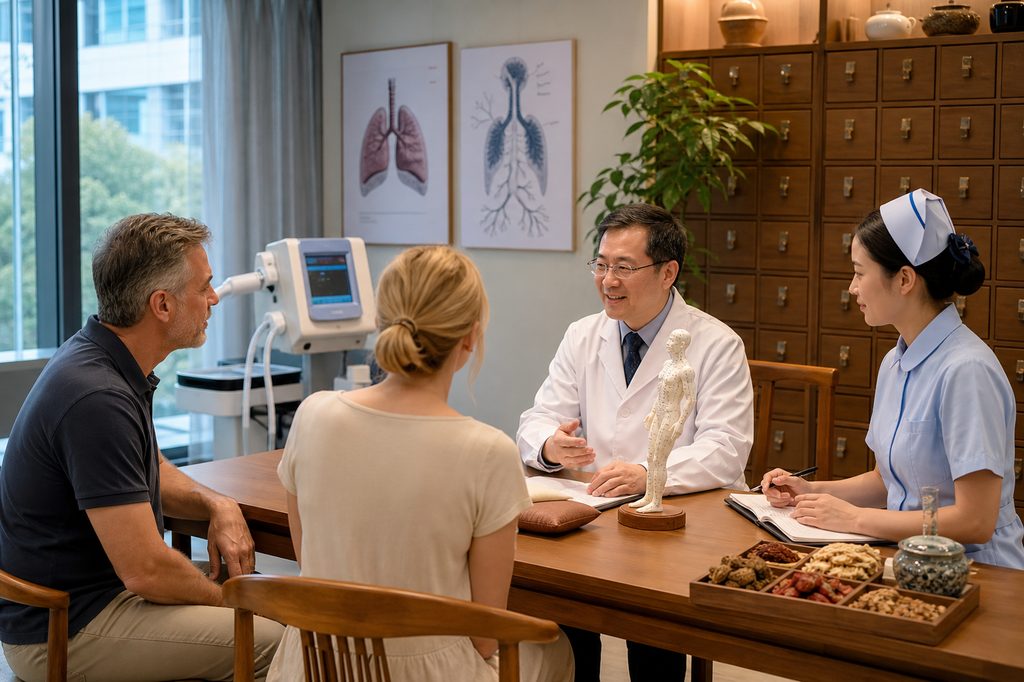
A patient arriving for traditional Chinese medicine lung cancer treatment China often expects acupuncture and mysterious brown liquid. The reality is more structured. On admission day, the patient undergoes a full blood panel, ECG, and a TCM diagnostic assessment that includes tongue diagnosis and radial pulse palpation at three positions on each wrist. The attending physician — typically dual-trained in Western oncology and TCM — reviews the patient’s chemotherapy history, current medications, and imaging. A treatment plan is drafted within 48 hours. It typically includes a customized herbal decoction prepared twice daily by the hospital pharmacy, acupuncture sessions 3 to 5 times per week, and possibly moxibustion or cupping for specific symptom management. The herbal formula is not a fixed product. It is adjusted every 3 to 5 days based on the patient’s reported symptoms, sleep quality, appetite, and bowel function. This is the core difference between TCM inpatient care and buying herbal supplements online — the formula evolves with the patient’s changing presentation.
For lung cancer patients specifically, common herbal base formulas include Yangyin Qingfei Decoction for radiation pneumonitis with dry cough and tidal fever, or Bu Zhong Yi Qi Tang for post-chemotherapy fatigue with poor appetite. These are not secret remedies. They are classical formulas with centuries of documented use, now being studied in modern clinical trials for pharmacokinetic interactions with tyrosine kinase inhibitors and immune checkpoint inhibitors. A 2024 study from Zhejiang Chinese Medical University, the hospital’s affiliated academic institution, found that a modified Shenqi Fuzheng injection reduced grade 3-4 neutropenia incidence by 18% in NSCLC patients receiving pemetrexed plus platinum chemotherapy — a finding published in the Journal of Ethnopharmacology.
Is This the Best TCM Cancer Hospital in China for Foreigners?
Patients searching for the best TCM cancer hospital China for foreigners are asking a question that has no single answer. Zhejiang Provincial TCM Hospital is undoubtedly among the top tier. It is ranked in the top 10 nationally for TCM oncology by the Fudan University specialty reputation list. Its research output is substantial. Its international patient service, while limited in scope, exists and functions. But other institutions also merit consideration depending on the specific cancer type and patient needs. Guang’anmen Hospital in Beijing has a larger international patient volume and more established English-language infrastructure. Shanghai Longhua Hospital has particular expertise in TCM oncology for gastrointestinal cancers. The “best” hospital is the one whose specific departmental strengths align with the patient’s diagnosis, stage, and treatment goals. Our job during the initial consultation is to make that match — not to push every patient toward a single institution.
One structural advantage Zhejiang Provincial TCM Hospital does offer is location. Hangzhou is a more navigable city for foreigners than Beijing or Shanghai. It is smaller, greener, and less overwhelming. The hospital is a 40-minute drive from West Lake, a UNESCO World Heritage site where convalescing patients can walk in relative tranquility. For a patient spending three weeks in a foreign country while physically depleted from cancer treatment, the surrounding environment is not a trivial factor. Recovery happens in context.
Frequently Asked Questions
Yes, and this is the standard model at Zhejiang Provincial TCM Hospital. The TCM oncology department routinely manages patients who are concurrently receiving oral targeted therapy, immunotherapy infusions, or hormonal therapy. The key requirement is full medication transparency. You must provide a complete list of all drugs, dosages, and schedules. The TCM attending physician will check for known herb-drug interactions — St. John’s wort, for instance, is contraindicated with most tyrosine kinase inhibitors due to CYP3A4 induction. The hospital pharmacy’s herbal formulations are screened to avoid such conflicts. This is not a guarantee of zero interactions, but it is a structured safety process that does not exist when a patient self-medicates with store-bought supplements.
Zhejiang Provincial TCM Hospital is a full-service tertiary hospital, not a standalone TCM clinic. It has an emergency department, an intensive care unit, and on-site CT and MRI imaging. If a patient develops a complication — febrile neutropenia, pleural effusion requiring drainage, pulmonary embolism — the hospital can manage it internally without transferring to another facility. The TCM oncology attending physician will coordinate with the relevant Western medicine department. This integrated infrastructure is a significant safety advantage over small private TCM centers that lack acute care capability. That said, patients with a high anticipated risk of acute decompensation should discuss this with our physician advisor before travel. Not every patient is stable enough for a cross-border TCM stay.
The S2 visa is the correct category for short-term private medical treatment in China. You will need an invitation letter from Zhejiang Provincial TCM Hospital confirming your appointment and treatment plan. We obtain this letter on your behalf after your case is accepted. The visa application also requires a valid passport with at least six months remaining validity, a completed visa application form, and a recent passport photo. Processing time at most Chinese embassies and consulates is 4 to 7 business days. The S2 visa typically allows a stay of 30 to 90 days. If your treatment plan requires more than 180 days, an S1 visa may be necessary. We guide you through the specific documentation requirements based on your nationality and treatment duration. Do not apply for an M visa — that is a business visa and is not valid for medical treatment purposes.
Coverage varies dramatically by insurer and policy. Some international plans with comprehensive complementary medicine riders will reimburse TCM hospital treatment, especially when delivered in a recognized hospital setting with proper medical coding. Others explicitly exclude all TCM modalities. We provide itemized billing with ICD-10 diagnostic codes and treatment descriptions in English to support your reimbursement claim. But we cannot guarantee coverage. We recommend contacting your insurer before committing to travel and asking specifically about coverage for inpatient traditional Chinese medicine treatment at a recognized Chinese public hospital. The hospital’s international department can provide a pro forma treatment plan and cost estimate to submit to your insurer for pre-authorization.
Your Next Step
Choosing to travel to China for TCM oncology care is not a decision to make lightly. It requires weighing clinical evidence, logistical complexity, and financial cost against the potential for improved quality of life during cancer survivorship. The data on adjunctive TCM for chemotherapy side effect management and post-treatment recovery is strengthening year by year. The cost advantage relative to Western integrative programs is real and substantial. But the language barrier, the visa process, and the sheer operational friction of navigating a Chinese public hospital are not obstacles to underestimate. They are the reason our service exists.
If you are considering TCM treatment in China, start with a conversation. No commitment. No pressure. Just a clear-eyed assessment of whether Zhejiang Provincial TCM Hospital — or another institution in our network of 340+ top-ranked hospitals — is the right clinical and logistical fit for your specific situation. Request a free consultation and we will help you think through the decision with the honesty it deserves.
For more medical information and treatment options in China, visit chinamedservices.com (China Medical Services).
