Preparing for an Orthopaedic Consultation in Chengdu: What to Bring
Key Takeaways
- Preparation is mostly paperwork: imaging files, prior operative notes, medication lists, and a short written symptom history do more for a Chengdu orthopaedic visit than almost anything else you can bring.
- Public hospital outpatient registration in China is generally same-day and cannot usually be reserved from abroad in advance; a bilingual medical companion helps with the queue, the registration desk, payment, and interpreting the consultation itself.
- The honest barrier is language and logistics, not clinical capacity. A large Chinese hospital may see thousands of outpatients in a single day, and signage, forms, and most clinicians operate in Chinese.
- Decide in advance what you want from the visit — a diagnosis, a second opinion, a surgical plan, or a rehabilitation pathway — because the records you gather should match that goal.
Start With the Plain-Language Answer
If you are wondering what to prepare before a medical escort for orthopaedic consultation in Chengdu, the short answer is this: prepare your medical record as if you were handing it to a surgeon who has never met you and cannot read your home-language notes. That means recent imaging on disc or as original files, the radiology reports that go with them, any previous operation records, a current medication list, and a one-page summary of your symptoms and what you have already tried. Everything else — the companion, the hospital registration, the visa — is logistics built around that core.
An orthopaedic consultation is a conversation about mechanics: where it hurts, how it moves, what the imaging shows, and what has already been done. The quality of that conversation depends heavily on what the clinician can see and read. A patient who arrives with a disorganized phone gallery of blurry X-ray photos will get a shorter, less useful appointment than one who arrives with labeled files and a clear timeline. That gap is what preparation closes.
The Problem: Orthopaedic Records Are Fragmented and Hard to Carry
Orthopaedic care is unusually record-heavy. A single knee or spine problem can generate X-rays, MRI series, CT scans, bone density studies, injection records, physiotherapy notes, and sometimes a prior arthroscopy report — each produced by a different clinic, in a different format, over months or years. Patients commonly arrive at a specialist appointment with only the most recent report and no images at all, which forces the clinician to either re-order imaging or work from a description.
Travel adds a second layer. International patients heading to Chengdu face a language barrier in a system where most documentation and almost all conversation happens in Chinese. Public hospital outpatient registration is typically handled on the day rather than booked from overseas, so the visit itself is a queue-and-wait process. None of this means care is unavailable — Chengdu has major teaching hospitals with strong orthopaedic departments — but it does mean the appointment is only as productive as the material you bring into it. The preparation burden falls on the patient, and a companion service exists to carry the logistics, not to replace the records.
Why Chengdu Is a Reasonable Place to Seek an Orthopaedic Opinion
Depth of specialist capacity
Chengdu is home to West China Hospital, one of the largest teaching hospitals in the country and consistently represented in China’s Fudan hospital rankings. The Fudan ranking publishes a Top 100 general list in tiers rather than numbered positions, and separate specialty reputation lists that rank hospitals within each of 45 specialties, including orthopaedics. That structure is useful: it tells you which hospitals are recognized in a given specialty without inventing a national ranking that does not exist. Our hospital database covers 340+ top-ranked hospitals across 37 cities, and the Chengdu city page lists the institutions we can help you approach.
Volume and subspecialization
Large Chinese orthopaedic departments split into subspecialty clinics — spine, joint replacement, sports medicine, trauma, hand surgery, paediatric orthopaedics. For a patient with a specific problem, that subspecialization matters more than the size of the hospital. The practical implication is that the referral question should be specific: not “I need an orthopaedic opinion” but “I have a suspected rotator cuff tear with two years of failed conservative treatment and I want a sports medicine assessment.”
Cost structure, stated carefully
Cost is often part of the motivation for travelling to China, but it should be framed honestly. Prices vary by hospital, by whether you use the standard outpatient route or an international/VIP channel, and by the complexity of the case. We do not publish fixed surgical prices, because a quote without a diagnosis is a guess. What can be said is that consultation and imaging costs at Chinese public hospitals are generally lower than equivalent private-sector charges in the United States or Western Europe, and that any treatment plan should be confirmed in writing by the hospital before you commit to travel.
What to Prepare Before a Medical Escort for Orthopaedic Consultation in Chengdu: The Document Checklist
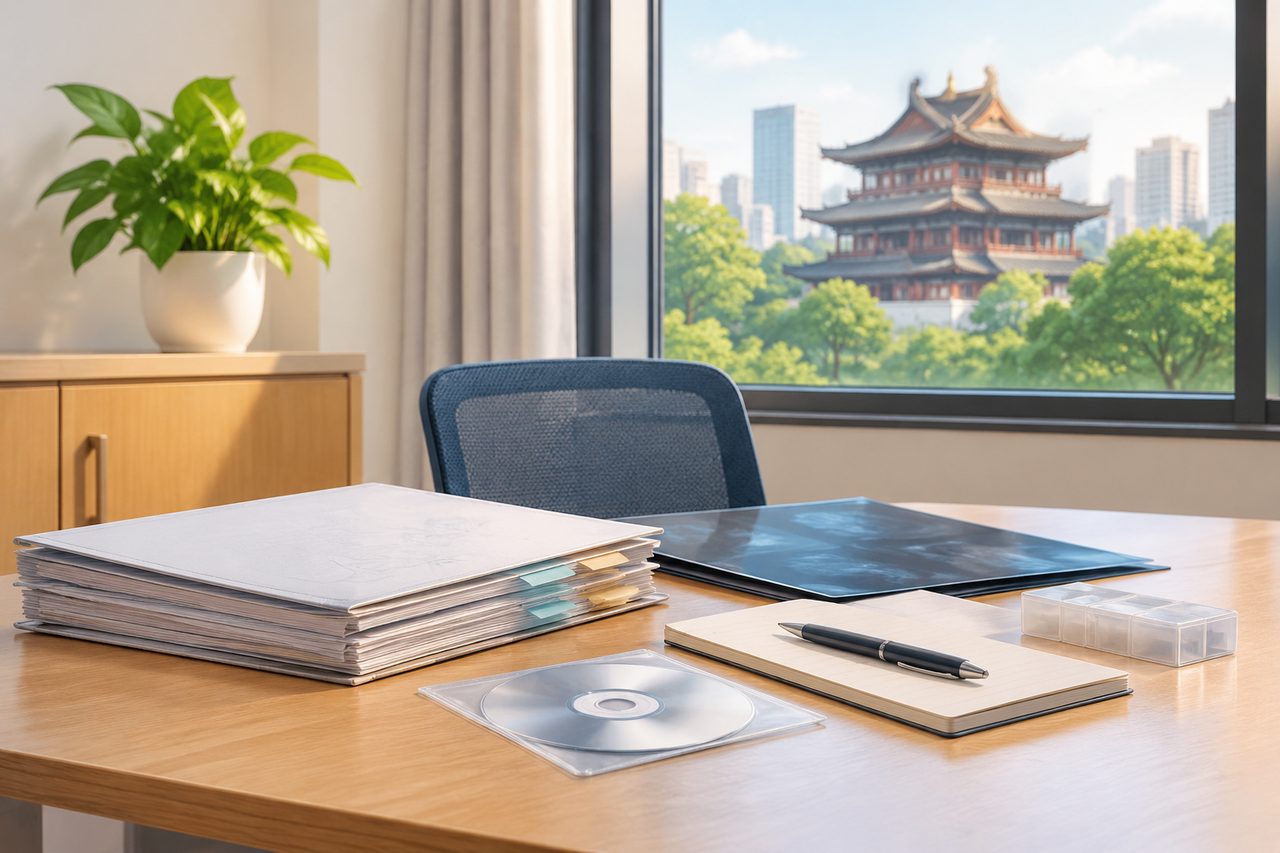
This is the section to work through methodically. Build it as a single folder, ideally in both paper and digital form, with English labels and — where possible — short Chinese translations of key terms.
| Item | What exactly to gather | Why it matters at the consultation |
|---|---|---|
| Imaging files | Original DICOM files on disc or USB, plus the written radiology reports. Ask your imaging centre for the raw files, not screenshots. | Chinese clinicians read the images, not just the reports. Screenshots lose diagnostic detail. |
| Prior operative records | Operation notes, implant details and serial numbers if you have had joint replacement or fixation, and discharge summaries. | Implant type affects revision planning and MRI safety screening. |
| Medication list | Generic drug names, doses, and frequency. Include anticoagulants, biologics, and anything injected in the last six months. | Affects surgical planning and interaction checks. |
| Symptom timeline | One page: when the problem started, what makes it worse, what treatments you have tried, and what you want from the visit. | Gives the interpreter and clinician a shared starting point in a short appointment. |
| Allergy and comorbidity record | Known allergies, diabetes, cardiac history, previous anaesthetic problems. | Relevant to any discussion of injection, sedation, or surgery. |
| Identification and insurance | Passport, visa, and any international insurance card or policy summary with direct-billing terms. | Registration and payment route depend on it. |
Two practical notes. First, imaging files are the item patients most often fail to bring; request them well before departure, because some imaging centres take days to prepare discs. Second, keep a short written list of your three most important questions. In a bilingual consultation, a written list prevents the appointment from drifting.
Choosing the Right Consultation Route and Avoiding Common Mistakes
Bilingual medical companion support starts from $300 per day, covering registration, queueing, payment, wayfinding, and interpretation — not a guaranteed introduction to a named specialist. Hospital consultation and imaging fees are billed separately by the hospital and vary by department and case complexity. Service fees for consultation, proxy visits, and coordination are accounted separately from hospital medical costs, and no offset or credit toward later treatment is offered.
That is a possible and legitimate outcome, but it is a decision for you and the treating team, not for us. Any admission or operation remains subject to hospital rules and to the clinician’s assessment after seeing you in person. We can help with hospital communication and arrival logistics if you decide to proceed, but we do not provide diagnoses or guarantee treatment outcomes.
Your Next Step
Preparation is the part of medical travel you control: the imaging files, the operative notes, the medication list, and the one-page summary that lets a Chengdu orthopaedic clinician understand your case quickly. Get those in order first, and the logistics become far simpler. China Medical Services is a coordination service, not a hospital and not a provider of diagnoses — we help international patients match with appropriate Chinese hospitals, prepare records, arrange appointments, and navigate language and visa steps. If you would like an initial conversation about your case, you can request a free consultation with no obligation.
This article is for general information only and does not constitute medical advice. Always consult a qualified clinician about your own condition and treatment options.
For more medical information and treatment options in China, visit chinamedservices.com (China Medical Services).
