72 Hour Custom Implant China: Beijing Orthopedic 3D Printing Rapid Turnaround for Urgent Cases
Key Takeaways
- Beijing hospitals can design, print, and sterilize a patient-specific titanium implant in approximately 72 hours for urgent reconstructive cases—a timeline that often exceeds 6 weeks in Western health systems.
- The custom 3d printed implant China price typically ranges from $8,000 to $25,000 depending on complexity, which is roughly 60-80% less than equivalent custom devices in the United States or Europe.
- This rapid turnaround pathway exists almost exclusively through hospital international VIP departments. Standard public outpatient channels will not grant foreign patients direct access to these expedited workflows.
- Success depends entirely on having your existing CT scan data formatted correctly before you travel. Without DICOM files in hand, the 72-hour clock cannot start.
The Problem: When Standard Implants Are Not Enough
Most orthopedic surgeries use off-the-shelf implants. For a routine hip replacement or a standard fracture plate, that works fine. But roughly 1 in 10 complex reconstructive cases requires something that does not exist on any shelf. Severe trauma that destroys bone geometry. Tumor resection that leaves a defect no standard prosthesis can fill. Revision surgeries where previous implants have failed and bone loss is extensive.
In these situations, a surgeon needs a device built for one specific patient. And the clock is ticking. Every week of waiting means more soft tissue contracture, more bone resorption, and a harder recovery. In the United States, the timeline for a custom implant from design to surgery is typically 6 to 8 weeks. Canada and the UK often stretch beyond 12 weeks. For a patient with an unstable pelvis or a massive femoral defect, that delay is not just inconvenient—it directly compromises the surgical outcome.
This is where Beijing’s orthopedic 3D printing ecosystem has carved out a niche that few Western patients know exists. The question we hear most often from patients facing these urgent timelines is blunt: can you get a custom implant in 3 days in China? The answer requires understanding how the process actually works.
Who We Are
We are not a hospital. We do not employ surgeons, we do not provide medical treatment, and we do not make clinical decisions. China Medical Services functions as your logistical bridge to China’s top-tier orthopedic centers. Our team handles the coordination that makes a 72-hour custom implant possible for international patients: identifying the right surgical team, ensuring your imaging data meets Chinese hospital specifications, managing the visa and travel logistics, and placing a bilingual medical companion at your side throughout the process. We connect you with expertise. You remain in control of every medical decision.
How Does Rapid 3D Printed Implant Surgery Work in Beijing?
The 72-hour figure is real. But it is not magic—it is a highly coordinated industrial and clinical workflow that compresses what normally takes weeks into three days. Understanding the sequence matters because it reveals where delays can happen and what must be prepared in advance.
Day Zero: Imaging Data Arrives
The clock starts when the hospital receives your high-resolution CT scan in DICOM format. This is the single most common failure point. If your scans are low-resolution, incomplete, or in the wrong format, nothing moves forward. Beijing hospitals performing rapid turnaround orthopedic implant China procedures typically require slice thickness of 1mm or less through the region of interest. Standard diagnostic CT scans from many Western imaging centers use 3mm to 5mm slices—insufficient for designing a precise implant. Our team verifies scan quality before you book a flight. If the data is inadequate, we arrange a repeat scan at a facility that understands the specification.
Day One: Digital Design and Biomechanical Modeling
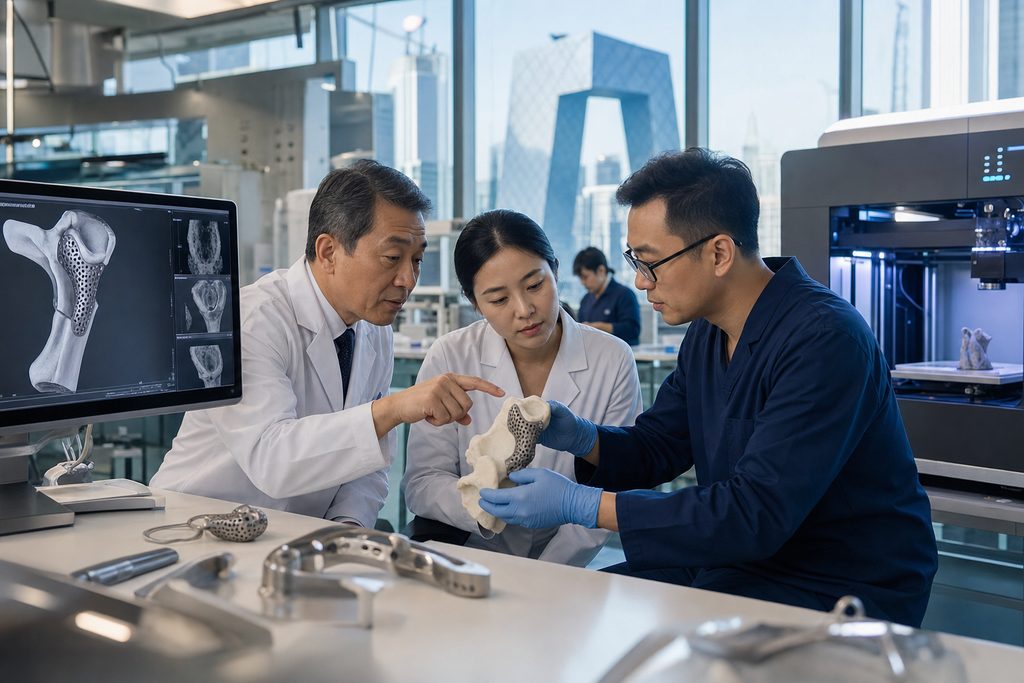
Once the DICOM data is accepted, a biomedical engineering team converts the CT slices into a 3D model of the patient’s anatomy. This is not simple segmentation. The engineers must identify the exact boundaries of the defect, model the mirror-image contralateral side for symmetry reference, and design an implant that matches both the bone geometry and the anticipated mechanical loads. Finite element analysis simulates stress distribution. Porous lattice structures are integrated into the implant surface to promote bone ingrowth. By the end of day one, a digital design file is ready for review by the attending surgeon.
Day Two: Printing and Post-Processing
The approved design goes to a medical-grade electron beam melting or selective laser melting printer. Titanium alloy powder—typically Ti6Al4V ELI, the same material used in FDA-approved orthopedic implants—is fused layer by layer. A complex pelvic implant might take 12 to 18 hours to print. After printing, the implant undergoes heat treatment to relieve internal stresses, then support structures are removed. The surface is blasted and cleaned. Quality control includes dimensional verification against the digital model and radiographic inspection for internal voids.
Day Three: Sterilization and Surgery
The finished implant is packaged and sterilized, usually via autoclave. It arrives in the operating room sterile and ready. Surgery proceeds. The implant fits because it was designed from the patient’s own anatomy. Post-operative CT confirms placement. The patient begins recovery.
This timeline is not theoretical. It has been documented in clinical literature from institutions including Peking University Third Hospital, which has published extensively on 3D-printed orthopedic implants for complex spinal and pelvic reconstructions. The key variable is always the same: data quality on day zero.
Why Beijing Delivers Results That Other Systems Struggle to Match
Surgical Volume Creates Design Expertise
A top orthopedic tumor surgeon at a major Beijing center may perform 80 to 120 complex limb-salvage procedures annually. Many of these involve custom implants. That volume drives a feedback loop: surgeons see more complex cases, engineers design more custom devices, and the collaboration between the operating room and the design lab tightens with each case. When we connect a patient to a hospital through our network—which spans 340+ top-ranked hospitals across 37 cities—we are matching them with teams that have seen their specific problem before. Not once or twice. Dozens of times.
Manufacturing Lives Next Door to the Operating Room
In many Western hospitals, custom implant design is outsourced to a third-party manufacturer in another state or country. The design team never meets the surgeon. Iterations happen over email. Each revision costs days. Beijing’s leading orthopedic centers often house the 3D printing facility on the hospital campus or within the same university system. The engineer can walk into the surgeon’s office with a prototype. Adjustments happen in hours, not weeks. This physical proximity is not a marketing claim—it is a structural advantage that directly explains the rapid turnaround orthopedic implant China pathway.
Cost Structure Without the Middlemen
Let us address the question that brings most international patients to this page: what is the custom 3d printed implant China price? The implant itself typically costs between $8,000 and $25,000. A custom pelvic prosthesis for a tumor reconstruction sits at the higher end. A smaller cranial or maxillofacial implant may fall at the lower end. The total surgical package—implant, hospital stay, surgeon fees, anesthesia, and post-operative care—generally runs from $25,000 to $55,000.
Compare this to the United States, where a custom orthopedic implant alone can exceed $60,000 before surgical costs. The price difference is not about lower quality. It is about structural economics. Chinese hospitals manufacture implants in-house or through closely affiliated university labs, eliminating the margin stacking of third-party device companies. Hospital overhead is lower. Surgeon compensation is different. The regulatory pathway for patient-specific devices in China allows for rapid production under hospital ethics committee oversight, without the multi-month FDA custom device exemption process required in the US.
This does not mean the care is inferior. Peking Union Medical College Hospital, Peking University Third Hospital, and Jishuitan Hospital all run orthopedic programs that publish in top international journals and treat international referral cases. The cost difference reflects system design, not quality compromise.
What You Need to Know Before Going Alone
We tell every patient the same thing: the technology exists, the surgeons are world-class, and the barriers to accessing it independently are significant. Here is what you face if you try to arrange this without local coordination.
- Visa Requirements: Medical treatment in China requires an S2 visa with supporting documentation from the treating hospital. This includes an official invitation letter, hospital registration confirmation, and proof of treatment arrangements. Hospitals will not issue these documents to a patient they have never evaluated. You need a clinical pre-assessment before the paperwork starts. Our team handles this sequence: we present your case, secure a preliminary acceptance, and then guide the visa documentation.
- Data Standards and Communication: Most Western radiology centers export DICOM files on a CD or a basic portal. Chinese hospitals often require specific file structures, slice parameters, and upload methods that differ from Western norms. Language barriers compound this. A radiology technician in Beijing who needs to clarify a scan parameter cannot easily call a US imaging center. These small frictions kill timelines.
- Payment and Financial Logistics: Public hospitals in China operate on a pre-payment system. You deposit funds before admission, and services are deducted from that balance. International wire transfers can take days to clear. Credit card limits on foreign cards often cap at amounts below what a major surgery requires. Without someone on the ground to facilitate payment, you can arrive ready for surgery and be blocked by a banking problem.
How We Help You Navigate This
These barriers are real. They are also solvable with the right coordination. Our process starts with a free consultation where we review your imaging, your diagnosis, and your timeline. If a 72 hour custom implant Beijing cost and pathway fits your case, we move to a structured coordination plan.
Before you travel, we verify your CT data meets hospital specifications. We present your case to the appropriate surgical team and secure a preliminary treatment acceptance—the document that unlocks your S2 visa application. We provide an estimated cost breakdown so you know what to expect before committing. During your stay, a bilingual medical companion handles registration, payment deposits, pharmacy runs, and every conversation between you and the clinical staff. After discharge, we coordinate follow-up imaging and communication with your home physician. The goal is not to insert ourselves into your medical care. It is to remove every logistical obstacle so you and your surgeon can focus entirely on the surgery and recovery.
For patients considering a broader range of options, our specialty department pages provide data on which hospitals lead in orthopedics, oncology, and other fields where custom implants are most commonly needed. If your case is urgent, we prioritize speed without sacrificing thoroughness.
Frequently Asked Questions
Yes, in the right circumstances. The 72-hour timeline applies to urgent cases where the patient’s CT data is already in hand and of sufficient quality, the implant design is complex but not unprecedented, and the hospital’s 3D printing facility has capacity. This is not a guaranteed timeline for every case—it is the fastest realistic pathway for patients who arrive prepared. Cases requiring multi-material printing, unprecedented design complexity, or additional regulatory review will take longer. We help you understand which category your case falls into before you commit to travel.
The implant cost covers design engineering, titanium powder material, printing, post-processing, sterilization, and quality control. It does not include the surgeon’s fee, anesthesiology, hospital bed charges, nursing care, medications, or post-operative imaging. The total surgical package cost—implant plus all hospital and professional fees—is what we help patients budget for. Third-party payer reimbursement depends entirely on your insurance policy. Chinese public hospitals do not directly bill international insurers. You pay the hospital, and you seek reimbursement from your insurer with the documentation we help you compile.
This is the hardest question, and it deserves a direct answer. Custom implants are designed from CT data, and CT data can have artifacts, distortions, or resolution limitations that affect fit. Reputable Beijing hospitals build contingency plans. The design team typically prepares a backup implant or has the ability to modify the device intraoperatively if minor adjustments are needed. Complication rates for custom implant surgeries are comparable to those for complex orthopedic procedures using standard implants—they are not zero. You should discuss specific complication risks with the treating surgeon during your pre-operative consultation. We are not clinicians, and we do not minimize surgical risk. We do ensure you have full access to the surgical team for informed consent discussions before any procedure begins.
Qualification depends on three factors. First, the clinical urgency: is there a documented medical reason why waiting 6-8 weeks would worsen your outcome? Second, the data readiness: do you have high-resolution CT scans available now, and do they meet the 1mm slice thickness standard? Third, the implant feasibility: can your anatomical defect be addressed with a 3D-printed titanium implant based on current clinical evidence? Our initial consultation evaluates all three. If your case does not qualify for the 72-hour pathway, we will tell you directly and discuss alternative timelines and options.
The titanium alloy used—Ti6Al4V ELI—is an international standard material used in orthopedic implants worldwide. Chinese manufacturers follow ISO 13485 quality management standards for medical devices. Several Beijing hospitals have published their custom implant outcomes in peer-reviewed international journals with follow-up periods of 5 years or longer. The technology is mature. The variable is not the implant quality—it is the surgical team and the appropriateness of the implant design for your specific anatomy. That is why hospital selection matters enormously, and why we connect patients only with orthopedic programs that have documented experience with their specific type of case.
Your Next Step
A 72-hour custom implant is not for every orthopedic patient. For the patient with a complex defect, a failing reconstruction, or a tumor resection that cannot wait, it represents a pathway that simply does not exist in most Western health systems at any price. The technology is real, the surgical expertise is concentrated in a handful of Beijing centers that do this work at high volume, and the cost is a fraction of what equivalent care would cost in the United States or Europe.
The difference between a successful outcome and a wasted trip comes down to preparation. If you are considering urgent custom orthopedic implant China medical tourism, start by getting your CT data reviewed. Our free consultation is designed to do exactly that—no commitment, no pressure, just an honest assessment of whether this pathway fits your case.
For more medical information and treatment options in China, visit chinamedservices.com (China Medical Services).
