3D Printed Surgical Guides China: Precision Joint Replacement with Custom Cutting Blocks
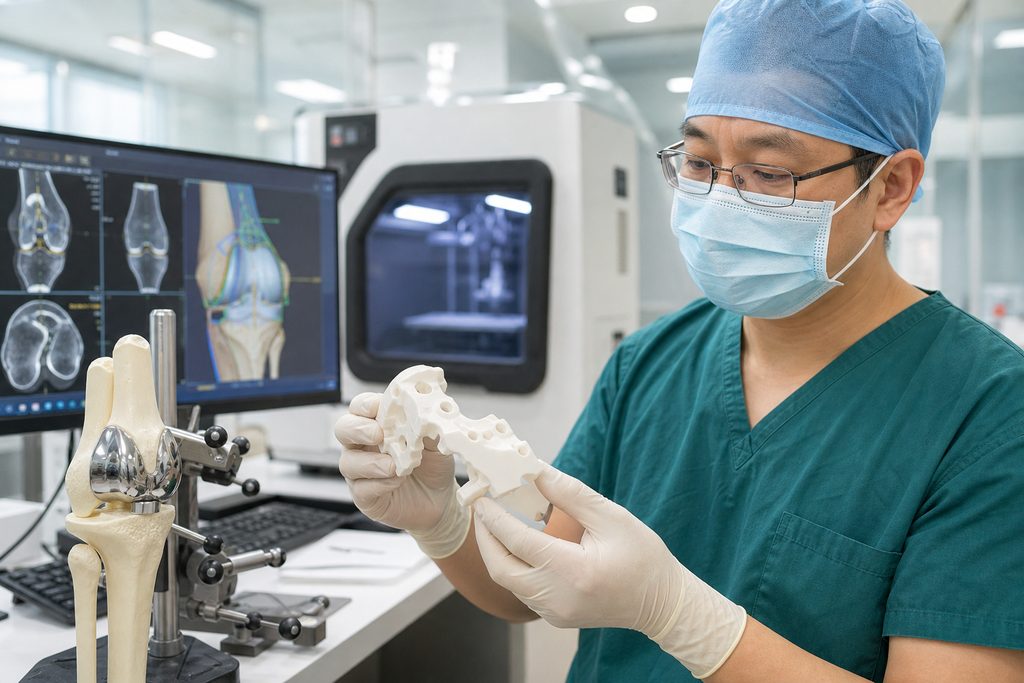
A 3D printed surgical guide sounds complex. Strip away the jargon and it is a personalized template. Your surgeon uses your own CT or MRI scans to print a physical guide that fits your bone perfectly. This guide tells the surgeon exactly where to cut, at what angle, and how deep. No guesswork. No eyeballing. Just a pre-planned, patient-specific roadmap for placing a knee or hip implant.
The consequences of misalignment are not subtle. A study in the *Journal of Arthroplasty* found that malalignment greater than 3 degrees can accelerate polyethylene wear by up to 40%. That translates to a joint replacement that might fail years earlier than expected. For the 7 million Americans currently living with a hip or knee replacement, the precision of that initial surgery dictates the next 15 to 20 years of their mobility.
Our team at China Medical Services has watched this technology mature rapidly in China’s top-tier orthopedic centers. We are not surgeons. We are the logistical architects who connect you with the surgical teams that have adopted these tools at a scale rarely seen in Western hospitals. The difference in cost, access, and surgical volume is stark. And it deserves a clear-eyed explanation.
Key Takeaways
- Custom 3D printed cutting guides improve implant alignment accuracy to within 1 degree and 1 millimeter of the preoperative plan, directly reducing long-term wear and revision risk.
- China’s top orthopedic hospitals perform thousands of these procedures annually, with the full procedure costing 60-80% less than comparable US surgeries.
- Independent navigation of China’s public hospital system is extremely difficult without Mandarin fluency and local knowledge—this is not a barrier to dismiss lightly.
- The technology itself is well-established; the real variable is the surgical team’s experience and the hospital’s perioperative care protocols.
The Problem: Implant Longevity Hinges on Surgical Precision
Joint replacement surgery has a dirty secret. The implants themselves are marvels of engineering—cobalt-chrome, highly cross-linked polyethylene, ceramic composites. They can last 30 years or more in laboratory testing. But in the human body, the average lifespan of a knee replacement is closer to 15 to 20 years. For hip replacements, roughly 58% survive 25 years, according to data from the Lancet’s 2019 meta-analysis of over 200,000 cases.
Why the gap? The implant is only half the story. The other half is placement. A femoral component set in slight internal rotation. A tibial tray with 2 degrees of varus. These are not dramatic errors. They are subtle deviations that alter the biomechanics of walking. Over a decade, that altered gait grinds down the polyethylene liner unevenly. The patient feels fine for years. Then the pain returns. Revision surgery looms.
Traditional jigs help. But they rely on intramedullary rods inserted into the femur and tibia. The assumption is that the rod represents the mechanical axis of the bone. For many patients, that assumption is wrong. Bowed femurs, prior fractures, or simply unusual anatomy can throw the alignment off. The surgeon compensates with experience and intraoperative judgment. Most of the time, that works. But “most of the time” is cold comfort when you are the outlier facing a revision at age 68.
That is where the 3D printed surgical guide changes the equation. It removes the anatomical assumption. The guide is contoured to your specific bone surface. It locks onto a unique topography of osteophytes and ridges that no generic instrument can match. The cutting slots are positioned based on a 3D reconstruction of your CT scan. The surgeon does not need to guess your mechanical axis. The guide already knows it.
Who We Are
We are not a hospital. We do not provide medical treatment or clinical diagnoses. China Medical Services is a patient coordination organization with a database of 340+ top-ranked hospitals across 37 cities in China. Our team handles the logistics that make international orthopedic care feasible: hospital matching based on your specific condition, appointment coordination, bilingual medical companions, visa guidance, and post-operative recovery planning. We bridge the gap between you and China’s top-tier surgical expertise, but we never step into the role of your doctor.
Why 3D Printed Surgical Guides in China Deliver Results
Surgical Volume Builds Procedural Fluency
The numbers tell a story that matters for outcomes. A senior orthopedic surgeon at a high-volume Chinese joint replacement center typically completes 300 to 600 arthroplasties per year. The average US orthopedic surgeon performs approximately 65 total knee replacements annually, according to a 2022 analysis in the *Journal of Bone and Joint Surgery*. This is not a critique of individual skill. It is a structural reality. China’s population of 1.4 billion, combined with centralized referral patterns to top hospitals, concentrates complex cases in a handful of centers.
What does volume buy you? Pattern recognition. A surgeon who sees 500 knees a year has encountered virtually every anatomical variation. The severely valgus knee. The post-traumatic arthritis with retained hardware. The obese patient with a short, thick tibia. When you combine that clinical experience with a 3D printed surgical guide, the guide does not replace judgment. It amplifies it. The surgeon can anticipate challenges during the preoperative planning phase, not discover them mid-incision.
Data supports this. A 2020 study in *Orthopaedic Surgery* examined 120 patients undergoing total knee arthroplasty with patient-specific instrumentation in a Chinese hospital. The mean coronal alignment deviation from the planned axis was 0.9 degrees. Outliers beyond 3 degrees occurred in less than 2% of cases. Compare that to conventional instrumentation, where outlier rates of 10-15% are commonly reported. The difference is not marginal. It is the difference between a 20-year implant and a 10-year revision.
Technology Adoption at Scale Lowers Costs
The question of 3D printed surgical guide China price comes up early in every consultation. Patients have heard the Western numbers. In the United States, a custom cutting guide alone can add $1,000 to $2,500 to the surgical bill. The full procedure—including the implant, hospital stay, surgeon fees, and anesthesia—ranges from $35,000 to $70,000 for a knee replacement, depending on the facility and region. A hip replacement lands in a similar range.
In China’s top-tier public hospitals, the economics are fundamentally different. The total cost for a knee or hip replacement using 3D printed surgical guides typically falls between $10,000 and $18,000. That includes the custom guide fabrication, the implant itself, a 5-7 day hospital stay, surgeon fees, and standard preoperative imaging. The custom cutting blocks knee replacement China cost is not a separate line item that inflates the bill. It is often integrated into the surgical package because the in-hospital 3D printing labs operate at a scale that amortizes the equipment cost across thousands of cases per year.
Why is it cheaper? Labor costs account for part of the difference. But the larger factor is hospital efficiency. A high-volume Chinese orthopedic ward may run 8 to 12 joint replacements per day in a single operating theater. Turnover time between cases is measured in minutes, not hours. The sterilization protocols are rigorous. The implant inventory is deep. The supply chain for 3D printing materials—medical-grade polyamide, titanium powder for custom implants—is domestic and mature. None of this compromises quality. It reflects a system optimized for throughput without cutting corners on sterility or surgical technique.
Some patients ask about medical tourism China joint replacement packages. These exist, but we advise caution. A package that bundles airfare, hotel, surgery, and a tour of the Great Wall sounds appealing. Surgery is not a vacation. Your body needs focused recovery, not tourist excursions. The reputable hospitals we work with do not offer “packages” in the vacation sense. They offer coordinated care with transparent pricing. That distinction matters.
Accuracy You Can Measure
How accurate is 3D printed joint replacement surgery? The short answer: within 1 degree of angular alignment and 1 millimeter of bone resection depth, when the guide is properly designed and seated. The longer answer requires understanding where errors can creep in.
The guide is only as good as the CT scan. A low-resolution scan with metal artifact from old hardware can degrade the 3D model. The segmentation process—turning those 2D CT slices into a 3D reconstruction—requires a trained biomedical engineer. The guide design itself involves decisions about the cutting slot position, the pin holes for fixation, and the contact surface area. A poorly designed guide can rock on the bone surface, introducing error. The surgeon must also verify intraoperatively that the guide fits snugly and the pins are placed correctly. No technology eliminates the need for surgical judgment.
That said, the published accuracy data is compelling. A 2018 systematic review in *Knee Surgery, Sports Traumatology, Arthroscopy* pooled results from 44 studies on patient-specific instrumentation. The mean deviation from the planned mechanical axis was 0.8 degrees for guides versus 1.5 degrees for conventional instrumentation. The proportion of outliers beyond 3 degrees was 9% with guides versus 22% without. These are not laboratory numbers. They are intraoperative and postoperative radiographic measurements from real patients.
For hip replacements, the 3D printed surgical guide for hip replacement Shanghai centers have published similar results. A 2021 study from Shanghai Ninth People’s Hospital, a recognized leader in orthopedic 3D printing, reported mean cup inclination accuracy of 1.2 degrees and anteversion accuracy of 1.4 degrees compared to the preoperative plan. The clinical significance? Accurate cup placement reduces the risk of dislocation, edge loading, and accelerated liner wear. These are the mechanical failures that drive patients back to the operating room.
What You Need to Know Before Going Alone
Let us be direct about the barriers. They are real. They are not insurmountable, but underestimating them will lead to frustration, wasted money, or worse—a surgery you cannot access.
- Public Hospital Access Is Not Open to Walk-In International Patients: China’s top-tier public hospitals are not set up for direct international booking. The outpatient registration system is largely app-based, in Chinese, and requires a local phone number. Specialist consultations fill within minutes of release. You cannot email a surgeon’s office and request a surgery date. The pathway to care runs through the hospital’s international medical center or VIP department, which operates on a different scheduling and pricing model. Navigating this without local representation is, bluntly, nearly impossible.
- Payment Is Upfront, Insurance Reimbursement Is Retrospective: Chinese public hospitals require prepayment for surgical procedures. They do not direct-bill Western insurance companies. You pay the hospital. You submit the claim to your insurer afterward. If your policy covers out-of-network international care, you may receive partial or full reimbursement. If it does not, you bear the full cost. We help patients understand their insurance coverage before travel, but we do not guarantee reimbursement. That is between you and your insurer.
- Medical Records and Imaging Transfer Require Formal Translation: A surgical team in Shanghai or Beijing will not accept your MRI report in English and proceed. Your records must be translated into Chinese by a qualified medical translator. The imaging files must be in DICOM format, not JPEG screenshots. The 3D printing lab needs thin-slice CT scans—typically 0.625mm slice thickness—to generate an accurate model. If your scans are inadequate, you will repeat them on arrival, adding time and cost.
How We Help You Navigate This
These barriers exist for structural reasons, not malice. China’s healthcare system was built to serve its domestic population first. International patients are accommodated through specific channels that require local knowledge to access. That is where our team operates.
We start with your imaging and medical history. You send us your DICOM files and relevant records. Our clinical team reviews them—not to diagnose, but to understand the complexity of your case. Is this a straightforward primary knee replacement in a patient with mild varus deformity? Or is it a revision of a failed implant with significant bone loss requiring custom augments? The answer determines which hospital and which surgical team we recommend.
We then match you with a hospital from our network that has demonstrated volume and outcomes in your specific procedure. If you need a 3D printed surgical guide for hip replacement Shanghai, we look at centers like Shanghai Ninth People’s Hospital or Changzheng Hospital, both known for their orthopedic 3D printing programs. If you are seeking best hospitals for personalized knee surgery abroad, we consider centers in Beijing, Guangzhou, or Chengdu based on your anatomical complexity and recovery preferences.
Once matched, we coordinate the preoperative process. Your translated records go to the surgical team. They review and confirm that you are a surgical candidate. We schedule your consultation, arrange your S2 visa invitation letter, and book your initial appointment through the hospital’s international channel. A bilingual medical companion meets you at the hospital on your first visit. They handle registration, guide you to the correct department, and translate the surgeon’s assessment in real time.
During your hospital stay, the companion remains available. They explain the nursing protocols, translate medication instructions, and coordinate with the hospital’s international department on discharge planning. Post-operatively, we help arrange follow-up imaging and physical therapy if you choose to recover in China before flying home. We also ensure you leave with a complete set of surgical records—operative notes, implant stickers, postoperative X-rays—in both Chinese and English, formatted for your home-country orthopedic surgeon.
Our coordination fee is separate from hospital charges. It covers the logistical work, not the medical care. And if you later decide to proceed with surgery through us, any prior consultation fee is credited in full toward the coordination service. That is our commitment to alignment of incentives. We succeed when you access excellent care, not when you pay for services you do not need.
Frequently Asked Questions
The guide fabrication itself typically ranges from $800 to $2,000, but it is often bundled into the total surgical package. The full knee replacement procedure—including the custom guide, implant, hospital stay, surgeon fees, and anesthesia—generally costs between $10,000 and $18,000 at top-tier Chinese public hospitals. This compares to $35,000 to $70,000 in the United States. Final pricing varies by hospital, implant type, and case complexity. We provide a detailed cost estimate during the hospital matching process.
The materials and printing technology are equivalent. Chinese hospitals use the same medical-grade polyamide (PA12) and stereolithography resins used in FDA-approved guides. The difference is not in the printer or the material. It is in the design software, the engineer’s experience, and the surgeon’s preoperative planning protocol. The hospitals we work with use engineers who specialize exclusively in orthopedic guide design and surgeons who plan each case on a 3D model before entering the operating room. These are the same workflows you would find at a top US academic center.
This is rare but accounted for. The surgeon always has conventional instrumentation sterilized and available as a backup. If the guide does not seat properly—due to inadequate cartilage removal, unrecognized osteophytes, or a design error—the surgeon abandons the guide and proceeds with standard intramedullary or extramedullary alignment techniques. The surgery continues safely. A guide is a tool, not a crutch. The surgical team at any reputable hospital is fully capable of performing the procedure without it. The guide improves precision; it does not replace surgical competence.
Plan for 3 to 4 weeks minimum. The hospital stay is typically 5 to 7 days. After discharge, you need at least 2 weeks of monitored recovery before flying long-haul. The risk of deep vein thrombosis is elevated after joint replacement, and a long flight too soon after surgery is dangerous. Some patients stay 6 weeks to complete early physical therapy in China before returning home. Your surgeon will clear you for flight based on your mobility, wound healing, and DVT prophylaxis status. Do not book a return ticket with a fixed date before your surgery. Flexibility is essential.
Yes, we strongly encourage it. Your family member or companion applies for an S2 visa, the same visa category used for medical treatment accompaniment. The visa is issued based on your hospitalization documentation. We provide the invitation letter and supporting documents for both your visa and your companion’s visa. The S2 typically allows a stay of up to 180 days, which covers even extended recovery periods. Do not apply for an M visa—that is a business visa and is not appropriate for medical travel.
Your Next Step
Precision in joint replacement surgery is not a luxury. It is the variable that determines whether your implant lasts 15 years or 30 years. 3D printed surgical guides tilt the odds in your favor, and China’s high-volume orthopedic centers have integrated this technology into routine practice at a cost that makes the procedure accessible to patients who would otherwise face years of waiting or unaffordable bills.
If you are considering a knee or hip replacement and want to understand whether a Chinese hospital with 3D printed guide capability is the right path for you, start with a conversation. Send us your imaging and a brief medical history. We will review your case, recommend appropriate hospitals from our network of 340+ top-ranked institutions, and give you a transparent cost estimate. There is no obligation. There is no pressure. There is just clarity about an option you may not have known existed. Reach out to our team when you are ready to explore it.
For more medical information and treatment options in China, visit chinamedservices.com (China Medical Services).
