Carbon Ion Therapy China for Radioresistant Tumors: Sarcoma & ACC Access
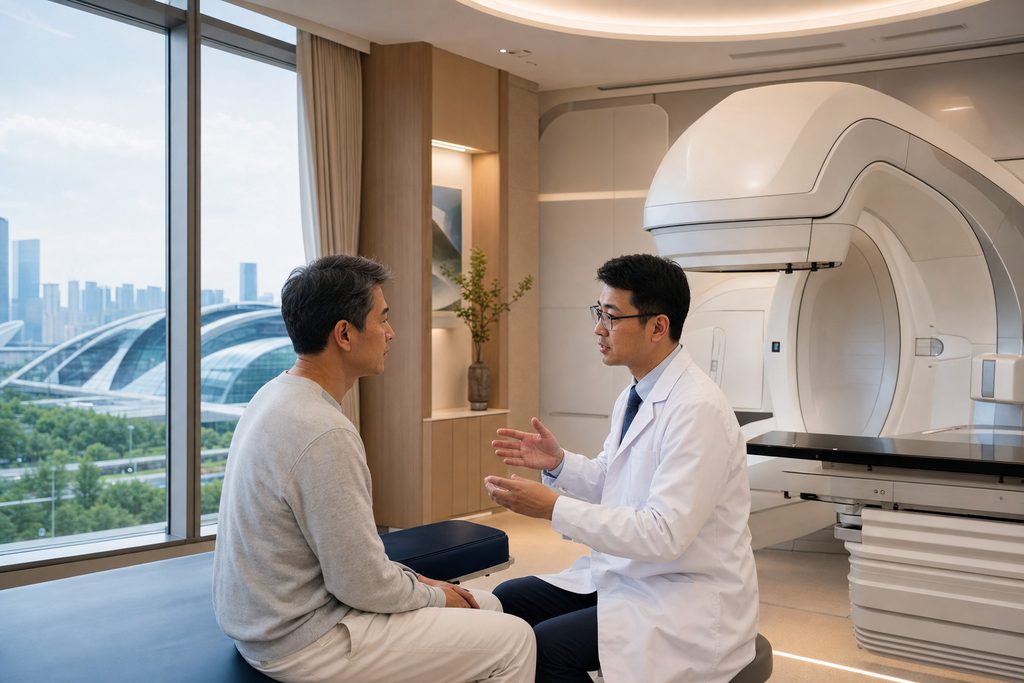
You have probably heard that when tumors resist standard radiation, options narrow fast. The next conversation often shifts to systemic therapies with significant side effects. But there is a physical treatment modality that destroys cancer cells X-rays cannot touch. It is called carbon ion therapy. China has invested billions to make it clinically accessible. For patients with sarcoma, adenoid cystic carcinoma, and other radioresistant malignancies, this changes the calculus entirely.
Our team helps international patients navigate this landscape. We do not provide medical treatment. We do not offer clinical diagnoses. We are your logistical architects. We bridge the gap between you and China’s top-tier carbon ion centers. The technology exists. The expertise is here. The barrier is not medicine. It is navigation. We solve that.
Key Takeaways
- Carbon ion therapy delivers 2 to 3 times the biological effectiveness of proton therapy, achieving local control rates above 80% for inoperable adenoid cystic carcinoma in some studies.
- China operates some of the world’s most advanced heavy ion facilities, with treatment packages priced far below what comparable proton centers charge in the United States.
- Public hospital outpatient registration cannot be secured from overseas without a physical presence, making coordinated international access essential before you travel.
- No legitimate medical concierge can guarantee a specific surgery date or promise you will skip a queue; the value lies in accurate scheduling, bilingual advocacy, and avoiding costly administrative dead ends.
The Problem: When Standard Radiation Stops Working
Roughly 1 in 10 patients with localized sarcoma will develop local recurrence after conventional treatment. For adenoid cystic carcinoma, the numbers are more sobering. Perineural invasion means microscopic disease threads along nerve sheaths, often beyond the surgeon’s margin. Photon radiation can hit the bulk of it. But what about the residual cells with high DNA repair capacity? They survive. They adapt. They come back.
This is the clinical definition of radioresistance. It is not that the tumor never responds. It responds poorly, or incompletely, and the therapeutic window closes. At that point, oncologists in the United States or Europe may discuss re-irradiation with protons. That is a step forward. Protons deposit most of their energy at a specific depth, sparing healthy tissue. But biologically, protons are still low-LET radiation. Their relative biological effectiveness is only about 1.1 times that of photons. Carbon ions are different. Much different.
The National Institute of Radiological Sciences in Japan has published long-term data showing that carbon ion therapy achieves local control rates exceeding 90% for certain bone sarcomas at 5 years. These are tumors that surgeons cannot always resect cleanly. Tumors that photons struggle to sterilize. For patients who have exhausted first-line options, the question shifts from “is there a treatment” to “where can I access it.”
Who We Are
China Medical Services maintains a curated network of 340+ top-ranked hospitals across 37 cities. We are not a hospital. We do not employ physicians. What we do is translate clinical complexity into executable logistics. That means we match your diagnosis to the right heavy ion center, coordinate the hospital’s international department on your behalf, arrange bilingual medical companions, and guide your visa application. We handle the friction so you can focus on treatment. Our team has walked this path with sarcoma patients, with ACC patients, with families who had nowhere else to turn.
What Is Carbon Ion Therapy for Adenoid Cystic Carcinoma and Other Radioresistant Tumors
The question we hear most often from international patients is straightforward: what is carbon ion therapy for adenoid cystic carcinoma, and why does it work when photons fail? The answer sits at the intersection of physics and biology.
Carbon ions are heavy charged particles. They deposit relatively little energy as they enter the body, then release a massive burst at a precise depth. That burst is called the Bragg peak. The physical dose concentration is sharp. But the real advantage is biological. Carbon ions create dense clusters of DNA damage. Double-strand breaks. Complex lesions that cellular repair machinery cannot easily fix. Even cells that shrug off photon-induced damage get overwhelmed. This is high-LET radiation. Its relative biological effectiveness is 2 to 3 times higher than protons.
For adenoid cystic carcinoma, this matters enormously. ACC grows slowly. Its cells have time to repair sublethal damage between photon fractions. Carbon ions overwhelm that repair capacity. The Japan Carbon-Ion Radiation Oncology Study Group reported 5-year local control of 82% for ACC of the head and neck treated with carbon ions. Many of those patients had inoperable disease. Many had received prior radiation.
Sarcoma presents a parallel story. Chondrosarcoma and chordoma are notoriously photon-resistant. Surgery is the mainstay, but complete resection is often impossible along the spine or skull base. Carbon ion therapy has emerged as the definitive adjuvant or even primary local treatment in these settings. The Heidelberg Ion-Beam Therapy Center in Germany pioneered this approach. China has since scaled it.
How Effective Is Heavy Ion Therapy for Sarcoma
Let us look at the data directly. A pooled analysis from the Heavy Ion Medical Accelerator in Chiba, Japan, examined over 500 patients with bone and soft tissue sarcomas treated with carbon ions. The 5-year local control rate for unresectable sacral chordoma was 77%. For unresectable retroperitoneal sarcoma, local control at 5 years reached 69%. These are tumors that would otherwise progress on observation or systemic therapy alone.
How effective is heavy ion therapy for sarcoma when compared to surgery? That is the wrong comparison. Carbon ions are not competing with a clean R0 resection. They are competing with the alternative: an R1 or R2 resection followed by conventional radiation, or no local treatment at all. In that context, the numbers speak clearly. Carbon ions offer durable local control where other modalities fall short.
But there is a nuance. Carbon ions are a local treatment. They do not address micrometastatic disease. A patient with high-grade sarcoma who develops lung metastases will need systemic therapy regardless of local control. The oncologists at China’s carbon ion centers understand this. They integrate heavy ion therapy into a broader treatment plan, not as a standalone miracle cure.
Best Carbon Ion Centers China for Radioresistant Tumors
China has moved aggressively to build and operate heavy ion facilities. The best carbon ion centers China for radioresistant tumors are concentrated in a few cities, each with distinct clinical volumes and equipment profiles.
The Shanghai Proton and Heavy Ion Center was the first in the country to treat patients with carbon ions. It opened in 2015 and has since treated more than 6,000 patients. The center uses a synchrotron-based system developed in collaboration with Siemens. It is a high-volume facility. Physicians there have accumulated significant experience with ACC and sarcoma cases. Wait times exist, but they are manageable with proper coordination.
Wuwei Heavy Ion Center in Gansu province operates a fully domestically developed carbon ion system. It was the first China-made heavy ion accelerator to receive regulatory approval. Clinical volumes are growing. For patients who cannot secure a slot in Shanghai quickly, Wuwei offers a viable alternative with shorter queues.
Lanzhou Heavy Ion Hospital, also in Gansu, runs a similar system. Both Gansu facilities benefit from lower operational costs, which translates into treatment package pricing that is meaningfully lower than Shanghai. The trade-off is a more remote location and less developed international patient infrastructure. That is where coordination support becomes essential.
Other centers are coming online. Beijing, Guangzhou, and Hangzhou have heavy ion projects in various stages of construction or commissioning. For now, Shanghai and Gansu are the operational hubs. Our team tracks capacity in real time. We know which center is accepting international patients, which has slots, and what documentation each requires before scheduling.
Carbon Ion Therapy Cost China Sarcoma Patients Should Expect
Let us address the financial question directly. Carbon ion therapy cost China sarcoma patients face depends on the center, the treatment volume, and the number of fractions. The Shanghai Proton and Heavy Ion Center typically quotes a full treatment course at approximately $45,000 to $65,000 USD. This covers simulation, treatment planning, and all fractions. It does not include hospitalization if needed, medications, or post-treatment imaging.
The Gansu centers are less expensive. Treatment packages there range from roughly $30,000 to $45,000 USD. The lower cost reflects regional economics and the domestic equipment supply chain. Clinical outcomes have been comparable in published series, though long-term data from the Chinese domestic systems is still maturing.
For context, proton therapy in the United States costs between $100,000 and $180,000 per course. Carbon ion therapy in Europe, at centers like Heidelberg or Marburg, runs €70,000 to €90,000. China’s pricing is structurally lower. Labor costs, equipment amortization, and hospital operational models all differ. Lower cost does not signal lower quality. It signals different economics.
There is a term you will encounter when discussing access: carbon ion therapy package price Shanghai. This phrase often refers to the bundled fee that covers the technical and professional components of treatment. It is not an all-inclusive medical tourism package. Flights, accommodations, visa fees, and post-treatment recovery support are separate. We help patients build a complete budget before any commitment is made.
| Cost Component | Shanghai (USD) | Gansu (USD) |
|---|---|---|
| Treatment course (all fractions) | $45,000 – $65,000 | $30,000 – $45,000 |
| Pre-treatment evaluation & imaging | $2,000 – $4,000 | $1,500 – $3,000 |
| Bilingual medical companion (per day) | from $200 | from $200 |
| Accommodation (monthly estimate) | $2,500 – $4,000 | $800 – $1,500 |
How to Book Carbon Ion Treatment China Adenoid Cystic Carcinoma Patients Can Actually Use
The process is not as simple as calling a hospital and reserving a slot. We wish it were. The reality is that China’s public hospital system does not allow overseas patients to secure outpatient registration or treatment appointments remotely. You cannot book carbon ion treatment China adenoid cystic carcinoma patients need by sending an email to the general admissions desk. It will not work.
Here is what does work. First, a clinical review. The center needs your complete medical records: pathology reports, imaging studies on CD, prior radiation treatment summaries, surgical notes. A multidisciplinary team at the hospital evaluates whether carbon ion therapy is indicated. This is a medical decision, not an administrative one. If the indication is confirmed, the hospital’s international department issues a treatment invitation letter. That letter is the document you need for your visa application.
Visa type matters. Foreign nationals seeking medical treatment in China apply for an S2 visa with a medical purpose annotation. Accompanying family members apply for the same S2 visa. The M visa is for commercial business. It is not valid for medical treatment. We have seen patients arrive on the wrong visa and get turned away at hospital registration. Do not let that happen.
Once the visa is secured, you travel. Our bilingual medical companion meets you at the airport. They accompany you to the hospital for simulation, treatment planning, and every fraction. They translate clinical conversations in real time. They handle registration queues, payment counters, and pharmacy pickups. You focus on treatment and recovery. They handle everything else.
Important: Treatment slots at Shanghai Proton and Heavy Ion Center can be fully booked 6 to 8 weeks in advance. Gansu centers often have shorter wait times but less English-language infrastructure. Start the coordination process early. Last-minute access is rarely possible.
What You Need to Know Before Going Alone
Some patients attempt to arrange treatment independently. We understand the impulse to save on coordination costs. But there are structural barriers that are genuinely difficult to overcome without local expertise.
- Hospital registration systems: China’s public hospitals use domestic ID-linked registration platforms. Foreign passport holders cannot self-register online. You must appear in person at the international department, often with a Chinese-speaking advocate, to complete intake.
- Payment infrastructure: Public hospitals require upfront deposit payments. International credit cards are not universally accepted. Wire transfers to hospital accounts require precise Chinese-language beneficiary information. Errors in a single character can delay treatment by weeks.
- Medical record translation: The carbon ion center’s multidisciplinary team reviews records in Chinese. Your English-language pathology and imaging reports must be professionally translated. A poor translation can lead to a rejected application or an inappropriate treatment plan.
- Post-treatment follow-up: After you return home, your local oncologist needs Chinese-language treatment summaries translated back into English. The hospital provides records in Chinese. Without coordination, this handoff can break down.
How We Help You Navigate This
These barriers are not malicious. They are structural features of a healthcare system designed for a domestic population of 1.4 billion. International patients are a small fraction of volume. The system does not bend for them. But it can be navigated with the right support.
Our process starts with a free consultation. You share your diagnosis, treatment history, and goals. We identify which carbon ion center is most appropriate based on tumor type, urgency, and budget. We contact the hospital’s international department and initiate the clinical review. We coordinate document translation. We track the invitation letter. We guide your visa application with precise documentation requirements.
When you land in China, our bilingual medical companion is there. They stay with you through every step of treatment. They translate complex clinical discussions about fractionation schedules, side effect management, and post-treatment surveillance. They ensure your follow-up imaging gets scheduled before you leave. When you return home, we facilitate the medical record transfer to your local oncology team. The loop closes cleanly.
This is not concierge medicine in the luxury sense. It is case management. It is the difference between navigating a foreign healthcare system alone and having a local team who knows exactly which door to walk through.
Frequently Asked Questions
“Cure” is a word we use carefully. Carbon ion therapy achieves high rates of local control for ACC, particularly in the head and neck. Published series report 5-year local control above 80%. But local control is not the same as cure. ACC can metastasize years after treatment. Carbon ions treat the local tumor. They do not prevent distant spread. Your oncologist will discuss long-term surveillance and the role of systemic therapy if needed.
A typical carbon ion therapy course runs 4 to 6 weeks, with daily fractions delivered Monday through Friday. You will need to arrive a few days early for simulation and treatment planning. Plan for a total stay of 5 to 7 weeks. Some centers can accommodate hypofractionated schedules that shorten the course. This depends on tumor characteristics and center protocols.
Side effects are local and depend on the treatment site. For head and neck tumors, acute mucositis and skin erythema are common. For pelvic or abdominal targets, gastrointestinal symptoms may occur. Late effects are generally less severe than with photon re-irradiation because carbon ions spare more normal tissue. But no radiation is side-effect-free. The treating radiation oncologist will review your specific risk profile during the planning phase.
Some Chinese carbon ion centers treat pediatric patients on a case-by-case basis. The decision depends on the tumor type, the child’s age, and the ability to cooperate with immobilization during treatment. Pediatric cases require general anesthesia for simulation and treatment delivery. Not all centers have dedicated pediatric anesthesia support. We clarify this during the initial clinical review before any travel commitment.
Most international health insurance plans do not cover carbon ion therapy abroad unless it is explicitly included in the policy. Some plans may cover it as out-of-network care. We recommend contacting your insurer with a detailed treatment plan and cost estimate before traveling. Many of our patients pay out-of-pocket. The cost differential compared to U.S. or European centers makes this feasible for families who would otherwise face financial barriers at home.
Your Next Step
Carbon ion therapy exists. It is clinically proven for radioresistant tumors. China has made it accessible at a fraction of Western costs. The remaining challenge is not medicine. It is coordination. If you are considering this path, start with a conversation. No commitment. No pressure. Just a clear-eyed discussion of whether this treatment fits your diagnosis and what it would take to make it happen.
Visit our patient coordination page to begin. We will review your case, identify the right center, and map out every logistical step before you book a single flight. You deserve to know all your options. We are here to make sure you do.
This article is for informational purposes only and does not constitute medical advice. Treatment decisions should be made in consultation with a qualified physician who has reviewed your individual case. China Medical Services does not provide clinical care or guarantee specific treatment outcomes.
For more medical information and treatment options in China, visit chinamedservices.com (China Medical Services).
