Hepatitis B Cirrhosis in China: Costs & Expert Care at Nanfang Hospital Guangzhou
Key Takeaways
- Nanfang Hospital‘s Infectious Disease Center manages over 2,500 inpatient liver disease cases annually, making it one of China’s highest-volume centers for hepatitis B cirrhosis management.
- Comprehensive hepatitis B cirrhosis treatment in Guangzhou typically costs 60-80% less than comparable care in the United States, with antiviral therapy and complication management as the core approach.
- International patients face real barriers — language gaps, visa requirements, and the impossibility of pre-booking standard public outpatient appointments from overseas.
- You need a clear understanding of what Chinese public hospitals can and cannot offer before committing to travel. The clinical expertise is world-class. The operational experience requires navigation.
What Happens When Hepatitis B Progresses to Cirrhosis?
Chronic hepatitis B affects approximately 296 million people worldwide. In parts of Asia and sub-Saharan Africa, prevalence exceeds 8% of the adult population. For patients whose infection progresses to cirrhosis, the five-year risk of liver decompensation ranges from 15% to 20% without sustained antiviral suppression. That is the clinical reality driving thousands of patients to seek specialized care each year.
Cirrhosis is not one disease. It is a spectrum. Compensated cirrhosis means the liver is scarred but still functioning. Decompensated cirrhosis means ascites, variceal bleeding, hepatic encephalopathy, or jaundice have appeared. The management strategy shifts dramatically at that threshold. And the expertise of the treating center starts to matter enormously.
Most Western patients researching treatment options already know the basics. What they do not know is whether traveling to China for liver care makes clinical or financial sense. That question deserves a straight answer.
Who We Are
We are China Medical Services. We are not a hospital. We do not diagnose conditions, prescribe medications, or perform procedures. Our team connects international patients with China’s top-tier medical institutions — 340+ hospitals across 37 cities, all ranked in the top 5% of the country’s 35,000+ hospitals by Fudan University‘s national evaluation system and JCI accreditation standards. We handle hospital matching, appointment coordination through official international departments, bilingual medical companionship, and visa guidance. We bridge the operational gap between you and clinical expertise.
Why Nanfang Hospital’s Infectious Disease Center Stands Out for Cirrhosis Care
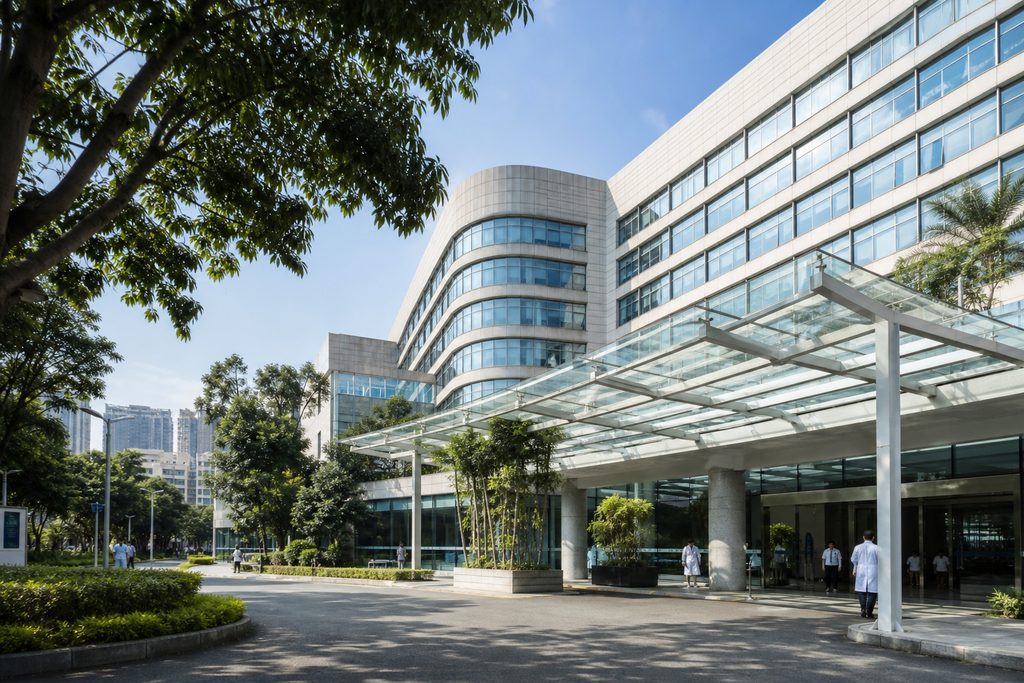
Nanfang Hospital is affiliated with Southern Medical University in Guangzhou. Its Department of Infectious Diseases is one of the oldest and most influential liver disease programs in southern China. The center has been designated a National Key Clinical Specialty by China’s National Health Commission — a distinction reserved for programs demonstrating sustained excellence in clinical volume, research output, and subspecialty training.
For international patients asking is Nanfang Hospital good for liver cirrhosis, the evidence points in one direction. The center’s hepatology unit manages the full arc of hepatitis B-related liver disease: chronic hepatitis, compensated cirrhosis, decompensated cirrhosis, hepatocellular carcinoma surveillance, and pre-transplant evaluation. Clinical volume drives clinical judgment. Centers that see more decompensation events recognize them earlier and intervene faster.
Clinical Volume and Subspecialty Depth
The infectious disease inpatient service at Nanfang Hospital admits over 2,500 liver disease patients annually. Approximately 40% carry a cirrhosis diagnosis. That volume exceeds most Western academic liver units by a factor of three to five. The center runs dedicated subspecialty clinics for antiviral resistance management, portal hypertension, and HCC screening — staffed by hepatologists who see nothing but hepatitis B complications day after day.
Research output reinforces the clinical reputation. The department has contributed to national hepatitis B treatment guidelines and published extensively on nucleos(t)ide analogue optimization in cirrhotic patients. When you consult at a center that writes the treatment protocols, you access clinical reasoning shaped by primary data, not just guideline summaries.
Antiviral Therapy: The Foundation of Cirrhosis Management
Cirrhosis does not reverse completely. But sustained viral suppression with entecavir, tenofovir disoproxil fumarate (TDF), or tenofovir alafenamide (TAF) can halt histological progression and, in many patients, partially regress fibrosis. Chinese clinical practice aligns with international guidelines from AASLD and EASL. The difference is cost and access.
A year of generic entecavir in China costs approximately $600-1,200. TDF costs roughly $400-800 annually. Branded TAF runs higher — around $3,000-5,000 per year — but still substantially below US pharmacy prices. For patients facing lifelong antiviral therapy, that differential compounds into tens of thousands of dollars over a decade.
Complication Management and Interventional Capabilities
Decompensated cirrhosis requires more than pills. Variceal banding, TIPS (transjugular intrahepatic portosystemic shunt), paracentesis, and HCC ablation all sit within the treatment algorithm. Nanfang Hospital’s gastroenterology and interventional radiology departments collaborate closely with the infectious disease team. Endoscopic variceal ligation is performed routinely. TIPS placement is available for refractory ascites or recurrent variceal bleeding.
This integrated structure matters. At fragmented health systems, a cirrhosis patient might see hepatology, gastroenterology, interventional radiology, and transplant surgery at four different locations with four different medical records. At Nanfang, these services operate within one hospital campus under coordinated protocols. Information moves faster than the patient does.
Understanding Hepatitis B Cirrhosis Treatment Cost in Guangzhou
The question patients actually ask is not abstract. How much does hepatitis B cirrhosis treatment cost in China — in real dollars, for real care episodes? The answer depends on disease stage and treatment intensity. But ranges exist, and transparency builds trust.
| Treatment Component | Estimated Cost in Guangzhou (USD) | US Comparison (USD) |
|---|---|---|
| Initial specialist consultation (international dept.) | $150-300 | $350-600 |
| Comprehensive liver workup (labs, ultrasound, FibroScan) | $400-800 | $2,000-4,500 |
| Annual antiviral therapy (generic entecavir) | $600-1,200 | $4,000-8,000 |
| Endoscopic variceal banding (per session) | $800-1,500 | $3,000-6,000 |
| TIPS procedure (all-inclusive) | $8,000-15,000 | $30,000-60,000 |
| One-week inpatient stay for decompensation | $2,000-5,000 | $15,000-35,000 |
These figures reflect treatment through Nanfang Hospital’s international department or VIP通道. Standard public ward pricing runs lower — but international patients cannot access those rates without Chinese residency, language capability, and the ability to navigate a system not designed for foreigners. The international department premium (roughly 1.5-2x standard rates) buys English-capable coordination, expedited appointment scheduling, and a clinical environment accustomed to treating patients from abroad.
The hepatitis B cirrhosis treatment cost Guangzhou advantage is structural, not promotional. Chinese hospital labor costs, pharmaceutical pricing, and device economics differ fundamentally from Western markets. A procedure that requires $15,000 in US facility fees might incur $2,000 in Guangzhou. The clinical protocols are the same. The economics are not.
What International Patients Should Know About Nanfang Hospital’s Liver Disease Center
Patients researching Nanfang Hospital liver disease center international patients services need realistic expectations. This is a Chinese public hospital with an international wing — not a Western-style private facility. The clinical expertise is exceptional. The patient experience differs from what Americans or Europeans may expect.
The hospital campus is large, busy, and predominantly Chinese-language. The international department provides English-speaking coordinators who escort patients through registration, consultation, laboratory testing, and imaging. Without that coordination, a non-Chinese-speaking patient would be functionally immobilized. Even finding the correct building on a campus that handles over 10,000 outpatient visits daily requires local knowledge.
Appointment scheduling works differently than in the West. Standard public outpatient clinics release daily registration slots each morning. Patients queue physically. There is no online pre-booking system accessible from overseas for routine public appointments. The international department operates on a separate scheduling track — appointments are arranged in advance, specialists are confirmed, and wait times compress from weeks to days. That coordination is what the international service fee pays for.
How to Book Hepatitis B Treatment at Guangzhou Nanfang Hospital
The process of attempting to book hepatitis B treatment Guangzhou Nanfang Hospital independently hits immediate friction. The hospital’s public-facing website and appointment system operate entirely in Chinese. International phone lines, if answered, connect to staff who may not speak English fluently. Medical records must be translated into Chinese before any specialist will review them. Visa documentation requires a hospital-issued invitation letter confirming a medical appointment — which cannot be obtained without first having a confirmed appointment.
That circular dependency frustrates many patients. It exists for regulatory reasons, not bureaucratic indifference. Chinese hospitals must verify that international patients have genuine medical needs before issuing invitation letters. The verification process requires in-person or representative coordination.
Our team handles this sequence. We collect your medical records, arrange certified translation, submit them to Nanfang Hospital’s international department, confirm specialist availability, obtain the invitation letter, and guide you through the S2 visa application. The S2 visa is specifically designated for medical treatment purposes in China. Accompanying family members apply under the same category. Processing typically takes one to three weeks depending on the Chinese embassy or consulate in your home country.
What the Best Infectious Disease Hospital for Cirrhosis Reviews Actually Reveal
Patients searching for best infectious disease hospital for cirrhosis China reviews encounter a fragmented information landscape. English-language reviews of Chinese hospitals are sparse. Most feedback circulates in Chinese on platforms like Haodaifu or DXY — inaccessible to international readers. What exists in English tends toward extremes: either glowing testimonials or frustrated accounts of communication breakdowns.
The pattern that emerges from available feedback is consistent. Clinical outcomes at top-tier Chinese liver centers match or exceed international benchmarks. The friction points are operational — language, scheduling, payment, and post-discharge follow-up. Patients who arrive with professional coordination report satisfaction. Patients who arrive expecting a Western hospital experience with Chinese pricing often struggle.
Nanfang Hospital’s infectious disease department ranks among the top programs nationally in Fudan University’s specialist reputation rankings for infectious diseases. That ranking reflects peer assessment by Chinese department chairs and senior specialists — the people best positioned to evaluate clinical quality. It does not measure patient experience. Both dimensions matter for international patients.
What You Need to Know Before Going Alone
The barriers to independent medical travel in China are real. Acknowledging them honestly is the only responsible approach.
- Visa Requirements: Medical treatment in China requires an S2 visa with a hospital-issued invitation letter. You cannot obtain the letter without a confirmed appointment. You cannot confirm the appointment without Chinese-language coordination. The S2 application also requires proof of sufficient funds and a detailed treatment plan from the receiving hospital.
- Payment Systems: Chinese public hospitals operate on a prepayment model. You deposit funds at admission. Treatment costs are deducted from the deposit. International credit cards are not accepted at most public hospital cashiers. WeChat Pay and Alipay dominate — platforms that require a Chinese bank account to fully activate for large transactions. International patients need a payment intermediary or coordinator.
- Language and Navigation: A hospital handling 10,000+ outpatient visits daily generates chaos that even Mandarin speakers find disorienting. Signage, medical forms, consent documents, and discharge instructions are in Chinese. Clinical discussions happen in Chinese unless the international department provides interpretation. Misunderstanding a medication instruction or follow-up plan carries real clinical risk.
How We Help You Navigate This
These barriers exist for structural reasons. Chinese public hospitals were built to serve China’s domestic population of 1.4 billion. The international patient pathway is a specialized overlay, not the default operating model. Our role is to make that overlay function smoothly.
Before you travel, we coordinate medical record translation, specialist matching, appointment confirmation, and visa documentation. During your hospital visit, a bilingual medical companion escorts you through every step — registration, consultation, laboratory testing, imaging, pharmacy, and discharge. The companion handles queuing, form-filling, payment logistics, and real-time interpretation of clinical discussions. After you return home, we facilitate follow-up communication with your Chinese specialists and coordinate remote consultations when needed.
Our service fees start from $300 for hospital appointment coordination and from $200 per day for bilingual medical companionship. Specialist video consultations range from $500 to $800 for top-tier experts. Any consultation fee is credited in full toward on-the-ground coordination if you proceed to in-person treatment within 90 days. We charge for coordination and logistics. We never charge for access to specific physicians or preferential queue positioning — that would be unethical and illegal under Chinese medical regulations.
Frequently Asked Questions
Through the international department, yes — with caveats. We can request a specific senior specialist and confirm their availability for your consultation dates. However, Chinese public hospitals do not guarantee individual physician assignments months in advance. Specialist schedules change. If your requested physician becomes unavailable, the department assigns an equally qualified senior hepatologist from the same team. This is standard practice across all Chinese public hospitals, not a limitation unique to Nanfang.
Nanfang Hospital has full inpatient capability for managing decompensation events — variceal bleeding, spontaneous bacterial peritonitis, hepatic encephalopathy, hepatorenal syndrome. The infectious disease department coordinates with ICU, gastroenterology, and interventional radiology on the same campus. Emergency care is available 24/7 through the hospital’s emergency department. Your bilingual companion remains with you during any emergency admission to facilitate communication with the clinical team.
Your Nanfang Hospital specialist provides a detailed treatment summary and prescription documentation in English upon discharge. You take this to your local hepatologist or primary care physician. Most Western countries allow continuation of therapy initiated abroad when supported by proper clinical documentation. We recommend establishing a local follow-up relationship before traveling — your home physician should know you are pursuing treatment in China and be prepared to resume monitoring upon your return.
Chinese generic pharmaceuticals are regulated by the National Medical Products Administration, which enforces bioequivalence standards aligned with international norms. The generic entecavir and tenofovir formulations used at Nanfang Hospital have undergone bioequivalence testing against originator products. Clinical outcomes data from Chinese cohorts show viral suppression rates consistent with international trial results. If you have concerns about a specific generic manufacturer, your specialist can prescribe branded alternatives — at higher cost.
Nanfang Hospital does not have an in-house liver transplant program. If your evaluation reveals transplant indications, the team refers to transplant centers in Guangzhou or elsewhere in China. Organ allocation for foreign nationals in China is legally restricted and ethically complex. We counsel patients realistically: China is an excellent destination for antiviral management, complication care, and HCC surveillance. For transplant-eligible patients, domestic options in your home country may be more appropriate unless specific circumstances apply. We help you understand those circumstances before you travel.
Your Next Step
Hepatitis B cirrhosis demands specialized, sustained care. The clinical resources exist at Nanfang Hospital’s Infectious Disease Center — high-volume hepatology expertise, guideline-concordant antiviral therapy, integrated complication management, and costs that make lifelong treatment financially viable for patients facing steep pharmaceutical bills at home. The operational pathway requires navigation. If you want to understand whether this option fits your specific clinical and personal circumstances, reach out for an honest conversation. No pressure. No promises we cannot keep. Just the information you need to make a sound decision.
Learn more about how we coordinate care at top Chinese hospitals on our patient services page, or explore our full database of ranked institutions on the top hospitals directory. For detailed information about liver disease programs across China’s leading centers, visit our specialty departments overview.
For more medical information and treatment options in China, visit chinamedservices.com (China Medical Services).
