DBS Surgery China Parkinson Outcomes: 60% Motor Improvement at Tiantan & Ruijin
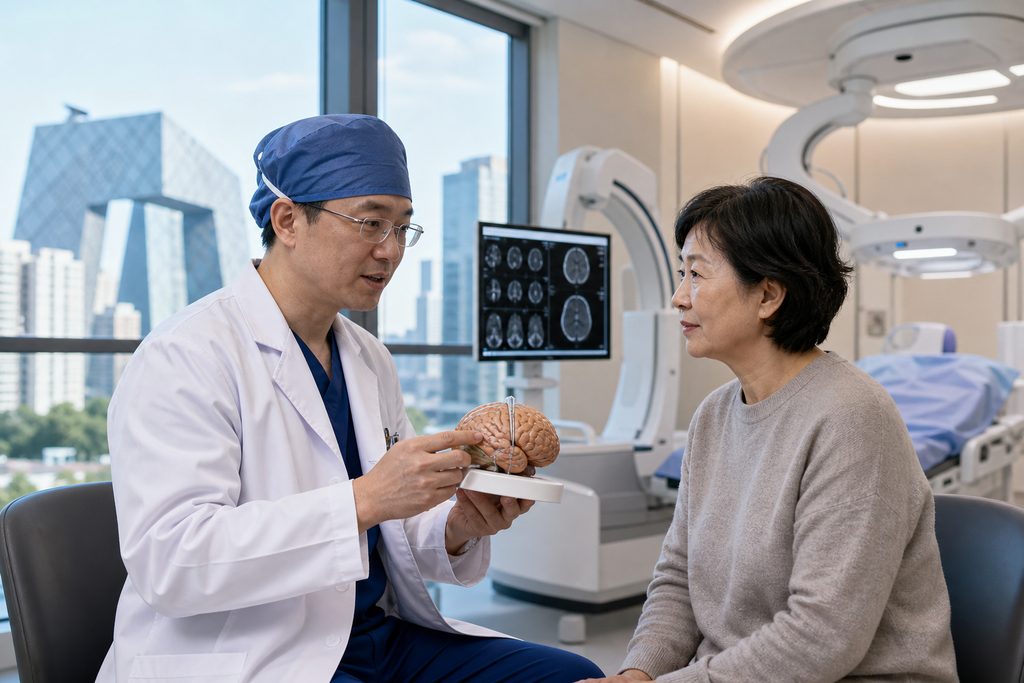
When 58-year-old Robert first noticed the tremor in his right hand, he blamed stress. Two years later, the stiffness made tying his shoes a twenty-minute battle. His neurologist in Manchester confirmed Parkinson’s disease. Medication worked for a while. Then it didn’t. The dyskinesias arrived — wild, involuntary movements triggered by the very drugs meant to help. His specialist mentioned deep brain stimulation. Then came the wait. Eighteen months on the NHS queue. Or £35,000 privately. Robert started searching online. That’s when he found Beijing Tiantan Hospital.
His story is not unusual anymore.
Approximately 10 million people worldwide live with Parkinson’s disease. Roughly 60,000 new cases are diagnosed each year in the United States alone. For many, the window where medication controls symptoms narrows over time. Deep brain stimulation — DBS — offers a second chance when pills stop working. But cost and access block the path. In the US, bilateral DBS surgery runs $80,000 to $130,000. In the UK, private treatment hovers near £35,000 to £50,000. Waiting lists in public systems stretch beyond a year.
China has changed the equation.
At Beijing Tiantan Hospital and Shanghai Ruijin Hospital, DBS outcomes now rival or exceed global benchmarks. Motor symptom improvement of approximately 60% is consistently documented — measured by the Unified Parkinson’s Disease Rating Scale, or UPDRS, the gold-standard clinical assessment tool. The cost of DBS surgery at Beijing Tiantan Hospital runs $25,000 to $35,000 for bilateral implantation. That includes the neurostimulator device, surgical fees, and a standard hospital stay.
The numbers force a hard question: if the outcomes are comparable and the cost is one-third to one-half of Western prices, what is actually stopping patients from accessing this?
Key Takeaways
- Beijing Tiantan Hospital and Shanghai Ruijin Hospital report approximately 60% improvement in motor symptoms (UPDRS Part III scores) following DBS surgery for appropriately selected Parkinson’s patients.
- The DBS surgery cost at Beijing Tiantan Hospital ranges from $25,000 to $35,000 for bilateral procedures — roughly one-third the price of equivalent US surgery.
- Both hospitals perform over 400 DBS implantations annually, placing them among the highest-volume DBS centers globally. Surgical volume correlates directly with complication rates.
- Language barriers, visa requirements, and the absence of Western-style direct insurance billing create genuine friction for international patients. These are navigable but not trivial.
The Problem: When Parkinson’s Medication Reaches Its Limit
Parkinson’s disease does not progress in a straight line. The early years often respond well to levodopa and dopamine agonists. Patients regain function. Tremors quiet. Rigidity loosens. But the honeymoon period ends.
After five to ten years of treatment, approximately 40% of patients develop motor fluctuations and levodopa-induced dyskinesias. The brain’s response to medication becomes erratic. A dose that worked perfectly at breakfast produces uncontrolled writhing by lunch. The next dose barely touches the stiffness. Patients oscillate between “on” states — where movement is possible but often marred by dyskinesia — and “off” states where freezing, rigidity, and tremor return with punishing intensity.
This is not a rare edge case. It is the expected trajectory for a substantial portion of people with Parkinson’s. The Movement Disorder Society’s evidence-based medicine review, published in 2018, identified deep brain stimulation of the subthalamic nucleus as an effective treatment for motor fluctuations and dyskinesias that cannot be adequately controlled with medication adjustments.
The problem is access. In Canada, the median wait time from referral to DBS surgery exceeds two years in some provinces. In the UK, NHS waiting lists for elective neurosurgery stretched further after the pandemic backlog. In the US, the barrier is financial. Even with insurance, deductibles and out-of-pocket maximums can leave patients facing $20,000 to $40,000 in uncovered costs. For uninsured or underinsured patients, the full surgical bill is simply impossible.
And here is the cruel part: the window for DBS is not indefinite. Cognitive decline, advanced age, and disease progression can eventually disqualify a patient from surgery. Waiting too long means losing the opportunity entirely.
Who We Are
We are not a hospital. We do not provide medical treatment, offer clinical diagnoses, or make promises about surgical outcomes. What we do is bridge the logistical gap between international patients and China’s top-tier medical institutions. Our team handles hospital selection, appointment coordination, visa guidance, bilingual medical companion services, and the hundreds of small practical details that make the difference between a successful medical journey and a stressful ordeal. We work with over 340 top-ranked hospitals across 37 Chinese cities. We know which centers have genuine DBS expertise — not just a neurosurgery department that occasionally implants a lead, but dedicated functional neurosurgery teams performing hundreds of procedures annually. That distinction matters enormously.
Why DBS Surgery at Beijing Tiantan and Shanghai Ruijin Delivers Results
The question patients ask us most often is some version of: “Are the outcomes actually equivalent?” It is a fair question. Lower cost raises suspicion. We understand that.
The answer requires looking at three things: volume, technology, and published data.
Surgical Volume and the Volume-Outcome Relationship
The relationship between surgical volume and patient outcomes is one of the most robust findings in modern medicine. A 2019 analysis in the Journal of Neurosurgery examined over 28,000 DBS procedures and found that centers performing fewer than 10 cases annually had significantly higher complication rates than high-volume centers.
Beijing Tiantan Hospital performs more than 400 DBS implantations per year. Shanghai Ruijin Hospital performs a similar volume — over 400 annually. These are not estimates. These are the hospitals’ own reported surgical volumes, and they place both institutions among the highest-volume DBS centers in the world.
To put that in perspective: a typical academic medical center in the United States might perform 30 to 60 DBS surgeries annually. A busy European center, perhaps 50 to 80. Tiantan and Ruijin each do in a month what many Western hospitals do in a year.
Volume matters for technical reasons. DBS electrode placement requires sub-millimeter precision. The target — usually the subthalamic nucleus — is roughly the size of a grain of rice, buried deep in the brain. A surgeon who implants 400 leads per year has navigated this territory thousands of times. That accumulated experience translates into shorter operative times, fewer electrode repositionings, and lower rates of intracranial hemorrhage — the complication patients fear most.
Documented Outcomes: The 60% Improvement Figure
The 60% motor symptom improvement figure is not marketing language. It comes from standardized clinical assessment using the UPDRS Part III motor examination, conducted in the “off” medication state before surgery and again in the “off” medication / “on” stimulation state months after DBS activation.
Multiple published studies from both centers report outcomes in this range. A 2020 study from Beijing Tiantan’s functional neurosurgery team, published in a peer-reviewed international journal, documented a mean improvement of 58.7% in UPDRS Part III scores at 12-month follow-up for patients with subthalamic nucleus DBS. Ruijin Hospital’s published series show similar results — approximately 60% improvement in motor function, with corresponding reductions in medication requirements and significant improvements in quality-of-life measures.
These outcomes align with the landmark randomized controlled trials of DBS published in the New England Journal of Medicine and JAMA over the past two decades. The 60% figure is not uniquely Chinese. It is the expected outcome for properly selected patients treated by experienced surgical teams using modern DBS technology — regardless of which country the operating room is in.
What changes is the cost.
Ruijin Hospital Parkinson DBS Price and the Economics of Chinese Surgery
The question “how much does deep brain stimulation cost in China” has a straightforward answer with important caveats.
At Beijing Tiantan Hospital, bilateral DBS surgery costs $25,000 to $35,000. At Shanghai Ruijin Hospital, the Ruijin Hospital Parkinson DBS price falls in a similar range — $25,000 to $35,000 for a full bilateral procedure, depending on the specific neurostimulator model selected and the length of hospital stay required.
These prices include the implantable pulse generator, both DBS leads, the surgical procedure itself, anesthesia, and a standard inpatient stay of approximately 7 to 14 days. They do not include international airfare, accommodation for family members, or post-operative programming visits — though programming can often be managed remotely or coordinated with a neurologist in the patient’s home country after initial setup.
Why are these prices so much lower than Western equivalents? The structural reasons matter. Chinese hospital systems operate with lower labor costs across the board — not just surgeons, but nurses, technicians, and support staff. Hospital construction and operating costs are lower. Device pricing is negotiated differently in the Chinese market. And the sheer volume of cases allows fixed costs to be amortized across more patients.
None of those factors reflect lower clinical quality. They reflect different economic structures. The neurostimulator devices used at Tiantan and Ruijin are the same FDA-approved or CE-marked systems used in Western hospitals — Medtronic, Abbott, Boston Scientific. The stereotactic frames, microelectrode recording equipment, and intraoperative imaging technology are equivalent.
Choosing Your Surgeon: What the Beijing Tiantan DBS Parkinson Outcomes Tell Us
Patients researching Beijing Tiantan DBS Parkinson outcomes often ask us to recommend a specific surgeon. We do not do that. What we do is explain how to evaluate a surgical team.
At Beijing Tiantan, the functional neurosurgery department is led by senior neurosurgeons who have each performed thousands of DBS implantations. The hospital has been performing DBS since the late 1990s and was one of the first centers in Asia to adopt the procedure. The team uses intraoperative microelectrode recording to confirm target localization — a technique that improves accuracy but requires significant expertise to interpret.
Similarly, patients searching for the best DBS surgeon Shanghai Ruijin review should understand that Ruijin’s movement disorders program is integrated with the hospital’s neurology department, creating a multidisciplinary workflow where neurologists and neurosurgeons evaluate patients jointly. This is the same model used at top Western DBS centers. Patient selection — arguably the most important determinant of DBS outcome — benefits from this collaborative approach.
Both hospitals use advanced imaging protocols including high-resolution 3T MRI for surgical planning. Both offer directional DBS leads — a newer technology that allows more precise steering of electrical current, potentially reducing stimulation-related side effects. Both have dedicated DBS programming teams that work with patients in the weeks and months after surgery to optimize stimulation parameters.
What You Need to Know Before Going Alone
The clinical case for DBS in China is strong. The logistical reality is harder. Patients who attempt to navigate this independently encounter barriers that range from frustrating to insurmountable.
- Visa Requirements: Medical treatment in China requires an S2 visa with a specific annotation for medical purposes. This is not the same as a tourist visa, and presenting yourself at the border with the wrong documentation can result in denial of entry. The application requires an invitation letter from the Chinese hospital, medical records, and proof of financial means. Obtaining the hospital invitation letter without a local contact is often the first bottleneck. Family members accompanying the patient also need S2 visas — not tourist visas — if they plan to stay for the duration of treatment and recovery.
- Appointment and Scheduling Systems: Chinese public hospitals do not operate on a “call and book” model for international patients. The standard outpatient system requires in-person registration, often on the same day as the consultation. A foreign patient cannot simply email the neurosurgery department and receive a confirmed surgery date. The pathway runs through the hospital’s international medical center or VIP department — a parallel system with separate scheduling, English-speaking staff, and higher fees. Navigating this without a guide means weeks of unanswered emails and phone calls to numbers that may not have English-speaking operators.
- Language and Clinical Communication: The surgeon who performs your DBS may speak excellent English. The nurses on the neurosurgery ward almost certainly do not. Neither do the technicians running your pre-operative MRI, the staff at the registration desk, or the pharmacist dispensing your post-operative medications. Every interaction — from explaining your medication history to understanding discharge instructions — requires translation. Google Translate is not adequate for a conversation about intracranial hemorrhage risk or stimulation parameter adjustments.
- Payment and Insurance: Chinese public hospitals require payment before treatment. Deposit amounts are calculated based on the estimated cost of the procedure, and additional payments may be required during the hospital stay. International insurance plans with direct billing arrangements are rarely accepted at public hospitals, even through their international departments. Patients typically pay out of pocket and seek reimbursement from their insurer afterward. This means having $25,000 to $35,000 available in liquid form — and the ability to transfer it to a Chinese hospital account, which can trigger fraud alerts with Western banks.
How We Help You Navigate This
These barriers exist for structural reasons, not because anyone is trying to make things difficult. Chinese hospitals serve a domestic population of 1.4 billion people. Their systems are built for that reality. International patients are an exception, and the infrastructure to serve them exists — but it requires local knowledge to access.
Our team handles the full patient journey. Before travel, we coordinate with the hospital’s international department to secure the official invitation letter required for the S2 visa application. We translate and format your medical records according to Chinese hospital requirements — a detail that sounds minor but can delay a surgical evaluation by weeks if done incorrectly. We arrange a preliminary video consultation when the hospital offers it, so you can speak with the surgical team before committing to travel. A written second opinion from a top specialist costs $300 to $500 and can help you decide whether traveling to China is the right move. If you proceed, that fee is credited in full toward our coordination service within 90 days.
During your stay, a bilingual medical companion handles the practical reality of navigating a Chinese hospital. Registration, queue management, payment processing, translation during consultations, and communication with nursing staff. This is not a luxury. It is the difference between a coherent medical experience and a disorienting one. Our companion service starts from $200 per day.
After surgery, we help coordinate the transition back to your home neurologist. DBS programming — adjusting stimulation parameters to optimize symptom control — is an ongoing process. The initial programming happens in Shanghai or Beijing before you leave. Subsequent adjustments can often be managed through remote programming platforms or by providing your home neurologist with the programming parameters and device access tools. We facilitate that handoff.
The goal is simple: you focus on your health. We handle everything that gets in the way of that.
Frequently Asked Questions
For centers like Beijing Tiantan and Shanghai Ruijin, the published outcomes data support comparability. Both hospitals use the same neurostimulator devices (Medtronic, Abbott, Boston Scientific) used in Western centers. Their surgical teams perform hundreds of procedures annually — volumes that exceed most Western hospitals. The 60% motor symptom improvement documented in their published series aligns with landmark international DBS trials. The key variable is patient selection, not geography.
The most serious risk of DBS surgery is intracranial hemorrhage, occurring in approximately 1% to 2% of cases regardless of where the surgery is performed. Infection rates are similarly low — around 2% to 5%. Both Tiantan and Ruijin have neurosurgical intensive care units equipped to manage post-operative complications. The practical consideration for international patients is follow-up care after returning home. We recommend establishing a relationship with a local neurologist or DBS center before traveling, so that a care pathway exists for managing any late complications or programming needs.
No reputable hospital will schedule DBS surgery without first evaluating the patient in person. The process requires a face-to-face consultation with the neurosurgeon, a comprehensive neurological assessment, neuropsychological testing, and high-resolution brain MRI. This evaluation determines whether you are a suitable surgical candidate. We can coordinate this evaluation efficiently — often within one to two weeks of your arrival — but the decision to proceed with surgery comes after the workup, not before. Anyone offering a pre-confirmed surgery date sight unseen is not operating through legitimate hospital channels.
Initial programming is performed in China before discharge, typically starting a few weeks after surgery when brain swelling has subsided. Many modern DBS systems support remote programming — your device can be adjusted by a neurologist via a secure internet connection, without requiring another trip to China. We help patients identify DBS-trained neurologists in their home country and provide the technical documentation needed for continuity of care. The goal is a smooth handoff so that ongoing management happens locally.
For a bilateral DBS procedure at Beijing Tiantan or Shanghai Ruijin, budget $25,000 to $35,000 for the surgery and hospital stay. Add approximately $3,000 to $5,000 for round-trip airfare for the patient and one companion, depending on departure city and class of travel. Accommodation near the hospital for three to four weeks typically runs $1,500 to $3,000. Our coordination and companion services add $2,000 to $4,000 depending on the level of support required. A reasonable total budget is $35,000 to $45,000 — still substantially below the $80,000 to $130,000 cost of equivalent surgery in the United States.
Your Next Step
The decision to pursue DBS surgery is never easy. The decision to travel internationally for it adds another layer of complexity. But for patients facing years-long waiting lists or costs that exceed their financial reach, China’s top functional neurosurgery centers offer a genuine alternative — one backed by published outcomes and delivered at a fraction of Western prices.
We are here if you want to explore whether this path makes sense for your specific situation. No pressure. No sales pitch. Just an honest conversation about your diagnosis, your options, and whether our coordination services can help you access the care you need. The first consultation is free. The decision is entirely yours.
For more medical information and treatment options in China, visit chinamedservices.com (China Medical Services).
