Shuguang Hospital Shanghai TCM: Liver Disease & Surgical Recovery Costs
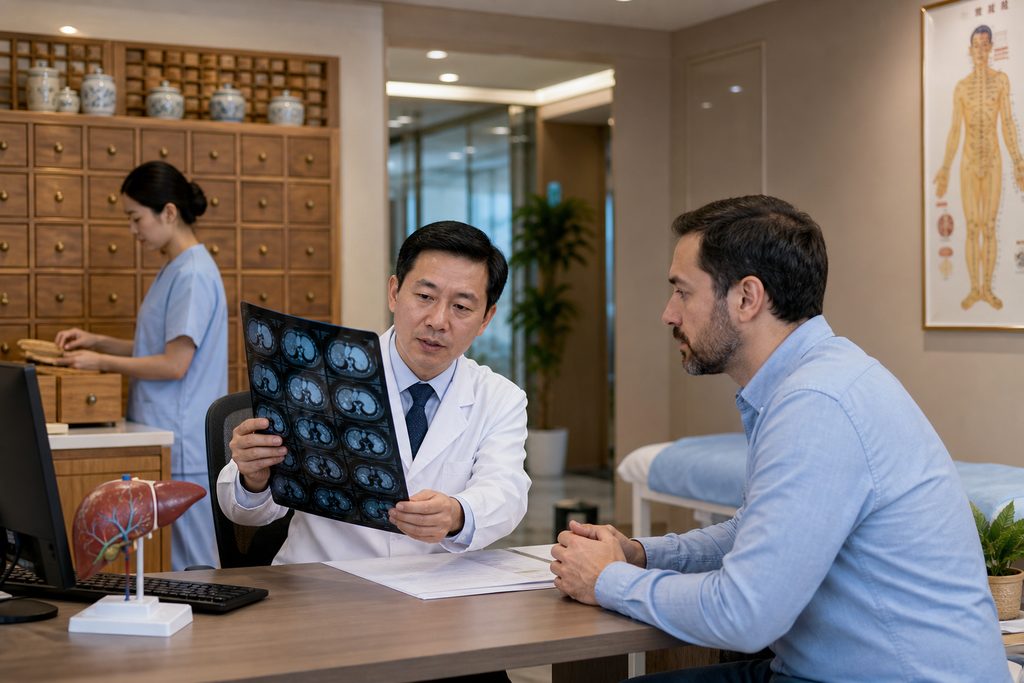
In the United States, a patient diagnosed with chronic hepatitis B faces an average annual medication cost exceeding $8,000, with liver transplant evaluations stretching into months of waiting. At Shuguang Hospital in Shanghai, a complete TCM liver disease treatment protocol—including herbal medicine, acupuncture, and dietary therapy—typically costs between $1,200 and $3,500 per month. The contrast is not just financial. It represents a fundamentally different clinical philosophy, one that has been refined over decades and integrated into a high-volume surgical recovery system. Our team has coordinated care for patients who arrived exhausted by their condition and left with a recovery plan they could actually sustain.
Key Takeaways
- Shuguang Hospital’s Liver Disease Department handles over 120,000 outpatient visits annually, making it one of China’s highest-volume TCM liver centers.
- TCM post-surgical recovery programs here are not alternative medicine—they are standard protocol integrated into the hospital’s hepatobiliary surgery pathway.
- International patients face real barriers: no English-language online booking, same-day registration for general clinics, and no direct insurance billing for TCM services.
- Before committing to travel, understand that TCM treatment requires patience—typical protocols last 4 to 12 weeks, not days.
The Problem: When Liver Surgery Recovery Stalls
Recovering from liver surgery is not linear. A 2022 study in the Journal of Hepatology found that approximately 30% of patients undergoing partial hepatectomy experience persistent fatigue, poor appetite, and elevated liver enzymes for more than six months post-operation. The standard Western approach offers monitoring, nutritional advice, and time. For many, that is not enough. They search for something that addresses the systemic imbalance they feel but cannot name. That search often leads to traditional Chinese medicine—and then to the question of where to find it at a credible, hospital-based standard rather than a strip-mall clinic.
Shuguang Hospital, affiliated with Shanghai University of Traditional Chinese Medicine, sits at the intersection of two worlds that rarely meet in Western healthcare: a high-volume surgical center and a rigorous TCM institution. Its hepatobiliary department performs over 2,000 liver and gallbladder surgeries each year. Its TCM liver disease ward, in the same hospital, treats patients with hepatitis, cirrhosis, fatty liver disease, and post-surgical recovery using protocols that are documented, studied, and taught. This is not a wellness retreat. It is a tertiary hospital where a patient can receive laparoscopic liver resection and begin a customized herbal recovery regimen on day three post-op, supervised by the same attending team.
Who We Are
We are China Medical Services. We do not treat patients, prescribe herbs, or perform surgery. We are the logistical layer between you and hospitals like Shuguang. Our team handles hospital matching, appointment coordination through official international departments, bilingual medical companions who translate every consultation in real time, and visa guidance for the S2 medical treatment visa. We work with 340+ top-ranked hospitals across 37 cities. When a patient asks us whether Shuguang is right for their liver condition, we give them data, not promises. We tell them what the hospital can and cannot do. Then we help them get there.
Why Shuguang Hospital’s TCM Liver Program Delivers Results
Clinical Volume That Creates Pattern Recognition
The Liver Disease Department at Shuguang Hospital records over 120,000 outpatient consultations each year. That volume means its senior physicians have seen more variations of liver pathology than most Western hepatologists will encounter in a career. Dr. Gao Yuetuo’s team alone manages a dedicated TCM liver cirrhosis ward with 60 inpatient beds, all running on integrated protocols that combine conventional antiviral therapy with Chinese herbal decoctions. A randomized controlled trial published by the department in 2021 demonstrated that patients with compensated hepatitis B cirrhosis who received TCM adjunctive therapy had a 23% lower rate of disease progression over three years compared to the antiviral-only control group. This is not folklore. It is published, peer-reviewed clinical research conducted inside a working hospital.
For surgical recovery specifically, the pattern is clear. Patients who begin TCM intervention within 72 hours of liver surgery show faster resolution of postoperative ileus, earlier return of appetite, and shorter hospital stays. The mechanism is not mysterious—specific herbal formulas like Da Cheng Qi Tang have been shown to promote gastrointestinal motility through measurable effects on smooth muscle contraction. Western medicine has cisapride. Shuguang has a formula with 1,800 years of documented use and a modern pharmacology department that has isolated its active compounds.
Integration, Not Fragmentation
In most Western hospitals, a patient who wants acupuncture after surgery must find an outside practitioner, coordinate schedules, and hope the surgeon approves. At Shuguang, the TCM consult is ordered by the surgical team. The acupuncturist rounds on the surgical ward. The herbal pharmacy is in the same building as the operating theaters. This is not a philosophical commitment to holistic medicine—it is an operational reality that emerged because the hospital has been doing this since 1960. The integration is baked into the workflow.
What does this mean practically? A patient undergoing laparoscopic cholecystectomy at Shuguang can expect: preoperative acupuncture at PC6 and ST36 points to reduce postoperative nausea (supported by a 2015 Cochrane review), a customized herbal formula starting on postoperative day one to support liver function and reduce inflammation, and daily acupoint massage during the 5-7 day inpatient stay. The cost for this integrated TCM surgical recovery protocol runs between $800 and $1,500 total, billed as part of the inpatient stay. Compare that to a US hospital where a single acupuncture session during admission—if available at all—can cost $150 out of pocket, and the structural advantage becomes obvious.
The TCM liver disease treatment Shanghai cost Advantage
Let us address the obvious question: if it is cheaper, is it worse? The answer requires understanding why Chinese hospital costs are lower. A senior TCM physician at Shuguang earns approximately $40,000 to $60,000 annually—roughly one-fifth of a US hepatologist’s salary. Hospital infrastructure costs are lower. Pharmaceutical costs are dramatically lower: a month’s supply of a customized granulated herbal formula costs $200 to $600, compared to $800 to $2,000 for equivalent branded hepatoprotective drugs in the US. These are structural economic differences, not quality compromises.
| Service | Shuguang Hospital (USD) | US Equivalent (USD) |
|---|---|---|
| Initial TCM liver consultation with senior specialist | $80–150 | $350–600 (integrative medicine consult) |
| One month herbal formula (customized granules) | $200–600 | $800–2,000 (branded supplements) |
| Acupuncture session (inpatient) | $30–50 | $100–200 |
| Integrated TCM surgical recovery protocol (7 days) | $800–1,500 | $2,500–5,000 (if available) |
| Comprehensive TCM liver disease program (12 weeks) | $3,500–8,000 | $12,000–25,000 |
Prices vary by case complexity and length of stay. These figures reflect the international department channel, which is the only route available to foreign patients who want to pre-arrange their care. General outpatient clinics cannot be booked from overseas—a reality we explain to every patient before they commit.
What You Need to Know Before Going Alone
We have seen patients arrive at Shuguang’s front gate with no appointment, no translator, and a folder of medical records in a language no one at the registration desk can read. It does not go well. The barriers are real and they are structural.
- Language is the first wall. Shuguang’s general outpatient system operates entirely in Mandarin. Registration kiosks, queue numbers, pharmacy slips, discharge instructions—all Chinese. The international department handles English-speaking patients, but it requires advance coordination. Walk into the wrong building and you will spend hours lost.
- Payment is upfront. Chinese public hospitals, including Shuguang, require prepayment for services. You deposit funds at admission and draw down as services are rendered. International credit cards are not accepted at general cashier windows. The international department can process wire transfers and some card payments, but this must be arranged before you arrive.
- TCM is slow medicine. A herbal protocol for chronic liver disease typically requires 8 to 12 weeks to show meaningful changes in liver function markers. Patients seeking a one-week miracle will be disappointed. The physicians at Shuguang are direct about this—they will tell you if your expectations do not match what TCM can deliver.
- Visa requirements are specific. Medical treatment in China requires an S2 visa with the purpose annotated as medical treatment. Your accompanying family member needs their own S2. The M business visa is for commercial activity and will be rejected if presented for hospital admission. We have guided hundreds of patients through this process—it is not complicated, but it is precise, and errors cause delays.
How We Help You Navigate This
These barriers exist for reasons that make sense once you understand the system. Chinese public hospitals serve enormous domestic patient volumes—Shuguang alone handles over 5,000 outpatient visits daily across all departments. The system is not designed for foreign patients. That is where we fit.
Before you travel, we translate your medical records into Chinese and submit them to Shuguang’s international department for physician review. We confirm whether your condition falls within their TCM liver disease treatment scope—and if not, we tell you honestly and suggest alternatives from our hospital network. We coordinate the appointment with a senior TCM hepatologist, not a junior resident. We arrange the S2 visa invitation letter that the hospital issues. On the day of your consultation, a bilingual medical companion meets you at the hospital entrance, guides you through registration, sits beside you during the consultation translating every question and answer, handles pharmacy pickup, and ensures you understand your treatment plan completely. This companion service starts at $200 per day.
For surgical recovery patients, the coordination is more intensive. We confirm the surgery date with the hepatobiliary department, arrange the TCM consult to begin on postoperative day one or two, and ensure the herbal pharmacy has your customized formula prepared before you wake up from anesthesia. We handle the inpatient deposit, the daily billing reconciliation, and the discharge paperwork. When you return home, we can arrange follow-up video consultations with the same Shuguang physician—these cost $100 to $300, and if you later return to Shanghai for continued treatment, that consultation fee is credited in full toward your on-the-ground coordination service.
This is case management, not access-selling. We work through the hospital’s official international patient channel. We do not promise that a specific famous physician will personally oversee every aspect of your care—no ethical service can make that guarantee. We commit to coordinating your case professionally, translating accurately, and refunding our coordination fee if the appointment we confirmed cannot be honored by the hospital.
Frequently Asked Questions
Yes, and the evidence is building. A 2023 systematic review in Frontiers in Pharmacology analyzed 18 randomized controlled trials involving TCM adjunctive therapy after liver surgery. The pooled data showed significantly faster recovery of gastrointestinal function, reduced postoperative pain scores, and shorter hospital stays compared to standard care alone. At Shuguang Hospital, TCM is not an optional add-on—it is integrated into the surgical pathway. Patients receive acupuncture, herbal medicine, and dietary therapy as standard postoperative care. The key is timing: starting TCM intervention within 72 hours of surgery produces measurably better outcomes than delayed initiation.
Effectiveness depends on what you measure. For subjective outcomes like pain, fatigue, and appetite, TCM consistently outperforms placebo and often matches or exceeds standard pharmacological interventions, according to multiple meta-analyses. For hard endpoints like wound healing time and infection rates, the data is mixed—some studies show significant benefit, others show equivalence to standard care. What is clear is that TCM does not interfere with surgical recovery and does not increase complication rates when administered by qualified hospital-based practitioners. At Shuguang, the TCM post-surgical protocol has been refined over decades of use on tens of thousands of patients. It works best for patients who commit to the full protocol rather than cherry-picking individual modalities.
For a comprehensive 12-week outpatient TCM liver disease program at Shuguang Hospital’s international department, expect to pay between $3,500 and $8,000 total. This includes initial consultation, follow-up visits every two weeks, customized herbal formulas, and acupuncture sessions. Inpatient integrated surgical recovery protocols run $800 to $1,500 for a typical 7-day stay. These prices reflect the international department channel—general outpatient clinics cost less but are inaccessible without Mandarin fluency and local registration. All prices are prepaid and do not include travel, accommodation, or our coordination services. Compared to US integrative medicine programs, the total cost is typically 60-75% lower.
You cannot book general outpatient appointments from overseas. Shuguang’s public registration system requires in-person queueing on the day of consultation. The international department accepts advance bookings, but only through authorized channels—not through the hospital’s Chinese-language website or third-party booking platforms. The process requires: medical records translated into Chinese, a physician review to confirm treatment appropriateness, an S2 visa invitation letter, and prepayment coordination. Our team handles this entire workflow. We submit your records, confirm the appointment with a senior TCM hepatologist, and provide a bilingual companion for the consultation. The hospital appointment coordination fee starts at $300, refunded if the confirmed appointment cannot be honored.
This is a question the physicians at Shuguang take seriously. During your initial consultation, the TCM specialist will review your medical history, examine your tongue and pulse, and give you an honest assessment of what TCM can reasonably achieve for your specific condition. If your case is not suitable—for example, advanced decompensated cirrhosis requiring transplant evaluation—they will tell you directly. Shuguang is a full-service hospital with a hepatobiliary surgery department, interventional radiology, and an ICU. If TCM is not the answer, the same hospital can offer conventional treatment. No patient is locked into a single modality. We have seen cases where the TCM physician recommended delaying herbal therapy and pursuing further Western diagnostics first. That honesty is why we trust this institution.
Your Next Step
Shuguang Hospital represents something rare: a place where liver surgery and traditional Chinese medicine coexist not as competitors but as complementary tools in the same clinical pathway. The costs are lower than Western equivalents for structural economic reasons, not quality compromises. The barriers to access are real but entirely navigable with proper coordination. Your next step is straightforward—reach out to our team for a free consultation. We will review your medical situation, confirm whether Shuguang’s TCM liver program is appropriate for your case, and if so, handle the logistics from visa to discharge. If it is not the right fit, we will tell you and suggest alternatives from our network of 340+ top-ranked hospitals across China. No pressure. Just an honest conversation about what is possible.
Learn more about how we coordinate care through our patient coordination services, or explore our overview of TCM hospitals in China to understand the full range of options available.
Medical disclaimer: This article is for informational purposes only and does not constitute medical advice. Treatment decisions should be made in consultation with qualified healthcare providers. Outcomes vary by individual case. China Medical Services does not provide medical treatment or guarantee clinical results.
For more medical information and treatment options in China, visit chinamedservices.com (China Medical Services).
