Suzhou BenQ Mingji Hospital: Taiwan JCI International Private Hospital Near Shanghai
When 42-year-old Michael first heard the diagnosis, he had no idea where to start looking for treatment. A complex orthopedic issue. His surgeon back in Manchester recommended a procedure with a six-month wait. The private route at a London hospital came with a quote that made him physically wince — over £18,000. His insurance would cover only a fraction. He started searching online late at night. Somewhere between reading medical journals and staring at his bank balance, he typed: “best private hospital near Shanghai JCI accredited Taiwan.” That search led him to a facility he had never heard of: Suzhou BenQ Mingji Hospital. And it changed the entire calculus of his treatment plan.
Michael is not alone. Approximately 1.4 million Americans travel abroad for medical care each year, according to data from the Centers for Disease Control and Prevention. The motivations vary. Some chase cost savings. Others want to skip waitlists. A growing number are looking for hospitals that blend Western clinical standards with Asian efficiency and pricing. Suzhou BenQ Mingji Hospital sits at the intersection of all three demands. It is a Taiwan-backed, JCI-accredited private hospital located roughly 25 minutes by high-speed train from Shanghai. For international patients, that geography matters. A lot.
Key Takeaways
- Suzhou BenQ Mingji Hospital is one of the few JCI-accredited private hospitals near Shanghai with direct ties to Taiwan’s medical system — a structure that attracts patients seeking a specific blend of clinical governance and cost efficiency.
- The hospital’s international medical center handles everything from appointment booking to post-operative recovery for foreign patients, with English-speaking staff available throughout the facility.
- Pricing transparency remains a challenge — the hospital does not publish a comprehensive Suzhou BenQ hospital price list for international patients online, and costs vary significantly based on procedure complexity and specialist seniority.
- JCI accreditation is a strong signal of safety and quality standards, but it does not guarantee a smooth experience — language barriers, payment logistics, and cultural differences in care delivery still require navigation.
The Problem: Medical Costs Are Breaking People — Even the Insured
A single orthopedic surgery in the United States can run anywhere from $20,000 to $50,000. In the United Kingdom, the wait for an NHS hip replacement stretches past 18 weeks for roughly 40% of patients, with some trusts reporting waits exceeding a year. Private care slashes the wait but multiplies the cost. For patients in Southeast Asia, the Middle East, or Eastern Europe, the math is equally brutal — top-tier private hospitals in Bangkok or Dubai charge rates that rival Western Europe, and not every facility has the accreditation to back up the price tag.
This is the structural reality. Healthcare is expensive because labor costs are high, regulatory overhead is massive, and insurance systems incentivize inflated billing. None of that reflects the actual cost of delivering excellent clinical care. It reflects the cost of delivering care inside a specific economic and regulatory environment. Change the environment, and the numbers shift dramatically.
Who We Are
We are not a hospital. We do not provide medical treatment or clinical diagnoses. Our team acts as your logistical architects — we bridge the gap between you and China’s top-tier medical expertise. China Medical Services maintains a database of 340+ top-ranked hospitals across 37 cities. We handle hospital matching, appointment coordination, bilingual medical companionship, and visa guidance. We connect you with the right facility for your specific condition and budget. That includes helping international patients understand whether a hospital like Suzhou BenQ Mingji — with its Taiwan pedigree and JCI accreditation — is actually the right fit for their needs.
Why Suzhou BenQ Mingji Hospital Draws International Attention
JCI Accreditation With Taiwan Clinical Governance
Joint Commission International accreditation is not a marketing badge. It means the hospital has passed an on-site evaluation covering over 1,200 measurable elements — patient assessment, infection control, medication management, surgical safety protocols. Suzhou BenQ Mingji holds that certification. But what sets it apart from other JCI-accredited facilities in mainland China is its direct connection to the Taiwan BenQ Medical Group. Taiwan’s healthcare system consistently ranks among the best globally. The 2023 World Index of Healthcare Innovation placed Taiwan 12th worldwide, ahead of Germany and just behind the United Kingdom. That clinical culture — rigorous documentation, patient-centered communication, systematic quality improvement — transfers directly to the Suzhou facility.
This matters when you are asking: is Suzhou BenQ Mingji hospital good for foreigners? The answer depends on what you are comparing it to. Against a top-tier public hospital in Shanghai, the clinical outcomes may be comparable. Against a random private clinic without international accreditation, the gap is enormous. JCI plus Taiwan governance means the systems are in place to deliver consistent, auditable quality. For a foreign patient who cannot independently verify a hospital’s surgical infection rate or medication error frequency, that signal carries real weight.
Location: 25 Minutes From Shanghai, a Fraction of the Cost
Shanghai’s private international hospitals are excellent. Jiahui Health and Shanghai United Family Hospital both hold JCI accreditation and cater heavily to expatriates. They also charge accordingly. A consultation with a senior specialist at a top Shanghai private hospital often starts at RMB 1,500 to 2,500 — roughly $200 to $350. Surgical packages climb steeply from there.
Suzhou BenQ Mingji operates in a different cost structure. Suzhou is a major city — population over 12 million — but its real estate costs, staff salaries, and operational overhead run below Shanghai levels. The hospital passes those savings through. A specialist consultation might cost 30% to 50% less than an equivalent Shanghai private hospital. For a full surgical package, the difference can reach five figures in dollar terms. The high-speed train from Shanghai Hongqiao to Suzhou takes about 25 minutes. That is less time than crossing Manhattan at rush hour.
International Medical Center: Built for Foreign Patients
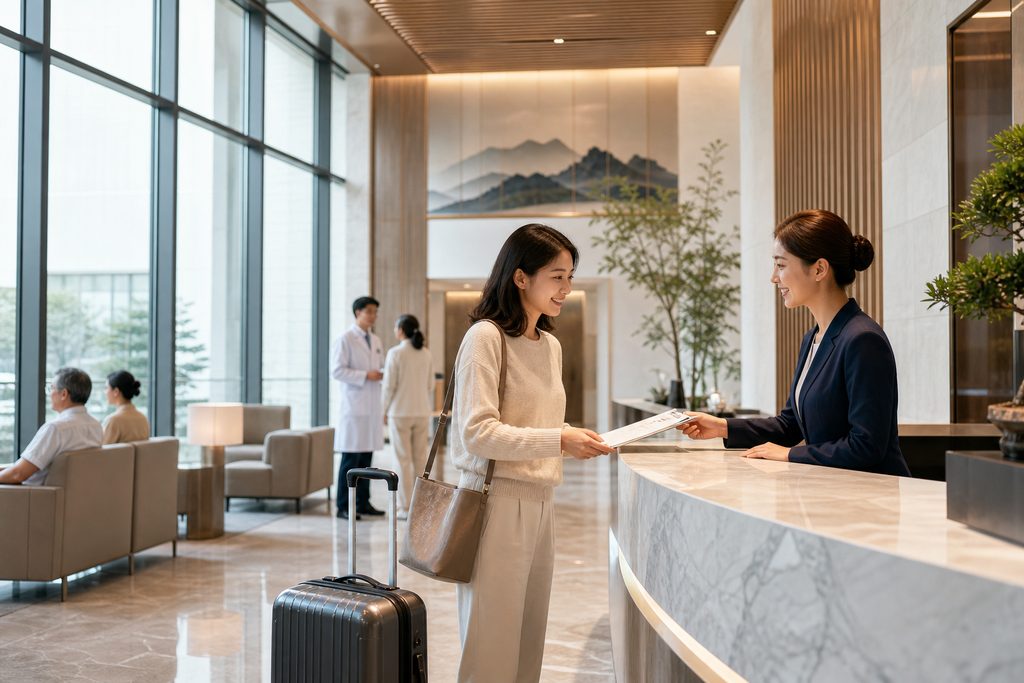
The hospital operates a dedicated international medical center. This is not a token translation desk. It is a separate department with English-speaking coordinators who handle appointment scheduling, medical record translation, insurance coordination, and inpatient support. They understand that a patient arriving from Dubai or London needs more than just a doctor who speaks English. They need help with admission paperwork, discharge summaries formatted for overseas insurers, and follow-up coordination that crosses time zones.
For patients asking how much does surgery cost at Taiwan hospital in China, the international center is the starting point. They provide itemized estimates before you travel. Not vague ranges — actual line items based on your specific diagnosis and imaging. That level of pre-travel transparency is not universal in Chinese healthcare. It is a direct reflection of the Taiwan-influenced administrative culture.
What You Need to Know Before Going Alone
A JCI plaque on the wall does not erase every barrier. If you try to arrange everything independently, here is what you will face.
- No Public Price List: The hospital does not publish a comprehensive Suzhou BenQ hospital price list for international patients online. You cannot browse a menu of surgical fees from your couch in Chicago. You must contact the international medical center, provide your medical records and imaging, and receive a customized quote. This protects you — pricing should reflect your actual clinical needs, not a generic package. But it also means you cannot comparison-shop in five minutes.
- Visa Requirements: Foreign nationals traveling to China for medical treatment need an S2 visa, specifically annotated for medical purposes. Your accompanying family members also need S2 visas. The application requires an invitation letter from the hospital confirming your treatment arrangement. Getting that letter requires a confirmed appointment. Getting that appointment requires medical records, translated into Chinese in many cases. The sequence is circular if you do not know the steps.
- Payment Systems: Suzhou BenQ Mingji accepts international credit cards and some direct insurance billing arrangements. But do not assume your US or European health insurance will be accepted for direct billing. Most international patients pay upfront and seek reimbursement from their insurer afterward. That means you need sufficient liquidity to cover the full treatment cost before traveling. For a major surgery, that could be $15,000 to $30,000 in available funds.
How We Help You Navigate This
These barriers exist for structural reasons. They are not designed to exclude foreign patients. They exist because China’s healthcare system evolved to serve a domestic population of 1.4 billion, and the international patient pathway is a relatively recent addition. Our job is to make that pathway feel like a straight line instead of a maze.
Before you travel, we handle the hospital matching. Not every patient should go to Suzhou BenQ Mingji. If your condition requires a subspecialist only available at a top-tier public hospital in Shanghai, we will tell you that. We translate and submit your medical records, secure the appointment confirmation, and obtain the invitation letter required for your S2 visa application. During your treatment, our bilingual medical companions accompany you on-site. They handle registration, queue management, payment processing, and real-time interpretation between you and your clinical team. After discharge, we coordinate follow-up communication and help you obtain properly formatted documentation for your insurer back home. Our hospital appointment coordination service starts from $300, with the final fee depending on case complexity and specialist seniority.
What Medical Tourism Packages Look Like at Suzhou BenQ
The phrase “medical tourism packages Shanghai Suzhou private hospital” implies something tidy — a bundled price with flights, hotel, surgery, and recovery all wrapped up. The reality is more nuanced. Suzhou BenQ Mingji does not sell all-inclusive packages in the way a resort sells a vacation deal. What they offer is a coordinated care pathway. The international medical center can recommend nearby accommodation — there are several international-brand hotels within a 10-minute drive — and they can sequence your consultations, diagnostics, procedure, and follow-up appointments into a coherent timeline. But you are still booking your own flight and hotel. You are still responsible for your own visa.
Some third-party medical tourism facilitators do bundle these elements. If you go that route, verify that the facilitator has a direct contractual relationship with the hospital. An intermediary who simply forwards your emails to the international center and adds a markup is not adding value. A legitimate facilitator — like our team — handles the logistics, provides on-ground support, and charges a transparent coordination fee separate from your hospital costs.
Frequently Asked Questions
Yes, with a caveat. The international medical center staff speak English. Many senior physicians trained in Taiwan or the United States and communicate comfortably in English. Nursing staff on the international ward have basic to intermediate English proficiency. But outside that dedicated unit — in the general radiology department, the pharmacy, the billing office — English capability drops off. A bilingual companion fills those gaps. Without one, you may find yourself stuck at the CT scan registration counter with no one who understands what you need.
Contact the international medical center directly via email or phone. They will request your medical records, imaging reports, and a description of your condition. A clinical coordinator reviews your case and confirms whether the hospital can treat you. If yes, they propose a specialist and a timeline. You then confirm the appointment and receive the invitation letter for your visa. The entire process typically takes one to three weeks, depending on how quickly you provide documentation. If navigating this on your own feels daunting, our team handles the full coordination — record translation, specialist matching, appointment confirmation, and visa documentation — as part of our hospital appointment coordination service, starting from $300.
Suzhou BenQ Mingji carries international medical liability insurance and operates under JCI-mandated adverse event protocols. Any complication is managed on-site by the treating clinical team. The hospital has ICU capacity and 24-hour emergency surgical backup. What it does not have is a direct transfer agreement with a hospital in your home country. If you require continued care after returning home, you will need to arrange that transition yourself. We help by ensuring your discharge summary, operative notes, and imaging are formatted to the standards your home-country physician expects. But continuity of care across borders requires active coordination on your end.
The differential varies by procedure, but the pattern is consistent. A knee replacement at Suzhou BenQ Mingji typically runs between $12,000 and $18,000 for international patients, depending on implant type and surgeon seniority. The same procedure in the United States averages $35,000 to $50,000. A laparoscopic cholecystectomy might cost $4,000 to $7,000 in Suzhou versus $15,000 to $25,000 in the US. These are self-pay rates. If your insurance covers treatment abroad, your out-of-pocket cost could be significantly lower. Always request a procedure-specific quote from the international medical center before making any financial commitment.
Your Next Step
Suzhou BenQ Mingji Hospital represents a specific value proposition: JCI-accredited private care with Taiwan clinical governance, located within striking distance of Shanghai, at a cost structure that undercuts comparable facilities in tier-one Chinese cities and dramatically undercuts Western hospitals. It is not the right answer for every patient. Complex oncology cases requiring multidisciplinary tumor boards may be better served at a major academic center like Fudan University Shanghai Cancer Center. But for orthopedic surgery, general surgery, gynecology, and a range of elective procedures, the hospital delivers a combination of quality assurance and cost efficiency that is genuinely difficult to find elsewhere.
If you are considering treatment at Suzhou BenQ Mingji — or simply trying to figure out which hospital in China makes sense for your specific situation — our team can help you evaluate the options. We do not charge for the initial conversation. We look at your diagnosis, your budget, your timeline, and we tell you honestly what is possible. China Medical Services exists to make that decision clearer. When you are ready, request a free consultation and we will walk through the details together.
For more medical information and treatment options in China, visit chinamedservices.com (China Medical Services).
