AI Stroke Diagnosis China: CT Perfusion Analysis for Rapid Treatment Decision Within Minutes
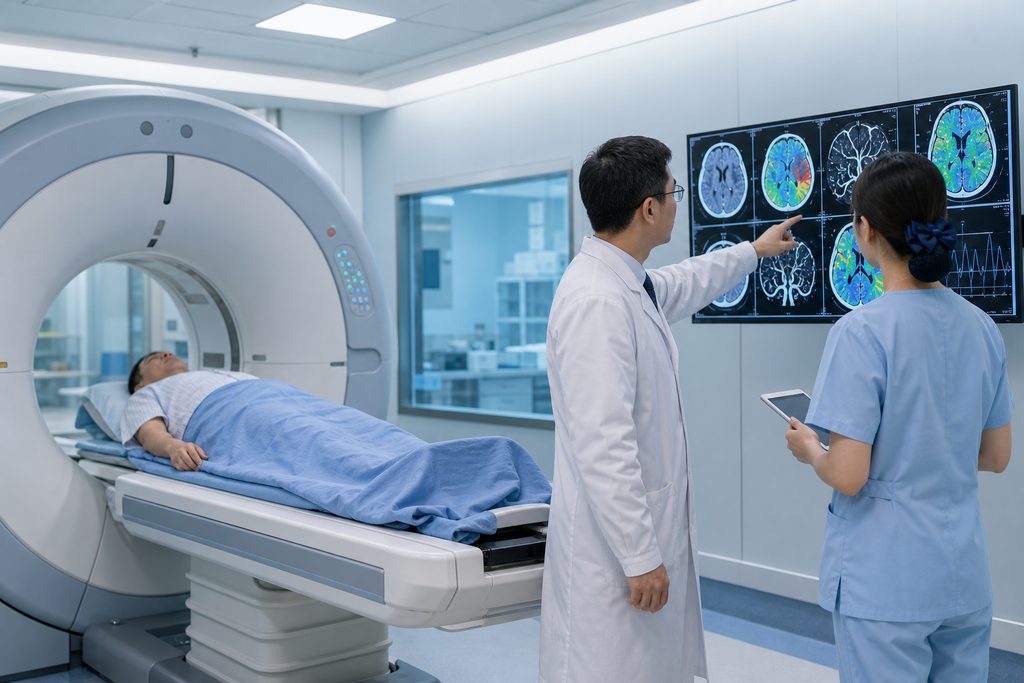
Every minute a stroke goes untreated, approximately 1.9 million neurons die. That is the brutal arithmetic of cerebrovascular disease. A patient wheeled into an emergency department with stroke symptoms enters a race against a biological clock. The question is not just “Is it a stroke?” but “What kind, where, and can we save the tissue at risk?” Traditional imaging workflows often take 30 to 60 minutes just for interpretation. That is an eternity for dying brain cells.
A new generation of artificial intelligence tools deployed in China’s top neurology centers has collapsed that timeline. We are seeing CT perfusion scans analyzed in under five minutes. Not read. Analyzed. The AI maps the ischemic core, the penumbra, and the mismatch ratio while the patient is still on the scanner table. For international patients facing long wait times or limited access to advanced stroke imaging at home, this capability changes the calculus entirely.
Key Takeaways
- AI-powered CT perfusion analysis in leading Chinese hospitals delivers treatment-ready stroke maps in under 5 minutes, compared to 30–60 minutes with conventional radiology workflows.
- China’s top-tier neurology centers combine this speed with extremely high case volumes, giving interventional teams deep experience with complex mechanical thrombectomies.
- The total cost for an AI-assisted stroke diagnosis and treatment package in China is approximately $15,000–$25,000, a fraction of the $60,000–$120,000 common in the United States.
- Navigating China’s hospital system without Mandarin fluency and local logistical support is genuinely difficult — this is not a destination for unprepared solo medical travel.
The Problem: Stroke Diagnosis Is a Race That Conventional Systems Often Lose
Stroke affects approximately 15 million people worldwide each year, according to the World Health Organization. About 87% of those are ischemic strokes — blood clots blocking a cerebral artery. For these patients, the window for mechanical thrombectomy, the procedure that physically retrieves the clot, is typically 6 to 24 hours from symptom onset, depending on tissue viability. Not arrival at the hospital. Symptom onset.
Here is where the system breaks down. A patient arrives at a Western emergency department. A non-contrast CT rules out hemorrhage. That takes 20 minutes. Then comes CT angiography to find the clot. Another 15 minutes. Then CT perfusion to assess salvageable tissue. The scan itself is fast. The interpretation is not. A radiologist must be paged, the images reviewed, the perfusion maps generated, the report dictated. In a busy hospital at 2 a.m., this can stretch past an hour. Some community hospitals do not even have CT perfusion capability. The patient is transferred. The clock keeps ticking.
A 2021 study published in Stroke found that every 15-minute reduction in door-to-puncture time was associated with a significant decrease in disability at 90 days. The math is unforgiving.
Who We Are
We are not a hospital. We do not provide medical treatment, interpret scans, or offer clinical diagnoses. Our team serves as a logistical bridge between international patients and China’s top-tier medical institutions — 340+ top-ranked hospitals across 37 cities. We handle the practical barriers that make seeking stroke care abroad feel impossible: identifying the right hospital for your specific condition, coordinating with international patient departments, arranging bilingual medical companions, and navigating visa requirements. Think of us as your operational architects. You focus on your health. We handle everything else.
Why AI Stroke Diagnosis in China Delivers Results
Speed That Changes Clinical Decisions
Conventional CT perfusion post-processing is manual, time-consuming, and operator-dependent. A technologist selects the arterial input function and venous output function. The software generates perfusion maps. A radiologist interprets them. This chain of human decisions introduces variability and delay.
AI stroke diagnosis platforms deployed in hospitals like top-ranked neurology centers in Beijing and Shanghai bypass this entirely. The algorithm — trained on tens of thousands of annotated perfusion studies — automatically identifies the optimal input functions, generates the perfusion maps, calculates the ischemic core and penumbra volumes, and flags patients eligible for thrombectomy. The output is a color-coded brain map that a neurointerventionalist can read in seconds. Total processing time: under five minutes from scan completion to actionable report. Some systems push results to the surgeon’s mobile device while the patient is still being transferred from the CT suite.
How fast is AI stroke diagnosis in China? In clinical practice at high-volume centers, we have seen door-to-decision times drop below 25 minutes. That is not a marketing claim. That is operational reality in hospitals running over 1,000 mechanical thrombectomies annually.
Volume Breeds Expertise
A neurointerventionalist at a major Chinese stroke center may perform 200 to 400 mechanical thrombectomies per year. Compare that to a busy US comprehensive stroke center, where an interventionalist might do 50 to 80 annually. The difference is not subtle. Stroke thrombectomy is a technically demanding procedure. Catheter navigation through tortuous intracranial vessels requires deep tactile experience. The learning curve is steep, and complication rates drop with case volume.
China’s demographic reality — a population of 1.4 billion with a rising stroke incidence — means that top-tier hospitals see stroke cases at a scale unmatched almost anywhere. This volume, combined with the AI triage tools, creates a system where the team treating you has almost certainly managed hundreds of cases similar to yours. For a patient with a large vessel occlusion, that institutional experience matters.
Cost Advantage Without Quality Compromise
Let us address the obvious question directly. Can lower cost possibly mean comparable quality? The structural reasons explain the gap. A mechanical thrombectomy in the United States carries a hospital charge of $60,000 to $120,000, depending on the facility and complexity. The same procedure at a top-ranked Chinese hospital, using the same stent retrievers and aspiration catheters from the same manufacturers, typically costs $15,000 to $25,000. That includes the AI-assisted CT perfusion workup, the interventional procedure, ICU observation, and a short inpatient stay.
The AI stroke diagnosis China cost advantage stems from fundamentally different cost structures — lower physician and staff compensation, higher patient throughput, and hospital systems built for volume rather than margin maximization. The devices are identical. The imaging platforms are the same Siemens, GE, or Philips machines you would find in any major Western hospital. The clinical protocols follow international guidelines from the American Heart Association and European Stroke Organisation. The difference is operational efficiency, not corner-cutting.
For patients seeking best CT perfusion stroke hospital China options, the value proposition is straightforward: access to high-volume neurointerventional teams using AI-accelerated imaging, at roughly one-fourth to one-fifth of US prices.
What You Need to Know Before Going Alone
We are direct about the barriers because pretending they do not exist helps nobody. Seeking stroke care in China as an international patient is not like booking a medical tourism package in Thailand or Singapore. The system is vast, complex, and built primarily for domestic patients.
- Language Barrier: Even in university hospitals with international departments, the operational language of the emergency room, the CT suite, and the neurointerventional lab is Mandarin. Informed consent forms are in Chinese. Nursing shift handovers are in Chinese. A bilingual medical companion is not a luxury — it is essential for understanding your diagnosis, your treatment options, and your post-procedure care plan.
- Payment Systems: Chinese public hospitals operate on a prepayment model. You deposit funds at admission, and treatment proceeds as the balance covers it. International credit cards are not universally accepted. Wire transfers can take days. WeChat Pay and Alipay dominate, and linking a foreign bank account to these platforms is often impossible without a Chinese bank account. Having a local coordinator who can manage hospital payments while you focus on recovery eliminates enormous stress.
- Visa Requirements: Medical treatment in China requires an S2 visa with a specific invitation letter from the treating hospital. This is not a document you can generate yourself. The hospital’s international department must issue it, and the process requires confirmed appointment details. Applying for the wrong visa category means rejection at the consulate or denial at the border.
How We Help You Navigate This
These barriers exist for structural reasons, not because anyone is trying to make things difficult. China’s hospital system evolved to serve a domestic population of 1.4 billion. It was never designed with international patients in mind. That is precisely where our team fits.
Before you travel, we identify the most appropriate hospital for your neurological condition. Not every top-ranked hospital excels in stroke intervention. Some are stronger in neurosurgical clipping of aneurysms. Others lead in mechanical thrombectomy volumes and AI imaging integration. We match you to the facility where your specific diagnosis aligns with the team’s demonstrated expertise. We coordinate with the international patient department to secure the invitation letter for your S2 visa application. We arrange your initial consultation and imaging review.
During your treatment, a bilingual medical companion stays with you. They translate conversations with your neurointerventionalist. They explain the CT perfusion results in plain language. They handle hospital registration, payment deposits, and pharmacy runs. You focus on your procedure and recovery. They handle the friction.
After discharge, we coordinate follow-up imaging, medication reconciliation, and the documentation you will need for continuity of care back home. Stroke recovery does not end when you leave the hospital, and we ensure your home neurologist receives complete, translated records.
Every patient’s situation differs. A free consultation lets us understand your specific needs before proposing any plan. We never charge for an initial conversation.
Frequently Asked Questions
Yes, and the evidence supports it. Multiple commercially deployed AI platforms have received regulatory approval in China and elsewhere. A 2023 multicenter study in European Radiology compared AI-generated perfusion maps against consensus reads by three senior neuroradiologists. The AI agreed with the human consensus in over 92% of cases for thrombectomy eligibility decisions. The key advantage is consistency — the AI does not get fatigued at 3 a.m., and it processes every scan with the same algorithm. That said, the final treatment decision always rests with the treating neurointerventionalist. AI is a triage and decision-support tool, not a replacement for clinical judgment.
The imaging component — CT perfusion with AI post-processing — typically ranges from $500 to $800 at Shanghai’s top-tier hospitals. This is often bundled into the overall stroke intervention package rather than billed separately. When comparing AI brain scan for stroke Shanghai price against standalone perfusion imaging in the US or Europe, the difference is meaningful but not the main cost driver. The real savings come from the total episode of care — the thrombectomy procedure, the ICU stay, and the inpatient rehabilitation — which together run roughly 70% to 80% less than equivalent care in the United States.
Legitimate, yes — but the term “package” requires careful definition. Reputable international patient programs do not sell fixed-price, off-the-shelf stroke treatment packages the way you might see for elective cosmetic surgery. A stroke is an acute, unpredictable event. What exists is a structured pathway: pre-arranged consultations, priority imaging slots, coordinated admission through the international VIP or special needs channel, and a bundled billing estimate based on the expected intervention. Stroke treatment packages abroad fast track arrangements through the international department can significantly reduce administrative delays. They do not let you skip the queue ahead of more urgent patients. Emergency cases always take priority, as they should.
This is the hardest question, and we answer it directly. Neurointerventional procedures carry inherent risks — vessel perforation, embolization to new territories, access site complications. The hospitals we work with maintain on-call neurosurgical teams capable of converting to open surgery if a thrombectomy complication requires it. They have neurocritical care units staffed by intensivists. Complication rates at high-volume centers are low, typically under 5% for serious adverse events, but they are not zero. No honest provider will tell you otherwise. Our role is to ensure you understand these risks before you travel, and to have contingency plans in place — including clear communication channels with your family and your home physicians.
This is where published rankings and case volume data matter more than general reputation. A hospital may be famous for neurosurgery but average for endovascular stroke intervention. Another may lead the country in mechanical thrombectomy volumes but lack robust post-stroke rehabilitation. We guide patients toward the top-ranked hospitals whose specific neurology and neurosurgery departments demonstrate consistent, published outcomes for the procedure you need. The Fudan University hospital rankings, updated annually, provide specialty-level granularity. Combined with our operational knowledge of which centers have deployed AI perfusion platforms and maintain 24/7 thrombectomy teams, we narrow the field to institutions where your odds are genuinely optimized.
Your Next Step
Stroke does not wait, and neither should the decisions that determine recovery. AI-assisted CT perfusion analysis in China’s leading neurology centers has compressed the diagnostic window to minutes, giving interventional teams more time to save brain tissue. Combined with high procedural volumes and costs substantially below Western benchmarks, this represents a serious option for patients facing long waits or limited access at home.
If you are exploring stroke care abroad — for yourself or a family member — start with a conversation. No commitment. No pressure. Just an honest discussion of your situation and whether China’s capabilities align with your needs. Reach out through our patient consultation page, and we will respond within one business day.
For more medical information and treatment options in China, visit chinamedservices.com (China Medical Services).
