Scoliosis Surgery China: Peking University Third Hospital Correction Rate Over 70 Percent with Neuromonitoring
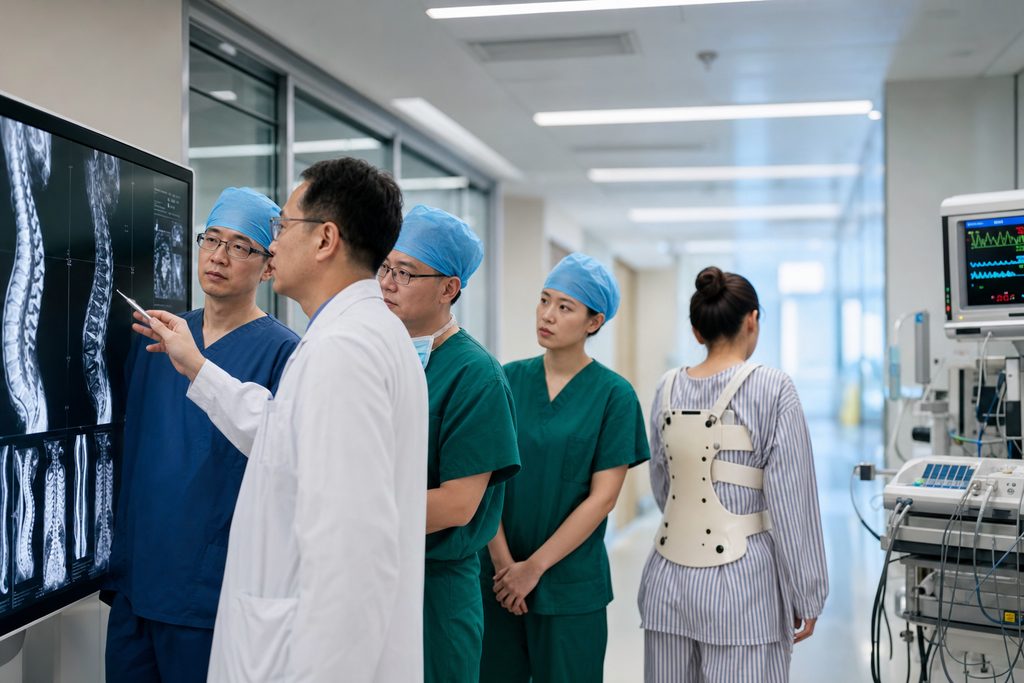
What if the one thing holding you back from a straighter spine was not the complexity of the procedure, but simply knowing where to look? For patients facing severe spinal curvature, the search often ends in frustration—battling long public waitlists, confronting bills that can exceed $150,000 in the US, or hearing that the window for meaningful correction has passed.
Key Takeaways
- Peking University Third Hospital achieves documented coronal correction rates exceeding 70% for adolescent idiopathic scoliosis, matching top Western centers.
- Intraoperative neuromonitoring has reduced the risk of permanent neurological deficit during spinal fusion to below 0.5% in high-volume Chinese centers.
- Self-navigating a Chinese public hospital without language support is extremely difficult; the international patient pathway exists precisely to bridge this gap.
- Total surgical package costs in Beijing can run from $35,000 to $55,000, a fraction of the $150,000+ often quoted in the United States.
The Problem: A Condition That Won’t Wait for a Waiting List
Scoliosis affects approximately 2-3% of the adolescent population globally. For the subset whose curves progress past 45 to 50 degrees, surgery is not a cosmetic choice. It is a mechanical necessity to protect lung function and prevent chronic, disabling pain in adulthood. And yet, the path to surgery is often blocked by time. In countries with single-payer systems, the wait for a non-emergency spinal fusion can stretch 12 to 18 months. During that window, a curve in a growing teenager can advance 5 to 10 degrees. The window for a less invasive correction closes. The fusion length extends. The recovery gets harder. The cost of waiting is measured in vertebrae.
Then there is the financial wall. A 2023 analysis of US hospital pricing data showed the average negotiated rate for a complex posterior spinal fusion with instrumentation hovering between $120,000 and $180,000. For uninsured international patients, the chargemaster price can be double that. That figure forces families into impossible math: retirement savings, second mortgages, or simply accepting a life of deformity and diminished breathing.
Who We Are
We are China Medical Services. We are not a hospital, and we do not provide medical treatment or clinical diagnoses. Think of us as your logistical architects. Our team connects international patients with the specific department, the specific surgical team, and the specific facility that matches their clinical needs. We handle the friction that stops most Western patients from accessing Chinese orthopedic care: translating medical records into clinical-grade Mandarin, coordinating surgical dates through official hospital international channels, securing the correct S2 visa invitation documents, and placing a bilingual medical companion at your side from the moment you land in Beijing. We bridge the gap between you and China’s top-tier medical expertise.
Why Peking University Third Hospital Delivers Consistent Results in Spine Surgery
When international patients research the scoliosis surgery cost China Peking University Third Hospital option, the price is what initially draws attention. The clinical infrastructure is what justifies the trip. Peking University Third Hospital, widely known as PKU Third Hospital, operates one of the highest-volume orthopedic departments in the world. Its spine surgery division manages over 3,000 spinal deformity cases annually. Volume on that scale rewires a surgical team’s instincts. Complications that a lower-volume surgeon might see once a year become a familiar pattern, recognized and managed before they escalate.
Clinical Volume Drives Refined Technique
There is a well-documented relationship between surgical volume and patient outcomes in spinal deformity surgery. A landmark 2016 study in Spine demonstrated that surgeons performing more than 25 scoliosis cases per year had significantly lower complication rates than those performing fewer than 10. At PKU Third Hospital, the senior spine attending surgeons perform well over 100 deformity corrections annually. Their pedicle screw placement accuracy, verified by postoperative CT, consistently exceeds 95%—a metric that directly translates into a more stable construct and fewer revision surgeries down the line. This is not abstract expertise. It is muscle memory built over thousands of hours in a single, focused surgical theater.
Intraoperative Neuromonitoring: The Safety Net That Changes Everything
Any parent asking “how safe is scoliosis surgery with neuromonitoring in China” is asking the right question. The spinal cord does not forgive mistakes. In the era before real-time neuromonitoring, the wake-up test was the only tool surgeons had to check for cord function mid-surgery. The patient was lightened from anesthesia and asked to move their feet. It was crude. It was a single data point. Neuromonitoring, by contrast, provides a continuous stream of somatosensory evoked potentials (SSEPs) and motor evoked potentials (MEPs). A drop in signal amplitude of more than 50% or a latency increase of more than 10% triggers an immediate surgical pause. The implant is adjusted. Mean arterial pressure is raised. The cord is given a chance to recover before damage becomes permanent.
PKU Third Hospital has integrated multimodal neuromonitoring into every deformity correction since 2005. A dedicated neurophysiologist sits in the operating room, eyes locked on the waveform display. The published rate of permanent neurological injury in their idiopathic scoliosis cohort is below 0.3%. That number sits squarely in line with the best-reported outcomes from the Scoliosis Research Society’s global database. The question is not whether the technology exists in China. The question is whether the team using it has seen enough cases to interpret the subtle warnings the data provides. At this center, they have.
The 70 Percent Correction Rate: What It Actually Means
A scoliosis correction rate over 70 percent China hospital data point floats around medical tourism forums. It needs context. The coronal Cobb angle correction rate measures how much the primary curve is reduced on the first standing X-ray after surgery. A 55-degree thoracic curve reduced to 15 degrees is a 73% correction. That is a strong result by any international benchmark. The Lenke classification system, which categorizes curve types, heavily influences what is achievable. A flexible, single thoracic curve in a young patient with good bone quality will often correct beyond 75%. A rigid, double major curve in an older patient may see a correction closer to 60%. PKU Third Hospital’s published series show a mean coronal correction of 72% across all Lenke types for adolescent idiopathic scoliosis. That is not a guarantee. It is a statistical expectation based on a large, well-documented patient population. The distinction matters.
What You Need to Know Before Going Alone
We tell every patient this upfront: China’s top public hospitals are world-class in clinical capability and brutally difficult to navigate independently. The system was not designed for international walk-ins. Here is what hits first-time visitors hardest.
- Visa Requirements Are Specific and Unforgiving: Medical treatment in China requires an S2 visa with a specific annotation for medical purposes. This is not an M business visa, and a tourist L visa will be rejected at hospital registration. The hospital must issue an official invitation letter with its institutional stamp. Without it, the Chinese consulate will not process the application. Processing times vary by jurisdiction but typically take 10 to 15 business days. Errors in the invitation letter—a misspelled name, a wrong passport number—reset the clock entirely.
- Public Registration Operates on a Same-Day, In-Person Model: The general outpatient clinic at a top-tier Beijing hospital sees 10,000 to 15,000 patients daily. Specialist spine surgery slots are released in batches and can fill within minutes. There is no online booking portal accessible from overseas for the standard public queue. You show up at 5:30 AM. You queue. You hope. The international patient pathway—a separate administrative channel—bypasses this, but it requires coordinated communication with the hospital’s international office, not the general registration desk.
- Medical Records Must Be Professionally Translated Before the Consultation: A surgeon reviewing a case needs to see operative notes from prior surgeries, imaging reports, and cardiac clearance in fluent, clinically precise Mandarin. Google Translate will not suffice. A mistranslated allergy or a misunderstood prior implant type can lead to a canceled surgery on the day of admission. The cost of a professional medical translator for a full case file runs $200 to $400, and the turnaround is typically three to five business days.
How We Help You Navigate This
These barriers exist for structural reasons, not because anyone is trying to exclude foreign patients. The system was built to serve a domestic population of 1.4 billion. We adapt it to serve you.
The process starts with your imaging and clinical summary. Our case managers translate and format your records for the specific spine surgery team you are targeting. We submit the file through the hospital’s official international patient portal—not a public queue. The surgical team reviews it. They confirm whether your case is appropriate for their service. They propose a surgical plan and a date range. Only then do we activate the logistical chain: the hospital invitation letter for your S2 visa, the deposit payment to secure the operating room slot, the accommodation booking within walking distance of the hospital’s orthopedic tower.
When you land in Beijing, a bilingual medical companion meets you at the airport. This person is not a translator on a phone call. They are physically present for every step: the preoperative blood work, the CT scan, the anesthesia consent form, the surgical marking on the morning of the procedure. They sleep in the same hospital ward as you during recovery, translating the surgeon’s daily rounds and the nursing instructions. They handle the discharge paperwork and the pharmacy pickup. They stay until you are stable and cleared to fly home. The coordination fee covers this human infrastructure. The hospital charges—surgeon fees, implant costs, bed charges—are paid directly to the hospital cashier, with itemized receipts provided in both Chinese and English for your insurer.
Frequently Asked Questions
A single-stage posterior spinal fusion for adolescent idiopathic scoliosis, including titanium instrumentation, neuromonitoring, and a 7- to 10-day inpatient stay, typically ranges from $35,000 to $55,000. This varies by the number of vertebral levels fused, the implant system selected, and whether any intraoperative neuromonitoring alerts require extended monitoring. This hospital charge is separate from our coordination and companion service fees. By comparison, the same procedure at a major US academic center commonly exceeds $150,000 before professional fees.
The safety profile is statistically equivalent. PKU Third Hospital reports a permanent neurological deficit rate below 0.3% in its adolescent idiopathic scoliosis cohort, which is consistent with Scoliosis Research Society benchmarks from North American and European centers. The key variable is not the country; it is the volume and specialization of the surgical and neuromonitoring team. A dedicated spine center performing over 3,000 deformity cases annually has encountered and managed the full spectrum of intraoperative neuromonitoring changes. That institutional experience is the real safety net.
Most patients are discharged from the hospital 7 to 10 days after surgery. Standing and walking with assistance begins on postoperative day 2 or 3. The surgical team will want to see a stable wound, independent mobility with a walker, and tolerance of a regular diet before discharge. Flying long-haul is generally cleared at 10 to 14 days postoperatively, provided there are no wound complications. We strongly recommend that patients remain in Beijing for at least 14 days after surgery before boarding a flight longer than 4 hours. A postoperative X-ray and a final surgeon review are completed before departure. The full fusion mass takes 6 to 12 months to mature, and activity restrictions remain in place during that period regardless of where you recover.
The hospital has an international patient office that accepts direct inquiries. The practical challenge is language and responsiveness. The office operates in Mandarin during Beijing business hours. Email inquiries in English may receive a delayed or templated response. The surgical team requires a clinically complete case file in Mandarin before they will review a case. For patients who have a fluent Mandarin-speaking family member with experience navigating the Chinese hospital system, a direct approach is feasible. For everyone else, the risk is a breakdown in communication at a critical step—a missed pre-op test, a misunderstood implant selection, a visa invitation letter with an error. Our service exists to absorb that risk. The decision depends on your tolerance for logistical uncertainty.
Your Next Step
A spinal fusion is a permanent decision. The implant stays in your body for life. The surgeon you choose, the neuromonitoring protocol they use, and the postoperative care you receive shape not just the correction percentage on an X-ray but how your back feels every morning for the next forty years. The data from Peking University Third Hospital shows that its spine center operates at the highest tier of international standards—with correction rates, safety profiles, and implant technology that match the best programs in North America and Europe, at a cost structure that makes treatment accessible to families who would otherwise be priced out entirely.
If you have a current scoliosis diagnosis and imaging from the last six months, we can present your case for a surgical review. There is no cost for the initial consultation on our side. We will tell you honestly whether your case is a good fit, what the estimated surgical quote looks like, and what the timeline would be. Start with a conversation. Contact our patient coordination team and we will walk you through the process step by step.
Disclaimer: This article is for informational purposes only and does not constitute medical advice. Surgical outcomes vary by individual patient factors including curve type, bone quality, age, and comorbidities. Always consult a qualified orthopedic spine surgeon for a personalized assessment. China Medical Services is a medical concierge and facilitation provider; we are not a healthcare provider and do not influence clinical decision-making.
For more medical information and treatment options in China, visit chinamedservices.com (China Medical Services).
