3D Printed Dental Implant China: Full Jaw Restoration with Computer Guided Surgery
Key Takeaways
- Full jaw restoration in China using 3D printed titanium implants and computer guided surgery typically ranges from $12,000 to $25,000 per arch—a fraction of the $45,000 to $60,000 charged in the United States.
- Computer guided surgery slashes surgical time by up to 40% and eliminates the guesswork of freehand implant placement, reducing the risk of nerve damage and sinus perforation.
- China’s top dental hospitals now use in-house 3D printing labs that fabricate custom subperiosteal or endosteal frameworks in under 48 hours, a workflow that still takes weeks in most Western clinics.
- Language barriers and the sheer complexity of coordinating lab work, surgery, and temporary prosthetics across borders mean independent travel carries real clinical and financial risk.
The Problem: When Your Jawbone Can’t Support Traditional Implants
Losing teeth is one thing. Losing the bone that once held them is another problem entirely. Approximately 25% of edentulous patients have such severe maxillary or mandibular atrophy that standard endosteal implants are simply not viable without extensive bone grafting. That statistic comes from a longitudinal study published in the Journal of Oral Implantology, and it represents a genuine clinical dead end for many patients. The traditional fix—harvesting bone from your hip or tibia, waiting six to nine months for it to integrate, then placing implants, then waiting again for osseointegration—can stretch treatment time to over a year. And the cost in the US? Easily $60,000 to $90,000 per arch when you tally the grafting, the implants, the temporary dentures, and the final prosthesis.
Patients in the UK, Australia, and Canada face similar math. Wait times compound the misery. An NHS patient needing full arch rehabilitation after trauma or periodontal disease might wait 18 months just for the initial surgical consult. Private care slashes the wait but not the bill. This is where structural innovation—not just a cheaper price tag—changes the equation.
Who We Are
We are not a hospital. We do not provide medical treatment, clinical diagnoses, or dental procedures. Our team at China Medical Services functions as your logistical architects—we bridge the gap between you and China’s highest-ranked dental hospitals. We handle hospital matching, appointment coordination, bilingual medical companion services, and visa guidance. We do not promise miracles. We promise clarity, access, and an honest assessment of whether traveling to China for full jaw restoration makes clinical and financial sense for your specific case.
How Does 3D Printed Jaw Implant Work: The Technology Shift
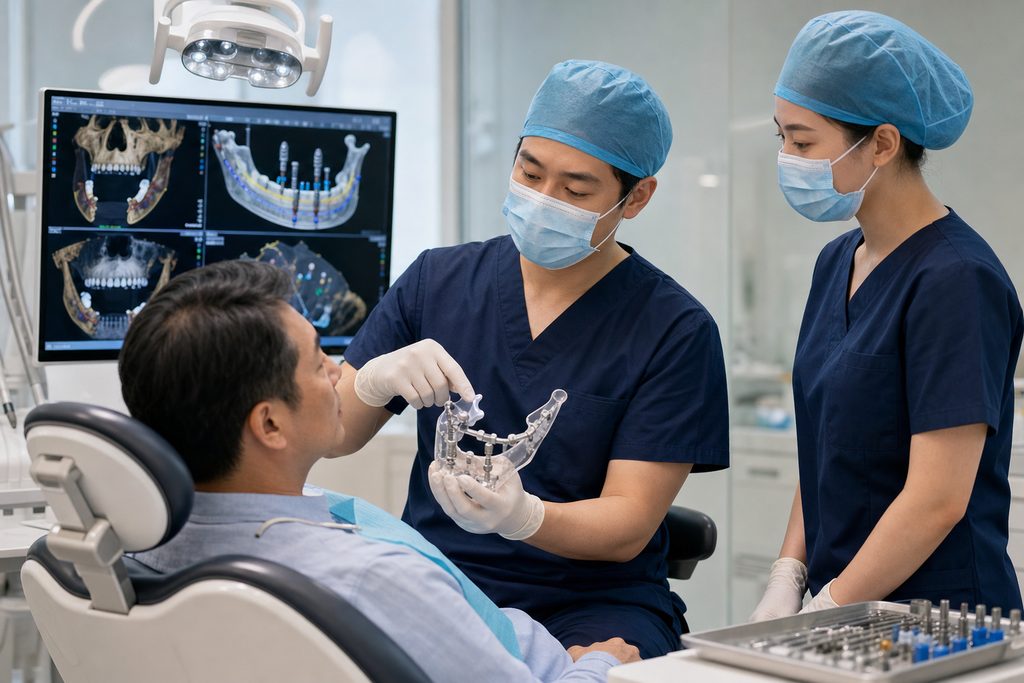
What if the implant wasn’t a standardized off-the-shelf screw, but a perfectly contoured titanium framework designed exclusively for your anatomy? That is the core premise behind 3D printed jaw implants. The process starts with a cone beam CT (CBCT) scan that generates a sub-millimeter 3D model of your skull. Software then maps the remaining viable bone, the path of the inferior alveolar nerve, and the sinus cavities. The surgeon and lab technician collaborate on a digital plan that positions each implant fixture in the zone of best bone density, at the optimal angle, avoiding critical anatomical structures.
That digital plan is then sent to a selective laser melting (SLM) printer. Titanium powder is fused layer by layer—sometimes as thin as 30 microns—into a monolithic framework. The result is not a generic implant. It is a patient-specific device with precisely engineered porosity to encourage osseointegration and a shape that distributes occlusal forces across the entire arch. The same digital file generates a surgical guide: a rigid, tooth-borne or bone-borne stent that dictates exactly where each osteotomy is drilled. The surgeon is not freehanding. The guide eliminates angular deviation to within 0.5 degrees in most cases.
Why Computer Guided Dental Implant Surgery China Delivers Results
Surgical Precision That Freehand Techniques Can’t Match
A 2021 meta-analysis in Clinical Oral Implants Research compared guided versus freehand full arch implant placement. The guided group showed a mean angular deviation of 2.1 degrees versus 5.9 degrees in the freehand group. Depth control was tighter by nearly 1.5 millimeters. Why does that matter? A drill that plunges 1.5 millimeters too deep can perforate the sinus membrane or compress the inferior alveolar nerve. That is not a minor complication. Nerve damage can mean permanent lip and chin numbness. Sinus perforation can require a secondary surgery and months of healing. Computer guided surgery turns a high-stakes manual procedure into a verifiable, pre-planned execution. The surgical guide acts as a physical constraint—the drill simply cannot go where it should not.
Speed: From Scan to Temporary Teeth in Days, Not Months
Traditional full arch implant workflows in the West are fragmented. The CBCT is taken at a radiology center. The surgical guide is fabricated by an external lab in another state. The implant framework is milled or printed by yet another facility. Each handoff adds days or weeks. China’s top dental hospitals—particularly those affiliated with major university medical centers—have collapsed this chain. The CBCT, digital design, 3D printing, and surgery happen under one roof. A patient arriving on a Monday can have their scan, digital plan, and custom framework printed by Wednesday. Surgery happens Thursday or Friday. A fixed temporary prosthesis is loaded within 48 hours post-op. This immediacy is not marketing fluff. It is a structural advantage born from vertical integration and the sheer volume of cases these hospitals process.
The Cost Reality: Why 3D Printed Dental Implant Cost China Is Structurally Lower
Let’s address the obvious question. How can a full arch restoration cost $12,000 to $25,000 in China when the same procedure runs $45,000 to $60,000 in the US? The answer is not lower quality. It is structural economics. Chinese hospital dental departments operate on high volume and thin margins. A single maxillofacial surgery department might handle 15 to 20 full arch cases per week. The in-house 3D printing lab amortizes its million-dollar SLM machines across thousands of cases annually. The cost of the titanium powder—medical grade Ti-6Al-4V—is roughly the same globally. What differs is the labor cost for the surgical team, the lab technician’s time, the hospital facility fee, and the absence of multi-layered insurance billing overhead. A US hospital’s charge for a single implant fixture can exceed $2,000 before the surgeon even touches the patient. In China’s top-tier public hospitals, that same fixture might cost $400 to $600.
| Procedure Component | US Average Cost (USD) | China Average Cost (USD) |
|---|---|---|
| CBCT Scan & Digital Planning | $800 – $1,500 | $150 – $300 |
| Custom 3D Printed Titanium Framework | $8,000 – $15,000 | $3,000 – $6,000 |
| Surgical Guide Fabrication | $1,200 – $2,500 | $400 – $800 |
| Surgical Fee (Full Arch) | $8,000 – $15,000 | $2,500 – $5,000 |
| Temporary Fixed Prosthesis | $3,000 – $6,000 | $1,200 – $2,500 |
| Final Zirconia Prosthesis | $8,000 – $14,000 | $3,500 – $7,000 |
| Total Estimated Range | $45,000 – $60,000 | $12,000 – $25,000 |
Prices vary by hospital, case complexity, and the specific implant system used. These ranges reflect full arch restoration with computer guided surgery at top-tier Chinese public hospitals as of 2026. Final quotes require a clinical evaluation.
Full Jaw Restoration China Price: What the Quote Actually Covers
Patients researching full jaw restoration China price often encounter package deals that look too good to be true. Some are. A legitimate quote from a top-ranked hospital will break down into distinct line items: the diagnostic workup, the digital planning and surgical guide, the custom 3D printed framework, the surgical fee, the temporary prosthesis, and the final prosthesis delivered after osseointegration—typically three to six months later. If a quote lumps everything into one vague number without specifying the implant system, the material of the final prosthesis, or the number of planned follow-up visits, that is a red flag.
Most Chinese university hospitals use internationally recognized implant systems alongside their custom frameworks. You will see Straumann, Nobel Biocare, and Dentium fixtures integrated into the 3D printed substructure. The final prosthesis is almost always monolithic zirconia or a titanium-acrylic hybrid. Monolithic zirconia costs more but offers superior wear resistance and aesthetics. A full arch in zirconia might add $3,000 to $5,000 to the total compared to a hybrid. Ask for the material specification in writing before you commit.
Best Dental Implant Hospitals China for Foreigners: Where to Look
Not every hospital with a 3D printer is equipped to treat international patients safely. The best dental implant hospitals China for foreigners share three traits: an in-house maxillofacial surgery department with a dedicated implantology unit, a digital dental lab with SLM printing capability, and an international patient center with English-speaking coordinators. These are typically university-affiliated teaching hospitals in Beijing, Shanghai, Guangzhou, and Chengdu. They appear on the Fudan University hospital rankings for stomatology—a specialty list that ranks China’s top 10 dental hospitals based on peer reputation and clinical output.
You can browse our database of ranked stomatology departments on our specialty pages. For patients who prefer a more Western-style care environment with direct insurance billing, several JCI-accredited private international hospitals in Shanghai and Beijing also offer computer guided full arch implantology. These private facilities charge more—typically 30% to 50% above public hospital international department rates—but provide fully English-speaking clinical teams and familiar billing processes. Our private hospitals directory lists JCI-accredited options with dental implant programs.
What You Need to Know Before Going Alone
We have seen patients try to arrange full jaw restoration in China independently. Some succeed. Many do not. The barriers are not insurmountable, but they are real and they compound quickly when you are managing them from 6,000 miles away.
- Visa Requirements: Medical treatment in China requires an S2 visa with a notation specifying the purpose of treatment. You cannot enter on a tourist visa and legally undergo surgery. The S2 application requires an invitation letter from the treating hospital—something no public hospital will issue without a confirmed clinical appointment and a deposit on file. Getting that appointment without a local phone number, WeChat account, and Mandarin fluency is the first major hurdle.
- Appointment and Payment Systems: China’s top public hospitals do not accept international credit cards for surgical deposits. Payment is typically required via domestic bank transfer or Alipay/WeChat Pay—platforms that require a Chinese bank account to fund above certain limits. The hospital registration system is entirely in Chinese. Specialist consultations are not bookable online from overseas for the standard public queue. You need access to the international medical department or VIP channel, which operates on a separate, non-public scheduling system.
- Lab-to-Surgery Coordination: A full arch 3D printed implant case requires tight coordination between the radiologist, the digital lab technician, and the surgeon. If your CBCT was taken abroad, the DICOM files must be formatted correctly for the Chinese lab’s software. A single file compatibility error can delay your surgery by a week. You need someone on the ground who speaks both the clinical language and the technical one.
How We Help You Navigate This
These barriers exist for structural reasons, not because anyone is trying to make things difficult. China’s hospital system was built to serve a domestic population of 1.4 billion. International patients are an afterthought in most departments. That is where our team fills the gap.
Before you travel, we collect your existing dental records, CBCT scans, and medical history. Our bilingual case managers translate and format these for the target hospital’s digital lab. We coordinate directly with the hospital’s international department to secure a confirmed surgical consultation slot—not a vague “show up and queue” instruction. We handle the invitation letter for your S2 visa application. When you land, a bilingual medical companion meets you at the airport, accompanies you to every appointment, translates clinical discussions in real time, and manages the logistics of hospital registration, payment, and pharmacy runs. After surgery, we coordinate your follow-up visits and the delivery of your final prosthesis. We stay involved until you are cleared to fly home.
Our service is case management. We charge a coordination fee that starts from $300 for appointment booking and scales based on the complexity and duration of your stay. Any fees paid for remote consultation or second opinion services are credited in full toward on-the-ground coordination if you proceed with treatment within 90 days. We do not mark up hospital fees. You pay the hospital directly at their published international department rates.
Frequently Asked Questions
The titanium alloy used—Ti-6Al-4V ELI—is an international medical-grade standard, not a local variant. The selective laser melting machines used by top Chinese dental labs are the same German and Swedish models used in Western labs. What differs is the regulatory pathway. Chinese custom implants are regulated by the NMPA under Class III medical device rules. If you want FDA-cleared or CE-marked components specifically, you need to specify that with the hospital before fabrication begins. Some hospitals can source internationally certified frameworks; others use NMPA-approved domestic equivalents that meet ISO 13485 standards.
Implant failure due to true biological rejection of titanium is extraordinarily rare—the literature puts it at well under 1%. The more common complications are peri-implantitis (infection around the implant) or mechanical failure of the prosthesis. You need a local dentist in your home country willing to manage follow-up care. Before you leave China, we ensure you receive a complete medical record in English, including the implant system specifications, the surgical report, and post-operative imaging. This allows your local dentist to understand exactly what was placed. We recommend identifying that local follow-up provider before you book your surgery in China.
No reputable hospital will finalize a surgical plan—let alone quote a firm price—without an in-person clinical examination and a CBCT taken on their own machine. You can book a consultation slot and secure a surgical window, but the final treatment plan is determined after the surgeon evaluates you face-to-face. Any provider offering a fixed-price “package” for full arch restoration without a clinical exam is cutting corners you cannot afford to cut. What you can arrange in advance is the consultation, the digital planning, and a provisional surgical date. That is what we coordinate.
Plan for two trips. The first trip is typically 10 to 14 days: consultation, CBCT, digital planning, framework fabrication, surgery, and delivery of the temporary fixed prosthesis. You return home to allow osseointegration—usually three to six months. The second trip is shorter, around 7 to 10 days, for delivery of the final zirconia prosthesis and any occlusal adjustments. Some patients opt to stay in China for the full osseointegration period. That is logistically possible but rarely necessary unless you have no local dentist at all.
Your Next Step
Full jaw restoration with 3D printed implants and computer guided surgery represents a genuine leap forward for patients who have been told their bone loss makes them ineligible for traditional implants. China’s top dental hospitals have integrated the digital workflow to a degree that shortens treatment time and reduces surgical risk. The cost advantage is real—and it is structural, not a compromise on materials or expertise. But this is not a procedure to arrange through a WhatsApp message and a wire transfer. It requires careful clinical vetting, honest communication with the surgical team, and a logistical partner who can translate both the language and the system. If you are ready to explore whether this path is right for you, we are here to help you take the first informed step—no pressure, no hard sell, just a clear assessment of your options.
For more medical information and treatment options in China, visit chinamedservices.com (China Medical Services).
