Knee Replacement China Canada: Skip 48-Week Wait, Pay Less
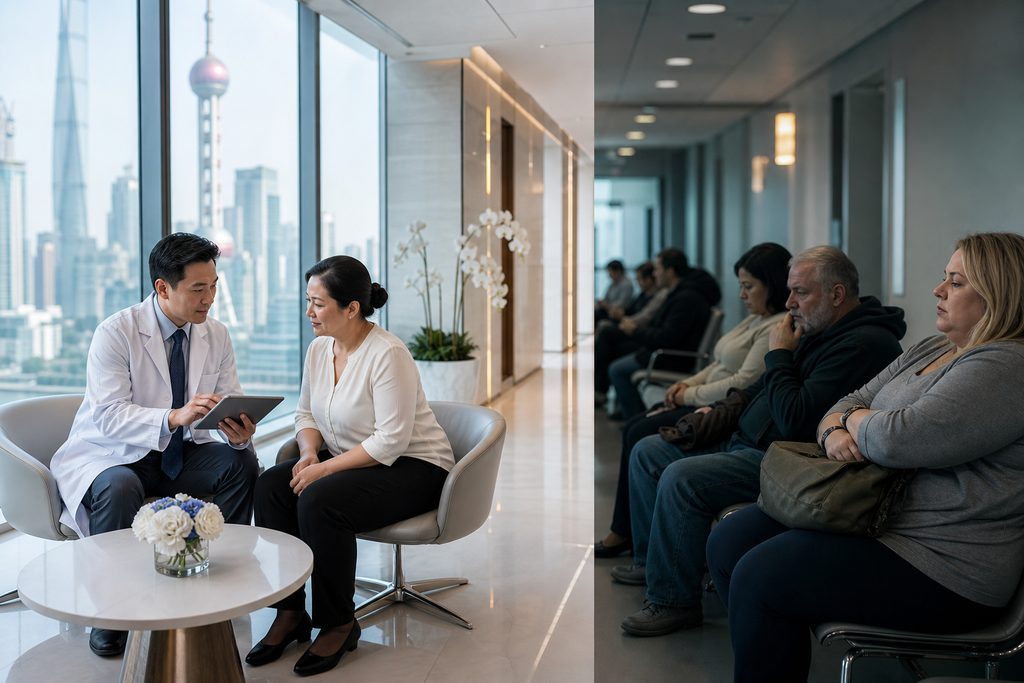
A knee replacement sounds drastic. But in simple terms, it is a resurfacing. A surgeon removes the worn-out cartilage and bone ends from your knee joint and caps them with smooth metal and plastic components. The pain that kept you from walking the dog or climbing stairs? That is what gets replaced. The question is not whether the surgery works. Data from national joint registries shows modern implants last 25-plus years in over 80% of patients. The real question is how long you have to wait for your life back.
If you are in Canada, the answer can be grim.
Key Takeaways
- The median wait time for knee replacement surgery in Canada reached 47.7 weeks in 2023 — nearly a full year of progressive pain and immobility.
- Top-tier Chinese orthopedic centers perform knee replacements at roughly one-third to one-fifth the North American cash-pay cost, often with next-week scheduling for international patients.
- Language barriers and navigating China’s hospital system are real obstacles; a local coordinator is not a luxury but a practical necessity for most Western patients.
- In-person surgery always requires a prior face-to-face consultation in China — no reputable hospital will let you book a knee replacement remotely without examining you first.
The Problem: 48 Weeks of Waiting While Your Joint Deteriorates
Canada’s provincial health systems are strained. The Canadian Institute for Health Information reported that only 66% of knee replacement patients received surgery within the recommended 26-week benchmark in 2023. Another dataset from the Fraser Institute pegged the median wait between a specialist consultation and actual surgery at 47.7 weeks. That is 334 days. In some provinces, the number stretches past 60 weeks.
That wait is not just an inconvenience. A 2022 study in the Journal of Bone and Joint Surgery tracked patients awaiting total knee arthroplasty. Over a 12-month delay, researchers measured significant muscle atrophy in the affected quadriceps, declining gait speed, and a measurable increase in opioid dependence. Waiting does not just freeze your condition. It makes it worse. Your recovery gets harder. Your post-surgical outcome can actually degrade before you even reach the operating table.
Canadians are not passive about this. They search for alternatives. Some fly to private clinics in the United States and pay $35,000 to $50,000 USD out of pocket. Others look further afield. The question they type into search engines is blunt: is there a faster, safe option that does not bankrupt me?
Why China’s Orthopedic Centers Deliver Results for International Patients
The answer increasingly points toward East Asia. Not because it is exotic. Because the math is compelling. China’s top-tier hospitals operate at a volume and cost structure that fundamentally changes the equation for someone facing a year-long wait. The top 5% of China’s 35,000-plus hospitals — ranked by the Fudan University hospital rankings and often holding Joint Commission International accreditation — run orthopedic departments that rival any Western academic medical center.
Volume That Translates to Surgical Precision
Practice matters in surgery. A 2023 systematic review in The Lancet Rheumatology found a clear inverse relationship between a surgeon’s annual joint replacement volume and patient complication rates. In China, a senior orthopedic surgeon at a major center like Peking University Third Hospital or Shanghai Sixth People’s Hospital might perform 300 to 500 knee replacements annually. Compare that to Canada, where a typical arthroplasty surgeon performs approximately 60 to 100 per year according to the Canadian Joint Replacement Registry. The team around the surgeon matters too. Chinese operating room teams that do four or five knees a day develop a rhythm. The scrub nurses anticipate the next instrument. The anesthesia team dials in regional nerve blocks with precision born of repetition. This is not a knock on Canadian skill. It is a reality of scale.
Technology Adopted Without Legacy Debt
Many large Chinese orthopedic centers leapfrogged directly to robotic-assisted surgical platforms and computer-navigated alignment systems. Shanghai’s Changzheng Hospital, for instance, integrated the Mako robotic system years ago and now uses it for a significant portion of its knee cases. Computer navigation helps achieve neutral mechanical alignment — a factor linked to reduced implant wear. These are the same platforms used at the Mayo Clinic or HSS in New York. The difference is that a Chinese hospital serving a massive domestic population deploys them across a far larger patient volume, which drives down the per-case cost of the technology.
The Knee Replacement Cost China vs Canada Equation
Let us address the obvious. Price. A total knee replacement at a private US hospital often lands between $35,000 and $50,000 USD for an uninsured international patient. In Canada, the provincial system covers the cost for residents, but the wait is the price you pay. For a Canadian who wants to skip the queue and pay cash abroad, the knee replacement cost China vs Canada comparison is stark. At a top Chinese public hospital’s international VIP wing, the all-inclusive hospital bill — implant, surgeon fees, private room, nursing care, and three to five days of inpatient stay — ranges from $15,000 to $22,000 USD depending on the implant type and case complexity.
| Cost Factor | Canada (Private Pay / Out-of-Country Estimate) | China (Top Public Hospital VIP Wing) |
|---|---|---|
| Surgeon + Hospital Fees | $35,000 – $50,000 USD | $15,000 – $22,000 USD |
| Implant Type | Standard included; premium upgrades extra | Standard included; premium upgrades $2,000-$4,000 |
| Inpatient Stay | 2-3 days typical | 3-5 days typical (more conservative discharge) |
| Pre-op Diagnostics | Often billed separately | Bundled into package |
| Wait Time (Specialist to Surgery) | 47.7 weeks median | Often 1-3 weeks after in-person consultation |
That $15,000 to $22,000 range is not a budget hospital with questionable sterilization. These are JCI-accredited international departments where the nursing staff speaks English and the rooms look more like a business-class hotel than a ward. The cost structure reflects Chinese labor economics, not a compromise on safety. A senior surgeon’s salary, a private room, and a stack of sterile drapes simply cost less in Shanghai than in Toronto or Houston.
How the Fast-Track Process Works: From First Contact to Surgery
You cannot simply email a Chinese hospital, pick a date, and show up for your knee. The pathway has defined steps. Understanding them prevents expensive mistakes.
First, you need a pre-travel remote evaluation. You send your existing records — recent X-rays (weight-bearing AP, lateral, and skyline views), an MRI if available, your medical history, and a list of current medications. A Chinese orthopedic specialist reviews these. This step answers a basic question: are you actually a surgical candidate? It costs between $300 and $500 USD for a written second opinion from a senior consultant. That fee is not sunk. If you proceed to surgery, many coordination services credit it toward your on-the-ground support package.
Second, you travel for the in-person consultation. No reputable hospital will skip this. The surgeon needs to examine your knee’s range of motion, ligament stability, and alignment. They will order fresh standing X-rays if yours are more than a month old. They will also check your cardiac and pulmonary clearance. This is the gate. Once the surgeon confirms you are fit for surgery, the scheduling moves fast. How long is the wait for knee surgery in China after this consultation? At international patient centers, it is often one to three weeks. Sometimes the next week if your pre-op labs are clean and a slot opens.
Third, the surgery and inpatient stay happen. Expect three to five days in the hospital. Chinese protocols tend to be slightly more conservative on discharge than American ones. You will start walking with a walker on day one. Physiotherapy begins in your room.
Fourth, recovery continues locally. Most international patients stay in China for two to three weeks post-discharge. You need daily physio, wound checks, and a follow-up with your surgeon to clear you for the flight home. Stitches or staples come out around day 14. A long-haul flight immediately after a knee replacement raises the risk of deep vein thrombosis. Your surgeon will want you mobile, with your wound sealed and your swelling down, before you board a plane.
Which Hospitals Should a Foreigner Actually Consider for Knee Replacement?
Not every Chinese hospital equipped to do a knee replacement is set up for a patient who speaks only English and expects Western-style communication. The best knee replacement hospitals China for foreigners cluster in a few cities and share common traits: an established international medical center, English-speaking coordinators, and experience managing the visa and documentation needs of overseas patients.
Shanghai Sixth People’s Hospital runs one of the highest-volume orthopedic programs in the world. Its international department handles a steady stream of patients from Southeast Asia, the Middle East, and increasingly North America. Peking University Third Hospital in Beijing is another heavyweight — its sports medicine and joint reconstruction teams rank among China’s top two in the Fudan specialty reputation list. For patients who prefer a private, hotel-like environment with full English fluency, Jiahui International Hospital in Shanghai offers orthopedic surgery with Western-trained surgeons and direct insurance billing. United Family Healthcare, with locations in Beijing, Shanghai, and Guangzhou, provides a similar model.
The trade-off is price. A private international hospital charges more — closer to $25,000 to $30,000 USD — but the experience feels familiar to a North American. A top public hospital’s VIP wing costs less and offers arguably deeper subspecialty expertise, but the environment is more clinical and you will rely heavily on a bilingual coordinator outside of the international department bubble. Both paths are valid. The right one depends on your budget and your comfort with cultural friction.
Evaluating a hospital from abroad is hard. Look for JCI accreditation status — it is verifiable on the JCI website. Ask how many knee replacements the department performs annually. A number below 200 suggests it is not a core focus. Ask about the implant brands they stock. Zimmer Biomet, Stryker, DePuy Synthes, and Smith & Nephew are the global majors. If a hospital uses an implant you cannot Google, that is a red flag.
Practical Considerations: Visas, Payments, and Follow-Up Care
The logistics are manageable but specific. First, the visa. For medical treatment in China, you apply for an S2 visa. The hospital’s international department will issue an invitation letter confirming your treatment plan. Your accompanying spouse or adult child applies for their own S2 visa as a family member traveling for private affairs. Do not let anyone tell you to apply for an M visa. M is for commercial trade fairs and business meetings. Using the wrong category can get you turned away at the border.
Payment is the next hurdle. Chinese public hospitals — even their VIP wings — operate on a prepayment model. You deposit a lump sum upfront before admission. The hospital draws down from that deposit daily. If the balance runs low, you top it up. The final bill is settled at discharge. International wire transfers work, but they are slow. Many patients use a combination of credit card deposits and cash. Check your card’s daily limit. Some Chinese hospital payment terminals have a single-transaction cap of around $3,000 to $5,000 USD equivalent. You may need to run the card multiple times or arrange a higher limit with your bank before you travel.
Insurance is retrospective. Chinese hospitals do not direct-bill Canadian provincial health plans. You pay out of pocket and seek reimbursement from your travel insurance or provincial health authority afterward. Some private international hospitals like United Family can direct-bill certain global insurers, but this is the exception. Confirm with your insurer in writing before you book a flight.
Follow-up after you return to Canada is critical. Your Chinese surgeon will provide a discharge summary, operative notes, and a recommended rehabilitation protocol. You hand these to your family doctor or a local physiotherapist. The implant stickers — small labels with the lot and serial numbers — go into your medical record. If you ever need a revision surgery in Canada, your orthopedic surgeon will need to know exactly what is in your knee. Keep those stickers. Scan them. Do not lose them.
A note on remote booking: No legitimate Chinese hospital will let you schedule a surgery date before an in-person consultation. If an agent promises a locked-in surgery slot before you have even met the surgeon, walk away. The sequence is non-negotiable: records review, fly to China, in-person exam, then schedule.
Frequently Asked Questions
For a Canadian with provincial health coverage, knee replacement at home costs nothing out of pocket for the surgery itself — but the wait is the hidden cost. If you choose to pay privately abroad to skip that wait, then yes, is knee replacement in China cheaper than Canada is a straightforward question with a clear answer: Chinese private-pay prices run $15,000 to $22,000 USD, compared to $35,000 to $50,000 USD for private-pay surgery in the United States. Canada does not have a parallel private-pay track for knee replacement in most provinces, so the practical comparison is China versus the US or other medical tourism destinations. The savings are real and substantial.
This is the hardest question and it deserves a straight answer. Your Chinese surgeon’s responsibility largely ends when you leave the country. Infection, stiffness, or a blood clot that appears weeks later will be managed by your local Canadian healthcare system. Your provincial coverage applies. Your family doctor refers you to a local orthopedic surgeon. The Chinese hospital will provide your records and imaging, but they will not fly a surgeon to Canada to manage a post-op problem. This is true of any cross-border surgery. It is the trade-off you accept for skipping the wait. Choose a hospital with a documented low complication rate and a clear process for post-discharge communication. Many international departments assign a coordinator who stays in touch via WeChat or email for the first 90 days.
Several agencies market skip the wait knee surgery abroad packages as turnkey solutions. The honest truth: you can drastically shorten the timeline, but you cannot eliminate every step. You still need pre-op clearance. You still need to travel. You still need to stay in-country for post-op rehab. A realistic timeline from first contact to surgery is four to six weeks — not 48. That includes records review, visa processing, travel, the in-person consultation, and a short pre-surgery buffer. Anyone promising you a surgery date in seven days from cold contact is cutting corners you do not want cut.
A proper medical tourism China knee replacement fast track package bundles the hospital’s surgical fee with logistical support: airport pickup, a bilingual coordinator who accompanies you to every appointment, hospital admission paperwork, and post-op accommodation arrangements. It does not include your flight, your visa fee, or your meals outside the hospital. The coordinator is the person who translates the surgeon’s explanation of implant choices, argues with the billing department about a stray charge, and makes sure your discharge medications are correctly labeled in English. Without this layer, you are navigating a Mandarin-only system with a fresh surgical wound. Few people want that.
Your Next Step
The math is clear: a year of waiting versus a few weeks, and a surgical bill that is a fraction of what you would pay across the border in the United States. The obstacle is not the quality of Chinese orthopedics — it is the complexity of arranging it from 10,000 kilometers away. Our team at China Medical Services exists to bridge that gap. We are not a hospital and we do not provide medical advice. We connect international patients with the right orthopedic center, coordinate the remote evaluation, and handle the on-the-ground logistics so you can focus on your recovery. If you want to understand what a fast-track knee replacement would look like for your specific situation, start with a conversation. No cost, no commitment — just clarity.
For more medical information and treatment options in China, visit chinamedservices.com (China Medical Services).
