Severe Food Allergy China Surgery: Real Hospital Diet Safety
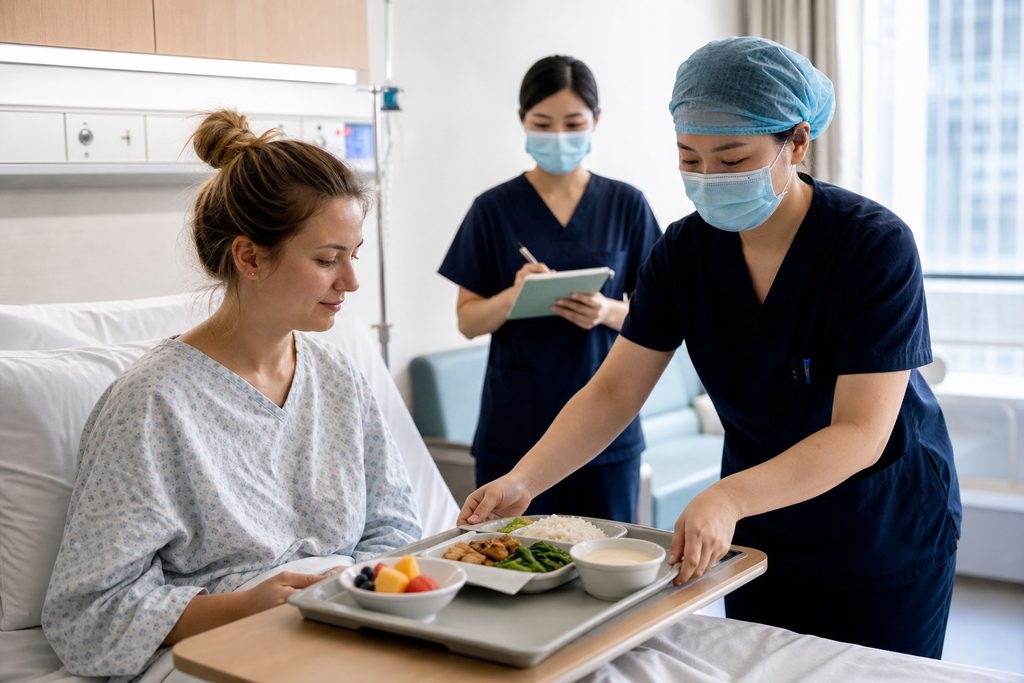
You have probably heard that having surgery abroad with a severe food allergy is a gamble you cannot afford to take. The fear is visceral: one wrong ingredient in a post-operative meal, one mislabeled tray, and a controlled clinical situation turns into an anaphylactic emergency far from home. That fear is rational. But the assumption that it automatically disqualifies China as a surgical destination rests on outdated information. The top 5% of Chinese hospitals—the ones we work with—operate food allergy protocols that often exceed what you find in many Western facilities, precisely because they treat such a high volume of international patients who bring complex dietary restrictions with them. The real question is not “can I eat safely in Chinese hospital with severe allergies,” but rather which hospitals have the systems to guarantee it, and what those systems actually look like on the ground.
Key Takeaways
- China’s top-ranked hospitals serve large international patient volumes, driving the development of rigorous, documented food allergen management protocols that are audited for JCI accreditation.
- A dedicated bilingual medical companion acts as your continuous safety layer—verifying every meal against your allergy card and communicating directly with the hospital’s nutrition department, not just the nursing station.
- The structural cost advantage means a comprehensive, allergy-safe surgical episode—including extended monitoring and specialized dietary management—typically runs 70-80% less than the same procedure in the United States.
- Food allergy safety is not automatic in every Chinese hospital. It is concentrated in the internationally accredited and Fudan-ranked institutions that have made patient safety their primary credential.
The Problem: When a Hidden Allergen Derails Everything
Food allergies affect approximately 220 million people globally, and the prevalence of severe cases—those that can trigger anaphylaxis—has been rising by about 50% in the last decade according to data from the World Allergy Organization. If you are one of those patients, a scheduled surgery is not just a medical event. It is a logistics puzzle where the stakes are life and death. You are temporarily dependent on a kitchen you cannot see, staff you have not trained, and ingredient supply chains you cannot audit. A 2023 study in the Journal of Allergy and Clinical Immunology: In Practice found that 1 in 12 inpatients with a known food allergy still experienced an allergic reaction during their hospital stay, often because the dietary restriction was documented in the chart but not communicated to the food service team. That gap—between what the doctor knows and what the kitchen does—is where the danger lives.
Now layer on the complexity of traveling to a country where you do not speak the language, do not know the brands, and cannot read the packaging. The default response for many patients is to delay or avoid necessary surgery. They wait. They manage symptoms. And the underlying condition—whether it is orthopedic, cardiac, or oncologic—gets worse. The cost of that delay is rarely factored into the initial fear. But it is real, and it is measurable in disease progression.
Why Top-Tier Chinese Hospitals Deliver Real Diet Safety
The hospitals that handle the largest international caseloads in China have built food allergy safety into their operational DNA. This did not happen by accident. It happened because JCI accreditation—held by a growing number of Chinese institutions—requires documented, auditable processes for identifying, communicating, and managing patient food allergies across every department that touches a meal tray. The Chinese hospitals that pursue this accreditation are not the ones cutting corners. They are the ones investing in systems that make a severe food allergy a manageable risk, not a disqualifying one.
Clinical Volume Drives Protocol Maturity
A hospital that treats 50 international patients a year can manage food allergies on a case-by-case basis. A hospital that treats several thousand cannot. It needs a system. Peking Union Medical College Hospital, for instance, handles over 2.26 million outpatient visits annually, with a significant international cohort. That volume forces standardization. The nutrition department does not improvise an allergen-free meal when a foreign patient arrives. It pulls from a documented, repeatable protocol that has been tested across hundreds of prior cases. Allergen identification is built into the admission workflow. The patient’s dietary restrictions are flagged in the electronic medical record, and that flag is visible to the kitchen, the nursing station, and the attending physician simultaneously. This is the same closed-loop communication model that top US academic medical centers use, but it operates at a scale that makes it a routine competency, not a special request.
Technology and Operational Transparency
What does this look like in practice? When you are admitted to a JCI-accredited Chinese hospital for surgery, the dietary safety process typically includes three mandatory checkpoints. First, a pre-admission nutrition screening where your allergies are documented in both English and Mandarin on a standardized form. Second, a meal-ordering system that links your patient ID to your allergen profile—if a tray contains a flagged ingredient, the system blocks it before it leaves the kitchen. Third, a bedside verification step where a staff member confirms your name, your allergies, and the meal contents before you eat. This is not theoretical. It is a written protocol that is reviewed during every JCI reaccreditation survey. The system is not perfect—no system is—but it is designed to catch errors at multiple points, which is how high-reliability organizations manage risk.
And there is a cultural factor that works in your favor. Chinese hospital food is prepared fresh on-site from raw ingredients far more often than in Western hospitals, where pre-packaged, outsourced meal trays are common. When a kitchen controls its own ingredients from scratch, it can eliminate allergens at the source. A soy-allergic patient, for example, cannot eat most pre-packaged Asian meals. But a hospital kitchen that cooks from whole foods can simply omit soy sauce from that patient’s dish. It is a simpler supply chain, and simpler supply chains have fewer hidden failure points.
Cost Advantage Without Safety Compromise
Here is the number that usually silences the skeptics. A comprehensive surgical episode in a top-tier Chinese hospital—including the procedure, a private room, daily specialist consultations, and fully managed allergen-safe meals—typically costs between $12,000 and $25,000 depending on the complexity. The same procedure in the United States, with equivalent dietary management, runs $80,000 to $150,000. That is not a trade-off between safety and savings. It is a structural price difference driven by lower labor costs, higher patient throughput, and a healthcare system that does not carry the administrative overhead of the US insurance model. You are buying the same safety protocols, the same JCI standards, the same vigilance. You are just not paying a 400% markup for them.
| Surgical Episode Component | Estimated Cost in China (USD) | Estimated Cost in USA (USD) |
|---|---|---|
| Knee Replacement Surgery | $12,000 – $18,000 | $35,000 – $50,000 |
| Cardiac Bypass Surgery | $15,000 – $22,000 | $70,000 – $120,000 |
| Spinal Fusion Surgery | $18,000 – $25,000 | $80,000 – $150,000 |
| Allergen-Safe Diet Management (daily) | $15 – $30 | $40 – $80 |
| Bilingual Medical Companion (full day) | From $200/day | N/A (not commonly available) |
Note: Costs vary by hospital, case complexity, and length of stay. These figures represent typical ranges for international patients at top-tier Chinese hospitals and are not binding quotes.
How a Chinese Hospital Actually Manages Food Allergies During Surgery
The search query “how do Chinese hospitals handle food allergies during surgery” gets to the heart of the anxiety. Surgery itself—the anesthetic, the sterile field, the recovery bay—is not where the food risk lives. The risk lives in the 48 to 72 hours after surgery, when you are awake, hungry, and being handed a tray by a rotating shift of nurses. Here is the step-by-step reality at the hospitals we coordinate with.
Before you ever board a plane, your allergy profile is translated into Chinese by a medical translator who understands clinical terminology. This is not a Google Translate job. “Whey protein” and “casein” have specific Mandarin equivalents that a general translator will miss. The translated allergy card is embedded in your admission file and sent to the hospital’s international patient center at least one week before your scheduled admission. The nutrition department reviews it, identifies which standard meal plans are safe, and flags any ingredients that require substitution. By the time you arrive, the kitchen already knows what you cannot eat. You are not explaining your allergies to a new person every shift. The system already has the answer.
On the day of admission, a nutritionist or a trained nurse from the international ward meets you to confirm the allergy list, discuss cross-reactivity risks, and walk through the meal-ordering process. You receive a printed card—in English and Chinese—that stays on your bedside table and is checked against every meal delivery. If you have an allergy that carries a high risk of anaphylaxis, the ward stocks epinephrine auto-injectors at the nursing station, and your allergy status is displayed on the whiteboard in your room. This is the same visibility protocol used for fall risks and DNR orders. It makes your allergy impossible to overlook.
This level of coordination does not happen automatically at every Chinese hospital. It is a hallmark of the internationally accredited, Fudan-ranked institutions that have built dedicated international patient centers. At a standard public hospital without an international ward, the dietary safety process is far more variable. That distinction—between a top-tier international ward and a general public ward—is the single most important factor in determining whether your food allergies will be managed safely. Knowing which hospitals have the right infrastructure is the entire reason a patient should work with a service that understands the landscape.
Finding the Best Hospital in China for Severe Food Allergy Surgery
The phrase “best hospital in China for severe food allergy surgery” contains an important misconception. There is no hospital that specializes in surgery for food allergy patients as a distinct category, because the food allergy is not the reason for the surgery. It is a complicating factor that must be managed alongside the primary procedure. So the right question is: which top-ranked hospitals for your specific surgery also have the strongest international patient infrastructure and dietary safety protocols?
For orthopedic surgery, West China Hospital in Chengdu runs one of the largest joint replacement programs in the world and maintains a fully staffed international medical center with English-speaking coordinators and a documented food allergy management protocol. For cardiac surgery, Fuwai Hospital in Beijing performs over 14,000 cardiac surgeries annually and has treated enough international patients that dietary restrictions are a standard part of the pre-admission workflow. For oncology surgery, Fudan University Shanghai Cancer Center combines a top-10 oncology department with an international ward that has handled complex dietary requirements from patients across Southeast Asia, the Middle East, and Europe. These are not hospitals that will be surprised by a dairy allergy or a nut restriction. They have seen it before, and they have a process for it.
What you should look for—and what we verify before recommending any hospital—is three things. First, does the hospital have a dedicated international patient center with English-speaking staff who handle dietary coordination, not just translation? Second, is the hospital JCI-accredited or ranked on the Fudan Hospital List, both of which require documented patient safety protocols that cover food allergen management? Third, does the hospital have an on-site nutrition department that prepares meals from raw ingredients, which allows for true allergen elimination rather than reliance on pre-packaged alternatives that may contain hidden triggers? If the answer to all three is yes, the hospital is capable of managing a severe food allergy safely. If any answer is no, the risk increases substantially.
Practical Considerations: Documentation, Visa, and the Human Layer
Managing a severe food allergy during surgery in China requires more than a good hospital. It requires the right paperwork, the right visa, and a human being on the ground who can catch what the system misses. Here is what you need to know before you go.
Medical documentation. You will need a formal letter from your allergist or primary physician, in English, that lists every confirmed food allergy, the typical reaction severity, and any cross-reactive foods that should also be avoided. This letter must be on letterhead and signed. It will be translated into Chinese by a medical translator and attached to your hospital file. You should also bring two printed copies of this letter with you—one for the hospital, one for your own records. Do not rely solely on digital copies. A printed document on a bedside table is seen by every shift change. A PDF on your phone is not.
Visa category. Foreign nationals traveling to China for medical treatment apply for an S2 visa, which covers short-term private affairs including medical care. The S2 visa requires an invitation letter from the treating hospital, which the international patient center will provide once your treatment plan is confirmed. Accompanying family members also apply for S2 visas. The M visa—which some patients mistakenly think is a medical visa—is strictly for commercial and trade activities and will not be accepted for medical travel. Visa processing times vary by embassy, but you should allow at least four to six weeks from the time you receive your hospital invitation letter.
The human layer. Even the best hospital protocol has gaps. A shift change happens. A new kitchen staff member does not check the allergen flag. A meal tray is placed in front of you with no one to verify it. This is where a bilingual medical companion becomes not a luxury but a safety redundancy. A companion who knows your allergy profile, speaks the clinical language, and is physically present during meal delivery can intercept an error before it reaches your mouth. They also serve as your advocate during pre-op and post-op rounds, ensuring that every new clinician who enters your room is aware of your dietary restrictions. In a system where you do not speak the language, a companion is your voice. For severe food allergy patients, that voice can be the difference between an uneventful recovery and a preventable emergency.
Frequently Asked Questions
Yes, but only at hospitals with documented food allergen management protocols—typically JCI-accredited institutions with dedicated international patient centers. These hospitals use closed-loop communication systems that flag your allergies at admission and carry that flag through to the kitchen and the bedside. General public wards without this infrastructure carry a higher risk. Hospital selection is everything.
The surgical procedure itself is not priced differently because of a food allergy. What changes is the level of dietary management and monitoring required. A full surgical episode at a top-tier Chinese hospital, including allergen-safe meal management and a private international ward room, typically costs $12,000 to $25,000—roughly 70-80% less than the equivalent care in the United States. The cost of a bilingual medical companion, which adds a critical safety layer for allergy patients, starts at $200 per day.
International wards at JCI-accredited Chinese hospitals stock emergency medications including epinephrine, antihistamines, and corticosteroids. Your allergy status is displayed on your room’s patient board, and the nursing station is trained to respond to anaphylaxis according to international protocols. That said, the goal of the dietary safety system is to prevent a reaction from occurring in the first place. The multiple verification checkpoints—at admission, in the kitchen, and at the bedside—are designed to catch allergens before they reach you.
You cannot simply book a surgery online and show up. The process starts with a remote evaluation: you send your medical records and allergy documentation, the hospital’s international center reviews them, and a treatment plan is developed that includes dietary management. Only after the hospital confirms it can safely accommodate your allergies do you schedule the procedure. This pre-screening step is essential and cannot be skipped. It is also where a coordination service proves its value—we handle the document translation, hospital communication, and protocol verification so that you arrive with the dietary safety plan already in place.
Your Next Step
Traveling to China for surgery with a severe food allergy is not a leap of faith. It is a decision that can be made with the same evidence-based rigor you would apply to any major medical choice. The hospitals exist. The protocols exist. The cost
For more medical information and treatment options in China, visit chinamedservices.com (China Medical Services).
