Stay Connected After Surgery in China: Finding Your Recovery Community
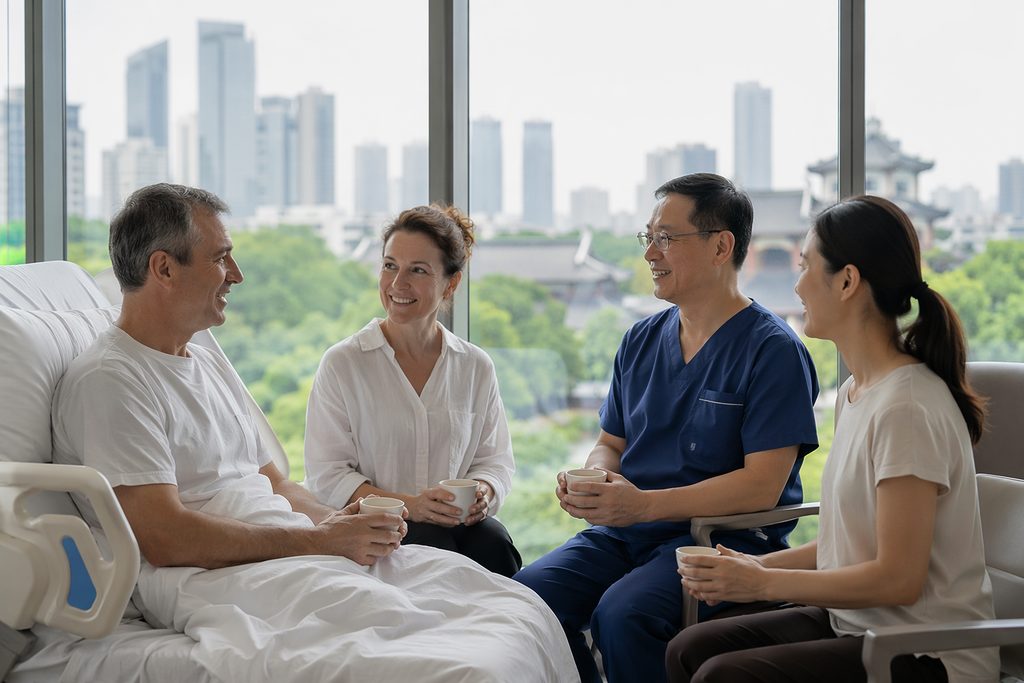
While a patient in the UK might wait 18 weeks just for a specialist consultation after a GP referral, a top-tier hospital in Shanghai can often schedule complex spinal surgery within two weeks of receiving your complete medical records. The speed is staggering. But speed creates a particular kind of loneliness. You land, you prep, you undergo the procedure, and then—in a recovery room thousands of miles from your usual support network—you face the quiet, difficult work of healing. The clinical efficiency that drew you here doesn’t solve the human need to talk to someone who has been through the exact same thing. Finding a patient support group after surgery in China isn’t a luxury add-on to your medical journey. It’s the scaffolding that holds the whole experience together.
How This Actually Works, Step by Step
Most people imagine a formal, hospital-run circle of chairs in a conference room. That exists, but it’s rare. The real landscape of connection is more organic and, honestly, more useful. Here is the sequence our team observes again and again with the international patients we coordinate for.
You arrive with a specific clinical goal. Maybe it’s a knee replacement at a major orthopedic center in Beijing. Maybe it’s a cardiac ablation in Shanghai. Your bilingual medical companion is with you for the admission process, translating every form and question. During the first 48 hours post-surgery, you’re focused entirely on pain management and early mobilization. The need for peer connection usually hits around day three or four. The initial adrenaline of travel and surgery has worn off. You’re alert enough to be bored and anxious. That’s when the search begins.
The most immediate channel is often the international patient coordinator assigned to your case. These coordinators at China’s top-tier hospitals manage dozens of foreign patients each month. They know who is currently on the same ward, who is a week ahead of you in recovery, and—with consent—can facilitate an introduction. This is not a formal service you’ll see advertised on a hospital’s English website. It’s a human judgment call made by a coordinator who sees two patients with the same procedure, from the same region, and simply asks each one: “Would you like to talk to someone going through this?” We’ve seen this informal matching happen at Peking Union Medical College Hospital, at Fuwai Hospital, and at the international divisions of several facilities in our network of 340+ top-ranked hospitals across 37 cities.
The second layer is digital. Every expat and long-stay medical traveler in China eventually ends up on WeChat. Not the English-language tourist version. The full ecosystem of groups, channels, and direct messaging that 1.3 billion people use daily. There are condition-specific groups. Procedure-specific groups. City-specific groups for foreigners recovering in Shanghai, Beijing, or Guangzhou. Finding them requires a guide—someone already inside the network who can share a QR code or add you directly. That guide is typically your medical companion, a patient coordinator, or a previous patient who pays the favor forward.
The third layer, and the one that takes the longest to build, is the follow-up thread. Patients who met in a hospital corridor exchange WeChat contacts. They leave China a week apart. They keep talking. Three months later, one sends a photo of a hiking trail to the other. Six months later, they’re the ones answering questions from a nervous new arrival. This is how a patient support group after surgery in China actually functions—not as a formal institution, but as a living network that grows one introduction at a time.
The Digital Campfire: Where Medical Tourists Actually Gather
Some exist, particularly for cosmetic surgery and orthopedic procedures, but they’re not the dominant platform. WeChat is the primary communication tool in China, and the most active patient communities live there. WhatsApp groups tend to form among patients from specific countries—a group of UK patients who all had knee replacements at the same hospital, for instance—and are often invite-only. Your best entry point is asking your hospital coordinator or searching expat forums for active invitation links.
Share only what you’re comfortable having permanently associated with your online identity. Recovery photos, procedure details, and surgeon names can be screenshotted and shared beyond the group. Many patients use a pseudonym or first name only and avoid posting identifying information like exact surgery dates. The communities themselves are generally supportive and well-intentioned, but no online space is perfectly private. If you want completely confidential peer support, ask your hospital coordinator about one-on-one connections with former patients who have agreed to be contacted directly.
What if the patient group gives me advice that contradicts my surgeon?
Your surgeon’s instructions always take precedence. Patient groups are peer support, not medical supervision. If a group member suggests an exercise, a supplement, or a wound care approach that differs from your discharge protocol, ignore it and confirm with
Frequently Asked Questions
Yes. The hospitals used for international patients are JCI-accredited and follow the same international safety standards as top hospitals in the US and Europe. Surgical teams perform high volumes of procedures — often more than their Western counterparts — which studies show leads to better outcomes.
Costs vary by procedure and hospital, but international patients typically save 40-80% compared to US prices — even when factoring in travel and accommodation. A consultation with our team will give you an exact, all-inclusive quote with no hidden fees.
Send us your existing medical reports to get started. We handle everything from hospital selection and appointment scheduling to visa assistance and post-operative recovery planning. Your medical records are reviewed by the specialist before you even book a flight.
For more medical information and treatment options in China, visit chinamedservices.com (China Medical Services).
