Hospital Diet Coordination in China for International Patients: Halal, Vegetarian, and Western Meals
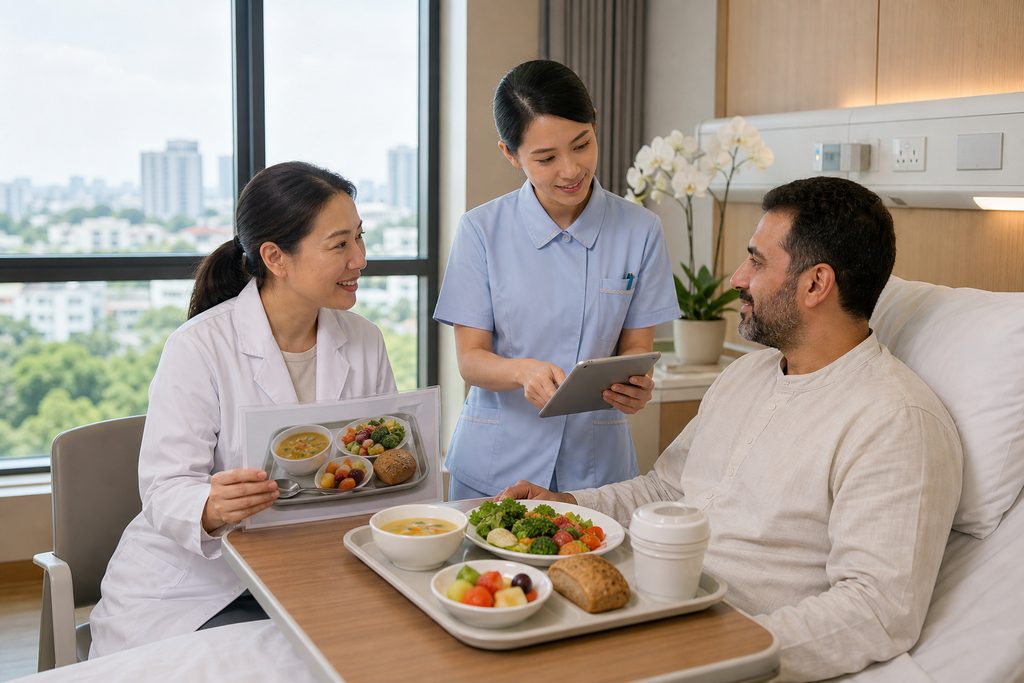
When 54-year-old Fatima from Dubai scheduled her knee replacement in Shanghai, her surgeon reviewed the implant options, the rehabilitation timeline, and the risks. Her real anxiety surfaced later, quietly, over a cup of tea. “But what will I eat for ten days?” She had heard stories. Hospital food in a foreign country can be a grim parade of broths you cannot name and meats you cannot verify. For international patients, dietary requirements are not a preference. They are a non-negotiable extension of faith, health, or medical necessity. And getting them wrong is not just unpleasant. It can derail recovery entirely.
The question of the halal meal hospital China price, or whether a public hospital can actually deliver a genuine vegetarian menu, is not a footnote to your treatment plan. It is a core logistics challenge. This article maps out exactly how diet coordination works inside Chinese hospitals, what you can expect to pay, and where the system delivers—and where it still falls short.
Key Takeaways
- Dietary coordination in China’s top-tier hospitals has improved significantly, with many international wards now offering halal-certified, vegetarian, and Western meal plans as structured add-ons to inpatient care.
- The real differentiator is not the menu itself but the coordination layer: a bilingual liaison who translates dietary restrictions into the hospital’s meal-ordering workflow before you are admitted.
- Outside of major international hospital wings in Beijing and Shanghai, genuinely halal-certified kitchens remain rare. Many facilities offer “Muslim-friendly” meals that require careful vetting.
- You should never assume your dietary needs will be understood on arrival. Written, translated dietary instructions submitted 72 hours before admission is the minimum standard that prevents errors.
The Problem: When a Hospital Tray Becomes a Barrier to Care
A 2023 survey by the Medical Tourism Association found that 41% of international patients cited food and dietary concerns as a top-three anxiety when considering treatment abroad. That ranks higher than language barriers. For Muslim patients, the concern is specific: halal certification in China is fragmented. There are over 20 halal-certifying bodies, and a hospital kitchen in Guangzhou may follow a different standard than one in Urumqi. For vegetarian patients, the challenge is conceptual. Chinese culinary culture does not always classify chicken broth or oyster sauce as breaking a vegetarian meal. A “vegetable dish” can arrive with minced pork.
Western patients face a different version of the same problem. Breakfast in a standard Chinese hospital ward is often rice porridge, a boiled egg, and pickled vegetables. Nutritious. Culturally appropriate for local patients. Utterly alien for someone recovering from spinal surgery who needs protein and familiar comfort food to regain their appetite. These are not luxury complaints. Post-operative nausea, medication interactions, and wound healing all tie directly to what a patient can or cannot eat. A patient who refuses meals for two days because nothing meets their dietary requirements is a patient with a compromised recovery curve.
Why China’s International Hospital Wards Have Transformed Dietary Coordination
The stereotype of Chinese hospital food as a one-size-fits-none tray of mystery meat and cold rice is about fifteen years out of date. Not everywhere. But in the 340+ top-ranked hospitals our team works with, the international and VIP wards have built dietary coordination into their patient intake process. The driving force is economic. International patients represent a growing revenue stream, and hospitals competing for medical travelers from the Middle East, Southeast Asia, and Russia have learned that a halal or Western meal plan is a baseline expectation, not a perk.
Halal Meal Hospital China Price: What You Actually Pay for Dietary Coordination
Let us address the specific search behind this article. The halal meal hospital China price is not typically a standalone line item on your hospital bill. In most international wards, meal plans are bundled into the room rate. A private room in a Shanghai international medical center runs $200 to $500 per night, and that rate includes three meals and two snacks. Halal, vegetarian, or Western menus are offered at no additional charge within that bundled rate. Where there is a separate cost, it is modest. Some hospitals charge an extra $10 to $15 per day for a specialized halal or Western meal plan sourced from an external certified kitchen. That is the ceiling. You are not looking at hundreds of dollars in hidden food costs.
What you are paying for, indirectly, is the coordination. A hospital that can reliably deliver halal meals has invested in one of two things: an in-house halal-certified kitchen with segregated prep areas and verified supply chains, or a contract with a third-party halal caterer that delivers to the ward. Both models exist in China. The second is more common outside of cities with large Muslim populations like Xi’an or Lanzhou. In Beijing and Shanghai, several JCI-accredited private hospitals now maintain dedicated halal pantries and employ Muslim kitchen staff. That infrastructure cost is absorbed into the room rate. It is not billed to you as a dietary surcharge.
Vegetarian Meals in Chinese Hospitals: The Translation Gap
Can you get vegetarian meals in Chinese hospitals? Yes. Can you get them without a fight? That depends entirely on how you define “vegetarian” and whether that definition has been translated into Mandarin before you check in. A standard hospital kitchen in China understands “vegetarian” as no visible chunks of meat. Fish sauce, chicken stock, and lard are often considered seasonings, not animal products. This is not deception. It is a culinary taxonomy difference. The Chinese term “素食” (sùshí) can mean a Buddhist vegetarian diet that excludes all animal products including eggs and alliums, or it can mean simply “vegetable-heavy.” You need to specify.
Our team provides patients with a translated dietary card that lists permitted and prohibited ingredients in Chinese characters. It specifies no animal fats, no meat-based broths, no oyster sauce, no gelatin. We submit this to the ward nutritionist 72 hours before admission. Hospitals with an international patient department take these cards seriously. They will often assign a bilingual nurse to review each meal tray before it reaches the room. This is not a guarantee of perfection. Mistakes happen. But it reduces the error rate from “nearly every meal” to “once or twice per stay, and corrected quickly.”
Hospital with Western Food for International Patients China: What the Menu Actually Looks Like
A hospital with Western food for international patients in China is not serving restaurant-quality cuisine. Set your expectations realistically. The Western menu in a top-tier international ward typically includes: grilled chicken breast or baked fish, steamed vegetables, mashed potatoes or rice, clear soups, toast, eggs, cereal, and fruit. It is simple, bland, and designed to be tolerable for a patient on pain medication with a suppressed appetite. Some private hospitals in Shanghai and Beijing have more ambitious kitchens. They offer pasta, sandwiches, salads, and even a daily special. But the baseline is clinical nutrition that looks and tastes familiar to a Western palate. That alone can be a profound comfort.
| Hospital Type | Halal Meals | Vegetarian Meals | Western Meals | Typical Daily Meal Cost |
|---|---|---|---|---|
| Public Hospital (Standard Ward) | Rarely available; may offer “Muslim-friendly” upon request | Limited; high risk of cross-contamination with meat broths | Not available | $5–$10 (bundled) |
| Public Hospital (International/VIP Ward) | Available with 72-hour notice; often sourced from external halal caterer | Available with translated dietary instructions; requires active coordination | Standard offering; simple grilled proteins, vegetables, soups | $15–$25 (bundled in room rate) |
| Private International Hospital (JCI-Accredited) | In-house halal kitchen or dedicated halal meal program; most reliable option | Well-understood; can accommodate vegan, lacto-ovo, and Buddhist vegetarian | Full Western menu with multiple daily options | $25–$50 (bundled in room rate) |
International Patient Diet Coordination Service Shanghai: How the Logistics Actually Work
Shanghai has the most developed international patient diet coordination service infrastructure in mainland China. The city is home to several JCI-accredited hospitals and the international divisions of major teaching hospitals like Huashan Hospital and Ruijin Hospital. These wards have seen thousands of patients from the Middle East, Europe, and North America. Their dietary workflows are battle-tested. Here is what the process looks like when it functions well.
Step one: dietary assessment. After you confirm your admission date, the hospital’s international patient coordinator sends you a dietary requirements form. This form asks about religious dietary laws, allergies, intolerances, and preferences. You return it with supporting documentation if needed—a halal certification requirement statement, a doctor’s letter for a medical diet, a list of prohibited foods.
Step two: translation and submission. A bilingual coordinator translates your requirements into a format the hospital kitchen can use. This is not a Google Translate job. It requires someone who understands both the clinical nutrition vocabulary and the cultural nuance. The phrase “no cross-contamination with pork products” needs to be rendered in a way that a Chinese kitchen worker understands as a procedural instruction, not a vague preference.
Step three: kitchen briefing. The ward nutritionist or head nurse briefs the kitchen team on your file. In hospitals with dedicated halal or international pantries, this step is routine. In hospitals that are less experienced, this is where the coordinator earns their fee. They physically walk the dietary card to the kitchen, speak with the shift supervisor, and confirm that the message has been received.
Step four: meal verification. At each meal service, a nurse or patient coordinator checks the tray against your dietary file before it enters your room. Errors are caught here. The most common error is a standard tray being sent by mistake because the kitchen reverted to autopilot. A good coordinator catches this before you see it.
This four-step process is what you are paying for when you book a hospital in China with a halal kitchen through a coordination service. The kitchen itself may be competent. The breakdown usually happens in steps two and three—the handoff between your dietary requirements and the person plating your food. That handoff is where a bilingual liaison changes the outcome.
Best Hospital for Muslim Patients in China: What to Look For Beyond the Menu
The best hospital for Muslim patients in China is not necessarily the one with the most extensive halal menu. It is the one with a demonstrated workflow for handling Muslim patients’ needs holistically. That includes prayer space, privacy considerations, and an understanding of how faith intersects with medical care. Several hospitals in China now offer prayer rooms or can arrange a quiet space for daily prayers. Some have partnered with local mosques or Islamic community centers to provide spiritual support during long hospital stays.
When evaluating a hospital, ask these specific questions. Does the hospital have a dedicated halal kitchen, or does it source halal meals from an external caterer? If external, what is the certifying body, and can they provide documentation? How are meal trays labeled to prevent mix-ups? Is there a point of contact on the ward who speaks Arabic, Urdu, or Bahasa, depending on your language needs? Has the hospital treated Muslim patients from your region before? The answers to these questions tell you more than a menu PDF ever will.
Geography matters too. Xi’an, a city with a centuries-old Muslim community, has hospitals that understand halal requirements intuitively. The same is true in parts of Yunnan and Ningxia. In Shanghai and Beijing, the understanding is more institutional than cultural, but the systems are often more rigorous precisely because they were built for international patients from the ground up. Neither is inherently better. You need to match the hospital’s experience to your specific needs.
Practical Considerations: Submitting Dietary Requirements That Actually Get Followed
You can request vegetarian meals, but the outcome is unpredictable. Standard wards serve meals designed for the local patient population, and the kitchen staff may not have training in cross-contamination or hidden animal products. If you are admitted to a standard ward, bring a translated dietary card and be prepared to supplement with your own food. For patients with strict dietary requirements, the international ward premium is often worth it for the dietary coordination alone.
Mistakes happen in any hospital system. If you receive an incorrect tray, do not eat it. Notify your nurse or patient coordinator immediately. In a well-coordinated ward, the error should be corrected within 30 minutes. Document the incident. If errors are repeated, request a meeting with the nursing supervisor and your patient coordinator to reset the kitchen workflow. A single error is a lapse. Repeated errors indicate a systemic failure in the handoff process, and that needs to be addressed at the management level.
Shanghai and Beijing have the most developed international patient infrastructure, including halal meal programs, prayer facilities, and multilingual staff. Xi’an has a deep cultural understanding of Islamic dietary requirements due to its large Muslim community. For complex medical procedures, we typically recommend matching the hospital’s clinical expertise to your condition first, then layering dietary coordination on top. A world-class cardiac surgeon in Shanghai with a well-managed halal meal program is a better outcome than a less experienced surgeon in a city with a more intuitive cultural understanding of halal food.
You cannot book a hospital bed directly as an international patient. The process works through the hospital’s international patient department or through a coordination service that has established relationships with those departments. You submit your medical records and dietary requirements. The coordinator confirms which hospitals can meet both your clinical and dietary needs, provides options with cost estimates, and handles the admission paperwork. Dietary requirements should be part of the initial intake conversation, not an afterthought after the bed is booked.
For patients and families navigating this process, the dietary question is never just about food. It is about dignity during a vulnerable time. It is about maintaining your identity and your values when you are in a foreign hospital bed, far from your own kitchen and your own community. The Chinese hospitals that understand this are the
Frequently Asked Questions
Yes. The hospitals used for international patients are JCI-accredited and follow the same international safety standards as top hospitals in the US and Europe. Surgical teams perform high volumes of procedures — often more than their Western counterparts — which studies show leads to better outcomes.
Costs vary by procedure and hospital, but international patients typically save 40-80% compared to US prices — even when factoring in travel and accommodation. A consultation with our team will give you an exact, all-inclusive quote with no hidden fees.
Send us your existing medical reports to get started. We handle everything from hospital selection and appointment scheduling to visa assistance and post-operative recovery planning. Your medical records are reviewed by the specialist before you even book a flight.
For more medical information and treatment options in China, visit chinamedservices.com (China Medical Services).
