5G Remote Telesurgery in China: Access, Safety, and Second Opinions for International Patients
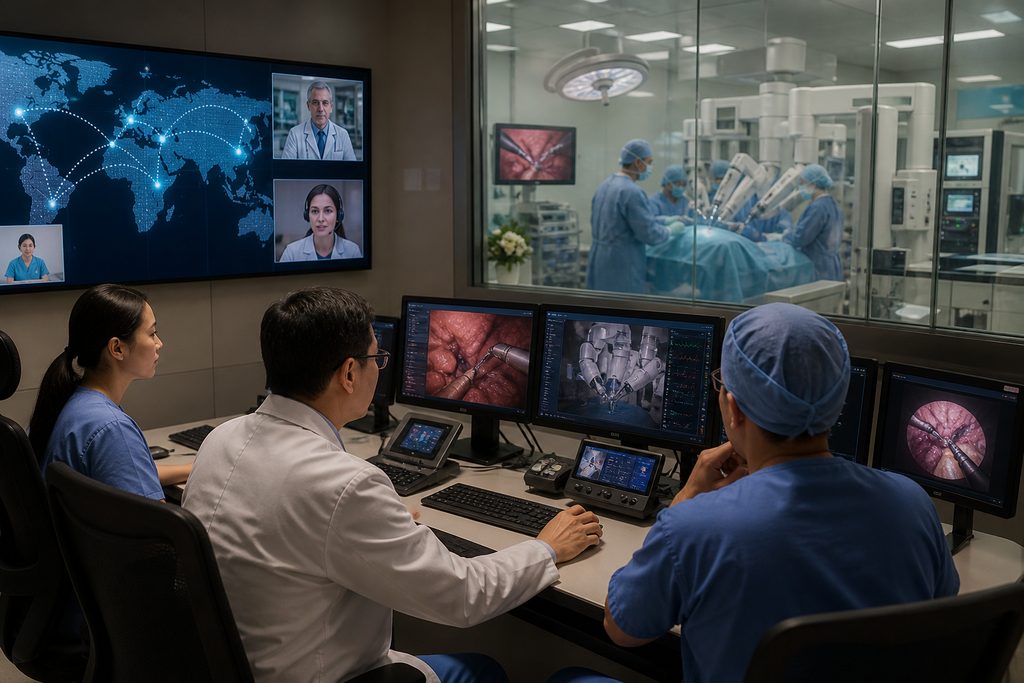
5G-Enabled Remote Telesurgery: The Short Answer
A surgeon in Beijing operating on a patient 3,000 kilometers away is no longer a concept. It is a documented clinical reality. The remote telesurgery cost in China is not a fixed menu price—it is a coordination fee layered onto a standard surgical bill. For international patients, the more immediate question is not “can they do it,” but “what is the actual pathway for someone outside China to access this capability.” The answer runs through a written second opinion first, not a direct booking portal.
We have watched the headlines pile up. A neurostimulator implanted via remote robotic surgery between Beijing and Sanya. A liver resection guided from a control console in Shanghai with the patient on a table in a distant province. These are real cases, published in peer-reviewed journals. But they were part of structured clinical trials and domestic hospital partnerships. They were not walk-in international cases. Understanding that gap is where a practical conversation begins.
Who This Is Right For — and Who It Isn’t
5G-enabled remote telesurgery in China is not a universal solution. It is a tool with a narrow, high-value application window. The technology currently serves patients who need a specific surgeon’s expertise but cannot physically travel to that surgeon’s city. For international patients, the logic shifts slightly. You are already traveling. The telesurgery component becomes relevant when the world’s highest-volume specialist for your condition practices in China, and you want that specific pair of hands guiding the robotic instruments.
Typically a good candidate:
- A patient with a complex, localized tumor where robotic precision demonstrably improves organ preservation.
- A patient who has been told locally that a procedure is inoperable and seeks a final expert review.
- A patient whose condition makes long-haul flight risky, and the remote component would allow pre-operative planning and expert oversight while a local surgical team executes.
- A patient who already knows the Chinese specialist they want and needs a structured channel to engage that team.
Not a good fit:
- Emergency or acute trauma cases. Remote telesurgery workflows require days of planning, network testing, and legal clearances.
- Patients seeking a bargain. The coordination, network redundancy, and dual-team staffing add cost layers that offset some of the baseline price advantage.
- Procedures where the evidence for robotic over laparoscopic benefit is thin. The technology is not the point. The outcome is.
- Anyone unwilling to start with a remote written second opinion. No responsible Chinese hospital will schedule a remote procedure without first reviewing your full imaging and history.
The Options, Compared
When international patients contact us about robotic surgery in China, they are usually weighing three distinct paths. Each has a different logistical footprint, price band, and timeline.
| Pathway | Surgeon Involvement | Estimated Coordination Cost (USD) | Typical Timeline | Key Limitation |
|---|---|---|---|---|
| Written Second Opinion | Top-tier specialist reviews records, provides written analysis | $300–500 | 5–10 business days | Advisory only; no direct surgeon-patient interaction |
| Video Consultation with Specialist | Live discussion with the surgical team | $500–800 | 1–3 weeks to schedule | Requires translated medical records in advance |
| In-Person Surgery (with robotic assistance) | Full hands-on procedure by the specialist | $800–1,200 coordination fee + hospital charges | 4–8 weeks from arrival to surgery | Requires S2 visa, pre-operative face-to-face consultation |
The table above covers coordination fees for international patient support. It does not include the hospital’s own surgical charges, which vary by institution, complexity, and length of stay. A robotic-assisted procedure at a top-tier public hospital in Shanghai typically runs $15,000–35,000 for complex abdominal surgery, compared to $80,000–150,000 for equivalent care in the United States. That gap narrows when you add the cost of a two-month stay, family accommodation, and flights. We lay this out because patients who budget only for the hospital bill end up stressed. Patients who budget for the whole episode do better.
Can International Patients Get 5G Surgery in China: The Real Pathway
The short answer is that remote telesurgery for international patients is not a commercial service you can book online. It exists inside research frameworks and hospital-to-hospital partnerships. What you can access now is the expertise behind those headlines. The same surgeons who perform remote procedures are the ones reviewing cases through the international departments of hospitals like our network of top-ranked institutions.
Here is how the sequence actually works. First, you send your existing diagnostic imaging and pathology reports. Our team translates them into clinical Chinese and routes them to the relevant department. The specialist reviews the material and issues a written opinion: is the case operable, what approach would they recommend, and would robotic assistance add meaningful value. That written second opinion costs from $300–500 and gives you a decision-making document, not a vague email.
If the opinion confirms surgical candidacy and you decide to proceed, the next step is a video consultation. You speak directly with the surgical team. They explain the technique, the recovery arc, and the risks. Only after that consultation do you begin the logistical work: S2 visa application, hospital pre-admission paperwork, and scheduling. The remote telesurgery cost China component—meaning the technology fee for 5G-enabled robotic platforms—gets bundled into the hospital’s surgical quote. It is not a separate line item you negotiate. It is infrastructure, like the anesthesia machine.
What about a true remote procedure, where the surgeon is in Shanghai and you are on a table in your home country? That requires a formal partnership between the Chinese hospital and a local institution. These agreements exist. We have seen them between Chinese university hospitals and centers in Southeast Asia and the Middle East. But they are negotiated government-to-government or institution-to-institution. A single patient cannot trigger one. If your local hospital has a sister relationship with a Chinese center, that is the channel. If not, you travel.
How Safe Is Remote Surgery Abroad: The Data So Far
Safety is the question that keeps people awake. A surgeon operating through a robotic console with a signal traveling across cellular networks—what happens if the connection drops? The answer is layered, and the Chinese clinical literature is transparent about both the safeguards and the failures.
China has published over 50 peer-reviewed studies on 5G-enabled telesurgery since 2019. The largest series, from the Chinese Journal of Minimally Invasive Surgery, reported a 0% conversion-to-open rate and no network-related adverse events across 38 remote procedures. But those procedures were conducted on dedicated 5G network slices with guaranteed bandwidth and latency below 20 milliseconds. The network was not public internet. It was a controlled medical-grade channel with redundant fiber backup.
The safety architecture works like this. The robotic system requires a continuous signal. If latency exceeds a preset threshold—typically 200 milliseconds—the console locks, and the robotic arms freeze in place. The on-site surgical team, which is always present, can then convert to a standard laparoscopic approach or stabilize the patient until the connection resumes. There is no scenario where the robot continues moving without the surgeon’s input. The fail-safe is mechanical, not aspirational.
For international patients, the risk profile shifts slightly. You are not dealing with network instability if you travel to China for surgery. You are dealing with the standard risks of any complex procedure performed away from home: post-operative follow-up, continuity of care once you return, and the challenge of explaining a complication to a local doctor who was not in the operating room. These are manageable risks. They are not unique to robotic surgery. But they are real, and they deserve planning.
Best Hospitals for Robotic Surgery in Shanghai
Shanghai concentrates more surgical robotics platforms than any other Chinese city. Three institutions dominate the clinical volume and the publication record for robotic-assisted procedures.
Zhongshan Hospital, affiliated with Fudan University, runs one of the highest-volume robotic general surgery programs globally. Their hepatobiliary team has published extensively on robotic liver resections, including the remote procedure cases that made international news. The hospital’s international department handles foreign patient intake and can arrange English-speaking coordination, though the surgeons themselves typically work through interpreters.
Ruijin Hospital, part of Shanghai Jiao Tong University’s medical school, operates a dedicated robotic surgery center with multiple da Vinci systems and a growing portfolio of domestically produced robotic platforms. Their pancreatic surgery team is particularly strong, and they have been early adopters of 5G-enabled remote proctoring—where an expert surgeon in Shanghai guides a less experienced team elsewhere through a complex case in real time. That proctoring model is more accessible to international patients than full remote surgery, because it does not require the patient to be in a partner hospital.
Changhai Hospital, the naval medical university’s flagship, has built a reputation for robotic urology and colorectal procedures. Their patient volume means shorter wait times for surgical slots, though their international patient infrastructure is less developed than Zhongshan or Ruijin.
For a broader look at institutions across specialties, our department-specific hospital rankings break down the top 10 hospitals for surgical oncology, orthopedics, and other procedure-heavy fields.
Remote Telesurgery Cost in China: What the Numbers Actually Include
The remote telesurgery cost China figure that patients ask about is almost never just the technology fee. It is the total cost of a surgical episode that happens to use a 5G-enabled robotic platform. We will break it down honestly because sticker shock on arrival helps no one.
A standard robotic-assisted complex abdominal surgery at a top Shanghai public hospital runs $18,000–30,000. That includes the surgeon’s fee, operating room time, robotic system consumables, anesthesia, and a 7–10 day inpatient stay. If the procedure uses a 5G remote setup—meaning the primary surgeon operates from a console in another building or city with a backup surgical team on-site—the hospital adds a network coordination charge of roughly $3,000–5,000. That covers the dedicated bandwidth, the redundant connection, the on-site backup surgeon’s time, and the pre-operative latency testing.
What is not included: pre-operative imaging if you need fresh scans, the initial consultation fees, the cost of translating your medical records, visa and travel expenses, accommodation for family, and post-discharge medications. A realistic all-in budget for an international patient traveling to Shanghai for robotic surgery starts at $35,000 and can reach $55,000 depending on the procedure and length of stay.
The comparison point matters. The same procedure in the United States, even at a high-volume center, routinely exceeds $100,000 in facility and professional fees alone. That delta of $45,000–65,000 covers a lot of flights, apartments, and bilingual support. But it requires you to be away from home for six to eight weeks. Some patients can do that. Some cannot. Neither answer is wrong.
Medical Tourism Packages for Robotic Surgery in Beijing
Beijing’s robotic surgery landscape differs from Shanghai’s in one important way: the concentration of national-level specialty centers. When patients search for medical tourism packages for robotic surgery in Beijing, they are often looking for bundled pricing that includes hospital, hotel, and interpreter services. The reality is more modular.
Peking Union Medical College Hospital operates the country’s highest-volume robotic urology program and has an established international medical service that handles foreign patients. They do not offer a “package” with a fixed price and a hotel booking. They offer a clinical pathway with a coordination office that can recommend nearby accommodation. The hospital’s coordination fee for international patients starts at $800–1,200, and the surgical quote is generated after the specialist reviews your case.
Beijing Friendship Hospital and Beijing Hospital have invested heavily in domestically manufactured robotic systems, which carry lower per-case consumable costs than imported da Vinci platforms. That can reduce the total surgical bill by 15–20%, though the domestic robots have a shorter published track record. The trade-off is real and worth discussing with the surgical team directly.
What a “package” actually looks like, in practice, is a sequence of services arranged by a coordinator: hospital selection and appointment scheduling, records translation, S2 visa documentation support, airport pickup, bilingual accompaniment for the first consultation and admission, and a point of contact throughout the stay. The coordination fee covers that labor and logistics. The hospital charges are separate and paid directly to the hospital. Anyone offering a single all-in price that includes surgery is either a hospital itself or is marking up the surgical component. Ask to see the breakdown. If they will not show it, walk away.
Practical Considerations: Records, Visas, and Follow-Up
The logistics of pursuing robotic surgery in China are not insurmountable, but they are specific. Getting them wrong costs time and, occasionally, the surgical window.
Medical records. Chinese surgical departments expect the following at minimum: contrast-enhanced CT or MRI within three months, pathology slides or reports, a summary of prior treatments including surgical notes if applicable, and a current medication list. Everything must be translated into Chinese by a medical translator—not a generalist. A mistranslated pathology term can derail a surgical assessment. Our team handles this translation as part of the coordination process because we have seen the consequences of machine translation in clinical documents.
Visa. The correct category for medical treatment in China is S2, with the purpose annotated as private affairs including medical treatment. The hospital provides an invitation letter confirming the appointment and treatment plan. The local Chinese embassy or consulate processes the application, typically within one to two weeks. S2 visas are issued for stays up to 180 days. If your treatment and recovery will exceed that, an S1 visa applies. Family members accompanying you also apply for S2. Do not let anyone tell you to apply for an M visa. M is for commercial and trade activities. Using it for medical treatment creates problems at the border and inside the hospital’s registration system.
Payment. Chinese public hospitals require a deposit before admission, typically 50–70% of the estimated surgical cost, paid via wire transfer or in person. International credit cards are accepted at international departments but not always at standard cashiers. Private international hospitals like United Family accept direct insurance billing. Public hospitals do not. You pay, then you claim reimbursement from your insurer. Get pre-authorization from your insurance company before you travel, and confirm in writing what they will cover for overseas robotic surgery.
Follow-up. This is the hardest piece. You will be discharged with a surgical summary in Chinese and, if you arrange it, an English translation. You will need a local surgeon back home who agrees in advance to manage post-operative care, including drain removal, wound checks, and any late complications. Find that surgeon before you book the flight. A Chinese hospital’s international department can provide a discharge summary and imaging on a USB drive. They cannot manage your recovery from 7,000 miles away.
Frequently Asked Questions
Yes, and that is the correct starting point. A written second opinion from a Chinese specialist costs $300–500 and requires your existing medical records and imaging. The specialist reviews the material and issues a written analysis with treatment recommendations. This document is for reference only—it is not a prescription and does not establish a doctor-patient relationship. But it tells you whether traveling for surgery is worth pursuing. Any coordination fee you pay for the second opinion is credited in full toward on-the-ground coordination if you proceed to surgery within 90 days.
The published Chinese data on 5G-enabled telesurgery, drawn from controlled clinical environments with dedicated network infrastructure, shows safety outcomes comparable to conventional robotic surgery. The key variable is not the distance between surgeon and patient. It is the quality of the network, the presence of a qualified on-site backup surgical team, and the rigor of the pre-operative latency testing. In a commercial international patient context, you are almost certainly traveling to the surgeon’s hospital, which removes the network variable entirely. The procedure becomes a standard robotic surgery with the expert at the console in the same building.
Every 5G-enabled telesurgery protocol in China requires a fully qualified surgical team scrubbed and present in the operating room with the patient. If the network fails, the robotic system locks, and the on-site team converts to an open or laparoscopic approach based on the pre-agreed contingency plan. The remote surgeon provides voice guidance. The patient is never alone with a frozen robot. This is not a theoretical safeguard. It is a condition of the hospital’s ethics committee approval for every telesurgery case.
Are medical tourism packages for robotic surgery in Beijing cheaper than in Shanghai?
Not necessarily cheaper, but sometimes structured differently. Beijing hospitals with domestically manufactured robotic systems can offer lower consumable costs per procedure, which may reduce
For more medical information and treatment options in China, visit chinamedservices.com (China Medical Services).
