Ankle Surgery and Fusion in China: How We Coordinate Your Procedure
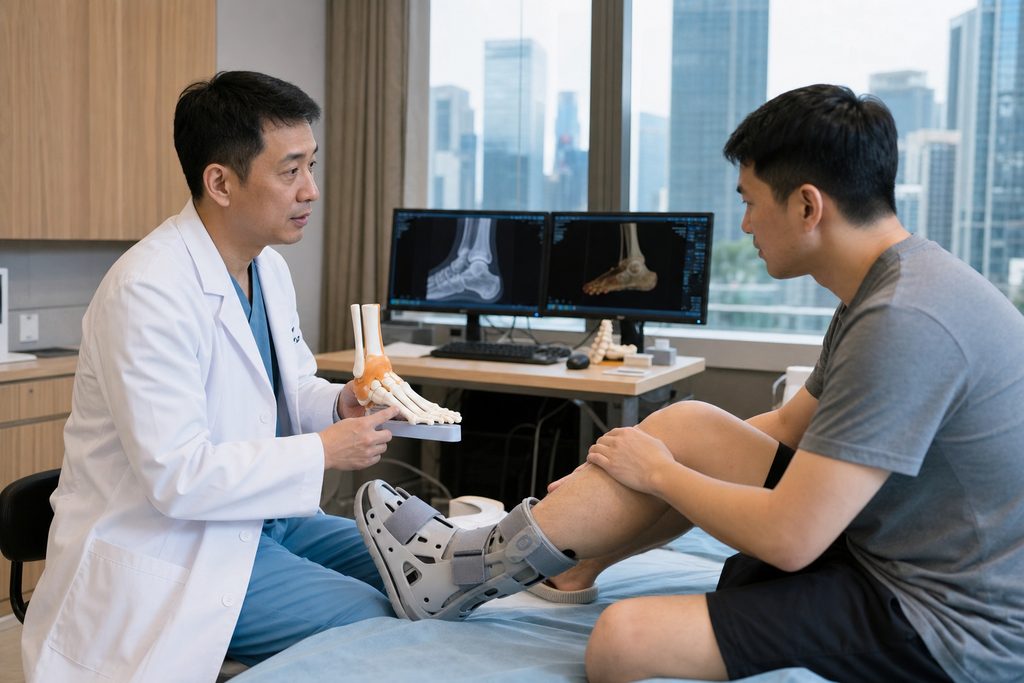
You have probably heard the warning. Surgery abroad means gambling with quality. The reality of modern Chinese orthopedics dismantles that assumption with hard data. The ankle fusion surgery cost in China is a fraction of what you would pay in the US or UK, but the clinical volumes and technology stacks are world-class. Our team does not perform surgery. We are the operational layer that connects you with the right surgical team and handles the logistics so you can focus on one thing: getting your mobility back.
Key Takeaways
- The ankle fusion surgery cost in China typically ranges from $8,000 to $15,000, compared to $40,000–$70,000 in the US, without sacrificing clinical quality.
- Top-tier Chinese orthopedic centers perform thousands of ankle procedures annually, generating a depth of subspecialty experience that few Western hospitals can match.
- Language barriers and hospital navigation are the real hurdles—not surgical competence. A bilingual coordinator transforms a disorienting experience into a smooth one.
- Ankle fusion is not always the right answer. A thorough remote evaluation can clarify whether fusion, replacement, or a different intervention best fits your case before you travel.
The Problem: The Real Cost of Waiting for Ankle Surgery
End-stage ankle arthritis does not pause for a waiting list. It grinds down cartilage until bone rubs on bone, making every step a negotiation with pain. In the UK, the NHS reports that routine orthopedic surgery waiting times have stretched past 18 months in some trusts. In Canada, the median wait for ankle surgery sits at nearly 8 months. In the US, the delay is not bureaucratic but financial. A self-pay patient can face a bill exceeding $50,000 for an ankle fusion, and even the insured can drown in deductibles and out-of-network surprises.
The damage accumulates. While you wait, your gait changes. The opposite knee and hip start to compensate. Muscles atrophy. What could have been a straightforward fusion becomes a more complex reconstruction. The ankle fusion surgery cost China offers is not just a price tag. For many, it is a way to interrupt that downward spiral before the collateral damage becomes irreversible.
Why China Delivers Results in Complex Ankle Surgery
China’s orthopedic infrastructure is not a budget alternative. It is a high-volume, high-specialization system built on a simple principle: surgeons who do one thing constantly get exceptionally good at it.
Clinical Volume Drives Better Outcomes
Volume is a blunt metric, but for ankle fusion, it matters enormously. A study published in The Journal of Bone and Joint Surgery found that surgeons performing more than 20 ankle fusions annually had significantly lower complication rates. At a major center like Shanghai Sixth People’s Hospital, foot and ankle surgeons routinely handle volumes that dwarf those thresholds. One department can perform more complex hindfoot reconstructions in a month than a typical US community hospital does in a year.
This is not anecdotal. The hospital’s orthopedic department is ranked among China’s top 10 for orthopedics by the Fudan University hospital ranking system. When you consult with a specialist there, you are tapping into a team that has seen the full spectrum of ankle pathology—post-traumatic arthritis, failed prior fusions, Charcot deformities, and revision cases that make a primary fusion look simple.
Technology and Efficiency at Scale
The imaging workflow tells the story. A patient can get a weight-bearing CT scan, have a 3D-printed model of their ankle joint generated for surgical planning, and review the preoperative plan with the surgeon—all within 48 hours. That kind of speed is not marketing. It is a structural consequence of hospitals that run imaging departments 24/7 and have in-house 3D printing labs.
Arthroscopic ankle fusion, which uses smaller incisions and typically leads to faster healing, is standard practice at these centers. The technique requires steep learning curves. Surgeons who do it weekly develop an intuitive command of the arthroscope that a surgeon doing it quarterly simply cannot match.
Cost Advantage Without Quality Compromise
Let us address the elephant in the room directly. How much does ankle surgery cost in Shanghai if the quality is this high? The total ankle fusion surgery cost China delivers—including hospital fees, surgeon fees, implant costs, and a standard inpatient stay—runs between $8,000 and $15,000. The same procedure in the US averages $40,000 to $70,000.
These numbers are not magic. They reflect structural economics. Chinese hospital systems operate at enormous scale, with lower per-unit costs for everything from surgical screws to sterilization. Surgeon compensation is not tied to a fee-for-service model that inflates every line item. The implants themselves—often the exact same FDA-approved or CE-marked hardware used in Western operating rooms—cost less because hospitals buy in massive bulk. Lower cost does not signal lower quality here. It signals a different economic model.
What the Procedure Actually Involves: A Step-by-Step Reality Check
Ankle fusion is not a minor procedure. It permanently eliminates motion at the tibiotalar joint to stop pain. Understanding what you are signing up for is essential.
The surgeon removes the remaining cartilage from the ends of the tibia, fibula, and talus. Then they position the bones in a functional, plantigrade position—foot flat, slightly externally rotated, neutral dorsiflexion. Large screws or a plate hold the bones together while they heal into a single solid unit. The surgery takes two to three hours. You stay in the hospital for three to seven days afterward. Full bone fusion takes 10 to 14 weeks. Weight-bearing is restricted for at least six to eight weeks. You will be in a cast or boot, then in physical therapy.
Motion at the ankle is gone. That is the trade-off. But the pain is gone too. And the adjacent joints—the subtalar joint and the midfoot—pick up enough compensatory motion that most patients walk without a noticeable limp once fully recovered.
Is Ankle Fusion in China Safe for Foreigners? The Hard Questions
You send us your imaging—X-rays, CT scans, MRI if available—and your medical history. We have it translated and reviewed by a foot and ankle specialist at a top-ranked orthopedic center. The specialist provides a written second opinion: is ankle fusion the right procedure, or would you be better served by a total ankle replacement or a supramalleolar osteotomy? This written second opinion costs from $300 to $500 and takes about five to seven business days. If you later proceed with surgery through our coordination, that fee is credited in full toward the coordination service.
This step alone has saved patients from unnecessary surgery. One patient arrived with imaging suggesting end-stage arthritis. The Chinese specialist identified a subtle subtalar coalition that had been missed—a condition requiring a different surgical approach entirely.
Hospital and Surgeon Matching
If fusion is confirmed as the right path, we match you with a hospital and surgical team. The best ankle surgeon for international patients in China is not a single name. It depends on your specific pathology. A surgeon who excels at arthroscopic fusion may not be the right choice for a complex post-traumatic deformity requiring an open approach with bone grafting. We match based on subspecialty, not brand recognition.
Our hospital network spans 340+ top-ranked hospitals across 37 cities. For ankle surgery, we frequently coordinate with centers in Shanghai, Beijing, and Guangzhou—cities where the orthopedic departments have dedicated foot and ankle divisions with fellowship-trained surgeons.
Logistics and On-the-Ground Support
Once you choose a hospital and a surgical date is confirmed, we handle the operational layer. We guide you through the S2 visa application, providing the invitation letter and hospital documentation you need. We arrange airport pickup. A bilingual medical companion meets you at the hospital on day one and stays with you through admission, preoperative testing, surgery day, and discharge.
That companion is not a translator alone. They navigate the physical hospital—a sprawling campus where the CT department might be in Building 3, the lab in Building 1, and the inpatient tower a ten-minute walk away. They manage the payment queue, the pharmacy pickup, the discharge paperwork. They make sure you understand your postoperative instructions and that your questions get answered before you leave.
For patients who want to book ankle fusion surgery abroad as a coordinated package rather than piece together flights, hotels, hospital appointments, and recovery accommodations alone, this integrated approach removes the friction that makes medical travel exhausting.
Practical Considerations: Documents, Payments, and Recovery
You need current imaging (weight-bearing X-rays and CT of the ankle, dated within three months), a summary of prior treatments and surgeries, a medication list, and basic blood work. Have everything translated into Chinese or plan for us to handle the translation. The S2 visa is the correct category for medical treatment; expect the application to take two to four weeks depending on your local Chinese embassy or consulate.
Hospitals require prepayment. A deposit covering the estimated surgical cost is due upon admission. Credit cards work at international departments, but notify your bank in advance—large foreign transactions often trigger fraud alerts. Travel insurance typically does not cover elective surgery abroad. Some international health insurance plans do, but you must confirm coverage and preauthorization before booking anything. Reimbursement is between you and your insurer; the hospital provides the itemized receipts and medical records you will need.
Medical tourism China ankle replacement recovery timelines apply similarly to fusion: plan to stay in China for at least three to four weeks post-surgery. The surgeon will want to see you for a wound check and stitch removal around week two, and a follow-up X-ray before you fly home. Flying with a cast increases deep vein thrombosis risk—your surgeon will advise on blood thinners and in-flight mobility. You will need a wheelchair at the airport and an aisle seat with legroom. Book a follow-up with an orthopedic surgeon in your home country before you leave, so someone is lined up to take over your care when you return.
Frequently Asked Questions
How do I know if I need ankle fusion or ankle replacement?
Fusion is typically better for younger, heavier, or more active patients with isolated ankle arthritis. Replacement preserves motion but has a higher long-term failure rate and is usually reserved for older, lower-demand patients. A written second opinion from a specialist who has reviewed your actual imaging is the only reliable way to make that call.
What if the fusion fails or I get an infection?
Nonunion occurs in roughly 5% to 10% of ankle fusions regardless of where the surgery is performed. Top Chinese centers manage this with revision surgery, bone grafting, or electrical bone stimulation. Infection is rare but treated aggressively with debridement and antibiotics. The surgeon will explain their specific complication protocols before you consent. We recommend staying in China until the initial wound is healed and the first follow-up X-ray confirms proper alignment.
Can I bring a family member, and will they be accommodated?
Yes. Family members apply for their own S2 visa as your companion. Many international hospital wards offer private rooms with a sofa bed or cot for a family member. Your bilingual companion can also assist your family member with practical needs—pharmacy runs, food ordering, navigating the area around the hospital.
How much does ankle surgery cost in Shanghai compared to other Chinese cities?
Shanghai prices sit at the higher end of the range, typically $10,000 to $15,000 for an ankle fusion at a top public hospital’s international department. Beijing is comparable. Guangzhou and Chengdu tend to be slightly lower, in the $8,000 to $12,000 range. These figures cover the hospital and surgical fees only; travel, accommodation, and our coordination services are separate.
Your Next Step
You now have a clear picture of the ankle fusion surgery cost in China, the clinical reality behind it, and the coordination layer that makes it accessible. Our team is not a hospital. We do not diagnose or treat. We are the operational bridge—matching you with the right surgical team, managing the logistics, and ensuring you are never alone in a system where you do not speak the language. If you are ready to explore whether ankle surgery in China is the right move for you, the next step is a free consultation. We will review your case, answer your specific questions, and outline what a coordinated pathway would look like—no pressure, no commitment, just clarity.
For more medical information and treatment options in China, visit chinamedservices.com (China Medical Services).
