Your TCM Treatment at Hubei Provincial Hospital Wuhan: How We Arrange It
Key Takeaways
- Hubei Provincial TCM Hospital integrates diagnostics like MRI with classical therapies, a model that treats over 2 million outpatients annually.
- An international patient pathway sidesteps the standard chaotic挂号 queue, coordinating directly with specialist departments for a structured treatment block.
- Language is the single biggest barrier—without a native-speaking interpreter familiar with TCM terminology, the clinical nuance of a tongue-and-pulse diagnosis simply evaporates.
- Treatment packages are built around your specific chronic condition, not a one-size-fits-all tourist menu; a genuine internal medicine consultation drives every prescription.
The Problem: Chronic Pain Doesn’t Wait for a Passport
Living with persistent lower back pain or recalcitrant migraines grinds down more than just your body. The Global Burden of Disease Study identifies low back pain as the leading cause of disability worldwide, affecting approximately 619 million people. When conventional pharmaceuticals offer only partial relief and the side effects mount, the search for a different model becomes urgent. You are not looking for a spa weekend. You are looking for a medically rigorous system that takes your MRI seriously but reads your pulse with equal weight. That search often dead-ends. Western TCM clinics can feel fragmented—acupuncture here, an herbalist there—rarely housed under one roof with full diagnostic imaging and a unified treatment plan.
Flying to China for care solves the fragmentation but introduces a new layer of friction. You face a hospital where the outpatient hall sees thousands of patients before noon. The registration system is entirely in Mandarin. The specialist you read about in a research paper does not take walk-in international appointments. You need a bridge between the clinical depth of a top-tier Chinese institution and the logistical reality of navigating it as a foreigner.
Why Hubei Provincial TCM Hospital Delivers a Different Standard of Care
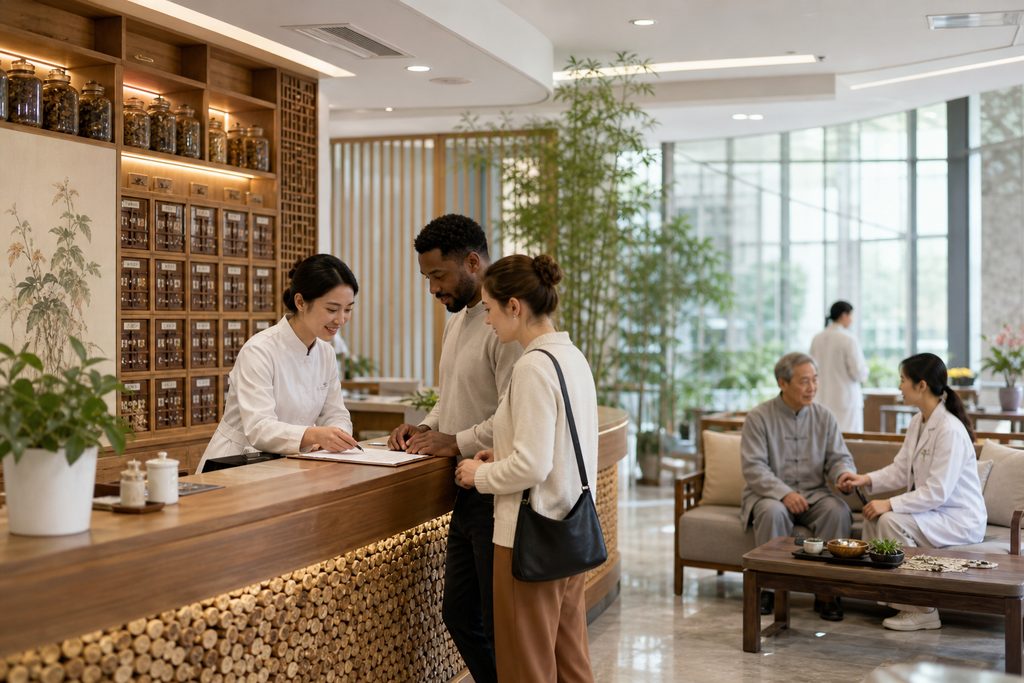
This is not a small private clinic. Hubei Provincial TCM Hospital in Wuhan is a Grade-A tertiary hospital, a teaching base, and a national TCM clinical research center. It runs over 2,000 inpatient beds and more than 80 specialized outpatient clinics. When we connect you here, you are stepping into a system where acupuncture, tuina, herbal decoctions, moxibustion, and modern diagnostics operate as a single, integrated workflow.
Integration That Western TCM Clinics Rarely Achieve
In most cities outside China, an acupuncturist sends you to a separate lab for blood work. Here, the same attending physician who prescribes your customized herbal formula can order a 3.0T MRI, a CT scan, or a full metabolic panel on the same floor. The radiology report is read alongside your tongue coating color and pulse quality. That dual-diagnostic lens matters. A 2023 review in the Journal of Pain Research noted that combining TCM pattern differentiation with conventional imaging leads to more precise treatment stratification for chronic spinal conditions. This is the hospital’s standard operating procedure, not an experimental protocol.
The Volume of Clinical Experience
Scale translates directly into pattern recognition. The acupuncture and tuina departments here handle a patient volume that dwarfs any private practice abroad. A senior tuina therapist in this hospital may treat 40 to 60 patients in a single day, five days a week. That repetition forges a tactile diagnostic skill—feeling muscle fiber adhesions, fascial restrictions, joint micro-misalignments—that simply cannot be acquired through occasional treatments. For conditions like cervical spondylosis or lumbar disc herniation, this accumulated hands-on experience often identifies the precise biomechanical trigger faster than a textbook protocol would suggest.
Cost Structure Without the Layers of Markup
Let’s address the obvious question directly: the TCM treatment cost Hubei Provincial Hospital Wuhan reflects a fundamentally different economic model. A comprehensive session—physician consultation, acupuncture, and a week’s supply of custom-granulated herbs—typically runs between $60 and $120 USD. A targeted tuina session by a senior therapist costs between $30 and $50. Compare this to a major US city where acupuncture alone bills at $100 to $250 per session, and herbal prescriptions are an additional out-of-pocket expense. The differential is not about lower quality. It is about a hospital-based system that operates on high patient throughput, state-subsidized infrastructure, and a pharmaceutical model where the hospital pharmacy dispenses directly without a chain of third-party markups.
How We Structure a Treatment Block: From Inquiry to Recovery
The standard international patient pathway here is not a single appointment. It is a concentrated treatment block, typically 7 to 14 days, designed to compress what might take months of weekly visits abroad into a coherent, daily therapeutic rhythm. Here is what that looks like in practice.
Before you book a flight, we need your diagnostic records. A complete file includes recent imaging reports (MRI or CT, not just the CDs—the written radiology reports), a summary of your current medications, and a detailed symptom timeline. Our team translates these documents into medical-grade Chinese. We do not paraphrase. We ensure the specific terminology—disc protrusion versus extrusion, damp-heat versus qi stagnation—is rendered precisely. This file goes to the department director’s office for a preliminary review. The review answers one question: is your condition within the hospital’s demonstrated scope of effective treatment? If yes, we proceed to scheduling.
We coordinate a start date with the specific specialty department—not the general outpatient pool. Your first morning in Wuhan, you walk into the hospital with a bilingual medical companion. There is no standing in the registration queue. Your hospital card is pre-created. You go directly to the specialist’s examination room. The consultation is unhurried, often lasting 30 to 45 minutes. The physician takes your full history, examines your tongue coating, palpates your radial pulse on both wrists, and correlates these findings with your imaging. A treatment plan emerges: daily acupuncture, tuina every other day, a custom herbal decoction prepared by the hospital pharmacy, and possibly adjunctive therapies like cupping or moxibustion.
The next ten days follow a rhythm. Morning treatment sessions. Afternoons for rest, gentle walking, and letting the herbal formula do its work. Your companion is present for every clinical interaction, translating not just words but clinical intent—explaining why the acupuncturist chose GB30 over BL23 today, what the change in your tongue coating signifies, how to adjust your diet to support the herbal formula. At the end of the block, the physician provides a discharge summary and a maintenance plan: a herbal prescription you can fill through our pharmacy partners back home, a tapering schedule for self-acupressure, and clear criteria for when a follow-up visit would be warranted.
Who This Approach Works For—And Who It Doesn’t
This model is not for everyone. We say that plainly because mismatched expectations lead to poor outcomes.
The patients who benefit most are those with chronic, functional conditions where conventional medicine has plateaued. Persistent musculoskeletal pain—failed back surgery syndrome, fibromyalgia, chronic tension headaches—responds well to the daily, multi-modal intensity of a treatment block. Functional gastrointestinal disorders like IBS, where the gut-brain axis plays a central role, also show strong responsiveness. A 2022 meta-analysis in Phytomedicine found that individualized Chinese herbal formulas, when prescribed based on pattern differentiation rather than disease label alone, achieved significantly higher response rates for IBS than standardized herbal preparations. This hospital’s gastroenterology department applies that exact principle.
This is not a suitable pathway for acute medical emergencies, active oncological treatment requiring chemotherapy or radiation, or conditions where a delay in surgical intervention would be dangerous. If you need a hip replacement, go to an orthopedic surgeon. If you have chronic hip bursitis that hasn’t resolved after two cortisone injections, this TCM block may be exactly what you need. The distinction matters.
Also, be honest about your tolerance for intensity. Daily acupuncture is not a gentle spa experience. Therapeutic tuina can be deep and temporarily uncomfortable. The herbal decoctions are often bitter. You are not coming here for a relaxing retreat. You are coming for a concentrated medical intervention. Patients who understand that distinction report the highest satisfaction.
| Condition Category | Typical Treatment Block Duration | Estimated Block Cost Range (USD) | Expected Outcome |
|---|---|---|---|
| Chronic Low Back Pain (Discogenic) | 10–14 days | $1,200–$2,500 | Significant pain reduction, improved mobility; maintenance plan provided |
| Migraine / Tension Headache | 7–10 days | $900–$1,800 | Reduced frequency and intensity; trigger identification through pattern diagnosis |
| Functional GI Disorders (IBS, Functional Dyspepsia) | 14 days | $1,500–$3,000 | Symptom regulation; personalized dietary and herbal protocol |
| Insomnia / Anxiety-Related Disorders | 10–14 days | $1,200–$2,500 | Improved sleep latency and quality; ear seed protocol for self-care |
The cost ranges above include all physician consultations, daily treatments, and custom herbal prescriptions dispensed during the treatment block. They do not include airfare, accommodation, or visa fees. The final TCM treatment cost Hubei Provincial Hospital Wuhan for your specific case will be quoted after the department reviews your records and confirms the treatment protocol.
Practical Considerations: Visas, Payments, and What to Bring
Let’s get into the concrete logistics. These details are unglamorous but they determine whether your trip runs smoothly or becomes a bureaucratic headache.
Your visa category is S2, designated for short-term private affairs including medical treatment. The hospital provides an official invitation letter and a treatment confirmation document that you submit with your application. Processing times at your local Chinese embassy or consulate typically run 4 to 7 business days, though we recommend applying at least three weeks before your intended travel date. Do not apply for an M visa. M is for commercial trade activities and will be rejected if your stated purpose is medical treatment.
Payment at the hospital operates on a pre-deposit system. You load funds onto your hospital card at the cashier window, and services are deducted as they are rendered. The hospital accepts UnionPay cards, WeChat Pay, Alipay, and cash in RMB. International credit cards are not reliably accepted at the hospital’s own payment terminals. Our team can facilitate the deposit process and provide a clear accounting of every charge. At discharge, any unused balance is refunded to you.
Insurance reimbursement depends entirely on your policy. Hubei Provincial TCM Hospital provides itemized receipts and a stamped medical record summary suitable for submission to international insurers. We cannot guarantee that your insurer will reimburse TCM treatments, but we ensure you leave with documentation that meets the standard requirements for out-of-network claims. Check your policy’s language on “complementary and alternative medicine” before you commit.
What to bring: your passport, all original imaging discs and printed reports, a list of all current medications with generic names, and any previous TCM records if you have seen a practitioner at home. Wear loose, comfortable clothing. You will be lying on treatment tables and exposing your back and limbs for acupuncture and tuina. Leave jewelry at your accommodation on treatment days.
Frequently Asked Questions
No. The hospital’s protocol requires a full TCM internal medicine assessment before any treatment begins. The physician must establish a pattern diagnosis—identifying whether your back pain stems from kidney deficiency, qi stagnation and blood stasis, or invasion of cold-dampness—before selecting acupoints or writing an herbal formula. Skipping this step would reduce the treatment to symptomatic poking, which is not how this hospital practices medicine. The consultation is the engine of the entire treatment plan.
You could physically walk into the hospital, but you would not receive the same quality of care. The clinical dialogue in a TCM consultation is dense and specific. A physician will ask about your sleep quality, your bowel movements, your thermal preferences, the exact quality of your pain—aching versus stabbing versus distending. These distinctions map directly onto different herbal formulas. A generic translation app cannot capture this. Our bilingual medical companions are trained in TCM terminology and ensure that your subjective experience is accurately conveyed to the physician, and that the physician’s clinical reasoning is explained back to you.
Hubei Provincial TCM Hospital operates its own GMP-certified (Good Manufacturing Practice) pharmacy and herbal processing facility. Raw herbs are sourced through audited supply chains and tested for heavy metals, pesticide residues, and microbial contamination. Granulated herbal extracts are produced under pharmaceutical-grade quality control. This is not a street-market herb stall. The hospital’s pharmacy is subject to the same regulatory oversight as any conventional hospital pharmacy in China. If you have specific concerns about a particular herb, the attending physician can review the safety data with you during your consultation.
Some conditions exhibit a temporary “treatment reaction”—a brief intensification of symptoms as the body responds to acupuncture or deep tuina. The attending physician monitors this daily. If the reaction is outside normal parameters, the treatment protocol is adjusted immediately: acupoint selection changes, tuina pressure is reduced, or the herbal formula is modified. You are seen by a physician every day, not left to an independent therapist. If a serious adverse event occurs, the hospital has full emergency department capabilities and can order immediate imaging or laboratory tests.
Your Next Step
A treatment block at a top-tier TCM hospital is a serious medical undertaking, not a casual wellness trip. The patients who benefit most are those with clear diagnostic records, realistic expectations, and chronic conditions that have not fully responded to conventional care alone. Our team handles the logistics—document translation, department coordination, bilingual accompaniment—so that you can focus entirely on your treatment and recovery. We are not a hospital and we do not provide medical advice or diagnoses. If you want to know whether your specific condition is a good fit for this pathway, send us your records for a preliminary review. We will give you a candid assessment, not a sales pitch.
For more medical information and treatment options in China, visit chinamedservices.com (China Medical Services).
