Men’s Health Screening in China: Complete Panels for Foreign Patients
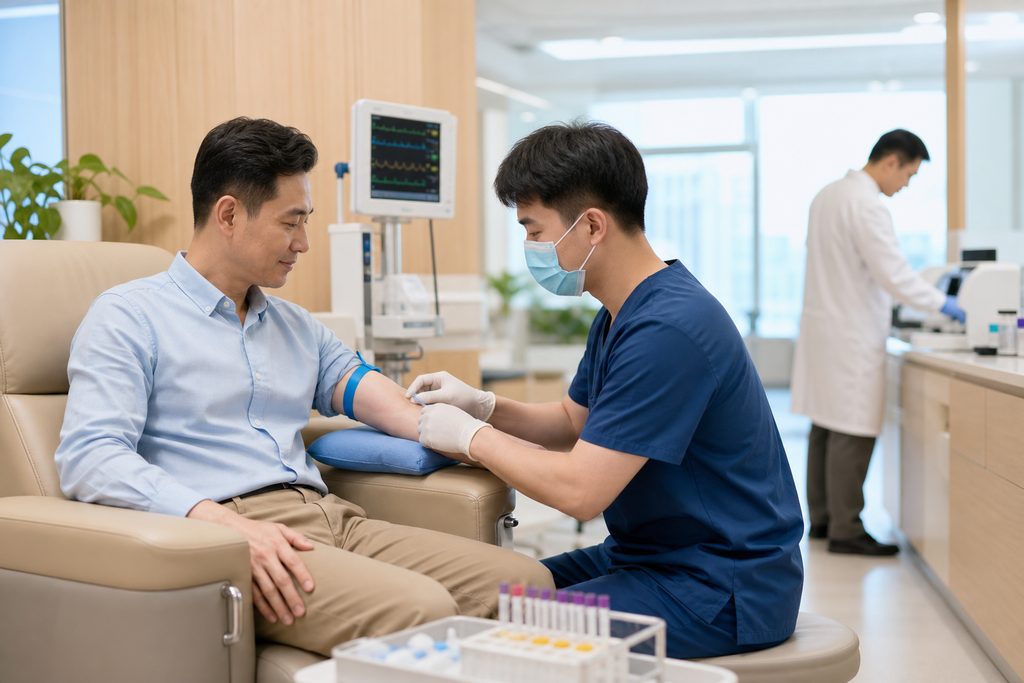
You have probably heard that getting comprehensive medical tests abroad means navigating chaos, language barriers, and questionable standards. That image dissolves fast when you walk into a Chinese international hospital at 7:45 AM, are greeted by English-speaking staff, and have your blood drawn before most clinics in London or Los Angeles have even opened their doors. The reality of elite-tier medical screening in China bears almost no resemblance to the outdated clichés.
The real question is not whether the quality exists. It is whether you can access it without getting lost in the system. A full men’s health screening package in China — covering prostate cancer markers, testosterone levels, and a cardiac panel — costs roughly $300 to $800 at a private international hospital. That is one-third to one-half of what you would pay out of pocket at a private clinic in the United States or United Kingdom. But the price tag alone is not the story. The speed, the technology, and the sheer clinical volume are what make this worth a serious look.
Key Takeaways
- A complete men’s health screening package in China — covering PSA, testosterone, and cardiac markers — typically costs between $300 and $800, compared to $1,200–$2,500 at private clinics in the US or UK.
- China’s top international hospitals run JCI-accredited labs with same-day or next-day results for most blood panels, eliminating the multi-week wait times common in Western public systems.
- Language remains the single biggest barrier — public hospital labs process thousands of patients daily with zero English support, making a bilingual medical companion essential for anyone without Mandarin fluency.
- You cannot simply walk into a top-tier Chinese hospital and get screened. Prior coordination through the hospital’s international department or VIP channel is required, and walk-in appointments at public hospitals are not available to overseas patients.
The Problem: Men Are Avoiding Screenings They Desperately Need
Men are terrible at preventive health. That is not a stereotype — it is epidemiology. According to the US Centers for Disease Control and Prevention, men are 33% less likely than women to have visited a doctor within the past year. The American Heart Association reports that approximately 1 in 3 adult men has some form of cardiovascular disease, yet many do not discover it until a cardiac event occurs. Prostate cancer remains the second most common cancer in men worldwide, with the World Health Organization estimating over 1.4 million new cases diagnosed globally in 2020.
The reasons are not mysterious. Cost is a real obstacle. A comprehensive executive health screening at a major US hospital — the kind that includes a cardiac stress test, full hormone panel, and advanced cancer markers — can easily exceed $3,000 without insurance. Even with coverage, deductibles and copays make men hesitate. Wait times add another layer of friction. In Canada and the UK, non-urgent cardiology referrals can take months. By the time the appointment arrives, the motivation has evaporated.
So men postpone. And postpone. And the numbers that could have been caught early become emergencies.
This is where the structural advantage of China’s healthcare system becomes relevant. Not because it is flawless — it has real friction points we will address honestly — but because it solves the speed and cost equation in a way that Western systems structurally cannot.
Who We Are
We are not a hospital. We do not provide medical treatment, interpret lab results, or offer clinical diagnoses of any kind. Our team at China Medical Services functions as your logistical architects — we bridge the gap between you and China’s top-tier medical institutions. We handle hospital matching, appointment coordination, bilingual medical companions, and visa guidance. Our database covers over 340 top-ranked hospitals across 37 cities, representing the top 5% of China’s 35,000-plus medical institutions. We exist because navigating this system alone is genuinely difficult. We make it straightforward.
What a Men’s Health Screening Package in China Actually Covers
When international patients search for “men’s health screening package China price,” they are usually thinking about three core areas: prostate cancer screening, hormone assessment, and heart health. Most international hospitals in Beijing, Shanghai, and Guangzhou offer modular packages that let you combine these into a single morning visit.
Prostate Cancer Screening: The PSA Test and Beyond
The prostate-specific antigen test remains the frontline screening tool for prostate cancer. In China’s international hospitals, a PSA test is typically bundled with a digital rectal exam and, for men over 50 or those with elevated risk, a multiparametric MRI if the PSA comes back above 4 ng/mL.
What surprises many Western patients is the speed. At a JCI-accredited facility like Shanghai’s Jiahui International Hospital or Beijing’s United Family Hospital, blood is drawn and results are often returned the same afternoon. Compare this to the UK, where NHS patients can wait two to three weeks for PSA results. The technology is identical — chemiluminescent immunoassay analyzers from Roche or Abbott, the same machines running in top labs in Germany or the US. The difference is throughput and administrative efficiency.
A standalone PSA test at a private international hospital in China costs roughly $60 to $120. When packaged into a broader men’s health screening package China price bundle, it often comes in lower.
Testosterone Level Check: Shanghai and Beijing Options for Foreigners
A testosterone level check Shanghai foreigner search typically leads patients to one of three pathways. The first is a private international hospital, where total and free testosterone are measured via morning blood draw, with results in 24 hours. The second is a public hospital VIP international department — cheaper but requiring more coordination. The third is a direct-to-consumer lab service, which exists in major cities but offers zero clinical interpretation.
Testosterone testing matters for more than libido. Low testosterone correlates with increased cardiovascular risk, reduced bone density, and metabolic syndrome. The Endocrine Society guidelines recommend testing for men with persistent fatigue, unexplained anemia, or loss of muscle mass. Yet in many Western systems, getting a testosterone panel approved by a primary care physician can feel like negotiating a treaty.
In China, you simply request it. A total and free testosterone panel at an international hospital runs $80 to $150. No gatekeeping. No six-week wait for an endocrinology referral.
Cardiac Panel: Heart Screening China for Expats
A cardiac panel heart screening China for expats typically includes high-sensitivity C-reactive protein, lipid profile, lipoprotein(a), fasting glucose, HbA1c, and often a resting electrocardiogram. More comprehensive executive packages add a stress ECG or CT coronary calcium score.
The coronary calcium score is where Chinese hospitals hold a genuine edge. A CT calcium score at a top Shanghai hospital costs approximately $200 to $400 and can often be scheduled within the same week. The same scan at a US hospital frequently runs $800 to $1,200, with scheduling delays stretching weeks. The machine is the same — a 64-slice or 128-slice CT scanner from Siemens or GE. The cost differential comes from labor, administrative overhead, and the structural inefficiencies baked into Western hospital billing.
A combined cardiac panel with ECG and calcium scoring at a Chinese international hospital lands between $300 and $600. That is not cheap in absolute terms. But it is dramatically less than the $1,500 to $3,000 price range common in the US private sector.
How to Get a Full Men’s Health Checkup in China: The Process
Understanding how to get full men’s health checkup in China requires unlearning the walk-in assumptions that work in your home country. China’s top hospitals do not operate on a walk-in basis for international patients. Here is the actual workflow.
First, you identify the right hospital. Public hospital international departments offer access to senior physicians at lower prices but have limited English-speaking administrative staff. Private international hospitals provide full English service and direct insurance billing but cost more. Our hospital database breaks this down by city and specialty.
Second, you coordinate the appointment. This means contacting the hospital’s international patient center — not the general outpatient hotline, which will be entirely in Mandarin. The international center confirms availability, sends a pre-visit questionnaire, and instructs you on preparation. Fasting requirements vary by panel. Some cardiac markers require 12-hour fasting. Testosterone must be drawn before 10 AM for accurate results.
Third, you arrive with your passport and medical history. The hospital registers you, processes payment upfront, and escorts you through the screening stations. At a well-run international hospital, the entire process — blood draw, ECG, CT, and physician consultation — takes three to four hours.
Fourth, you receive results. Most labs return within 24 hours. A follow-up consultation with a physician reviews findings and recommends next steps. If an abnormality is flagged, the hospital can schedule specialist referrals, often within days rather than weeks.
What You Need to Know Before Going Alone
The system works. But only if you respect its constraints. Here is what trips up independent travelers.
- Visa Requirements: Medical treatment in China requires an S2 visa with a note specifying the medical purpose. This is not a tourist visa. You need an invitation letter from the Chinese hospital confirming your appointment. Applying without this letter will result in rejection. Family members accompanying you also need S2 visas. An M visa is strictly for commercial business and has nothing to do with medical treatment — do not let anyone tell you otherwise.
- Payment Systems: Chinese hospitals operate on a prepayment model. You pay before services are rendered. International hospitals accept Visa and Mastercard. Public hospitals — even their international departments — may only accept UnionPay or WeChat Pay. Walking in with a foreign credit card and no local payment method is a recipe for a very frustrating morning.
- Language and Navigation: A public hospital in China can see over 10,000 outpatients in a single day. Signage is predominantly in Chinese. Queues form, numbers are called in rapid Mandarin, and departments are spread across massive campuses. Without a bilingual medical companion, you will lose hours simply finding the right building. This is not an exaggeration — it is the daily reality of Chinese public healthcare.
How We Help You Navigate This
These barriers exist for structural reasons, not because anyone is trying to make your life difficult. Chinese hospitals were built to serve a domestic population of 1.4 billion people. The international patient pathway is a bolt-on adaptation, not the core design. Our job is to make that adaptation seamless.
Before you travel, we match your screening needs to the right hospital. A patient wanting a best international hospital Beijing men’s health experience will get different recommendations than someone prioritizing cost over English-language service. We coordinate the appointment, confirm the exact panel components and pricing, and arrange the hospital invitation letter for your S2 visa application. Our hospital appointment coordination starts from $300, with a full refund if the specified appointment cannot be secured.
During your visit, a bilingual medical companion meets you at the hospital entrance. They handle registration, payment processing, queue management, and translation during your physician consultation. This is not a luxury add-on — for anyone without Mandarin fluency, it is the difference between a two-hour smooth screening and an all-day ordeal. Our companion service starts from $200 per day.
After your screening, we help you understand the logistical next steps. If follow-up is needed, we coordinate specialist referrals. If everything is normal, you leave with a comprehensive report and peace of mind. Any coordination fees you pay are credited in full toward future on-the-ground services within 90 days.
We also offer remote pre-screening consultations. A video consultation with a physician at a top international hospital costs $100 to $300 and lets you discuss which panels are appropriate before you even book a flight. This is not a medical consultation in the diagnostic sense — it is a triage conversation to ensure you are not flying across the world for tests you do not need.
Frequently Asked Questions
At JCI-accredited international hospitals, yes. These facilities use the same Roche, Abbott, and Siemens diagnostic platforms found in top US and European labs. They participate in international proficiency testing programs. The College of American Pathologists accredits several Chinese hospital labs. The technology is not the variable — the variable is whether you are at an accredited facility or a low-tier local lab. We only work with the former.
Most Western insurance plans do not cover elective screening abroad. Some premium international plans — such as those from Cigna Global, Allianz, or Bupa — may offer partial reimbursement for services at JCI-accredited hospitals. Private international hospitals in China can often bill these insurers directly. Public hospital international departments typically cannot. You pay upfront and submit a claim. Always verify coverage with your insurer before traveling. Do not assume anything.
This is the question that matters most. If a PSA comes back elevated or a cardiac calcium score indicates significant plaque burden, the hospital will recommend follow-up. Because you are already in the system, specialist referrals happen fast — often within days. The same urologist who would review your elevated PSA can perform a biopsy if clinically indicated. The same cardiologist can order a stress echocardiogram. You are not sent back to your home country to start over from scratch. That continuity is one of the underappreciated advantages of doing comprehensive screening in a single integrated system.
For a standard men’s health panel — blood work, ECG, and basic imaging — you need one full day. Results are typically available within 24 hours, and a follow-up consultation can be scheduled the next day. Plan for three days minimum: arrival and rest, screening day, and results consultation. If you add a stress test or colonoscopy, add one to two more days. Do not schedule your screening for the day after a long-haul flight. Jet lag and dehydration can skew certain markers, particularly cortisol and glucose.
Your Next Step
A men’s health screening package in China does not replace your relationship with your primary care physician at home. It is a tactical tool — a way to get comprehensive, high-quality baseline data quickly and at a fraction of Western private-pay prices. The labs are world-class. The speed is exceptional. The cost is transparent. The friction points are real but entirely manageable with proper coordination.
If you want to understand exactly what a package would cost for your specific panel and which hospital makes sense for your situation, reach out for a free consultation. No pressure. No commitment. Just a clear, honest conversation about what is possible.
For more medical information and treatment options in China, visit chinamedservices.com (China Medical Services).
