Eye Examination Package in China: Full Vision Screening with Retina OCT for International Patients
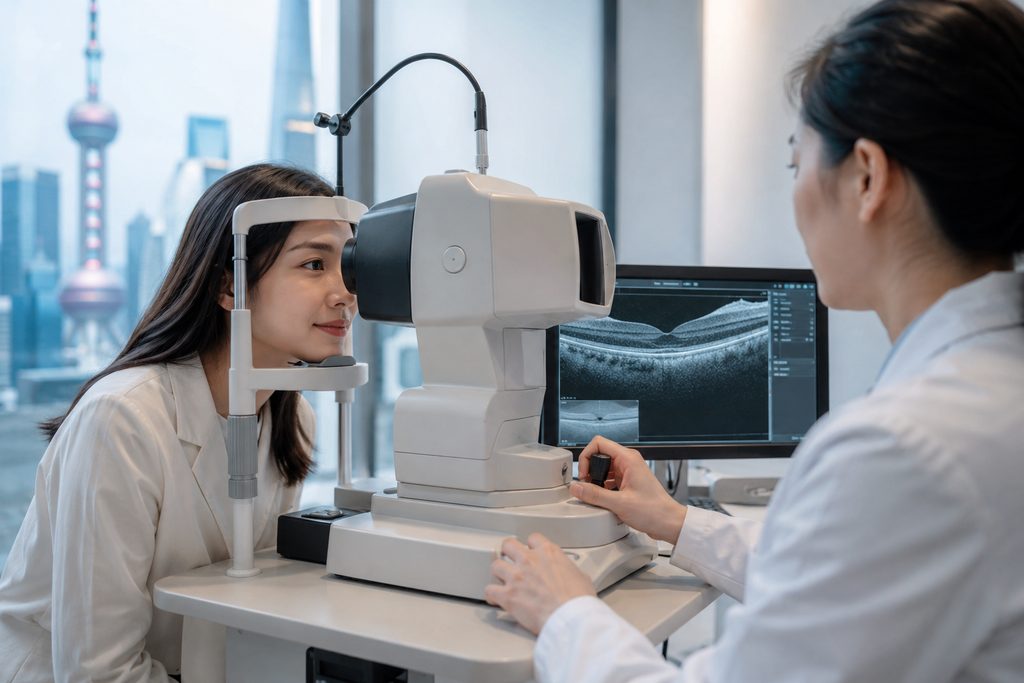
Key Takeaways
- A comprehensive eye examination package in China, including retina OCT, typically ranges from $150 to $500 — a fraction of the $800 to $1,500 you might pay in the US or UK for equivalent private screening.
- China’s top ophthalmology centers, such as those in Shanghai and Beijing, perform thousands of retinal scans monthly, giving their specialists a diagnostic volume that is hard to match in smaller Western clinics.
- Navigating a public hospital independently without Mandarin fluency is the single biggest barrier for foreign patients — registration kiosks, queue numbers, and test results are almost exclusively in Chinese characters.
- Before booking any medical travel, understand that a retina OCT scan is a diagnostic tool, not a treatment plan; you will need a qualified ophthalmologist to interpret the results and recommend next steps.
The Problem: Why a Standard Eye Checkup at Home Often Falls Short
An estimated 1 in 8 adults globally will develop some form of retinal disease in their lifetime, yet many standard vision screenings never look past the surface. You walk into a high-street optometrist. They check your prescription. You can still read the bottom line of the chart. They send you home. But a refractive test does not image the layers of your retina. It cannot spot early macular holes, diabetic retinopathy, or subclinical fluid accumulation that shows zero symptoms until central vision starts to blur. By then, irreversible damage may already be underway.
In countries like the United States and Australia, getting a retina OCT scan as part of a routine checkup often requires a referral, a specialist co-pay, and a wait that stretches for weeks. For uninsured or underinsured patients, the out-of-pocket cost for a comprehensive screening with OCT imaging can easily cross $1,200. That price tag makes people postpone the scan. They gamble. Some lose.
Who We Are
We are not a hospital. We do not provide medical treatment or clinical diagnoses. We are your logistical architects — we bridge the gap between you and China’s top-tier ophthalmology departments. Our team handles the opaque parts: identifying which hospital has the latest spectral-domain OCT machines, translating your medical history into Chinese before you arrive, and placing a bilingual coordinator beside you from the moment you walk through the hospital doors. We work with over 340 top-ranked hospitals across 37 cities, but our value is not the database — it is knowing which specific retina specialist in which specific facility is best suited to your case.
Why an Eye Examination Package in China Delivers More for Less
Diagnostic Volume That Sharpens Clinical Judgment
Zhongshan Ophthalmic Center in Guangzhou, one of the largest eye hospitals in the world, handles over 1.2 million outpatient visits annually. The retina department alone reads more OCT scans in a single week than many Western teaching hospitals read in a month. This is not about bragging rights. It is about pattern recognition. A retina specialist who examines 80 OCT scans a day has seen rare presentations — occult macular dystrophy, plaquenil toxicity, early choroidal neovascularization — enough times that the subtle signs jump off the screen. When you book a comprehensive vision screening for international patients in China, you are not just paying for machine time. You are paying for a reader whose eyes are calibrated by relentless volume.
Technology Deployment at Scale
Walk into a top-tier ophthalmology department in Shanghai, Beijing, or Chengdu, and you will find the same spectral-domain OCT and swept-source OCT machines used at Moorfields or Bascom Palmer — Heidelberg Spectralis, Zeiss Cirrus, Topcon Triton. The difference is deployment density. A single large Chinese eye hospital may run 15 to 20 OCT machines simultaneously, with dedicated technicians who perform nothing but retinal imaging all day. This eliminates the bottleneck. In many Western settings, the OCT device is a shared resource across multiple subspecialties, and booking a slot means competing with glaucoma, cornea, and neuro-ophthalmology patients. In China, the retina screening workflow is a dedicated assembly line built for throughput without sacrificing image quality.
Cost Structure That Makes Sense
The eye examination package cost China offers international patients reflects structural economics, not quality shortcuts. Labor costs for ophthalmic technicians and nursing staff are lower. Hospital infrastructure, while modern, was built at lower capital expenditure per square meter. And the sheer patient volume allows fixed costs — the OCT machine, the reading software license, the climate-controlled imaging room — to be amortized over thousands of scans per month rather than hundreds. The result: a full comprehensive vision screening for international patients China, including autorefraction, tonometry, slit-lamp examination, dilated fundus exam, and retina OCT of both eyes, typically ranges from $150 to $500 depending on the hospital tier and whether you choose the public international medical department or a private facility. In London, a private OCT scan alone can cost £250. In New York, the same single test can run $400. You get the full package here for roughly the price of one scan back home.
| Screening Component | Estimated Cost (China, International Dept.) | Estimated Cost (US, Private Clinic) |
|---|---|---|
| Comprehensive Eye Exam (refraction, slit-lamp, tonometry) | $50 – $120 | $200 – $350 |
| Retina OCT (both eyes, macular + optic nerve) | $80 – $200 | $300 – $500 |
| Dilated Fundus Examination | $20 – $60 | $80 – $150 |
| Full Package (all above, interpreted by retina specialist) | $150 – $500 | $800 – $1,500 |
All prices are approximate and vary by hospital and case complexity. Figures are in USD.
How Much Is a Full Eye Checkup in Beijing vs. Shanghai?
Patients often ask us to compare the two cities head-to-head. The answer depends on the type of facility you choose.
In Beijing, the international medical department at Peking Union Medical College Hospital (PUMCH) offers a full ophthalmology workup with retina OCT. For a self-paying international patient, the package typically lands between $350 and $500. The advantage here is direct access to a multidisciplinary hospital — if your OCT reveals hypertensive retinopathy, you can be referred to a cardiologist on the same campus within hours. The retina OCT scan price Shanghai tends to run slightly lower, especially at private international hospitals like Jiahui or United Family, where a full screening package with OCT often falls in the $250 to $400 range. These facilities are built for the international patient experience: English-speaking front desk staff, direct insurance billing, and appointment scheduling that does not require a local phone number. But you trade some of the sheer diagnostic firepower of a PUMCH or a Fudan-affiliated center.
If your goal is to book eye exam medical tourism China with the highest clinical density, Guangzhou’s Zhongshan Ophthalmic Center deserves a serious look. Its international department is smaller and less polished than Shanghai’s private hospitals, but the retina specialists reading your OCT are among the most experienced in the world. The package cost is comparable — roughly $200 to $400 — but you must book through the hospital’s official international patient channel, which is where our team steps in.
What You Need to Know Before Going Alone
The clinical value is real. So are the friction points. We believe in naming them plainly because a patient who arrives unprepared is a patient who leaves frustrated — or worse, with incomplete results.
- Language Barrier at Registration: Public hospital registration kiosks and queue systems operate entirely in Chinese. Even at hospitals with an “international department,” the ground-floor imaging center where OCT scans are performed often uses Chinese-language PACS software. The technician may understand basic English medical terms, but explaining that you need a macula-focused scan with enhanced depth imaging requires a translator who knows ophthalmic terminology in both languages.
- Payment and Refund Systems: Most public hospital international departments require upfront payment via WeChat Pay, Alipay, or UnionPay bank card. International credit cards are sometimes accepted at the international billing counter, but not always — and almost never at the ground-floor cashier. If you walk in with only a Visa card, you may find yourself unable to pay for the OCT scan after waiting two hours in the queue.
- Result Interpretation and Follow-Up: The OCT machine generates a report with automated measurements — retinal nerve fiber layer thickness, ganglion cell complex, macular volume. But the automated printout is not a diagnosis. You need a retina specialist to read the raw B-scans, correlate them with your fundus exam, and write a clinical interpretation. If you fly home with just a PDF of the OCT report, your local optometrist may not have the expertise to interpret the findings. We make sure you leave with a signed, translated clinical summary from the attending ophthalmologist.
How We Help You Navigate This
These barriers exist for structural reasons, not malice. Chinese public hospitals were designed to serve a domestic patient population of 1.4 billion people. The international patient pathway was bolted on later. Our job is to make that pathway feel like it was built for you.
Before you travel, we match your clinical needs — whether that is a baseline retina OCT for myopia monitoring, a diabetic retinopathy screen, or a macular degeneration rule-out — with the right hospital. We translate your ocular history, current medications, and specific concerns into a Chinese-language summary that the ophthalmologist reviews before you arrive. This is not a generic form. It is a clinical handover document.
On the day of your examination, a bilingual medical companion meets you at the hospital entrance. They handle registration, payment processing, and queue management. During the OCT scan, they stand beside the technician to ensure the correct scan protocols are selected — macular cube, optic disc circle scan, anterior segment OCT if needed. After the imaging, they accompany you into the retina specialist’s consultation room and provide real-time interpretation. You ask questions. The doctor answers. Nothing gets lost in translation.
After the visit, you receive a full digital package: the raw OCT images, the automated measurement report, and a clinical interpretation letter in English signed by the attending ophthalmologist. If the screening identifies a condition that requires treatment — a retinal tear, wet macular degeneration, significant diabetic edema — we can coordinate a follow-up consultation with a retinal surgeon, often within the same week.
Frequently Asked Questions
Yes. Unlike many Western systems that require a GP or optometrist referral for specialist imaging, most Chinese hospital international departments accept self-referred patients for diagnostic screening. You do not need a referral letter to book a retina OCT. However, if you have prior OCT scans, fundus photos, or visual field tests from your home country, bringing those on a USB drive or as printed reports gives the retina specialist valuable baseline data for comparison.
The hardware is the same. A Heidelberg Spectralis OCT in Shanghai produces images with identical resolution to a Heidelberg Spectralis in Boston. The price difference comes from lower operational overhead, not from using outdated or lower-resolution equipment. That said, the quality of the interpretation depends on the specialist reading the scan. This is why we direct patients toward hospitals with dedicated retina services, where the ophthalmologist reading your OCT is a fellowship-trained medical retina specialist — not a general optometrist who reads OCTs occasionally.
If the screening identifies a condition requiring urgent intervention — a macula-on retinal detachment, for example — the retina specialist can typically arrange surgical admission within days. For non-urgent findings, such as early dry macular degeneration or mild diabetic retinopathy, you receive a detailed management plan that you can take back to your eye care provider at home. We do not pressure patients into treatment decisions. We provide the diagnostic clarity and let you decide where and when to pursue care.
For a short diagnostic trip lasting less than 180 days, you will need an S2 visa with the purpose of visit noted as medical treatment. Your accompanying family member applies for the same S2 visa category. The hospital’s international department can issue an invitation letter and a treatment appointment confirmation, which you submit with your visa application. Our team guides you through the documentation requirements and ensures the hospital letter contains the specific details that Chinese visa offices expect — diagnosis purpose, appointment date, hospital stamp, and official contact information.
Your Next Step
A retina OCT scan takes about 10 minutes per eye. The images it produces can reveal the earliest signs of disease that, left undetected, could steal your central vision over the next decade. The eye examination package cost China offers makes this screening accessible to patients who would otherwise skip it due to price. If you want to know exactly what is happening at the back of your eye — not guesswork, not a chart on the wall, but high-resolution cross-sections of every retinal layer — we can make it happen. Reach out for a free consultation, and we will map out the hospital, the costs, and the timeline. No pressure. Just clarity.
Learn more about how we coordinate your medical journey — from hospital selection to bilingual support on the day of your screening.
For more medical information and treatment options in China, visit chinamedservices.com (China Medical Services).
