Vietnamese Patients Guide to Cross-Border Medical Care in China: Border Crossing and Hospital Booking
Key Takeaways
- China’s top-tier hospitals deliver outcomes comparable to Western centers at 70-80% lower cost, with cardiac surgery often priced at $12,000-20,000 versus $120,000+ in the US.
- Vietnamese patients can cross into Guangxi or Yunnan by land, but booking a public hospital directly from Hanoi or Ho Chi Minh City without a Chinese ID or local phone number remains nearly impossible.
- Without a bilingual coordinator, you face a real risk of misdiagnosis from communication errors, getting lost in hospitals that see 10,000+ outpatients daily, or paying inflated “foreigner” prices.
- The cheapest hospital in China for Vietnamese patients is rarely the best choice—understand why matching your condition to the right department matters more than finding the lowest sticker price.
The Problem: Medical Care at Home Comes with Brutal Wait Times and Rising Costs
Vietnam’s public hospitals in Hanoi and Ho Chi Minh City handle patient loads that frequently exceed bed capacity by 130% to 150% in major tertiary centers. A 2023 Ministry of Health report noted that patients in oncology and cardiology departments routinely wait 4 to 8 weeks for non-emergency surgeries. For families facing a serious diagnosis, that gap feels like an eternity. And when treatment finally begins, the out-of-pocket costs—even within the public system—can wipe out a year’s savings. Private hospitals in Vietnam offer faster access but at price points that push many families toward medical tourism.
That reality pushes thousands of Vietnamese patients north each year. Not to Singapore or Bangkok, where private hospital bills still run $15,000 to $40,000 for major procedures. They look to China. Specifically, to hospitals in Nanning, Guangzhou, and Shanghai that sit a short flight or a single-day bus ride away. The question is not whether Chinese hospitals can handle complex cases. They can. The question is whether a Vietnamese family can navigate the border, the booking system, and the language barrier without burning time and money they do not have.
Who We Are
We are not a hospital. We do not provide medical treatment, prescribe medication, or make clinical diagnoses. Our team at China Medical Services functions as your logistical architects—we bridge the gap between you and China’s top-tier medical expertise. We maintain verified relationships with over 340 top-ranked hospitals across 37 cities, and we handle the practical barriers that stop most international patients before they ever see a doctor: visa documentation, hospital selection based on real outcome data, appointment coordination through official international departments, and bilingual medical companions who stay with you through every consultation and payment counter.
Why Cross-Border Medical Care in China Delivers Results for Vietnamese Patients
Clinical Volume That Vietnamese Hospitals Cannot Match
Scale changes everything in surgery. A cardiac surgeon at Fuwai Hospital in Beijing performs over 200 bypass procedures annually. A top orthopedic surgeon in Shanghai completes 300 to 500 joint replacements each year. Compare that to the busiest public hospital in Ho Chi Minh City, where a senior surgeon might perform 80 to 120 major procedures annually. The evidence is clear: higher procedural volume correlates directly with lower complication rates and shorter recovery times. China’s top 5% of hospitals—the ones ranked by Fudan University’s hospital classification system—operate at a scale that simply does not exist anywhere else in Asia. That volume advantage matters most when you are facing a complex cardiac condition, a spinal surgery, or a cancer protocol that demands precise, high-volume expertise.
The Real Cost Difference: What Vietnamese Families Actually Pay
Let us address the search that brought many of you here. You typed “cheapest hospital in China for Vietnamese patients” because cost is your primary filter. We understand that instinct. But the cheapest option is rarely the safest option, and in Chinese healthcare, price variation reflects real differences in surgeon seniority, nursing ratios, and post-operative monitoring. A basic public hospital in Nanning might quote $3,000 for a gallbladder surgery. A Fudan-ranked hospital in Guangzhou might quote $6,000 for the same procedure. The difference is not a markup. It pays for a surgeon who has done that procedure 1,000 times, an anesthesiology team that handles high-risk patients daily, and a recovery ward with lower infection rates.
Here is what cross-border medical care costs in practice for Vietnamese patients traveling to China:
| Procedure | China Public Hospital (International Dept) | Vietnam Private Hospital | Singapore Private Hospital |
|---|---|---|---|
| Cardiac Bypass Surgery | $12,000 – $20,000 | $8,000 – $15,000 | $35,000 – $55,000 |
| Knee Replacement (Single) | $10,000 – $16,000 | $6,000 – $12,000 | $22,000 – $35,000 |
| Spinal Fusion (2 Levels) | $15,000 – $25,000 | $10,000 – $18,000 | $40,000 – $65,000 |
| Cataract Surgery (Both Eyes) | $2,500 – $4,500 | $1,800 – $3,500 | $8,000 – $12,000 |
| Comprehensive Health Screening | $300 – $800 | $150 – $400 | $1,200 – $3,000 |
All prices in USD. Ranges reflect hospital tier and case complexity. Actual quotes vary by hospital and case complexity.
Notice something important. Vietnam’s private sector is often cheaper than China’s international departments. So why cross the border? Because for complex conditions—cardiac, neurological, oncological—China’s top hospitals offer diagnostic precision and surgical volume that Vietnam’s system cannot yet replicate. You are not paying for a cheaper surgery. You are paying for a surgery you cannot get at home, at a price far below Singapore or South Korea.
How to Cross the Border for Medical Treatment in China: The Route Vietnamese Patients Actually Take
Geography works in your favor. From Hanoi, you can reach Nanning by bus or train in under 8 hours. The Youyi Guan border crossing at Pingxiang processes thousands of Vietnamese travelers daily. From Ho Chi Minh City, a direct flight to Guangzhou takes just over 3 hours. Shanghai, Beijing, and Chengdu are all reachable within a single day of travel.
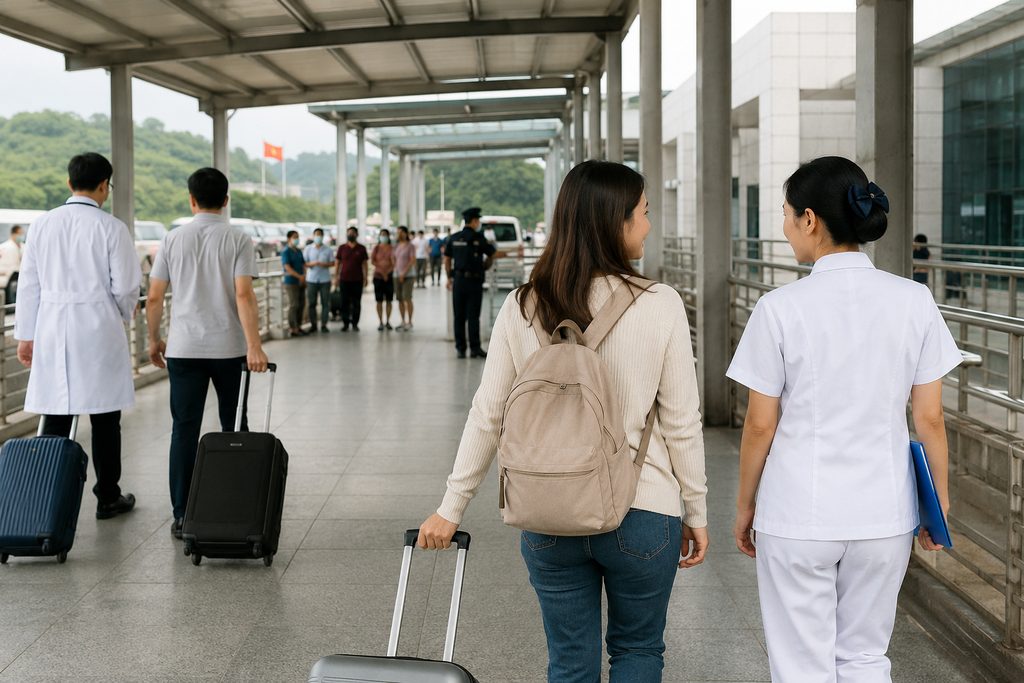
But the border crossing itself demands preparation. Chinese immigration officers at land borders in Guangxi see a high volume of Vietnamese nationals crossing for trade and short-term visits. When you present yourself as a medical traveler, you need documentation that matches your stated purpose. That means an S2 visa with a clear annotation for medical treatment, not a tourist visa that could get you turned back at the checkpoint. We have seen families arrive at the Pingxiang border with a hospital name scribbled on a piece of paper and no appointment confirmation. They spend hours in secondary inspection. Some get through. Some do not.
The smarter path: secure your hospital booking first, receive an official invitation letter from the hospital’s international department, and present that document at the border alongside your S2 visa. Immigration officers process medical travelers with legitimate documentation quickly and respectfully. Without it, you are just another uncertain case in a long queue.
Can Vietnamese Patients Book a Hospital in China Directly?
The short answer: technically yes. The practical answer: almost never without help.
Here is what happens when you try to book a Chinese public hospital directly from Vietnam. You call the hospital’s general switchboard. The operator speaks Mandarin. You navigate an automated menu. If you reach a human, they direct you to the outpatient registration desk, which only accepts in-person registration with a Chinese ID card or passport—and only for appointments within the next 7 days. There is no international hotline. There is no English or Vietnamese-language booking portal. There is no mechanism to reserve a specific surgeon or a surgery slot before you physically arrive and complete a face-to-face consultation.
This is not discrimination. It is how the Chinese public hospital system works for everyone, including Chinese citizens. The public outpatient system operates on a first-come, first-served basis for initial consultations. Surgery scheduling happens only after an in-person evaluation. The system simply was not designed for international patients who need to plan travel weeks or months in advance.
So how do foreign patients actually book? Through the hospital’s official international department or VIP channel. These departments exist specifically to handle cross-border cases. They employ English-speaking coordinators. They schedule appointments around your travel dates. They assign senior specialists who are accustomed to treating international patients. And they charge approximately 1.5 to 2 times the standard public rate—which still lands far below private hospital prices in Bangkok or Singapore.
This is where the question “can Vietnamese patients book hospital in China directly” meets reality. You can bypass the international department and try the public queue. You will save money on the coordination fee. But you will spend days navigating registration counters in Mandarin, waiting in lines that start forming at 5 AM, and hoping the doctor assigned to you has availability for surgery within your travel window. For a family traveling from Vietnam on a fixed timeline, that gamble rarely pays off.
Medical Tourism Packages China from Vietnam: What Is Actually Included
Search for “medical tourism packages China from Vietnam” and you will find a mix of legitimate facilitators and opaque middlemen. Some packages bundle airfare, hotel, hospital fees, and a translator into a single price. Others are little more than a hospital name and a marked-up consultation fee. Before you commit to any package, understand exactly what you are buying.
A legitimate China hospital booking for foreign patients should include at minimum: a pre-travel medical records review by the receiving hospital department, a confirmed appointment with a named specialist or department, visa support documentation, and a clear breakdown of estimated treatment costs versus service coordination fees. Anything less, and you are paying for hope rather than a plan.
We structure our coordination differently. We do not sell packages. We start with your medical records, match your case to the right hospital and department based on real outcome data—not marketing relationships—and then build a logistics plan around your specific timeline and budget. The hospital charges you directly for treatment. Our coordination fee is separate and transparent. And any consultation fee you pay is fully credited toward on-the-ground coordination if you proceed with treatment within 90 days. That means a $500 video consultation with a top specialist is not a sunk cost. It is a down payment on the real work of getting you into the operating room.
What You Need to Know Before Going Alone
We have guided enough Vietnamese families through this process to know exactly where independent attempts break down. The barriers are not insurmountable. But they are real.
- Visa Requirements: Medical treatment in China requires an S2 visa with a specific annotation for medical purposes. Tourist visas do not cover hospital admissions. M visas are for commercial trade only and have nothing to do with medical travel. Your accompanying family members also need S2 visas. The application requires an invitation letter from the Chinese hospital—something you cannot obtain without a confirmed booking. This creates a chicken-and-egg problem that stops many patients before they start.
- Payment Systems: Chinese public hospitals require upfront payment before admission. WeChat Pay and Alipay dominate, and international credit cards are often declined at hospital payment counters. Vietnamese bank cards linked to the NAPAS network do not work in most Chinese hospitals. You need a workable payment method on day one, or you will be stuck at the billing counter while your appointment window closes.
- Language and Navigation: A top-tier Chinese hospital sees 10,000 to 15,000 outpatient visits daily. Signage in Vietnamese does not exist. English signage is inconsistent outside of international departments. Registration kiosks operate in Mandarin. Pharmacy queues move fast and announcements are audio-only. Without someone who reads Chinese, speaks Mandarin, and knows the hospital layout, you will miss appointments, misunderstand medication instructions, and waste days on simple administrative tasks.
How We Help You Navigate This
These barriers exist for structural reasons, not because anyone wants to exclude Vietnamese patients. The Chinese hospital system evolved to serve a domestic population of 1.4 billion people. International patients were an afterthought. Our entire organization exists to bridge that gap.
Before you travel, we translate and format your medical records to Chinese hospital standards, match your case to the right specialist based on your diagnosis and budget, and secure a confirmed appointment through the hospital’s official international department. We handle the invitation letter for your S2 visa application. We advise on travel logistics—which border crossing to use, which airport, where to stay near the hospital.
During your treatment, a bilingual medical companion stays with you. This person handles registration, queues, payment counters, pharmacy pickups, and real-time translation during every doctor consultation. You focus on your health. We handle everything else. After discharge, we coordinate follow-up consultations, medication refills, and any rehabilitation arrangements before you return to Vietnam.
The cost for this coordination starts from $300 for basic appointment booking, with full bilingual companion services from $200 per day. A comprehensive VIP coordination package runs $5,000 to $8,000 for complex multi-specialty cases. Every dollar you spend on video consultations or second opinions is credited toward coordination fees if you proceed with treatment within 90 days—a one-time credit that applies to the coordination fee only, never to hospital treatment charges.
Frequently Asked Questions
Public hospitals in border cities like Nanning and Kunming offer the lowest sticker prices, sometimes 30-40% below their counterparts in Shanghai or Beijing. But we urge caution. The cheapest hospital may lack the specific specialist or surgical volume your condition requires. We help you find the right balance—a hospital with verified outcomes for your specific diagnosis at a price you can afford. That hospital is rarely the absolute cheapest option, and that is by design.
For non-emergency cases, expect 3 to 6 weeks from initial records review to surgery date. This includes medical records translation, specialist matching, appointment confirmation, visa processing, and travel arrangements. Emergency cases move faster through expedited channels. We have arranged specialist consultations within 72 hours for urgent oncology and cardiac cases. But realistic planning means giving yourself at least a month.
Chinese hospitals carry medical liability insurance, and international departments follow protocols for adverse events that meet JCI or equivalent standards. Your bilingual companion remains with you throughout any extended stay or complication management. We also coordinate medical evacuation back to Vietnam if your condition requires it and you have appropriate travel insurance. We do not control clinical outcomes—no facilitator can—but we ensure you never face a complication alone in a foreign hospital without language support.
Vietnamese public health insurance does not cover treatment in China. Some Vietnamese private insurance plans offer limited international coverage, but you will almost certainly need to pay upfront and seek reimbursement. Chinese public hospitals require prepayment. Private international hospitals in China—like United Family or Jiahui—can sometimes arrange direct billing with international insurers, but Vietnamese policies are rarely in their networks. Plan for out-of-pocket payment and reimbursement.
Yes. Even a single-day medical consultation requires an S2 visa. Vietnamese nationals cannot use the border-zone day-trip permits for hospital visits. Chinese immigration at land borders in Guangxi and Yunnan specifically checks for medical travelers and will deny entry if your visa category does not match your stated purpose. Do not risk a border rejection. Get the correct visa before you travel.
Your Next Step
Crossing into China for medical care is not complicated once you understand the system. It is just unfamiliar. The hospitals are world-class. The cost difference is real. The border is close. What stands between you and treatment is not distance or money—it is knowing which hospital to choose, how to book it, and who will stand beside you when you cannot read the signs or understand the doctor’s instructions. If you are ready to explore your options, we are ready to walk you through them. No pressure. No packages. Just a clear path forward.
Start with a free consultation—we will review your case and give you an honest assessment of your options in China.
For more medical information and treatment options in China, visit chinamedservices.com (China Medical Services).
