Dental Treatment in Beijing: Implant Companion Service and Real Costs
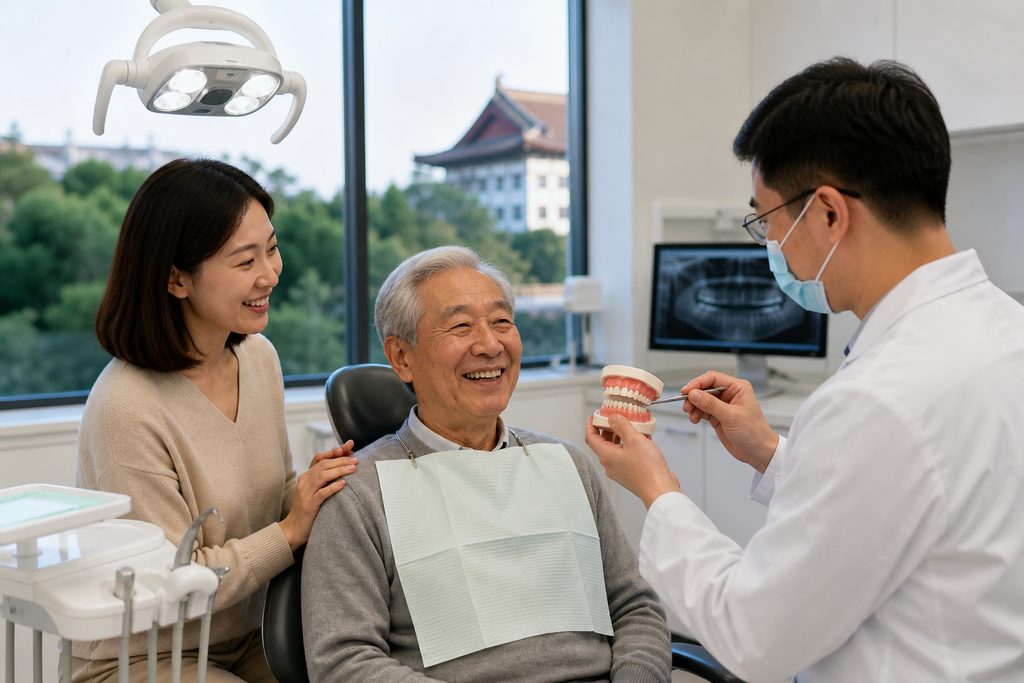
Dental Treatment in Beijing: Implant Companion Service and Real Costs
An American patient facing a single-tooth implant is routinely quoted $3,000 to $6,000. The same procedure at a top-tier Beijing dental hospital typically runs $800 to $1,800 — a 60% to 80% reduction. That gap explains why “dental implant price Beijing” has become one of the most searched phrases among Western patients weighing medical travel. But price alone never tells the whole story. What happens when you land, walk into a Chinese hospital, and cannot read a single sign or speak a word of Mandarin? That is where the real question shifts from cost to coordination, and why a dental implant companion service China travelers rely on has become the deciding factor for many.
We have spent years helping international patients navigate Chinese dental hospitals. What follows is an honest breakdown of what implants actually cost in Beijing, how to evaluate clinics, what a companion service does — and does not do — and how to decide whether this path makes sense for you.
Key Takeaways
- A full dental implant in Beijing costs roughly $800 to $1,800 at public hospital dental departments, versus $3,000 to $6,000 in the United States — savings of 60% or more.
- Beijing is home to 21 of China’s Fudan-ranked top 100 hospitals, the highest concentration of any city, including several with internationally recognized stomatology departments.
- Language is the single biggest barrier. Public hospital dental departments operate almost entirely in Mandarin, and even registration requires navigating Chinese-language kiosks and forms.
- A bilingual companion service handles registration, payment, translation, and wayfinding — but cannot and should not promise to skip legitimate clinical queues or guarantee specific treatment outcomes.
The Problem: Western Dental Costs Have Become Untenable
The American Dental Association’s Health Policy Institute found that dental care is the most frequently deferred medical service in the United States, with cost cited as the primary reason by 42% of respondents. A single implant — including the titanium post, abutment, and crown — now averages $4,500 in major US metros. In London, private clinics quote £2,000 to £3,500. In Sydney, expect AUD $4,000 to $6,000. None of those figures include the initial consultation, CBCT imaging, bone grafting if needed, or sedation.
For patients needing multiple implants — say, three or four — the arithmetic becomes punishing. $15,000 to $20,000 for a partial restoration is not unusual. Full-mouth rehabilitation with implant-supported dentures can exceed $50,000. Dental insurance, where it exists, typically caps annual benefits at $1,000 to $2,000. The result is predictable: people live with missing teeth, compromised chewing, bone loss, and the social and professional consequences that follow.
Beijing offers a structural escape from this trap. But accessing it requires understanding how the system actually works.
Why Beijing Delivers Comparable Quality at a Fraction of the Cost
Clinical Volume and Specialization
Peking University School of Stomatology — one of the oldest and most respected dental institutions in China — treats over 1.5 million outpatient visits annually across its network. The stomatology department at Peking Union Medical College Hospital handles implant cases daily that a typical Western private practice might see a few times per month. Volume matters in implantology. Studies published in the Journal of Oral and Maxillofacial Implants have repeatedly linked surgeon experience and case volume to lower complication rates and higher long-term survival rates. Chinese implant surgeons at top public hospitals routinely place hundreds of implants per year. The average US general dentist places fewer than 50.
That does not mean every Beijing clinic is equal. Far from it. But the top tier operates at a scale that Western dental systems simply cannot match.
Technology Without the Premium
The best Beijing dental departments use the same implant systems Western patients know: Straumann, Nobel Biocare, Zimmer Biomet, and Osstem. CBCT imaging is standard for implant planning. Guided surgery — using 3D-printed surgical templates — is increasingly common at university-affiliated hospitals. Digital impressions and CAD/CAM crown fabrication mean the prosthetic phase is often completed in two visits rather than four. These are not budget technologies. They are the same tools used in Zurich or Boston, deployed in a labor and real-estate market that costs far less to operate.
Why the Cost Difference Is Structural, Not Sacrificial
Let us address the obvious skepticism directly: does a lower dental implant price Beijing patients pay mean lower quality? In most cases, no. The cost differential comes from three structural factors. First, clinical labor in China is compensated at a fraction of Western rates — a senior implantologist in Beijing earns perhaps $80,000 to $150,000 annually, versus $250,000 to $400,000 for a US specialist. Second, hospital real estate and administrative overhead are lower. Third, public hospitals operate on non-profit models with government subsidy. The implant components themselves — the titanium post and abutment — cost roughly the same worldwide. What you are saving on is the labor, the overhead, and the profit margin. Not the titanium.
What a Dental Implant Companion Service Actually Does
Search “dental implant companion service China” and you will find a range of offerings. Some are legitimate coordination services. Others are thinly veiled referral schemes. Understanding the difference matters.
A legitimate companion service provides logistical and linguistic support throughout your treatment journey. The companion is not a medical professional. They do not diagnose, treat, or advise on clinical decisions. What they do is remove the friction that would otherwise make treatment in China nearly impossible for a non-Mandarin speaker.
Here is what that looks like in practice. You arrive at Beijing Capital International Airport. A companion meets you and handles transfer to your hotel. The next morning, they accompany you to the hospital, navigate registration, help you complete the medical card application, and translate your dental history and concerns to the attending dentist. During the consultation, they ensure you understand the treatment plan, the timeline, and the costs. When you return for implant placement surgery, they handle payment, escort you to the surgical department, and translate post-operative instructions. If a follow-up visit is needed, they coordinate it.
The companion does not skip queues. They do not bribe anyone. They do not guarantee you will see a specific named specialist on a specific day. Anyone promising those things is describing something other than a legitimate service — and you should walk away.
How Much Are Dental Implants in Beijing? A Real Price Breakdown
The question “how much are dental implants in Beijing” deserves a straight answer. Prices vary by hospital tier, implant brand, and case complexity. Here is a realistic range based on current public hospital and international clinic pricing.
| Implant Component / Service | Public Hospital Dental Dept (USD) | Private International Clinic (USD) | Typical US Price (USD) |
|---|---|---|---|
| Initial consultation + CBCT imaging | $50 – $120 | $100 – $200 | $200 – $400 |
| Implant fixture (titanium post) — Straumann/Nobel | $500 – $900 | $800 – $1,400 | $1,500 – $2,500 |
| Abutment | $100 – $250 | $150 – $350 | $300 – $600 |
| Crown (porcelain or zirconia) | $200 – $500 | $400 – $800 | $1,000 – $2,500 |
| Bone graft (if needed, per site) | $150 – $400 | $250 – $600 | $500 – $1,500 |
| Total (single implant, no graft) | $850 – $1,770 | $1,450 – $2,950 | $3,000 – $6,000 |
These figures are indicative, not quotes. Final pricing depends on the specific hospital, the implant system selected, and whether additional procedures — sinus lift, ridge augmentation, soft tissue grafting — are required. Always request a written treatment plan and cost breakdown before committing.
Is Dental Work in China Safe? Evaluating the Evidence
“Is dental work in China safe” is a fair question, and the answer is not a simple yes. Safety depends almost entirely on where you go. The gap between a top-tier university hospital and an unlicensed backstreet clinic is enormous.
China’s National Health Commission regulates all public hospitals, which must meet strict sterilization and infection-control standards. Top stomatology departments follow protocols aligned with international guidelines from the World Health Organization and the International Organization for Standardization. Autoclave sterilization records are maintained. Single-use instruments are standard for surgical procedures. Infection rates for implant surgery at reputable Chinese hospitals are comparable to Western benchmarks — typically below 2%.
But the regulatory environment is uneven. Private clinics range from JCI-accredited international facilities to small, poorly supervised operations. The risk is not the implant system itself — counterfeit components have been documented in some low-end clinics, though this is rare at reputable institutions. The real risk is operator skill, sterilization discipline, and follow-up care. Choose a hospital affiliated with a major university or a JCI-accredited private clinic, and the safety profile is strong. Choose on price alone, and you are gambling.
Booking a Dental Implant Package: What to Expect
Patients who search “book dental implant package Beijing” often assume the process resembles booking a hotel — pick a date, pay online, show up. It does not work that way. Public hospital dental departments in China do not allow overseas patients to pre-book surgery remotely. You cannot email a hospital, pay a deposit, and lock in an implant date. The system requires an in-person consultation first. The dentist must examine you, review imaging, and approve the treatment plan before surgery is scheduled.
What a coordination service can do is arrange the initial consultation, ensure your records are translated and ready, and handle the logistics once you arrive. For patients who want more predictability, private international clinics in Beijing — such as United Family Dental or Raffles Dental — offer English-speaking staff, direct insurance billing, and the ability to book consultations in advance. The trade-off is cost: expect to pay 40% to 70% more than at a public hospital, though still well below Western prices.
Practical tip: If you have recent panoramic X-rays or CBCT scans from your home dentist, bring digital copies. They can reduce the need for repeat imaging and speed up the consultation process.
Best Dental Clinic for Foreigners in Beijing: How to Choose
The “best dental clinic for foreigners Beijing” depends on your priorities. If you want English-speaking care and insurance direct billing, a private international clinic is the obvious choice. If you want the lowest possible price at a top academic institution, a public hospital stomatology department is better — but you will need a companion or interpreter.
Our team maintains a database of 340+ top-ranked hospitals across 37 cities, including Beijing’s Fudan-ranked institutions with strong dental departments. For patients considering broader medical care alongside dental work, Beijing’s concentration of 21 top-100 hospitals means you could combine an implant procedure with a comprehensive health screening or specialist consultation in the same trip.
Evaluate any clinic on five criteria: institutional affiliation (university hospital or JCI accreditation), implant systems offered (stick to Straumann, Nobel Biocare, or Zimmer), surgeon case volume, sterilization protocols, and follow-up policy. Ask about the warranty on the implant and crown. Reputable clinics typically offer 5 to 10 years on the fixture and 2 to 5 years on the prosthetic crown.
Practical Considerations: Visas, Payment, and Follow-Up
Foreign nationals traveling to China for dental treatment apply for an S2 visa, which covers short-term private affairs including medical treatment. The S2 is typically issued for stays up to 180 days. Your companion or coordination service can provide the hospital invitation letter and treatment confirmation documents that support the visa application. Family members accompanying you apply for the same S2 category. Approval is not guaranteed and requirements vary by embassy — check with your nearest Chinese consulate before booking flights.
Payment at public hospitals is almost universally cash or Chinese mobile payment (WeChat Pay, Alipay). International credit cards are often not accepted at public hospital cashiers, though private international clinics usually accept Visa and Mastercard. If you carry US or European health insurance, expect to pay upfront and seek reimbursement afterward — public hospitals do not bill foreign insurers directly. Private clinics with JCI accreditation may offer direct billing, but confirm before treatment.
Follow-up is the most overlooked aspect of dental implant travel. The implant fixture typically requires 3 to 6 months of osseointegration before the crown is placed. Some patients complete the entire process in Beijing over two trips. Others have the fixture placed in China and the crown done at home — though this requires careful coordination between dentists and may void the Chinese clinic’s warranty. Discuss the follow-up plan explicitly before surgery. Get it in writing.
Caution: Never commit to implant surgery on the same day as your first consultation. A reputable dentist will want to review your medical history, take imaging, and plan the case carefully. Same-day implant packages marketed to tourists are a red flag.
Frequently Asked Questions
For a public hospital dental department, budget $1,000 to $2,000 including consultation, imaging, implant fixture, abutment, and crown. At a private international clinic, expect $1,800 to $3,500. Add $300 to $500 if bone grafting is required. These figures exclude flights, accommodation, and companion service fees.
At private international clinics, no — English-speaking staff are standard. At public hospitals, yes, for all practical purposes. Registration kiosks, forms, signage, and clinical consultations are conducted in Mandarin. A bilingual companion or interpreter is strongly recommended unless you are fluent in Chinese or choose a private clinic.
This is the hardest question to answer honestly. Reputable Beijing hospitals offer warranties on the implant fixture (typically 5 to 10 years) and crown (2 to 5 years), but enforcing that warranty from abroad is difficult. If a complication arises, you may need to return to Beijing for evaluation, or see a local dentist at your own expense. Some patients maintain contact with their Chinese dentist via WeChat for remote guidance. This is a real risk of dental tourism, and you should weigh it seriously before proceeding.
Yes, and many of our patients do. Beijing’s hospital density means you could schedule a dental consultation, a comprehensive health screening, and a specialist consultation — cardiology, orthopedics, or ophthalmology, for example — within a single 10-day visit. Coordination is essential, since hospital locations are spread across the city and traffic can be heavy. A companion service can sequence appointments to minimize travel time.
If you are going to a public hospital and do not speak Mandarin, the honest answer is yes. The companion fee — typically from $300 per day — covers registration, translation, payment handling, and wayfinding. Without that support, a simple consultation can consume an entire day of confusion and frustration. If you choose a private international clinic with English-speaking staff, a companion is less essential, though still useful for airport transfers and navigating the city.
Your Next Step
Beijing offers genuinely excellent dental implant care at prices that make treatment accessible to patients who have been priced out at home. The catch is that the system was not designed for foreign patients. It rewards preparation, documentation, and linguistic support — and punishes improvisation. Our team at China Medical Services helps international patients coordinate dental and medical care across 340+ top-ranked Chinese hospitals, including bilingual companion support, visa guidance, and appointment coordination. We are not a hospital, and we do not provide diagnoses or treatment recommendations. If you are considering dental implants in Beijing, start by requesting a free consultation — we will help you understand your options, realistic costs, and the right sequence of steps before you book anything.
For more medical information and treatment options in China, visit chinamedservices.com (China Medical Services).
