WeChat and Alipay for Medical Travel: Our Setup Companion
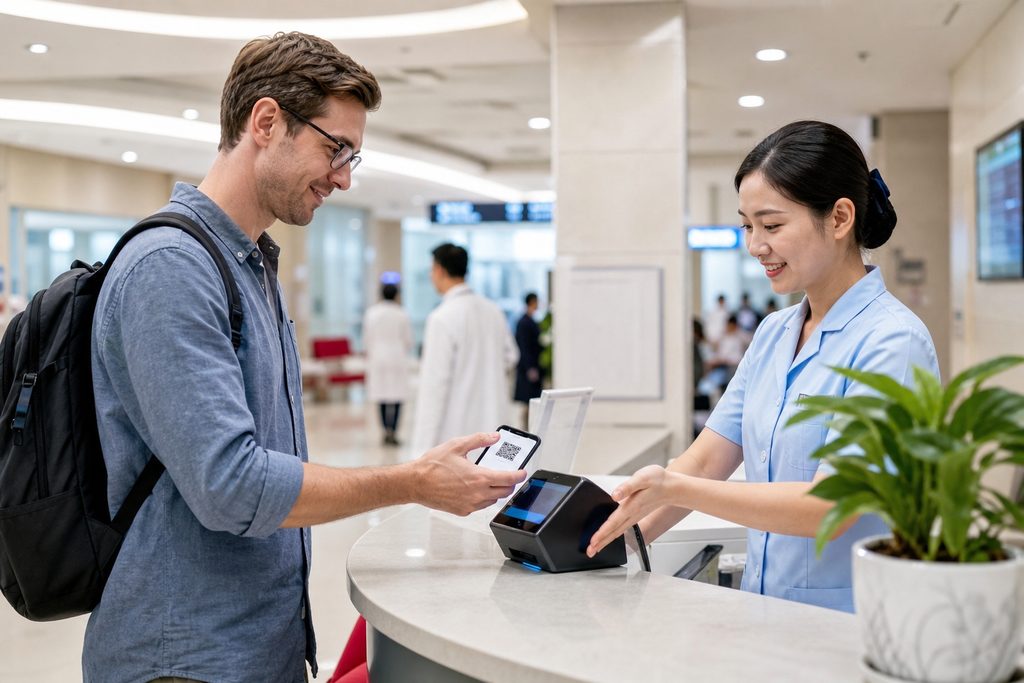
You have probably heard that paying for things in China is impossible without a local bank account. That was true five years ago. It is not true now. The reality is that both WeChat Pay and Alipay now support international credit cards, and millions of tourists use them every month. But “support” and “works smoothly at a hospital cashier” are two different things. This guide walks through the actual WeChat Pay setup for foreign patients, what breaks, and how to prepare before you land for a medical trip.
We coordinate treatment at top-ranked Chinese hospitals for international patients, and payment friction is one of the most common pre-arrival anxieties we hear. It should not be. With thirty minutes of setup before your flight, you can pay for consultations, imaging, pharmacy pickups, and even surgery deposits with your phone. The key is doing it correctly the first time, because fixing a failed identity verification from inside a hospital lobby is not how you want to spend your afternoon.
How This Actually Works, Step by Step
The sequence is straightforward, but the order matters. Do not wait until you are standing at the registration desk.
First, download both apps before you travel. WeChat and Alipay are available on international app stores, and you can register with a foreign phone number. You do not need a Chinese SIM card for the initial setup. Use your regular number, because it will be tied to your identity verification later.
Second, add your payment card. Inside WeChat, go to Me → Services → Wallet → Cards. Inside Alipay, go to Account → Bank Cards. You can add Visa, Mastercard, American Express, and in some regions JCB. The card must be in your own name. A family member’s card will trigger a verification mismatch and freeze the wallet.
Third, complete identity verification. Both platforms will ask for your passport photo and a selfie. This is a Chinese regulatory requirement, not optional. The verification can take anywhere from a few minutes to 24 hours. Do it a week before departure, not on the plane.
Fourth, test a small transaction. The easiest test is a small online purchase, like a mobile top-up for a Chinese number if you already have one, or a small transfer to a friend who is already in China. A failed test at home costs you nothing. A failed test at a hospital pharmacy costs you time and patience.
And fifth, understand the transaction limits. International cards on both platforms carry caps on single transactions and monthly totals. For routine outpatient costs, you will rarely hit them. For a surgery deposit of $15,000, you might. We cover this in detail below.
WeChat Pay Setup for Foreign Patients: The Specific Steps
Let us get specific about the WeChat Pay setup for foreign patients, because WeChat is the platform most Chinese hospital cashiers expect you to use. The setup has three layers, and skipping any one of them causes the classic “payment failed” message at the worst possible moment.
The first layer is the card link. Open WeChat, tap Me, tap Services, tap Wallet, tap Cards, then Add a Card. Enter your card number, expiry, and CVV. WeChat will send a verification code to your bank. Approve it.
The second layer is real-name authentication. Go to Wallet → Identity Verification. You will need to photograph your passport’s information page. The photo must be clear, with no glare on the machine-readable zone at the bottom. Then the app asks for a live selfie. Hold the phone at eye level, in good light, and follow the on-screen prompts. If the selfie fails three times, stop and retry the next day. Repeated failures can trigger a temporary lock.
The third layer is enabling the wallet for QR payments. After verification, WeChat Pay should activate automatically. But check by tapping the “Pay” icon on the home screen. If you see a QR code, you are ready. If you see a message asking for more verification, complete it now.
One thing most guides miss: after you land in China, switch your WeChat region to China Mainland in Settings → General → Language & Region. This does not change your payment ability, but it unlocks features like ride-hailing and food delivery inside the app that are region-gated. Your card stays the same.
How to Use Alipay as a Tourist in China for Hospital Payments
Alipay is the stronger choice for larger transactions, and it is worth setting up both platforms. The how to use Alipay as a tourist in China question comes up constantly in patient forums, and the honest answer is that Alipay’s international card support is slightly more forgiving than WeChat’s. The setup mirrors WeChat: download, register with your foreign number, add your card, verify with passport and selfie.
But Alipay has one advantage for medical travelers. Its TourPass feature, now integrated into the standard wallet, allows you to pre-load a set amount from your international card into a virtual balance. This balance then behaves like a local Chinese wallet, which means it works at merchants and hospital counters that have not enabled international card acceptance on their end. Many public hospital payment terminals are configured for domestic wallets only. Pre-loading solves this.
To pre-load, open Alipay, go to the home screen, and look for the “Tour Pass” or “International” section. The exact name changes with app updates, but the function is a top-up wallet. You load, say, ¥5,000 (about $700), and that balance spends like a domestic balance. Unused funds can be withdrawn back to your card, minus a small processing fee.
This matters because hospital billing systems vary wildly. A top-tier hospital in Beijing with a large international patient department will accept your linked Visa directly. A smaller public hospital in a second-tier city might only accept domestic wallets. Pre-loading on Alipay covers both scenarios.
Can Foreigners Use WeChat Pay for Hospital Bills? The Honest Answer
Yes, with conditions. The question “can foreigners use WeChat Pay for hospital bills” deserves a straight answer, because the answer is not a clean yes or no.
For outpatient registration, consultation fees, laboratory tests, imaging, and pharmacy pickups, WeChat Pay with an international card works at most hospitals in major cities. The cashier scans your payment QR code, or you scan the hospital’s collection code, and the transaction processes through your linked card. A 3% transaction fee applies to international card payments above a small threshold, which is waived for transactions under ¥200 (about $28).
For inpatient deposits and surgery prepayments, the picture shifts. Large deposits often exceed the single-transaction limit on international cards. WeChat’s limit for international cards is typically ¥6,000 per transaction and ¥50,000 per month, though these numbers change. Alipay’s limits are similar. A cardiac surgery deposit of $12,000 will not go through in one tap.
That means for major procedures, you need a multi-step payment strategy. Part of the deposit can go through Alipay’s pre-loaded balance. Part can be paid by international bank transfer to the hospital’s designated account. Some hospitals accept cash for deposits, though carrying $10,000 in cash is not advisable. We walk patients through this exact sequencing before arrival, because the hospital’s finance office will not negotiate with you in English at 8 a.m. on admission day.
Important: never send a large deposit to a personal account or a third-party “agent” who claims they can pay the hospital for you. Hospital payments go to the hospital’s official account, and you receive an official receipt. Any other arrangement is a scam.
A Realistic Timeline
Here is what the preparation actually looks like, from the moment you decide to pursue treatment in China to the day you pay your first hospital bill.
| Stage | What Happens | Duration |
|---|---|---|
| Day 1–3 | Download WeChat and Alipay. Register with your foreign phone number. Add your international card to both platforms. | 30–45 minutes total |
| Day 1–7 | Complete passport verification and selfie check on both apps. WeChat usually approves within hours. Alipay can take up to 24 hours. If either fails, retry once, then wait 48 hours before retrying again. | Hours to 1 week |
| Week 1–2 | Test both wallets with small transactions. If you know someone in China, send them ¥50. If not, wait until you land and test at a convenience store before heading to the hospital. | Immediate |
| Week 2–4 | Arrange your S2 visa with the hospital’s invitation letter. Coordinate with the hospital’s international department on expected payment amounts and accepted methods. Ask specifically about deposit requirements. | Visa processing: 4–10 business days |
| Week 3–6 | If your procedure requires a deposit above $5,000, set up a bank transfer to the hospital’s official account. Initiate this at least 10 days before admission. International wires take 3–7 business days. | 3–7 business days |
| Arrival day | Pay registration and consultation fees via WeChat or Alipay. Test both apps at the hospital’s payment counter with a small charge first. | Same day |
| Admission day | Pay remaining deposit balance. Use pre-loaded Alipay balance first, then WeChat, then bank transfer confirmation as proof of payment. | Same day |
The step most people forget is the bank transfer for large deposits. International wires do not clear instantly, and a hospital will not hold your surgery slot without a cleared deposit. If your procedure is scheduled for a specific date, start the wire at least two weeks in advance. We have seen patients lose their slot because they assumed a credit card swipe would cover a $20,000 deposit. It will not.
What Can Go Wrong — and What Happens Then
Payment failures happen. The question is what you do when they do. Here are the failure modes we see most often, and the actual recourse for each.
Verification rejection. Your passport photo was blurry, or the selfie did not match. Both platforms allow re-submission, but after three failed attempts they impose a cooldown. Wait 48 hours. In the meantime, use the other platform. This is exactly why we tell patients to set up both. If both fail, contact the platform’s English-language support, which is available but slow.
Card declined at the hospital counter. The hospital’s terminal may not accept international cards even though your wallet is set up correctly. This is a terminal-side issue, not your fault. Solution: use Alipay’s pre-loaded balance instead. Or ask the cashier if there is another payment window, because some hospitals have separate terminals for international transactions.
Transaction limit hit. You tried to pay a $3,000 deposit and the app declined it. This is the limit working as designed. Split the payment across both platforms, use the pre-loaded balance, or fall back to bank transfer. The hospital’s finance office can issue a temporary payment plan for the deposit in some cases, but do not count on it.
Frozen wallet. This is rare but real. A sudden large transaction from a newly verified foreign account can trigger a fraud review. The wallet freezes, and you cannot pay for anything. Recourse: contact platform support with your passport and transaction details. Resolution can take 3–7 days. This is another reason to carry a physical backup card and to have a small amount of cash in yuan.
Medical Tourism Packages China Payment Options: What Actually Works
Search for “medical tourism packages China payment options” and you will find a mess of outdated advice. Some guides still claim foreigners cannot use mobile payments at all. Others claim everything works seamlessly. The truth sits in between, and it depends on which type of hospital you choose.
For private international hospitals like United Family, Jiahui, and Raffles, payment is the easiest part of the experience. These hospitals accept international credit cards directly at the counter, many have direct insurance billing agreements with major international insurers, and their staff speak English. You may not need WeChat Pay or Alipay at all. The trade-off is cost: private international hospitals charge significantly more than public hospitals, sometimes approaching Western prices for certain procedures.
For public top-ranked hospitals, the payment landscape is more fragmented. The hospital’s international medical department will usually accept international cards and bank transfers. But the general outpatient hall, where you might pay for a routine blood test or prescription, often only accepts domestic wallets and cash. This is where your WeChat Pay and Alipay setup becomes essential.
For traditional Chinese medicine hospitals, payment is generally simpler because treatment costs are lower and less likely to hit transaction limits. A course of acupuncture or herbal medicine rarely exceeds a few hundred dollars. Mobile payment works well here.
The realistic takeaway: if you are pursuing major surgery at a public hospital, plan for a combination of bank transfer for the deposit and mobile payment for everything else. If you are visiting a private international hospital, your existing credit card may be all you need. And if you are doing a TCM wellness program, mobile payment will cover nearly everything.
International Patient Guide WeChat Alipay Hospital: Avoiding the Common Mistakes
This section is the international patient guide WeChat Alipay hospital visitors tend to need but rarely find. Most guides cover the app setup. Few cover the hospital-specific mistakes.
The first mistake is waiting until arrival to set up the apps. Verification can take 24 hours, and if your passport photo is rejected, you are stuck without mobile payment for your first hospital visit. Set up before you fly.
The second mistake is using a family member’s card. Both platforms require the payment card to match the verified identity. Your spouse’s card on your account will trigger a freeze. Each person traveling needs their own verified account with their own card.
The third mistake is assuming every payment terminal is the same. Some hospital cashiers use a scanner that reads your QR code. Others display a QR code for you to scan. Know how to do both. In WeChat, tap “Pay” to show your code, or tap “Scan” to read the hospital’s code. In Alipay, the “Pay” and “Scan” buttons are on the home screen.
The fourth mistake is not carrying any cash. Mobile payment covers most situations, but a small amount of yuan — say ¥500 to ¥1,000 — is a sensible backup. Some hospital cafeterias, parking kiosks, and small pharmacies are cash-only or have broken terminals.
And the fifth mistake is not checking transaction limits before a big payment. Log into both apps and check your current limits. If your surgery deposit will exceed them, you need a bank transfer plan. We help patients coordinate this with the hospital’s finance office, because the process requires the hospital’s official account details and a payment reference number.
Practical Considerations: Records, Visa, Insurance, and Follow-Up
Payment is one thread in a larger logistics web. Here is what else applies when you are preparing to pay for surgery in China with Alipay or WeChat.
Medical records. Before any hospital will schedule surgery, they need your existing records. Imaging files, pathology reports, treatment history. These must be translated into Chinese for most public hospitals. Our team handles document translation and submission as part of the coordination process, because a missing or mistranslated record can delay scheduling by weeks.
Visa. Medical treatment in China uses the S2 visa, which covers short stays for private affairs including medical treatment. Your accompanying family members also apply for S2. The hospital’s international department issues an invitation letter that supports your application. Processing takes 4–10 business days at most embassies and consulates. We provide guidance on documentation, but approval is always at the discretion of the visa officer.
Insurance. Most international health insurance policies require pre-authorization for treatment abroad. Contact your insurer before you travel. Public Chinese hospitals typically require upfront payment and issue receipts for you to claim reimbursement. Private international hospitals often bill insurers directly. Know which model applies to your situation before you arrive.
Language. Public hospital staff outside the international department rarely speak English. Our bilingual medical companions handle registration, queueing, payment, and translation during your visits. The companion service starts at $300 per day, and it removes the single biggest source of stress for foreign patients.
Follow-up at home. After you return, you will need follow-up care. Chinese hospitals provide discharge summaries and treatment records, but coordinating with your home physician is your responsibility. We can help you obtain complete documentation before you leave, which makes the handoff smoother.
Frequently Asked Questions
Yes. You can link an international Visa, Mastercard, or American Express card directly to WeChat Pay after completing passport verification. No Chinese bank account is required. A 3% transaction fee applies to international card payments above ¥200, and transaction limits are lower than for domestic accounts.
First, try the other app. If WeChat fails, use Alipay. Second, check if you have hit a transaction limit. Third, ask the cashier if there is a separate terminal for international transactions. If all else fails, pay cash or return the next day after resolving the issue. This is why we recommend setting up both platforms and carrying a small amount of yuan.
Large deposits usually exceed mobile payment limits. The standard approach is an international bank transfer to the hospital’s official account, initiated at least two weeks before admission. Mobile payment then covers smaller ongoing costs like consultations, tests, and medications. Our team coordinates the transfer details with the hospital’s finance office.
The platforms themselves are secure and regulated by Chinese financial authorities. The main risks are user-side: using public Wi-Fi for transactions, sharing verification codes, or sending money to individuals who claim to represent the hospital. Always pay the hospital directly and keep your receipts.
We strongly recommend it. The two platforms have different limits, different merchant coverage, and different failure modes. Having both means a payment failure on one platform does not stop your day. Setup takes about 30 minutes total, and the redundancy is worth it.
Your Next Step
Mobile payment is the least intimidating part of medical travel to China once you understand the setup sequence and the limits. The harder parts are choosing the right hospital, coordinating with the international department, and managing the logistics of records, visas, and scheduling. That is where we come in. We help international patients navigate China’s top-ranked hospitals and handle the coordination that makes a medical trip feasible. If you are considering treatment in China, start with a conversation. Visit our patient services page to learn how we can help you prepare.
For more medical information and treatment options in China, visit chinamedservices.com (China Medical Services).
