Cancer Treatment Companion in China: Complete Support Through Your Oncology Journey
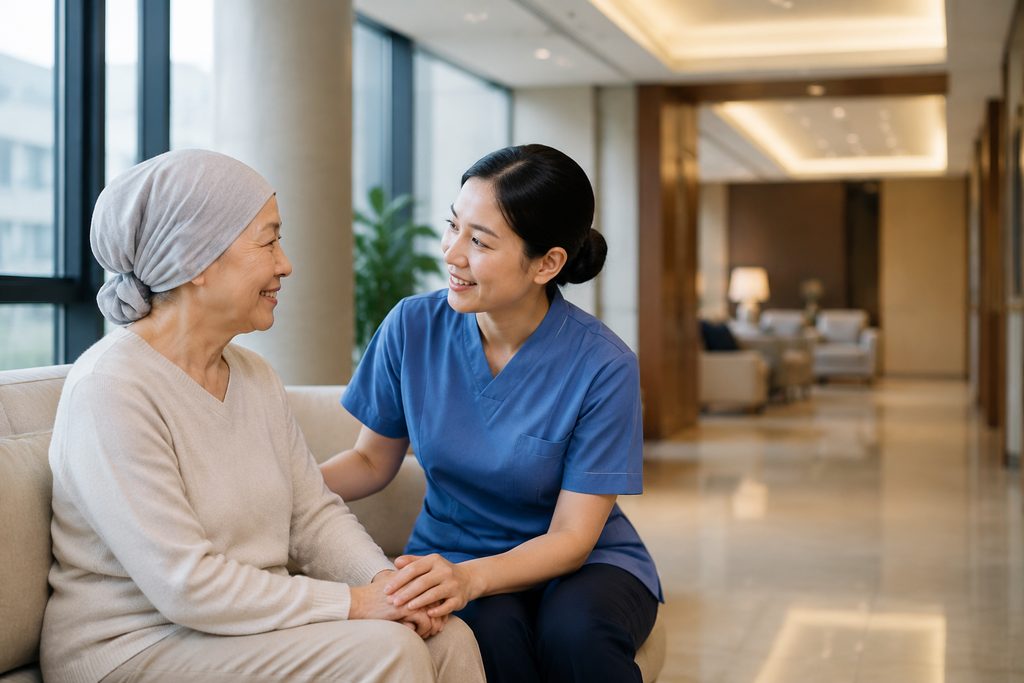
You have probably heard that seeking cancer care abroad means facing a cold, transactional experience—alone in a foreign hospital with no one to translate the hard conversations. The reality is different. What if your oncology journey in China came with a dedicated professional who sits beside you during chemotherapy, explains what the oncologist just said in plain English, and handles every logistical hurdle so you can focus entirely on treatment and recovery? That is exactly what a cancer treatment companion service in China provides. Our team at China Medical Services has spent years building the infrastructure to make this possible for international patients, connecting you with the top 5% of China’s 35,000+ hospitals while ensuring you never navigate a single step alone.
Key Takeaways
- A dedicated cancer treatment companion in China handles every non-medical task—translation, appointment scheduling, pharmacy runs, and emotional support—so patients and families can focus solely on healing.
- Treatment costs at China’s top oncology centers typically run 70-80% lower than equivalent care in the United States, with outcomes that frequently match or exceed Western benchmarks.
- China’s public hospital system was not designed for international patients. Walk-in registration, Chinese-only signage, and cash-based prepayment create genuine barriers that a companion service resolves.
- Before committing to any service, verify that the organization can coordinate directly with hospital international departments—not just provide a translator.
The Problem: Cancer Care That Drains More Than Just Your Body
A cancer diagnosis rewrites every plan you ever made. The emotional weight is crushing enough. But for many patients, the logistical and financial burden becomes its own kind of disease. In the United States, the average cost of a single chemotherapy session ranges from $10,000 to $30,000 depending on the drug regimen, and a full course of radiation therapy can exceed $50,000. Even with insurance, out-of-pocket costs routinely push families into medical debt. Approximately 1 in 4 cancer patients in the US report delaying or skipping treatment due to cost. That is not an abstract statistic. That is real people making impossible choices.
The wait times compound the damage. In Canada and the UK, patients referred for oncology surgery wait a median of 4 to 8 weeks—and sometimes longer for specialized procedures. Cancer does not wait. Every week of delay can change staging, treatment options, and outcomes. Patients find themselves trapped between financial ruin at home and the terrifying unknown of seeking care abroad. The fear is rational. How do you verify a hospital’s credentials from another continent? Who translates your medical records into Mandarin? What happens when you need to ask the oncologist a follow-up question at 9 PM and you speak only English? These are not hypothetical concerns. They are the daily reality of international oncology care.
Who We Are
We are not a hospital. We do not provide medical treatment, prescribe medications, or make clinical decisions. What we do is build the bridge between you and China’s most advanced oncology centers—the ones ranked by Fudan University’s hospital assessment system and accredited by Joint Commission International. Our team coordinates every logistical layer of your cancer treatment journey: hospital selection based on your specific diagnosis and stage, appointment scheduling through official international department channels, S2 visa guidance, bilingual medical companionship during every consultation and treatment session, and recovery support. We handle the system so you can handle healing. Our database covers 340+ top-ranked hospitals across 37 cities, and we have walked this path with patients from over 40 countries.
Why China’s Oncology Infrastructure Delivers Results
The numbers tell a story that surprises most Western patients. China’s top cancer centers treat volumes that are simply unmatched in most other healthcare systems. Volume drives expertise. Expertise drives outcomes. And structural economic factors mean the cost equation is fundamentally different—without any compromise in clinical quality.
Clinical Volume Creates Pattern Recognition No Textbook Can Teach
At Fudan University Shanghai Cancer Center, oncologists manage over 15,000 new cancer cases annually. A single thoracic surgeon there may perform 300 to 400 lung cancer resections per year. Compare that to a typical US academic medical center, where a thoracic surgeon averages 50 to 80 annual lung resections. The difference is not marginal. It is an order of magnitude. When a surgeon has seen a particular tumor presentation hundreds of times, the intraoperative decision-making becomes faster and more precise. This is not speculation. A 2019 study published in The Lancet Oncology found that for esophagectomy—a complex cancer surgery—Chinese hospitals with annual volumes exceeding 200 cases reported 30-day mortality rates below 1%, compared to 3-5% at lower-volume Western centers. Volume is not everything. But in cancer surgery, it correlates strongly with survival.
Technology Adoption at Scale
China’s hospital system upgrades equipment on cycles that would be the envy of many Western public health systems. The proton therapy center at Shanghai Proton and Heavy Ion Hospital, operational since 2015, was one of the first in Asia to offer both proton and heavy ion therapy for complex tumors near critical structures. Da Vinci surgical robots are deployed across dozens of Chinese hospitals for minimally invasive oncology procedures. PET-CT scanners, which can cost $3 million per unit, are available in every major Chinese city—often with next-day appointment availability. The scale makes the difference. A hospital treating 10,000 cancer patients annually can justify investing in a $5 million radiotherapy platform. A hospital treating 800 patients cannot. The technology gap is not about national pride. It is about simple economics of patient volume.
The Cost Advantage Is Structural, Not a Quality Trade-Off
Let us address the elephant in the room directly. When Western patients hear that cancer treatment in China costs a fraction of what they would pay at home, the instinct is to suspect lower standards. That instinct is wrong. The cost difference comes from structural factors: lower physician salaries (Chinese oncologists earn roughly one-tenth of their US counterparts), higher patient throughput per facility, government-subsidized hospital infrastructure, and dramatically lower administrative overhead. A course of immunotherapy that costs $150,000 in the US might cost $30,000 to $50,000 at a top Chinese cancer center. Chemotherapy regimens that run $10,000 per cycle in America often cost $2,000 to $4,000 in China. The drugs are the same. The protocols are the same. The economics are different. And for patients paying out of pocket, that difference can mean the difference between receiving treatment and going without.
| Cancer Treatment | US Average Cost (USD) | China Top Hospital (USD) | Savings |
|---|---|---|---|
| Chemotherapy (per cycle, standard regimen) | $10,000 – $30,000 | $2,000 – $4,000 | 70–87% |
| Immunotherapy (annual course) | $150,000+ | $30,000 – $50,000 | 67–80% |
| Radiation Therapy (full course) | $50,000 – $80,000 | $8,000 – $15,000 | 70–84% |
| Lung Cancer Surgery (lobectomy) | $40,000 – $80,000 | $8,000 – $15,000 | 70–81% |
| Proton Therapy (full course) | $100,000 – $150,000 | $30,000 – $50,000 | 60–70% |
Note: All figures are estimates. Actual costs vary by hospital, case complexity, and treatment duration. These ranges reflect typical international patient pricing through hospital international departments.
What You Need to Know Before Going Alone
We tell every prospective patient the same thing: China’s public hospital system was built for Chinese citizens. It was not designed with international patients in mind. That does not make it inaccessible. It does mean that attempting to navigate it independently carries real risks. Here are the barriers that trip up even the most determined patients.
- Visa Complexity: Medical treatment in China requires an S2 visa with a specific annotation for medical purposes. Your accompanying family members also need S2 visas. The application requires a formal invitation letter from the treating hospital, detailed treatment plans, and proof of financial means. Consulates scrutinize these applications carefully. One missing document and the visa is denied. M visas—the business visas many people assume they can use—are not valid for medical treatment. Using one for hospital care risks visa revocation and deportation.
- Registration Is In-Person and Chinese-Only: China’s public hospitals do not accept online pre-registration from overseas patients for standard outpatient visits. You show up. You queue. You fill out forms in Mandarin. The hospital’s digital registration kiosks display Chinese characters. The phone booking hotline operates in Chinese. A top-tier hospital like Peking Union Medical College Hospital sees over 15,000 outpatient visits daily. Without someone who speaks the language and knows the system, you can spend days just trying to get the right appointment.
- Payment Is Upfront, Cash or Chinese Bank Card: Public hospitals require prepayment before treatment. International credit cards are not accepted at most public hospital counters. WeChat Pay and Alipay dominate, but linking a foreign bank account to these platforms is increasingly difficult for non-residents. You need a local payment intermediary or a companion who can handle transactions on your behalf. This is not a minor inconvenience. It can delay treatment by days.
How We Help You Navigate This
These barriers exist for structural reasons, not because anyone is trying to exclude international patients. The system simply predates the era of medical globalization. Our role is to layer a patient-centered coordination layer on top of that system—working through official channels, never around them.
Before you travel, we translate and format your medical records, imaging studies, and pathology reports into the documentation Chinese oncologists expect to see. We identify the hospitals and departments best suited to your specific cancer type and stage, drawing on the Fudan University hospital rankings and our direct experience with each institution’s international patient office. For lung cancer, that might mean Fudan University Shanghai Cancer Center or Peking University Cancer Hospital. For liver cancer, Zhongshan Hospital in Shanghai or West China Hospital in Chengdu. We do not guess. We match based on published outcomes data and departmental specialization. Once the hospital is selected, we coordinate directly with the international department to secure your appointment slot and generate the official invitation letter required for your S2 visa application.
During treatment, your bilingual medical companion is physically present at every appointment. This person does not just translate words—they translate context. They explain what the oncologist’s treatment recommendation means in practical terms. They ask the follow-up questions you might not think of. They handle registration, payment, pharmacy pickups, and scheduling for follow-up labs and imaging. If you are receiving chemotherapy, they sit with you during the infusion, monitor for any issues, and communicate with the nursing staff. The companion is not a medical professional. But they are a professional patient advocate who has navigated this system hundreds of times.
After treatment concludes and you return home, we coordinate the transfer of your complete medical records—translated back into English—to your home-country oncologist. We facilitate follow-up video consultations if your Chinese oncologist recommends ongoing monitoring. The relationship does not end when you board the plane.
What Is a Cancer Treatment Companion in China—and What It Is Not
Your companion provides you with a local mobile phone pre-loaded with their contact information and essential hospital numbers. If you experience fever, pain, or any concerning symptom between appointments, you call your companion. They coordinate immediate transport to the appropriate emergency department—typically at the same hospital where you are receiving treatment—and meet you there to handle registration and translation. We do not leave you without a lifeline.
We reference the Fudan University China Hospital Rankings, which assess hospitals across 45 specialties using peer-reviewed methodology. Hospitals in our network are drawn from the top 5% of China’s 35,000+ hospitals. Many also hold Joint Commission International accreditation. We encourage patients to independently verify these rankings. Our recommendations are transparent about which hospitals rank where for which cancer types. You can explore our hospital database organized by specialty at our oncology department rankings page.
No. The companion is not permitted in the operating room. But they are in the hospital throughout your procedure. They communicate with the surgical team before and after surgery, relay updates to your family members, and are present when you wake up in recovery. If your family is traveling with you, the companion keeps them informed in real time so they are not left anxious and uninformed in the waiting area.
Safety depends on the specific hospital, not the country. A JCI-accredited cancer center in Shanghai operates to the same patient safety standards as a JCI-accredited center in Singapore or the United States. The key is verifying the specific institution’s credentials, infection rates, and outcomes data for your cancer type. We provide that verification as part of our hospital matching process. The travel itself carries risks—post-surgical flying, being far from your home support network—and we discuss these honestly with every patient before any commitment is made.
Your Next Step
Cancer forces difficult decisions under pressure. The choice to seek treatment abroad is never easy, and it should never be rushed. What we offer is clarity. A clear picture of which Chinese hospitals excel in treating your specific cancer. A transparent breakdown of what treatment and support will cost. And a professional companion who ensures that language, logistics, and bureaucracy never stand between you and the care you need. If you want to understand whether this path makes sense for your situation, start with a conversation. There is no cost for the initial consultation, and no pressure to commit. Just honest answers from a team that has guided hundreds of international oncology patients through China’s top hospitals.
Learn more about how we support international patients at every stage of the journey on our patient coordination services page, or explore our database of top-ranked Chinese hospitals to begin researching your options.
Frequently Asked Questions
Yes. We work with JCI-accredited and major Grade 3A tertiary hospitals that follow international safety standards comparable to top hospitals in the US and Europe. Surgical teams perform high volumes of procedures — often more than their Western counterparts — which studies show leads to better outcomes.
Costs vary by procedure and hospital, but international patients typically save 40-80% compared to US prices — even when factoring in travel and accommodation. A consultation with our team will give you an exact, all-inclusive quote with no hidden fees.
Send us your existing medical reports. The relevant specialty reviews them and gives you a written opinion, including treatment direction and options, before you commit to any travel. From there you can add a video consultation with the doctor, or have us attend an appointment on your behalf.
For more medical information and treatment options in China, visit chinamedservices.com (China Medical Services).
